|
|
|
|
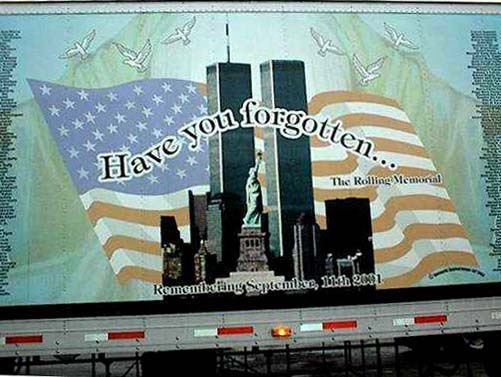
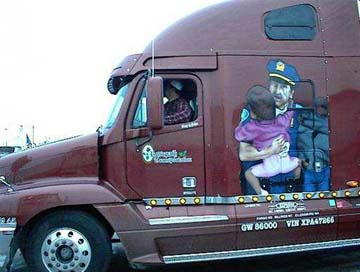
Have you forgotten? September 11, 2001 The Rolling Memorial An independent
trucker has painted his cab and trailer with the names of all those who
lost their lives in 9/11. |
| Somos
Primos
September 2005 Dedicated to
Hispanic Heritage and Diversity Issues |
|
|
|
|
|
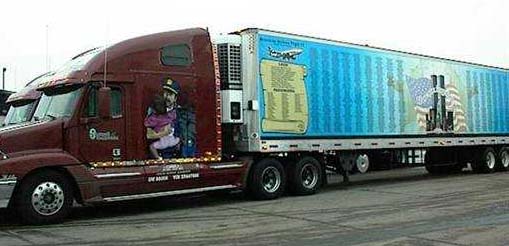
Have you forgotten? September 11, 2001 The Rolling Memorial An independent
trucker has painted his cab and trailer with the names of all those who
lost their lives in 9/11. |
|
|
| The entire crew and passengers of
United Flight 175 and American Airlines Flight 11 are listed. |
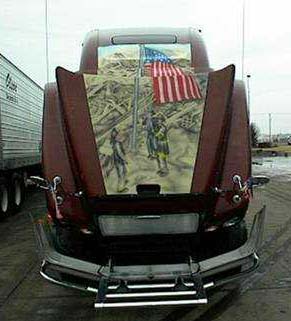 |
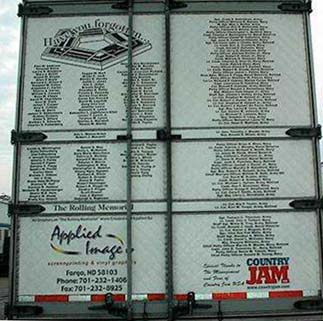 |
| The cab itself has a the raising of the flag by firemen in the middle of the devastation. | The back of the truck has a
listing of all those that lost their lives in the pentagon.
|
| Content
Areas United States . . . 4 Anti-Spanish Legends. . . 27 Surname Lozano . . .32 Galvez Patriots . . .37 Orange County, CA . . .47 Los Angeles, CA . . .50 California . . .53 Northwestern US . . .70 |
Southwestern US . . .74
Black . . .80 Indigenous . . .83 Sephardic . . .87 Texas . . .89 East of the Mississippi . . .102 East Coast . . .107 Mexico . . .115 Caribbean/Cuba . . .139 |
Spain
. . .146
International . . .150 Dichos . . .167 History . . .168 Family History . . .175 Archaeology . . .179 Calendar Networking Meetings END . . .181 |
|
Letters to the Editor : |
|
|
Can't thank you enough for all your hard work, and for the enjoyment I get
out of the monthly newsletter. My goal is to introduce your work to at least
one Hispanic person each month. Thanks! Tim Crump crumpta@msn.com § Hi Mimi, I would like to tell you how much I enjoy reading Somos Primos each month. Thank you for the wonderful job that you do. It is appreciated. Would you please change my email address to Jimandbhicks@yahoo.com Thank you. § Hello, I just stumbled onto your web site. What a treasure. Please add me to your mailing list. I would be forever thankful. Your hard work and efforts are greatly appreciated. Rick r-osunchase@msn.com § § § |
Your paper has grown beautifully over the years. vivan.drake@va.gov My name is Geneva Moya Sanchez. My family lines are Sanchez, Mireles, Chapa, and Dela Garza on my mothers side. These family trees are from Vallecillo and Sabinas Hidalgo, N.L. Someone mentioned that you and I have the same family lines, but I really did'nt pay attention, until a relative of mine said that you were related to him when he saw the Juan Bautista Chapa tree. Which Chapa is your ancestor? Do you have any Mireles or Sanchez in your tree also. My Ancestor Maria Ursula Chapa ma.Jose Felix Mireles. Then I go all
the way to Juan Bautista Chapa. Thank you, hope to hear from you................ |
|
Somos
Primos Staff: Mimi Lozano, Editor John P. Schmal, Johanna de Soto, Howard Shorr Armando Montes Michael Stevens Perez Luke Holtzman, Layout and data entry Contributors: Min Alexander Dan Arellano David Barrios Eva Booher Bruce Buonauro Maria Luisa Caica Irma Cantu Bill Carmena Jack Cowan, Angel Custodio Rebollo Vivian Drake Mickey Margot Garcia George De La Garza Johanna De Soto Hector Diaz George Gause Henry Godines |
Gloria Golden Rosanne Gonzales-Hardy Carlos Ray Gonzalez José Román González López Ellen Griffith Lila Guzman, Ph.D. Rick Guzman Dennis Keesee Bermudez Marciel Hart Wood Michael Hardwick Lorraine Hernandez Zeke Hernandez Jim Hicks Win Holtzman Granville Hough, Ph.D. John Inclan Mike Jarvis, Alex Loya, Ph.D. Mike Mathes, Ph.D. Algis Marciuska D. Marquez Ophelia Marquez Carlos Martín Herrera de la Garza Eddie Martinez JV Martinez, Ph.D. Ana Maria McGuan Ronnie Mendez Michael Miller Topp |
Lupe Dorinda Moreno Geneva Moya Sanchez. Raul Nava Villa Paul Newfield Rafael Ojeda Carlos Olamendi Rick Osuna Roberto José Pérez Guadarrama Willie Perez Susie S. Porter Joseph Puentes Manuel.Quinones Refugio Rochin, Ph.D Alfonso Rodriguez Viola Rodriquez Sadler Roberta M. Rosa Sonia M. Rosa, Charles Sadler Benecio Samuel Sanchez, Richard G. Santos, John P. Schmal A. Seguin Howard Shorr Bob Smith Carlos Manuel Valdés Janete Vargas J.D. Villarreal Victor Villarreal Stewart Von Rathjen |
| SHHAR
Board: Bea Armenta
Dever, Steven
Hernandez, Mimi Lozano Holtzman, Pat Lozano, Henry Marquez,
Yolanda Ochoa Hussey, Michael Perez, Crispin Rendon, Viola Rodriguez Sadler, John P. Schmal |
|
Hispanic
Heritage Month resource: http://www.somosprimos.com/heritage.htm
National Museum of the American Latino in Washington, D.C. Step 1, October 15, 2003: 108th Congress, H. R. 3292 Step 2, May 21, 2004: Senator's Bill to Create National Study Step 3, May 5, 2005: 109th Congress, H. B. 2134 Latino Congressional Representation Spanish Echoes Increasing in US Congress Nuestros Ranchos Podcast Hispanics: Go for the Gold with a Good Education Hispanic Media Turning to English Mija's Magazine $7 million grant, strategies to help English language learners Our Sad Neglect of Mexico Youth Driving Hispanic Population Boom Second National Head Start Hispanic Institute, Call for Abstracts Major Waves' in Population Hispanics a Melding of Cultures The 25 Most Influential Hispanics in America Latinos In Information Sciences and Technology Minority Hiring in Science and Engineering Association (LISTA) |
| Don't Forget . . . Hispanic Heritage Month, September 15th to October 15th |
|
for materials and resources go to http://www.somosprimos.heritage.htm |
|
|
|
Chronology. . . National Museum of the American Latino |
|
|
October 15, 2003, Representative Xavier Becerra (D-CA) together with 28 co-sponsors, introduced the "Commission to Establish the National Museum of the American Latino Act of 2003" (H.R. 3292), legislation to establish a 23-member commission that would develop a plan of action for the creation of a national museum focusing on the history and contribution of the Latino population in the United States. Included on the commission would be an individual with "experience in the study and teaching of Latino culture and history at the post-secondary level." The bill was referred to the House Resources Committee for consideration. May 21, 2004, U.S. Senators Orrin Hatch (R-UT), Barbara Boxer (D-CA), Kay Bailey Hutchinson (R-TX), and Jeff Bingaman (D-NM)
introduced bipartisan legislation to celebrate the culture of American Latinos by beginning the process of creating a National Museum of the American Latino. |
|
| Step
One, October 15,
2003: 108th CONGRESS,
1st Session,
H. R. 3292, To establish the Commission to Establish a National Museum of the American Latino to develop a plan of action for the establishment and maintenance of the National Museum of the American Latino in Washington, D.C., and for other purposes. IN THE HOUSE OF REPRESENTATIVES October 15, 2003 Mr. BECERRA (for himself, Ms. ROS-LEHTINEN, Mr. RODRIGUEZ, Mr. LINCOLN DIAZ-BALART of Florida, Mr. ORTIZ, Mr. MARIO DIAZ-BALART of Florida, Mr. ACEVEDO-VILA, Mr. BACA, Mr. CARDOZA, Mr. CLYBURN, Mr. GONZALEZ, Mr. GRIJALVA, Mr. GUTIERREZ, Mr. HINOJOSA, Mr. HONDA, Mr. LARSON of Connecticut, Mr. LEWIS of Georgia, Mr. MATSUI, Mr. MENENDEZ, Mrs. NAPOLITANO, Mr. PASTOR, Mr. REYES, Ms. ROYBAL-ALLARD, Ms. LINDA T. SANCHEZ of California, Ms. LORETTA SANCHEZ of California, Mr. SERRANO, Ms. SOLIS, Ms. VELAZQUEZ, and Mr. WU) introduced the following bill; which was referred to the Committee on Resources, and in addition to the Committee on House Administration, for a period to be subsequently determined by the Speaker, in each case for consideration of such provisions as fall within the jurisdiction of the committee concerned A BILL To establish the Commission to Establish a National Museum of the American Latino to develop a plan of action for the establishment and maintenance of the National Museum of the American Latino in Washington, D.C., and for other purposes. Be it enacted by the Senate and House of Representatives of the United States of America in Congress assembled, SECTION 1. SHORT TITLE. This Act may be cited as the `Commission to Establish the National Museum of the American Latino Act of 2003'. SEC. 2. FINDINGS. Congress finds as follows: (1) American Latinos are an ethnically and racially diverse population. Still, whether known by the term `Hispanic' or `Latino,' or by the various national identities from which they obtain their ethnicity, American Latinos share a common heritage rooted in the mixture of the cultures of the indigenous peoples of the American continent, of the European colonizers from Spain, and of Africans who were brought to those colonies as slaves. (2) While the history of the United States formally dates from 1776, American civilization was already centuries old by then. Latinos were present on the continent for more than 200 years prior to the Declaration of Independence. Spanish colonists founded the first permanent settlement on future United States territory in St. Augustine, Florida in 1565. Indigenous nations that had thrived for centuries prior to the landing of Columbus would later mix with colonists of various ethnicities from Spain to create a third culture, one that continues to thrive in various forms throughout the Americas today. (3) Since before our Nation's founding, Latinos have come to this land searching for opportunity, prosperity, and chance. In this regard, not much has changed in over 3 centuries. Through every era of our Nation's history, whether in the fields of plenty or on the field of battle, a Latino presence was felt. Since before the early colonization of the west, Latinos have labored under the harsh sun to put food on America's tables. From the earliest days of American industry, Latinos have worked in our factories. Through every war and conflict, Latinos have served honorably and proudly next to their fellow Americans to defend the ideals of freedom, democracy, and liberty worldwide, earning countless awards for valor and sacrifice. (4) The history, art, politics, economy, and culture of the United States have been enriched since the Nation's founding by the influence of American Latinos and their traditions and innovations. Both native and foreign-born Latinos in the United States continue to make significant contributions to the arts and humanities, academia, and the popular culture that have benefited all Americans. (5) According to the Bureau of the Census, the population of American Latinos recently grew to become the largest demographic minority group in the country. As of July 2002, there were an estimated 38.8 million Latinos in the United States. One out of every three of these is under the age of 18, and four out of every 10 is under the age of 25. The youthfulness and rapid growth of this population ensure that American Latinos will have a substantial role in American life ranging from public policy to popular entertainment. Greater understanding of this role will benefit all of American society. (6) The American Latino population historically has been concentrated in certain regions of the United States. In the last several decades, however, there has been more dispersed growth of the community throughout the entire country. In the southern states other than Texas, most have seen the population of Latinos, primarily immigrants, double between the years 1990 and 2000, adding to the mixture of cultures already there as these individuals adapt to Southern life. (7) Despite the history and demography as well as the ongoing contributions that American Latinos make to the cultural life of the United States, there remains a great gap in the level and quality of awareness that other Americans possess about the rich and diverse character of Latino culture and history. Sometimes the lack of awareness manifests itself in the development of stereotypes or misconceptions about Latinos. Greater effort is needed at a national level to educate other Americans about Latinos, and to celebrate and disseminate information about Latino arts and history. Americans of all backgrounds benefit from greater understanding of the diversity that exists in the United States. (8) The Smithsonian Institution is the world's largest museum and research complex, with 16 museums in the District of Columbia and New York City. The Smithsonian Institution museums, especially those on the National Mall, play a unique and important role in educating visitors to the Nation's capital about our history, arts, and culture. The American people and international visitors recognize the Smithsonian Institution as the premier American museum, representing the vast diversity of cultural history of the United States. (9) After extensive dialogue, conferences, and collaboration among educators, scholars, and community leaders, as well as museums, universities, cultural, and public institutions, a task force appointed to examine the Smithsonian Institution's representation of American Latinos in its permanent exhibits and other public programs published `Willful Neglect: The Smithsonian Institution and U.S. Latinos' (May 1994) and `Toward a Shared Vision: U.S. Latinos and the Smithsonian Institution' (October 1997). The reports indicate that the Smithsonian historically had a poor record of representing Latinos. This criticism led to the creation of the Smithsonian's Center for Latino Initiatives in 1998. (10) The Center for Latino Initiatives has increased the profile of Latino arts and culture and should be commended for promoting diversity and understanding of American Latino culture by the Smithsonian's patrons. The Center's short history has shown that American Latino exhibits and programs are well received by the public and by the Latino community, which benefits from having some representation at the Smithsonian. Still, the level of representation at the Smithsonian of the Latino community is far from where it should be given American Latino history, demography, and contributions to the American cultural landscape. (11) For these reasons, it is necessary to establish a commission to draft a plan of action for creating a National Museum of the American Latino within the Smithsonian Institution, on or near the National Mall in Washington, D.C. SEC. 3. ESTABLISHMENT OF COMMISSION. (a) IN GENERAL- There is established the Commission to Establish the National Museum of the American Latino (hereafter in this Act referred to as the `Commission'). (b) MEMBERSHIP- The Commission shall consist of 23 members appointed not later than 6 months after the date of the enactment of this Act as follows: (1) The President shall appoint 7 voting members. (2) The Speaker of the House of Representatives, the minority leader of the House of Representatives, the Majority Leader of the Senate, and the Minority Leader of the Senate shall each appoint 3 voting members. (3) In addition to the members appointed under paragraph (2), the Speaker of the House of Representatives, the minority leader of the House of Representatives, the Majority Leader of the Senate, and the Minority Leader of the Senate shall each appoint 1 nonvoting member. (c) QUALIFICATIONS- Members of the Commission shall be chosen from among individuals, or representatives of institutions or entities, who possess either-- (1) a demonstrated commitment to the research, study, or promotion of American Latino life, art, history, political or economic status, or culture, together with-- (A) expertise in museum administration; (B) expertise in fundraising for nonprofit or cultural institutions; (C) experience in the study and teaching of Latino culture and history at the post-secondary level; (D) experience in studying the issue of the Smithsonian Institution's representation of American Latino art, life, history, and culture; or (E) extensive experience in public or elected service; or (2) experience in the administration of, or the planning for the establishment of, museums devoted to the study and promotion of the role of ethnic, racial, or cultural groups in American history. SEC. 4. FUNCTIONS OF THE COMMISSION. (a) PLAN OF ACTION FOR ESTABLISHMENT AND MAINTENANCE OF MUSEUM- The Commission shall submit a report to the President and the Congress containing its recommendations with respect to a plan of action for the establishment and maintenance of the National Museum of the American Latino in Washington, D.C. (hereafter in this Act referred to as the `Museum'). (b) FUNDRAISING PLAN- The Commission shall develop a fundraising plan for supporting the creation and maintenance of the Museum through contributions by the American people, and a separate plan on fundraising by the American Latino community. (c) REPORT ON ISSUES- The Commission shall examine (in consultation with the Secretary of the Smithsonian Institution), and submit a report to the President and the Congress on, the following issues: (1) The availability and cost of collections to be acquired and housed in the Museum. (2) The impact of the Museum on regional Hispanic- and Latino-related museums. (3) Possible locations for the Museum on or adjacent to the National Mall in Washington, D.C., to be considered in consultation with the National Capital Planning Commission. (4) Whether the Museum should be located within the Smithsonian Institution. (5) The governance and organizational structure from which the museum should operate. (6) How to engage the American Latino community in the development and design of the Museum. (d) LEGISLATION TO CARRY OUT PLAN OF ACTION- Based on the recommendations contained in the report submitted under subsection (a) and the report submitted under subsection (c), the Commission shall submit for consideration to the Committee on Transportation and Infrastructure of the House of Representatives, the Committee on House Administration of the House of Representatives, the Committee on Resources of the House of Representatives, the Committee on Rules and Administration of the Senate, and the Committees on Appropriations of the House of Representatives and Senate a legislative plan of action to create and construct the Museum. (e) NATIONAL CONFERENCE- In carrying out its functions under this section, the commission shall convene a national conference on the Museum, comprised of individuals committed to the advancement of American Latino life, art, history, and culture, not later than 9 months after the date of the enactment of this Act. SEC. 5. ADMINISTRATIVE PROVISIONS. (a) FACILITIES AND SUPPORT OF SECRETARY OF INTERIOR- The Secretary of the Interior shall provide the administrative services, facilities, and funds necessary for the performance of the Commission's functions. (b) COMPENSATION- Each member of the Commission who is not an officer or employee of the Federal government may receive compensation for each day on which the member is engaged in the work of the Commission, at a daily rate to be determined by the Secretary of the Interior. (c) TRAVEL EXPENSES- Each member shall receive travel expenses, including per diem in lieu of subsistence, in accordance with applicable provisions under subchapter I of chapter 57 of title 5, United States Code. SEC. 6. DEADLINE FOR SUBMISSION OF REPORTS; TERMINATION. (a) DEADLINE- The Commission shall submit final versions of the reports and plans required under section 4 not later than 18 months after the date of the enactment of this Act. (b) TERMINATION- The Commission shall terminate not later than 30 days after submitting the final versions of reports and plans pursuant to subsection (a). SEC. 7. AUTHORIZATION OF APPROPRIATIONS. There are authorized to be appropriated for carrying out the activities of the Commission $2,100,000 for fiscal year 2005 and $1,100,000 for fiscal year 2006. END Source: Orator.com http://media29.fastclick.net/w/safepop.cgi?mid=74414&sid=19219&id=
109008&len=115&c=24&nfcp=1&fp=2 |
|
|
Step Two, May 21, 2004:
Senators Introduce Bill to Create National Museum of the American Latino in Washington D.C. WASHINGTON, D.C. — U.S. Senators Orrin Hatch (R-UT), Barbara Boxer (D-CA), Kay Bailey Hutchinson (R-TX), and Jeff Bingaman (D-NM) yesterday introduced bipartisan legislation to celebrate the culture of American Latinos by beginning the process of creating a National Museum of the American Latino. The Senators’ legislation would create a national commission to study and plan for the development of a National Museum of the American Latino as part of the Smithsonian Institution in Washington, D.C. Boxer said, “Throughout our Nation’s history, Latinos have enriched our culture, contributed to our economy, and served honorably next to their fellow Americans in times of war. It is long past time to fully recognize and celebrate the Latino community as part of our diverse history.” After extensive collaboration among educators, scholars, and community leaders as well as museums, universities, and public institutions, a task force determined that the Smith-sonian had a poor record of representing Latinos in its permanent exhibits and other public programs. This criticism led to the creation of the Smith-sonian’s Center for Latino Initiatives in 1998. The Center for Latino Initiatives has been well received by the American Latino community and the general public, and has increased the profile of Latino arts and culture. Still, the level of representation of the Latino community at the Smithsonian is far from where it should be. With more than 38 million Latinos in the United States, Latinos now make up the largest minority group in the country. The size, youth, and growth of this population indicate that American Latinos will continue play a critical role in every aspect of American life. Boxer said, “From families with Puerto Rican and Dominican origins in New York, to those with Cuban blood in Miami, to the giant Mexican American and Central American community in California, American Latinos share a host of common values and similar experiences. A National Museum of the American Latino would help the larger American family celebrate this community’s history and diversity.” Representative Xavier Becerra and the Congressional Hispanic Caucus have sponsored the companion legislation in the House, H.R. 3292. Representative Becerra said, “I am elated that this bill has earned such strong bipartisan support in both houses of Congress and am so very grateful for the leadership Senators Bingaman, Boxer, Hatch and Hutchison have shown in introducing this important legislation. Our shared goal is to provide visitors to the museums in Washington, D.C., with a more complete picture of our collective history and culture so that the American mosaic portrayed in the nation’s capital more truly reflects who we are, and who we are becoming. With this legislation’s latest progression, we are getting closer and closer to making that dream, and this museum, a reality.” Source: Senators Introduce Bill to Create National Museum of the American Latino in Washington D.C http://www.laprensa-sandiego.org/archieve/may21-04/museum.htm
|
|
|
|
Spanish Echoes Increasing in US Congress
It has not yet replaced English, but increasingly, Spanish is becoming a requirement to work in the halls and make laws on the floor of the US Congress.
|
||
|
Nuestros
Ranchos Podcast
Interviews
with both the Scholar and Those in the Trenches
Joseph Puentes
|
|
Introducing my first interview in what I hope to be a long series. My first choice was to interview Mimi Lozano and I'm glad to say that interview is now available. I'm starting a series of FREE podcast interviews on the subject of Hispanic/Native American Genealogy and History. I hope to produce at least one interview per month in the 30-45 minute time range. If you are new to Podcasting I would suggest the following web site: http://en.wikipedia.org/wiki/Podcasting. Some might think this is highly technical but it isn't and all you have to do is work through a few steps to do it right. What follows are 3 ways to listen to these interviews. #1 Best Way, but slightly technical - Subscribe to Nuestros Ranchos 1) Subscribe to the Nuestros Ranchos Podcast series by: a) downloading one of the following free Aggragator software programs off the net: Doppler [http://www.dopplerradio.net]; iPodderX [http://ipodderx.com/]; iPodder [http://ipodder.sourceforge.net/index.php]; iTunes [http://www.apple.com/itunes/download/]. b) after downloading the software insert this feed in the "Add Feed" area: http://NuestrosRanchos.podlot.com/ c) click on "retrieve" and all podcasts I have available will automatically be downloaded to your computer. d) listen to them from your PC or upload them to your .mp3 players and listen to them at your leisure. #2 Okay Way, less technical - Download Directly a) go to http://NuestrosRanchos.net/ b) look for the listed podcasts c) once you've found an interview of interest "right click" on it. d) choose a folder where you want it saved e) select "Save Link Target As" and the file will be downloaded to your computer f) listen on your PC or upload to an .mp3 player and listen to them at your leisure #3 Another Way, easiest way - Listen Directly from Internet a) go to http://NuestrosRanchos.net/ b) click on the URL for specific interview c) listen then and there from the internet After you see the value of Podcasting I would encourage you to follow my lead and start your own Podcast. There is room here for 1000 others to begin their own informational series of podcasts on Hispanic Genealogy or on whatever subject you feel would uplift the community. Thank much, Joseph Puentes LaFamilia@NuestrosRanchos.net [[ Editor: This was a fun interview. Joseph did a great job as an interviewer, keeping me on track and editing those oops out of the interview. The concept of podcasts certainly opens creative doors.]] |
||
Hispanics: Go for the Gold with a Good Education http://www.scholarshipsforhispanics.org The National Education Association Continually updated. |
| Excerpt: Hispanic Media Turning to English by Leon Lazaroff Hispanic Business, August 5, 2005 Eager to reach younger and more affluent U.S. Hispanics, advertisers, publishers and cable television networks are discovering it is best to speak to them in their own language--English. Spanish may be the dominant language of Latinos, the fastest-growing ethnic group in the country. However, for bilingual, better-educated young Hispanics, English increasingly is the media language of choice. In response, a new crop of English-language television networks, radio stations and magazines have emerged to offer fresh choices to "acculturated" Latinos, those who maintain their Latin roots but identify closely with the American mainstream. "Marketers have long been frustrated that there aren't enough media channels to reach bilingual, bicultural Hispanics," said Erika Prosper, strategy director at Garcia 360Communications, an agency based in San Antonio. "It makes sense that when you look at your total Hispanic marketing plan that not 100 percent goes into Spanish-language media." |
| Mija's Magazine "It's not just a magazine, it's a movement" If Latinas feel that they don’t matter now; Mija Magazine will give them uncountable reasons to sway such crazy thinking. Mija's focal point is; to endorse and empower all Latinas that are looking to showcase themselves artistically in the arts, enlighten Latinas on concerns and problems that affect our community, represent different Latina communities; with NO discrimination, and to establish a network between all other Latina/o ran websites, colleges, businesses, companies and organizations. “We being Latina/o ran websites have a whole world to reach out to. Yes, we may have different missions, but we do have the same purpose and by networking/collaborating on various projects; we can accomplish this mission! If we do not work together to promote ourselves …then who will?” Sinceramente, Roberta M. Rosa CEO/Founder, Mija Magazine http://www.mijamagazine.com Sent by Lupe Dorinda Moreno dorindamoreno@comcast.net |
Extract: $7 million grant clears way for creation of national center for English language learners http://www.texasreading.org/utcrla/news/2005-05/ell.asp Sent by Viola Sadler vrsadler@aol.com A team of researchers from the Vaughn Gross Center and five other institutions across the country has won federal funding to ease the unique - and largely misunderstood - challenges faced by English language learners in grades 4 through 8. The U.S. Department of Education's Institute of Education Sciences has awarded more than $7 million in a five-year grant to establish the National Research and Development Center on English Language Learners, which will bring scientific research and expertise to strengthen an anemic knowledge base for a skyrocketing student population. "This just hasn't been done at this level," said Sylvia Linan-Thompson, a Vaughn Gross Center for Reading and Language Arts researcher who will serve as associate director of the project. According to federal statistics, 4.5 million English language learners currently are enrolled in U.S. public schools, an increase of more than 30 percent over the 1997-1998 school year. Yet several studies have revealed that as a group, English language learners do not excel academically. In their winning grant proposal, the researchers point out that for the 2001-2002 school year, only 18.7 percent of English language learners met state reading comprehension norms in the 41 states that report such statistics. The researchers trace the reasons for the gap between English language learners and their peers to several educational failures, including teacher preparation that does not match student needs. When teachers are not armed with appropriate instructional knowledge or do not possess alternate language proficiency, English language learners must struggle through conceptually advanced texts in a language they have not yet mastered - with too few or ineffective adaptations made. Once they fall behind, they rarely catch up. "The reality is that in most states, the instruction for older English language learners is delivered completely in English," Linan-Thompson said. The researchers will focus on vocabulary and comprehension strategy instruction using science and social studies text for English language learners in grades 4 through 8. Beginning this fall, the team will develop and test varying interventions in Texas and Maryland schools, disseminate the findings, and provide professional development training for teachers in the methods proven to be effective. Specifically, the goals of the study are to: Integrate vocabulary and English as a second language strategies into interventions to enhance comprehension strategy instruction. Determine the added value of strategies for English as a second language instruction and of vocabulary enhancement in the Teacher Directed Strategy Instruction intervention. Examine the efficacy of two interventions that vary in the method of delivery. Identify and describe the response to the interventions by students with differing levels of English proficiency. The team wants to close the gap between English language learners and their peers in academic achievement, but to do so, they first must close the gap in research. "Let's systematically study the variables that we think affect learning with English language learners; let's determine their effect," Linan-Thompson said. "This work can have a great impact." |
Our Sad Neglect of Mexico By Marcela Sanchez, http://www.washingtonpost.com Sent by John Inclan fromGalveston@yahoo.com Whether you believe Mexican immigrants help or hurt the United States, there is one truth you have to accept: Work here pays much, much better. A low-skill Mexican worker earns five to six times as much in this country as back home, assuming he or she could find a comparable job there. This truth is so obvious it seems a cliche and yet it remains mostly absent from the debate on how to reform U.S. immigration. For all the talk around the country of border enforcement, guest-worker programs, employer sanctions and driver's license restrictions, the sad fact is that none of these "solutions" addresses the root of the problem: a persistent and large income disparity between the United States and Mexico. Even the most comprehensive and progressive immigration reform proposal in years, introduced this month by Sens. John McCain (R-Ariz.) and Edward Kennedy (D-Mass.), is more concerned with making U.S. immigration policy more humane than dealing with this income disparity. The bill crafts a guest-worker program -- creating new visa categories and quotas and a secure identification system for employers -- but provides only a vague indication that income disparity might be a problem or a responsibility to take on. Why such reluctance? How can a proposal that purports to reduce the flow of illegal Mexican workers to the United States not take a stab at the root cause? Won't better conditions for immigrant workers here only be an invitation for more illegal migrants from Mexico, as the argument goes, as long as wage disparity remains unaddressed? To alter income disparity, it is obvious that Mexico must reduce its development gap and raise incomes. What is just as apparent is that Americans do not feel, at least at the moment, that they have a responsibility or even an interest in reducing that gap through investments of money and expertise. They don't feel the same obligation they once felt, say, after World War II for Europe, or that the European Union took on when it bolstered its poorest members. Mexico and the United States may share a 2,000-mile border, but their sense of a shared future runs about two inches deep. There is a strong sense in this country that Mexico's problems are of its own making, and must be solved by Mexico. That is why former Bush official Richard A. Falkenrath and others say a significant infusion of U.S. aid into Mexico is a "nonstarter." Indeed, Mexico desperately needs to collect more taxes and reform its energy sector and labor laws -- healing itself by removing structural constraints that make it more a Third World nation than the economic powerhouse it could become. The North American Free Trade Agreement, signed more than 10 years ago by Canada, Mexico and the United States, was supposed to generate more jobs in Mexico, raise salaries and reduce people's incentive to emigrate. That proved to be wishful thinking. In fact, NAFTA has not generated the number of new jobs predicted, nor has it alleviated rural poverty in many areas of Mexico. That would require, according to an upcoming report on NAFTA by the Institute for International Economics, "a sustained period of strong growth and substantial income transfers to poorer states." There are some in this country, a minority to be sure, who say Washington must get involved more directly. Otherwise, they argue, Mexico won't be able to reduce disparities for at least another hundred years. Among them is Robert Pastor, a former Carter administration official who has tirelessly argued for a North American Investment Fund. Pastor cites a 2000 World Bank estimate that Mexico would need $20 billion per year for a decade in essential infrastructure and educational projects to reduce that 100 years to 10. Pastor is under no illusions that such a fund will be created any time soon. Certainly the Bush administration is not talking about any such ideas within the recently launched Security and Prosperity Partnership of North America, the latest ambitiously named project that won't even touch on immigration, although immigration is directly connected to security and prosperity. The administration and Congress are under little
pressure to deepen the U.S. commitment to Mexico, not when the public is
increasingly fearful of and resentful toward immigrants, particularly
Mexicans. But if anything, such sentiments prolong illegal immigration
in the sense that they distract citizens and leaders alike into thinking
that if you put up enough barriers, Mexicans will go away. desdewash@washpost.com
|
|
Youth Driving Hispanic Population Boom http://email.hbinc.com/n.asp?n=23151 Between 1990 and 2003, the Hispanic population grew 78 percent - more than four times faster than the national growth rate. Today, Hispanics make up the largest ethnic minority in the United States, numbering 39.9 million. http://email.hbinc.com/n.asp?n=23288 South Leads US in Fastest Hispanic Growth The geographic dispersion of the U.S. Hispanic population continues. States with small Hispanic populations have shown the greatest growth in the last decade - with seven of the 10 fastest-growing states in the South. Hispanic Market http://email.hbinc.com/n.asp?n=24119 Native-born Hispanics Influence Numbers Better-educated, native-born Hispanics account for variations in education rates among Hispanic women. Only 13.3 percent of the female immigrants from Latin America have some college or an associate degree, compared to 18 percent of all U.S. Hispanic women. http://email.hbinc.com/n.asp?n=24123 Inside the House: Hispanics Subgroups Differ by Age Distinct age differences emerge among Hispanic subgroups. More than 20 percent of Cubans are 65 or older, while a scant 4 percent of Mexicans are in that age bracket. On the other hand, 37 percent of Mexicans and 31 percent of Puerto Ricans are younger than 18. Tuesday, July 12, 2005 o Volume 4, Issue #131 news@hbinc.com HispanicBusiness.com |
Call for Abstracts - Second National Head Start Hispanic Institute The Head Start Bureau invites you to submit an abstract for the upcoming 2nd National Head Start Hispanic Institute, scheduled for February 27 – March 3, 2006, in Denver, Colorado. A Call for Abstracts in both English and Spanish is attached together with the Abstract Submission Form that must accompany each submission. We would be most appreciative if you would pass along this information to others who might present important sessions to Institute participants. The deadline for submissions is September 23, 2005. Please contact them directly at: hispanicinstitute@pal-tech.com |
|
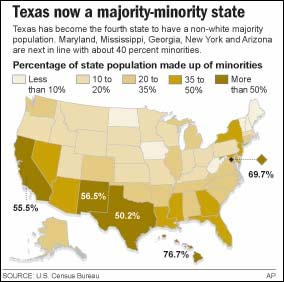
'Major Waves' in Population by Paul Overberg and Haya El Nasser, USA TODAY Sent by Win Holtzman and Howard Shorr howardshorr@msn.com (Aug. 11) - The nation's two largest minority groups are following strikingly different paths: Hispanics are moving to areas with few from their ethnic group; African-Americans are moving to suburbs in the South that have large black populations, Census estimates released Thursday show. "These are two major waves in America," says William Frey, demographer at the Brookings Institution in Washington. "One is the black return to the South. The other is Hispanics going to places where everybody else is moving, following the jobs." The July 1, 2004, estimates show that the share of Hispanics living in counties with large concentrations of Hispanics is slipping. In the 1990s, most Hispanic immigrants came to the USA through five "gateways": California, Texas, Illinois, New York and Florida. "Now, you're just as likely to go to Iowa, South Carolina or Tennessee," Frey says. (Related: Top 100 Hispanic counties) The spreading out of Hispanics challenges the communities they settle in and Hispanics themselves. Schools and local governments often are not equipped to deal with Spanish speakers. Hispanics make up at least 5% of the population in 28 states, up from 16 in 1990, Frey says. "You've got a very large share of the population living not in stereotypical neighborhoods where all the signs are in Spanish," says Roberto Suro, director of the Pew Hispanic Center, a research group in Washington. "There are still a lot living in densely Hispanic neighborhoods, but there are more who are scattered all over the landscape." Some are middle-class Hispanics moving to the suburbs. Others are less-educated, poorer immigrants seeking jobs in construction, service industries and retailing. Blacks' patterns are very different. The percentage in counties that have the largest share of blacks is inching up. More than 17 million - almost half of all blacks - live in the 11 states that were in the Confederacy, up a million from 2000. (Related: Top 100 black counties) Many black professionals are leaving Northern black strongholds such as Baltimore and Philadelphia and settling in mostly black suburbs of Atlanta, Birmingham, Ala., Charlotte and other Sun Belt metros. "They have housing options," says Roderick Harrison, demographer at the Joint Center for Political and Economic Studies, a think tank specializing in African-American studies. "They're seeking places where there are other successful upper-income blacks, where people feel they'll be more comfortable." The data also show that Texas has joined Hawaii, New Mexico and California as states whose minorities exceed 50% of the population. |
|
Abstract: Hispanics a Melding of Cultures Latinos, the Largest New Group, Are Making Their Presence Felt By George J. Church Time Magazine Archive Article, July 8, 2005 Sent by Rafael Ojeda rsnojeda@aol.com The Yakima Valley of southern Washington is 1,000 miles from the Mexican border. But so many former migrants have settled there after coming north to $ pick the valley's apples, pears and cherries that no one thought it odd when the governor of the Mexican state of Michoacan made a speech to them last spring over the local Spanish-language radio station. The governor, or so went the local joke, was only trying to stay in touch with his constituents. Union City, N.J., is 1,300 miles from Cuba. |
| Abstract: The 25 Most Influential Hispanics in America http://www.time.com/time/nation/article/0,8599,1093637,00.html From music to politics to business, Hispanics are remaking America. TIME presents 25 titans leading the Latino charge into the 21st century Posted Saturday, Aug. 13, 2005 Spanish has become the U.S.'s de facto second language, Nuevo Latino has taken its rightful place in haute cuisine, the sounds of rock en Español and reggaeton have filtered up the charts, and Latinos not only star on but own and manage major league baseball teams. But like any immigrant group that has shaped mainstream U.S. culture before fully asserting its economic or political power, the nation's 41.3 million Hispanics are just getting warmed up. While they command nearly $600 billion in buying power, they are only starting to attract the marketing attention on Madison Avenue that they merit, and their political clout similarly lags behind their sheer numbers. The country's largest ethnic minority, Hispanics promise to help remake America in the 21st century as vitally as African Americans did in the 20th. Still, perhaps more than any of their immigrant predecessors, Hispanics defy easy categorization. Mexican Americans, Cuban Americans and Argentine Americans may all speak the same language, but many wouldn't dream of standing under the same cultural umbrella. A fair number of U.S.-born Hispanics don't speak Spanish, and many others have little or no European blood. Indeed, the category Hispanic is a gringo construct—first used by the U.S. Census Bureau in 1980—and the only one based on culture and language instead of race. That dubious distinction frustrates some Hispanics, who believe they belong to a separate race, the product of an epic Latin American miscegenation of Iberian, Native American and African heritage. A growing number, especially in California and the Northeast, prefer the term Latino. But in a Time poll of Hispanic adults, 42% said they choose to be called Hispanic, only 17% said Latino and 34% had no particular preference. Such a wide array of opinions and agendas is reflected in Time's list of the nation's 25 most influential Hispanics, who range from celebrities like J. Lo and Los Angeles Mayor Antonio Villaraigosa to the lesser-known labor activist Pablo Alvarado and art curator Mari Carmen Ramirez. She says her job is to be an evangelist for Latino culture. With these 24 powerful Hispanics at her side, no wonder word is spreading fast. |
Latinos In Information Sciences and Technology Association (LISTA) LISTA Upcoming Events: September 25-October 1, 2005, a national awareness campaign held during Hispanic Heritage Month. The educational celebration engaging Hispanic communities across the country highlights how information technology can better support children's learning, assist in locating employment opportunities, and help provide overall economic enrichment. LISTA in partnership with Hispanic Engineer Magazine and IBM, will have a series of events in NY, NJ, Washington DC and Texas. For more information or to participate please call 718 601 8199 or visit http://www.a-lista.org. |
|
Status Check: Minority Hiring in Science and Engineering by Dan Woog, August 12, 2005, Monster Contributing Writer posted at: http://diversity.monster.com/articles/sciengdiv/ Sent by Refugio Rochin, Ph.D. rirochin@ucdavis.edu or rochin@cruzio.com Harvard University president Larry Summers's comment that "innate differences" between men and women might explain the lack of top-level female professionals in science and engineering spurred a nationwide debate on the numbers and status of women in those fields. But are minorities any more visible than women in the sciences? Building Engineering and Science Talent (BEST) offers some sobering statistics. According to the organization's Web site, in addition to women, African Americans, Hispanics/Latinos, American Indians and workers with disabilities "comprise two-thirds of the overall workforce but hold only about one-quarter of the technical jobs that drive innovation." A BEST report, "The Quiet Crisis," reports that African Americans, who make up 12.8 percent of the US population, hold only 7.2 percent of science and engineering jobs requiring a bachelor's degree and 3.6 percent of professional jobs requiring a PhD. Hispanics/Latinos, 13 percent of the population, fare even worse: They hold 3.7 percent of bachelor's degree-level jobs and make up just 2.1 percent of the PhD/professional workforce. American Indians, 1.2 percent of the US population, barely register, with 0.3 percent of bachelor's-degree jobs and a statistically insignificant number of PhD/professional jobs. Only Asian Americans are over represented. Although they comprise 4.5 percent of the US population, they hold 12.6 percent of all bachelor's-degree positions and a whopping 17.6 percent of PhD/professional jobs. Few Minorities in the Pipeline Why such low numbers? "It starts with the pipeline: Going through high school, college and then graduate school," says Refugio I. Rochin, executive director of the Santa Cruz, California-based Society for Advancement of Chicanos and Native Americans in Science (SACNAS). "For minorities, that pipeline thins out quickly." Rochin adds that education, government and private-sector organizations are ineffective at recruiting and hiring minority scientists and engineers. "Some of the top-tier schools have multimillion-dollar research labs, paid for with federal funds, but their efforts to find minority candidates are faint," he explains. "Government spends billions of dollars on research, and they run big labs, too, but when you ask about their hiring rates or efforts at diversity, they can't show you numbers." In private industry, fields like pharmaceuticals and chemicals rarely have minority scientists in charge. Even companies like Boeing, which Rochin says spends $80 million on diversity efforts annually, may not see their efforts pay off directly with more minority scientists and engineers. "Funding is always dependent on the economy," says Rochin. "And in today's global economy, diversity can be defined in a lot of ways. Some companies spread their money all over the globe." Too Little Diversity at the Top Science is like any other field, Rochin notes: People tend to hire other people who look like them. "Without minorities at the top or minority mentors and high-level career training, you're not going to get much movement for minorities," he says. The old-boy network, another barrier to advancement for women in science and engineering, also hinders minorities. "We don't have a lot of Nobel Laureates, senior academicians or people who can identify and promote top-notch candidates," Rochin says. "We're not yet on review panels, which is where research gets funded and careers get promoted. At the lower levels, after 30 years of pushing and prodding, we've got an emerging population of successful students, lab assistants and researchers. Our challenge now is to springboard them into the top positions." One scientific sector stands out for Hispanics/Latinos, African Americans and American Indians, says Rochin: Public health. These jobs, many well-paying, are available because public-health organizations reach out to minorities, hoping they will return to serve their communities of origin. SACNAS is working hard to open science and engineering's doors to minorities. The organization has supported nearly 15,000 students with educational and career-advancement programs. SACNAS runs an internship program, an annual conference and mentoring programs for K-12 teachers, undergraduate and graduate students and promising PhDs. Organizations allied with SACNAS include the National Oceanic and Atmospheric Administration, the Indian Health Service, NASA, the National Institutes of Health, the Department of Energy, the Alfred P. Sloan Foundation, Seagate Technology, IBM, HP and Agilent Technologies. Additional Resources For more information on minorities in the sciences and engineering, consider these sources: Minority Americans in Engineering and Science Magazine http://www.maesnationalmagazine.com/ Fall 2004 Vol. 13 No. 3 Maes National Magazine Celebrates Twelve Years of Publishing Excellence! MAES National Magazine was first published in March of 1992. The magazine focuses on minority engineers & scientists, ranging from students to accomplished professionals and the companies they work for. Over the last decade we have witnessed leading science and engineering companies realize the value in diversity initiatives and those companies are now reaping the benefits. National Action Council for Minorities in Engineering- http://www.nacme.org/ NACME Symposium 2005 Forging Partnerships... Sharing Goals Meeting America's Need for Engineering Talent NACME will convene a prominent group of corporate executives, college and university presidents and deans, foundation officers, government officials, educators from urban school districts, and representatives from science and engineering-focused organizations, at a symposium to address the shortage of young students prepared to pursue undergraduate degrees in engineering and technology, and the need to increase the representation of underserved students if we, as a nation, are to meet the future demand for professionals in those areas. Through a series of presentations and panel discussions, Symposium participants will tackle tough issues such as the offshoring of engineering and technology jobs, revitalizing curricula at both the secondary and post-secondary school levels, and the need for diversity in the engineering workforce. Join us! National Society of Black Engineers - http://www.nsbe.org/ NATIONAL LEADERSHIP CONFERENCE 2005 or NLC, is NSBE’s premier training program for key national and regional officers. Society of Hispanic Professional Engineers - http://www.shpe.org/ The Society of Hispanic Professional Engineers (SHPE) was founded in Los Angeles, California, in 1974 by a group of engineers employed by the city of Los Angeles. Their objective was to form a national organization of professional engineers to serve as role models in the Hispanic community. The concept of Networking was the key basis for the organization. SHPE quickly established two student chapters to begin the network that would grow to encompass the nation as well as reach countries outside the United States. Today, SHPE enjoys a strong but independent network of professional and student chapters throughout the nation. Talk about this article and get advice on the Diversity at Work message board as of August 12. 2005 -- visit http://forums.monster.com/forum.asp?forum=1896 |
|
Portola and Anza
Expeditions Example of anti-Spanish sentence in a history book ¿Smithsonian Identifies first Latino Hero during the American Revolution? Book: Tejano Roots Si, Se Puede: Felipe Alou Stands Up to Bigotry |
|
Portola and Anza
Expeditions HI Mimi, I was searching through your Newsletter, it is always so interesting. Especially the Anti- Spanish-Mexican Legends. Maybe you have come across this web site, I don't know, but it was so thrilling to me to read about the Portola and Anza Expeditions. How proud we should be of these Spanish-Mexican families that risked their lives to Colonize California. Web de Anza http://anza.uoregon.edu/siteindex.html
I had always wanted to read the Diaries of these men who were in charge, being in Spanish of course, I could not read them. One day through my many researches I came a website that was recommended by a Park Ranger. There they were, Diaries written in English which had been Translated by the Oregon University. They have been the most exciting reading material, you just can't put it down. I recommend that all your readers take a look and see for themselves. |
Example of anti-Spanish sentence in a history book Editor: Even within well documented historical books, I have frequently come across text segments that are imbued with anti-Spanish sentiments. A website to the book: "The Regiment of Louisiana & the Spanish Army in the American Revolution" was forwarded with information about the remarkable successes of General Galvez. However, one sentence jumped out at me. It is a very good example of how an anti-Spanish prejudice can be included in a historical text, seemingly as historical fact. "When the widening breach that had been growing between the Thirteen Colonies and the Mother Country exploded into a full-fledged rebellion in the spring of 1775, both the courts at Versailles and Madrid hailed the event as a godsend. Here was their chance to strike at their ancient enemy while her arms were tied and get some revenge for the humiliating defeats England had dealt them during the Seven Years War." Analyzing the sentence, they write that courts of Versailles and
Madrid hailed the rebellion of the American colonists as godsend
because: 2) the Spanish were pleased because they could now attack the
British while her arms
were tied 3) the motivation of trying to hold on to the lands that had been explored and colonized for about 300 years is dismissed as simply get some revenge. 4) the use of emotionally-packed words and images to explain Spain's involvement, humiliating defeats England had dealt them, in this case, implies in context that the Spanish were not gentlemen. Class was very important at that time, the upper class were considered superior and deserving of their position. The text implies that the Spanish were lower class and could not take defeat in the noble well-manner way of a gentleman. Instead, the Spanish were acting like the lower class, seeking revenge for their humiliation Within that one sentence, the authors have concluded that Spain (and
its people) were vengeful, cowardly, uncultured and inferior, and for
those reasons were in support of the American colonists. |
|
JV jvmart@verizon.net Editor: This question was forwarded to Somos Primos readers with a special interest in the American Revolution. You will enjoy the reasoning and answers, supported by facts, dates, and locations showing Miranda was a very poor choice by the Smithsonian for the First Latino Hero during the American Revolution. Go to First Latino Hero
|
|
BOOK:
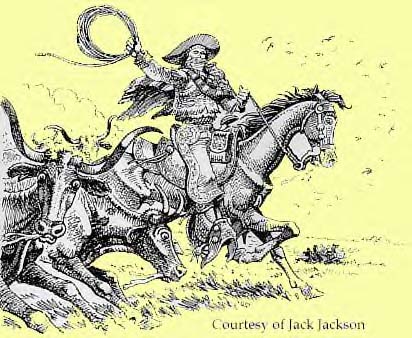
Tejano Roots DAVY CROCKETT Dying a warriors' death while swinging "ole Betsy" at the Alamo...wrongTEXAS INDEPENDENCE Starting at Gonzales in 1835...wrong again SIX FLAGS OVER TEXAS...still wrong TEXAS RANGERS Straight-shootin, square dealing lawmen...dead wrong Did you know that over 1000 Tejanos sacrificed their lives for liberty and freedom...yet have been forgotten? And it happened here in South Texas, and it was bigger and bloodier than the Alamo, San Jacinto and Goliad combined. "Tejano Roots" is the untold story of Tejanos who can finally claim their rightful place in the history of our country. "Tejano Roots" brings a historic and a renewed sense of pride to our Mexican-American community with a story that belongs to them, their families, their history and their hearts. Dan Arellano has appeared on Tejano Radio 1560 AM in Austin with Amy Garza, on KOOP radio FM 91.7 and TV Fiesta Musical both with Isidoro Lopez, and on Prime Time Tejano the Austin Music Network TV show with Jerry Avila. He has also been featured in La Prensa and Arriba, both Austin Newspapers, and at www.tejanomagazine.com. The book is available at Book People, 603 N. Lamar in Austin, and at Border Land Books in San Antonio, 6307 Wurzbach, and in California at Los Palominos 1901 N. Dinuba Blvd, Visalia, Ca. 93291 Or send $24.00 plus $3.00 s & h to Dan Arellano. PO Box 43012. Austin, Texas 78704. Contact: Excerpts from "Tejano Roots" "Many Mexican-Americans have given their lives, defending freedom and democracy. A thousand Tejanos were killed in one battle alone, in defense of these causes.But this conflict wasn't on foriegn soil. Not on the beaches of Normandy, not in Korea, Viet Nam, or Desert Storm, although Tejanos were there, but much closer to home, in South Texas, less than twenty miles outside of San Antonio. The Battle of Medina...the forgotten history of the Tejanos , these first sons and daughters of the State of Texas, unknown and unrecognized, for their ultimate sacrifice." "The battle raged for four hours going one way and then the other. Through the smoke and the roar of the cannon, men could be heard crying in anuish. Some men lost limbs, others had their heads blown off, there were body parts scattered all over the battlefield. The lucky ones died instantly, while others suffered a slow and agonizing death, until executed upon orders by Arredondo. The carnage was devastating; it was a horrible massacre of men." On this day in 1813, the Spaniards defeated a would-be Texas republic in the
bloodiest action ever fought on Texas soil. The battle of Medina ended the
filibustering efforts of the Gutiérrez-Magee expedition. |
| Si, Se
Puede: Felipe Alou Stands Up to Bigotry by Dave Zirin, August 8, 2005 by CommonDreams.org Sent by Howard Shorr howardshorr@msn.com In the current climate of anti-immigrant, Latino-bashing, let this message ring across the land: don't mess with Felipe Alou. Don't mess with the 70 year-old Giants manager, who has stared down the U.S. Marines, the Jim Crow south, and Major League Baseball and will give no quarter: Larry Krueger learned this late last week when the San Francisco KNBR "radio personality" described the San Francisco Giants as "brain-dead Caribbean hitters hacking at slop nightly" and then characterized Alou as having "cream of wheat in his brain." Krueger thought that his gutter racism would pass unnoticed. But by taking on Alou, Krueger has proven painfully overmatched. Alou's response was immediate, political, and refreshingly unforgiving. "It made me sad to know that 40, almost 50 years later, we have comments like that, especially in San Francisco," he said. "There are more countries [represented] in San Francisco now than when I was a player here and I never heard anything like that. I heard it in the South and in some other cities, but not here. A man like me and the Latin guys out there, we have to be aware now that [racism] is not over yet. It is coming back." His son Moises, who plays for the Giants, said that Krueger's comments were all too familiar to what is said by many off microphone. "In the minor leagues, people think all Dominicans, Mexicans and Venezuelans are dumb," he said. "You think if a guy doesn't speak English it's because he's stupid. You go to the Dominican and try to have conversation in Spanish, and see how easy it is." It is this pent up frustration felt by many Latino players that explains why Felipe Alou also rebuffed Krueger's efforts to save face and apologize. "I know this individual came to apologize to me. Are you kidding? There is no way to apologize for that kind of thing. If I say I accept it, the Latin players will never forgive me. There's no way to apologize for such a sin." Alou also asked people to consider how many countries comprise the Caribbean, and said, "All of these people were offended by that idiot." In taking on Alou, Krueger was out of his league. Alou was the first Dominican player ever to play in the Majors. Couple that with his dark complexion and a minor league stint in Louisiana, and Alou's intro to the United States was "a depth of racism I never saw in the Dominican Republic." While the rest of his team dined in segregated restaurants and stayed in "whites only "hotels, Alou ate meals on the team bus and scrounged for housing. But Alou never let it beat him down. "I was never scared. Some of my [Black] teammates were, but I was proud of who I was and where I was from." As a minor leaguer in Louisiana, Alou wouldn't listen when bus drivers would tell him to take his seat in the back. This didn't stop in the minors. When Felipe played with his brothers Jesus and Matty for the Giants, it took just one losing streak for manager Alvin Dark to say, "We have trouble because we have too many Negro and Spanish-speaking players on this team. They're just not able to perform up to the white players when it comes to mental alertness." Alou struck back by successfully campaigning for Major League Baseball to hire a person in charge of ensuring the welfare of Latin American Players. In 1965, Alou won when Commissioner William D. Eckert hired Cuban born Bobby Maduro for this newly created role. "Felipe went through a lot of trouble not just for Matty and me but a lot of Dominicans as a black Latin player," remembers Jesus. "He went through a lot to clear the path for others." Alou's politicization continued when he saw firsthand the US Marines occupy the Dominican Republic in 1965. "Hopefully it will be the only time I will have to confront soldiers from another country," he said in a recent interview. "We lived for months under occupation from foreign soldiers. You just can't ignore that."` Now looking at a world where military occupation and racist slander persist, Alou is wondering how much has changed. Despite the outrage over Krueger's remarks, the radio jock has been suspended by the station for only a week. "It's a slap on the hand,'' Alou said, slapping his own hand. "He could come back with something else in a week.'' Alou said that in protest, he would no longer do his pregame radio spot with the station. "My voice and the voices of others can't be coming out of the same wave,'' he said. "No way. I am a man of principle. I always have been and always will be.'' Let's see if we can rise to Felipe Alou's level and demand that KNBR step up and fire Larry Krueger. Email sports@knbr.com and let them know that we want our sports a la carte: hold the racism. Dave Zirin's new book "What's My Name Fool? Sports and Resistance in the United States" is published by Haymarket Books. Check out his revamped website http://www.edgeofsports.com. You can receive his column Edge of Sports, every week by e-mailing edgeofsports-subscribe@zirin.com . Contact him at whatsmynamefool2005@yahoo.com . |
|
SURNAME Lozano/Losano |
|
|
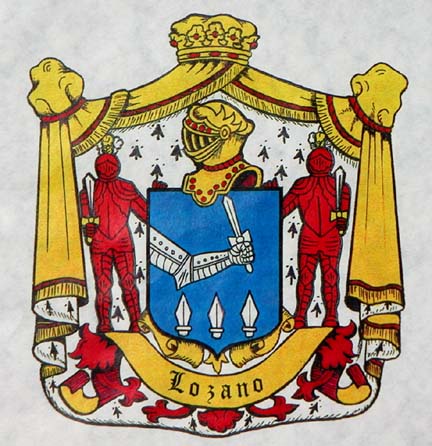
| This beautiful shield is printed on parchment
paper and is available from Armas de España.
Stewart Von
Rathjen owner of Armas de España produces authentically accurate family
shields, based on the research of staff in Spain. His products come in various
sizes and materials. Information: Armas de España, #3 Rancho Jurupa Place, Phillip's Ranch, Pomona, CA 91766 |
|
TEXT ACCOMPANYING THE SHIELD: For valor in combat, don Alfonso Manuel de Lozano and don Luis Sebastian de Lozano were created Knights of the most Noble Order of Santiago (founded 1160 A.D. by King Don Fernando II to guard the Holy Sepulchre of the Apostol Santigo in Compostela from the Moors). Don Carlos Tomas Lozano and don Ramon Ignacio de Lozano were created knights of Calatrava (founded 1158 A.D. by king Don Sancho III and confirmed by Pope Alejandro III in 1164 A.D. to wage Holy War upon the Arabs with fire and sword and, hasta La muerte). Lozano caballeros were Conquistadores del Nuevo Mundo and descendants reside in the Americas. Bibliografia: "Enciclopedia Heráldica"; "Nobilario Español"; "Linajes y Blasones de los Caballeros Hijosdalgo de España" Sus Armas: Azure (blue) an armed arm argent, issuing from the dexter flank, holding a naked sword in the hand; in base three lance heads argent (white or silver), posed in fesse
|
|
The Pedro LOZANO married to Mariana de la GARZA in 1669 in Monterrey, Mexico is considered the progenitor of the earliest LOZANOs in Nuevo León. However, Pedro remained a mystery person because at the time of his marriage to Mariana, 2 October 1669, there was no information given as to his place of origin or the names of his parents. To the best of my knowledge , no document has been located in the Archives of Monterrey that has a clue to his predecessors, such as a will, a land record, or a limpiza de sangre. In 1986, I started doing genealogical research. Using the
Monterrey Protocolos edited by Israel Cavazos Garza, I compiled family groups
working from the earliest Pedro LOZANO, forward. At the same time I worked
with the 1910 U.S. Census records finding my paternal grandparents. I started
working backward using the Texas marriage certificates of my parents and
grandparents. In their April/May 1994 issue, the Georgia publication, Family Tree surprised me by printing my Lozano lineage article. Another surprise was a letter dated April 18, 1994 from Avis Moore Rupert of Houston Texas which stated:
|
||
|
With both curiosity and doubt, I looked at the pedigree chart of John Robert Mayner III, Avis's son-in-law. There in the 5th generation was our same ancestor, Laureano LOZANO and Ysabel PENA, with a marriage date. I quickly mailed Avis a package of data, and was greatly surprised to receive a worried telephone call. Avis had gotten the marriage date off of an index of marriages in Monterrey and Laureano's parents were not the couple that I had given. She did not read Spanish so had not ordered the actual document. I quickly did and confirmed Avis's data. My lineage was from a Baltazar LOZANO and Maria del Refugio GONZALEZ. I had followed the wrong line. There were two Laureanos of the same approximate time period and, using just baptismal records and a "deductive jump," I had followed the wrong Laureano. With a planned trip to Houston for the State Hispanic Genealogical Conference, Ophelia Marquez, always one to meet a genealogical challenge, lent her expertise and support to see if we could find the link before the October conference. Unfortunately, we hit a brick wall in the marriage of Baltazar LOZANO's parents, Francisco LOZANO and Gertrudis AYALA. Francisco LOZANO and Gertrudis AYALA were married in Monterrey on 6 February 1792. Gertrudis' parents were listed, but Francisco's parents were not named. It was not uncommon at that time period for the name of the parents of a widow or widower not to be given, only the name of the deceased spouse. His first wife had been Rosalia TREVINO. No record of the marriage has been located. However, a book purchased in Houston by Ophelia entitled 'Testamentos Coloniales de Monterrey" by Lilia E. Villanueva de Cavazos provided the answer. Soon after returning home, I got an excited telephone call from Ophelia. She had broken the line for me. In 1783 a Francisco LOZANO, makes his will stating that he is the son of Andres LOZANO and Antonia GONGORA, and that his first wife had been Rita de la GARZA. Among his children from his first marriage was Jose Francisco who was married to Rosalia TREVINO. The father's will provided a positive identification of his son Francisco because he gave the name of the first daughter- in-law. With that crucial bit of information found by Ophelia, previous Monterrey Protocolos data, Paul Guerra's dispensation book, and Ophelia, we took the line back again to the original Pedro LOZANO and Mariana de la GARZA. But the support and networking of friends and relatives does not end, nor did the Lozano line. Jaime Holcombe, doing research in Zacatecas, found a will that enabled the descendants of the LOZANO line in Northeastern Mexico and South Texas to find their way back to Spain. In a letter to Ophelia, Jaime was kind enough to send along the following to me: "Before becoming immersed (and drowned) in the next record, let me say that in these records, when referring to the provinces of Nueva Galicia, Nueva Vizcayo and Nuevo León, the scribes would frequently omit the "Nueva" or "Nuevo." It is important to say so, because it's for Mimi Lozano Holtzman. A son of the maker of the will was living in (Nuevo) León. as I see it. If these aren't her LOZANOs, then the Pedro LOZANO in the entry will have been the root of part of the many LOZANOs there, unless of course, he died without seed". Ophelia and Raul were both positive that it was my line and proceeded to analyze the will that Jaime sent. I was in state of awe and busy preparing "Somos Primos." The will was dated in Zacatecas on 9
September 1674 and was written by a Pedro LOZANO.
|
|
|
|
Below is my direct line pedigree. You can see I
still have a several marriages to find. |
Catalino Lozano ~ Aurora Chapa M: Apr 20, 1931, San Antonio, Texas Jesus Lozano ~ Francisca Garcia M: Jan 18, 1896, San Antonio, Texas Laureano Lozano ~ Ysabel Peña M: Oct 30, 1857, Monterrey, N.L. Baltazar Lozano ~ Maria del Refugio González abt 1830 Francisco Lozano ~ Gertrudis Ayala (2nd wife) M: Feb 6, 1792, Monterrey, N.L. Francisco Lozano ~ Rita de la Garza M: Jul 22, 1743, Monterrey, N.L. Andrés Lozano ~ Antonia Góngora M: Jan 7, 1709, Monterrey, N.L. Pedro Lozano ~ Mariana de la Garza M: Oct 2, 1669, Monterrey, N.L. Pedro Lozano ~ Antonia de Urquizu M: Siguenza, Spain Francisco Lozano ~ Teresa de Alcolea Pedro Lozano ~ b. circa 1555 Spain |
| Surely the networking that included the expertise and loving support of Jaime Holcombe. Raul Guerra. and Ophelia
Marquez is an example of what the spirit of family research is all about. My sincere and grateful thanks to these three very talented researchers who shared their expertise generously and enthusiastically and, of course, to Avis Rupert for finding the incorrect link in my Lozano family chain.
|
| Knowing my interest in Pedro Lozano, Spanish
historian and columnist Angel Custodio Rebollo, kind friend that he is, sent other Pedro Lozanos among the Spanish archives in the 1500s. Pedro Lozano, hijo de Juan Lozano y Maria Mateos, vecinos de Coria de Galisteo. Salió para Indias el 7 de marzo de 1513. Pedro Lozano, hijo de Juan Lozano y Quiteria Larxidas, marcho a Indias como lego de 24 religiosos que iban con Fray Vicente Casas, en 1555. Pedro Lozano, escribano publico, natural de Burguillos, vecino de Puerto de Plata, hijo de Francisco Hernández y Catalina González, marcho el 12 de marzo de 1563 a la Isla La Española. Pedro Lozano, natural de Archilla, soltero, hijo de Juan Lozano y Teresa Fernández, a Nueva España, como criado de Luis Méndez de Sotomayor, el 11 de enero de 1593. Pedro Lozano, natural de Guareña, hijo de Martín Alonso Lozano y Maria Sánchez, a Perú el 6 de febrero de 1594. Fray Pedro Lozano, del Monasterios de Santa Cruz de las Carboneras, a Chiapas el 31 de mayo de 1577. |
|
Galvez Patriots |
|
Lorenzo's Revolutionary Quest, young
adult novel First Latino Hero during the American Revolution NSSAR - Spain's Involvement Mr. Del Moral, Mimi and All Bernardo de Galvez researchers/Language difficulties |
|
Lorenzo's Revolutionary Quest by Lila and Rick Guzman |
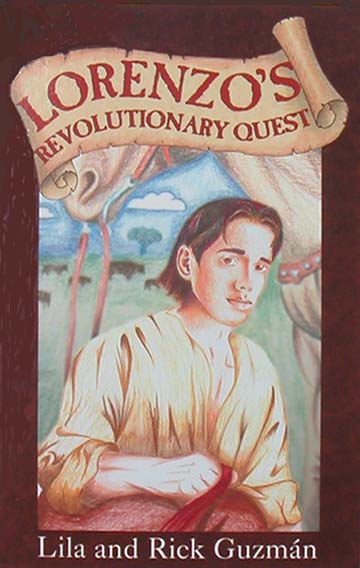 |
In his last adventure, Lorenzo
Bannister swept across the southern colonies of England and Spain, from
the teeming ports of New Orleans to the fertile plantations of Virginia,
struggling to deliver crucial supplies to George Washington.
Now, in this sequel to Lorenzo's Secret Mission, the intrepid young adventurer is back to fulfill his commitment to the American Revolution. When General George Washington names Lorenzo a captain in the Continental Army, he is sent on another challenging mission: to purchase 500 head of cattle in Texas from the Spanish. With Colonel De Galvez's aid, Lorenzo struggles to herd the cattle and his soldiers to the Mississippi River via King's Highway - a rustic dirt road through the provinces of Texas and Louisiana. Once again, Lorenzo finds himself charged with a life-threatening quest, a quest that will bring him face to face with the notorious renegade rustlers of the southwest under the command of the menacing Chien d"Or. And just in the shadows, waits "Saber Scar" - the man that holds Lorenzo responsible for his capture and imprisonment - whose escape from prison is one short breath away. Published by Piñata Books Please click for information on authors.
|
|
 |
 |
|
| Francisco de
Miranda identified by the Smithsonian as the . . . . . First Latino Hero during the American Revolution
A flyer from the Smithsonian that I picked up a while ago and which only now I have had a chance to concentrate on, notes that Francisco de Miranda (1756-1816) "is the first Latino hero of the American Revolution." Were you aware of this disclosure and wonder to what extent you agree with that statement. JV jvmart@verizon.net I sent out the follow email: Good morning my dear Revolutionary War experts . . . . Will you please respond to Dr. Martinez's query. I think your responses will make a good article. Your response need not be long, three or four paragraphs. Be sure and include your credits and justification for speaking on the topic. I think we can have something pretty powerful to share. JV is Dr. Joe Martinez, Senior Consultant, Department of Energy, D.C. He has been actively involved with SHHAR and Somos Primos for over ten years, and pushing for Hispanic historical recognition in DC for much longer than that. God bless you all, Mimi FROM: Hector Diaz, historian, reenactor, Dear Dr Martinez My initial reaction was one of surprise, to the fact that the Smithsonian Institution could have committed such an injustice. The contributions of Don Francisco de Miranda to the American Revolution cannot be denied; he fought in the Battle of Pensacola under the command of Spanish General Don Bernardo De Galvez, as the aide-de-camp of Spanish Field Marshall Juan Manuel de Cajigal, and wrote a diary of the campaign. He also he played a distinguished part in the combined Spanish-American attack and capture of the Bahamas. That being said, there are others more meritorious of such an honor as being the "First HISPANIC hero of the American Revolution" The term "Latino" does not apply here at all. I believe the King Juan Carlos I of Spain settled the matter long before it came to our attention. This was back in 1976, when in June that year, he inaugurated a statue of General Don Bernardo de Galvez not far from the Smithsonian Institution on Virginia Avenue, during the celebration of the Bicentennial of the United States. The monument is on a plaza located beside the U.S State Department and it serves, to this day, as a reminder of the assistance given by Spain and her colonies to the conflict. "King Juan Carlos' words that day ought to be even more clarifying. That is why I have taken the liberty of including them here. On unveiling this monument to Bernardo de Galvez, the great Spanish soldier whose contribution was decisive for the triumph of George Washington's armies in their struggle for American independence, I should like to call to mind very briefly the brilliant and courageous campaign he carried out in the lands bordering the Lower Mississippi. Apart from being a masterpiece of military strategy, the conquest of Western Florida was the blow that permitted the final victory of your armies, the end of the war, and the birth of the United States, since it considerably lightened the pressure of the English in the war against the American settlers who were fighting for their independence. Years later, Bernardo de Galvez was appointed Governor and Captain-General of the lands of West Florida, and married a creole from New Orleans, a city he loved as if it were his own. Galvez always felt himself to be just another American. My ancestor, King Carlos III who kept up correspondence and exchanged gifts with your first President, gave Galvez the right to use a coat-of-arms bearing the heraldic motto: "I alone." In this way he wished to honor the heroic conduct of Galvez when he forced his way, with one single vessel, into the Bay of Pensacola and succeeded with his troops, in compelling the English garrison to surrender. " "I alone" has often been the symbol of the Spanish pioneers in America. But it is also necessary to say that this tribute to the feats and actions of each man is acknowledgement of generosity, bravery and moral value of human acts that have often changed the course of history. May the Statue of Bernardo de Galvez serve as a reminder that Spain offered the blood of her soldiers for the cause of American independence. June 3, 1976, Juan Carlos I, Washington D.C. King of Spain Like I said before, I think this ought to settle the matter of who should be honored, perhaps not as the first because Galvez was not, but as a matter of fact, neither was Miranda, but as the most important Hispanic hero of the American Revolution. Aside from the statue in Washington D.C., Galvez has been honored by the U.S. Postal Service which issued a stamp in 1980, commemorating Galvez's triumph in Mobile 200 years before. I am a history researcher, reenactor of the Spanish forces of the American Revolution for 12 years now, and the originator, investigator, drafter and presenter of Maryland Senate Joint Resolution # 2 on the Hispanic Contributions to the American Revolution, which was adopted on April 8, 1997, by the Maryland Legislature. I also collaborated with the "Cobblestone" history magazine issue on "Spain and the American Revolution" which was published in November 2000. Saludos! Hector Diaz hldiaz60@hotmail.com
FROM: Jack Cowan, President, The Texas Connection to the American
Revolution The word Latino comes into question and by broad terms would include Peter Francisco who fought with Washington in 1777 at Brandywine. Francisco was kidnapped at a young age and set ashore in Virginia most probably from the Portuguese-held Azores. He was truly the biggest hero of the American Revolution (even according to General Washington). But if blood Spanish is what you want, the General himself has to be declared the first Latino hero of the American Revolution. Yes, that's what I said. Genealogy tells us that Washington was a descendent of King Ferdinand III via his daughter Elaine of Castile who married Kind Edward 1st and that makes him blood Spanish and the answer to your query. I hope you can find an answer in there somewhere.......... Jack Cowan
FROM: Paul Newfield, Historian, Genealogist,
Historian Sorry Folks, I have to plead basic ignorance on this one.
Wikipedia is my best/quickest source on Francisco de
Miranda. http://en.wikipedia.org/wiki/Francisco_de_Miranda My $0.02 -- Paul Newfield Addendum: Matias de Galvez - father to Bernardo and brother to Jose - was the man who initially organized the military recruitment of the Canary Islanders for Louisiana in c.1778. He was eventually replaced by as jefe of the recruitment by Andres Amat de Tortosa who brought the recruitment to a culmination. in about 1778-79, when 700 Canary Islands recruits and their families (more than 2000 people total) left the Canary Islands, bound for Louisiana. This group is MY personal link to my own Spanish heritage. Paul Newfield (New Orleans, La.) I am Professor Granville W. Hough, and I have studied Spanish participation in the Revolutionary War for about ten years. Of course, I have read the life of Miranda by William Spence Robertson, University of NC Press, 1929, but never would have concluded he was the first Latino hero of the American Revolution. Few Americans knew the name at that time. I would absolutely agree with General George Washington that
the first Latino hero of the American Revolution was the representative
of the Spanish government in Philadelphia. When this gentleman
died during the war, General Washington made sure he received full
military and diplomatic honors as an Ambassador (even though he was
not), and he may have sent General Baron von Steuben to assure it was
done properly. Addendum: George Washington's choice of the "first Latino hero of the
American Revolution" would of course have been Juan de Miralles y
Trajan/Troyllón, who died in 1780. He had been a Havana merchant, but
became the Spanish observer at Philadelphia from 1778 to 1780. I show
that authors Abbey, James, and Cummings each discussed some aspect of
his work. time, relating to American independence, Miranda does not compare
with Miralles, Could the Smithsonian writer have gotten the two people
confused? Granville W. Hough. Hello, I believe that to name Miranda as the first Latino of the American Revolution is a tremendous injustice to those whose contributions were much greater. It is to misdirect history now that the history of Spain and her children in American history is being brought to light. That is a tragedy. First, I would have to agree with Mr. Cowen and Mr. Newfield that to designate him as the first "Latino" is not only strange for the 18th century, it is also a misnomer that will, again, misdirect history to the wrong population group. "Latino" is a term that in today's context erases the the true ethnic and racial identity and heritage of both Peninsulares and Criollos, full Spaniards born in New Spain (as opposed to mestizos, mulattos, pardos, genizaros etc.)who made up the vast majority of the population of Northern New Spain, including Louisiana and Texas. That term also erases the heritage of many who were hispanicized but who had their origin in other places like Juan Seguin whose heritage is in France, or Jose Cassiano whose heritage was in Italy (I am just using them as an example, they are from a more recent historical period). Bernardo de Galvez was the man who was giving aid to the American Colonies before Spain got involved in the American Revolution. Bernardo de Galvez built gunboats to patrol the Mississippi River when the British began to fortify themselves along the River. Bernardo de Galvez was the man who mustered the Army that defeated the British all along the Gulf Coast. Bernardo de Galvez was the one who sent emissaries to Domingo Cabello, governor of Texas, to arrange for and to legalize the export of thousands of head of cattle to feed the American Revolution. Bernardo de Galvez is the one who opened up the Mississippi River system as a back door to counter the British blockade of the East Coast. Bernardo de Galvez defeated the British in Baton Rouge, Manchac, Mobile, Pensacola, St. Joseph, Michigan, St.Louis Missouri,Illinois etc. To credit Miranda is to discredit the contribution of Spain once again because he hardly did anything at all compared to Galvez. To credit Galvez is to credit Spain and her children and to force recognition of the major contribution he led in all these places and not just one battle. Bernardo de Galvez should be recognized by the Smithsonian and the U.S. Congress and all Americans NOT as the "first 'Latino' to contribute to the American Revolution", but as "the Spaniard General, Governor of Louisiana, who led the major contribution of Spain in the American Revolution". To do otherwise is to discredit Spain's contribution, mislead history and misidentify the majority of the participants in the North American theatre of operations. I am the author of the book "The Continous Presence of Italians and Spaniards in Texas as Early as 1520". I am a Doctor of Theology, which I pursued for personal enrichment, I hold two Master of Divinity Degrees, one of which is from New Orleans Baptist Theological Seminary where I was invited to the Ph.D. Fellowship. I have been instructor of Systematic Theology and Biblical Studies. I am currently training with the U.S. Army and I am in the process of becoming the Chaplain for the Special Warfare Instruction Center, Special Forces Operations Command, Airborne, Fort Bragg, S.C. I hope the Smithsonian corrects its mistake and gives credit to whom credit is due. One more thing, the King of Spain granted that Bernardo de Galvez, not Miranda, could have the words "Yo Solo" (I Alone) inscribed on his coat of arms specifically because of his contribution to the American Revolution. Alex Loya I believe the history of Spain and her children as it pertains to the history of the United States should be widely distributed and known, period, giving the proper honor to both Miralles and Galvez and all the others. Galvez and Miralles should not be turned against each other, they contributed together to the American Revolution, and together they should be honored, as well as all the other leaders, and the rank and file whose descendants now live in the bayous of South Louisiana, my home state, and the old colonial towns of Texas, my fathers' land, who by and large are today scattered. It seems to me that the "who is first" discussion is the proverbial fruit of discord thrown at our table. I propose that we direct the Smithsonian's attention, and the Library of Congress and whoever else, to not throw a bone at Spain and her children by noring one man, but that they make public the whole story, honoring all involved. If indeed George Washington had some roots in Castile, that should also be published, I am happy the third and final edition of my book is not yet ready for the printers. Once again, I propose that we pressure the Smithsonian to not honor one man's contribution, but the full contribution of Spain, Louisiana, Texas and the rest of the Southwest, not forgetting those from other places who also helped, being careful to keep it a United States of America history. What say you? Or, rather, what say ya'll? Pro Deo et Patria (For God and Country), Alex Loya
My name is Bruce Buonauro. I'm a historian and graduate of
History, education and theatre from Cal Poly Pomona. I have a program
from the last ten years. I've written and been
portraying called Bring Early California to life in a
dramatic and educational means. I theatrically portray Padre Junipero
Serra and Bernardo de Galvez. This program is what I'm
now basing my Masters Thesis on. Sincerely, Bruce Buonauro Lila holds a Ph.D. in Spanish literature (specialty: Modern
Peninsular) and was an officer in the Navy. My assignment at the
Defense Language Institute was to teach native speakers how to
teach their language to Army/Navy/Air Force/Marine personnel. Dear Dr. Martinez: It appears that you have a time crunch, so here goes: My initial reaction was to ponder the word "first." I would put Bernardo de Galvez first. My area of expertise is Don Bernardo. In Sept. 1776, he sent a flatboat flotilla from New Orleans to General Washington (via the Mississippi and Ohio). The supplies on board consisted of 9,000 pounds of gunpowder, along with cloth, muskets, and medicine. One thousand pounds of Spanish gunpowder went with George Gibson by ship to Philadelphia. It has always been my impression that Don Bernardo was ahead of the curve. Spain did not declare war on Great Britain until 1779. But from 1776 on, Don Bernardo was doing covert operations to supply Washington. In fact, some think that the dollar sign came from the Spanish emblem on Spanish pillar dollars. (A pillar with a banner around it.) So, I don't want to belittle anyone involved in the American Revolution, but Bernardo de Galvez forced the British from the Gulf area. He opened a second front that pulled British troops and supplies from the original thirteen colonies. Galvez reflects qualities that are quite admirable and should be encouraged with our young people. When he learned that the people of Pensacola--his British enemies--were low on food, he sent them flour. How many people feed the enemy? When he was in northern Mexico as a young army officer, he captured some Apache youths. What did he do? Sent them to school in Mexico City. He believed that you should give your heart to God and your hand to man.
Rick just handed me a map that Robert Thonoff sent us. It shows the future US in 1779-1782. The following places existed: San Francisco, San Jose, Monterey, Santa Barbara, Los Angeles, San Diego, Tucson, El Paso, Santa Fe, San Antonio de Bexar, Nacogdoches, Natchitoches, St. Louis, Natchez, Baton Rouge, Mobile, New Orleans, Pensacola, St. Augustine--and a few others. I have run into people who have told me that nothing significant to the American Revolution took place outside the original 13 colonies. Besides being myopic, that's just plain silly. So I suspect this business about Miranda is because he was in Philadelphia and the 13 colonies. For that matter, there were 15 British colonies in 1776. The original 13 plus West Florida and East Florida. We don't hear much about them because they were happy with King George and did not join the war. The war came to them, thanks to Don Bernardo de Galvez. Folks, we have got a lot of work to do when Miranda gets "first Latino hero" status. It sounds like someone is relying on Miranda's memoirs and in the writing business, we have a saying: Every man is the hero of his own journey. Giving the honor to Miralles gives me no heartburn. But when Miranda is listed somewhere as leading the charge into Pensacola when it was clearly Galvez--that's where I do indeed have heartburn. I'm the kind of woman who stands by her man. Galvez arrived in New Orleans in early 1776. By mid-July he was itching to send supplies to the rebellious colonies. By Sept. 1776, the supplies were on their way upriver. He was a steady provider of war supplies. He and Oliver Pollack helped finance George Rogers Clark's expedition in Indiana & Illinois. As I said in a previous email, I don't want to diminish the
contribution of others. But I don't want "my" guy
overlooked either. Lila The writer of the brochure should have simply said: Francisco Miranda, Hero of the American Revolution. If people can't figure out that "Francisco" and "Miranda" sound Spanish . . . well . . . In my humble opinion, Lila Viva Galvez! Lila and Rick Guzman Dear Friends, Your responses have been most magnanimous and I am deeply appreciative. Thanks to Mimi Lozano I have had an opportunity to include in my reading a foray into that history that has a bearing on my antecedents to whom I owe so very much. My professional concentration throughout my career has been dedicated to science and technology and even the history of that subject has been too far removed from my reading. I can't evaluate to what extent I will be able to fill my void on U.S. Hispanic history; however, the industry and contribution of U.S. Hispanics to the health, welfare and security of our nation has loomed large in my interests and blame my father for the result. It was communicating his sense of pride to me of being a Mexican that me to avoid falling a victim of internalized oppression. God love him and may he rest in peace. I view our knowing our history as tantamount to the advice source of which has been attributed to the Alice in Wonderland work, viz., "If one doesn't have a roadmap, it doesn't matter where one is going." (sic) In an more ideal national environment, Hispanics would know where they came from and be better prepared, in my view, as to where they are going. After all, it is projected they will be near 30% of the U.S. population in 20 years. Such an outcome could only do well for our country. With the above as background, please note that I paid attention to the dual language flyer emanating from the Smithsonian and queried the citation found in that flyer, to wit, "Franciso de Miranda (1756-1816), first Latino hero of the American Revolution." The undated flyer carries the title, "Our Journeys/Our Stories: Portraits of Latino Achievement". It includes what appears to be the name of an author, a name and affiliation that would surprise you; however, you must pardon me for not revealing that information since I feel it should have been the Smithsonian which bears the responsibility for the error. I hope to prepare a summary of your responses with the appropriate Smithsonian officials. As for identifying one as Hispanic the contents of the flyer continues a trend to stretch the limits to attract visibility. Admittedly, credit is due Spain since without it, Hispanics would not be. More than one observation has shown non-Hispanics have been claimed as Hispanics as a means to draw attention with a fervor that had led to unjustified errors and it seems likely such actions will continue short of better vigilance. The tendency to highlight where highlighting is not justified can sadly be attributed to internalized oppression. There are so many individuals that are deserving of distinction but we apparently fail to know who they are. In sum, I hope to summarize your responses and present the summary to the Smithsonian officials to become more aware of a need for quality control. In the meantime, I offer you my best wishes to continue on your work and extend my most sincere appreciation for your cooperation. I would like to make the proper citations as to the sources of the information in the summary and am beholden to you to disclose to me your full name and affiliation as you wish I refer. JV Martinez jvmart@verizon.net |
|
September 3rd,
VOCES DIFERENTES, Henry Godines September 11 Dia de la Familia, city-wide event, Sigler Park, Westminster September 15 "Latino Blood, American Hearts" Weekly Friday mornings family history research assistance in Anaheim New Spanish language Materials |
|
September 3rd, VOCES DIFERENTES |
|
|
|
|
| Prior to America's
official entry into WWII, Americans had been active participants in the
ETO since 1940. Flying under the banner of the Royal Air Force, the 71st
Eagle Squadron was one of three squadrons composed of American
volunteers. Spitfire Vb's from the 4th Fighter Group return from a
rhubarb.
Print size 23 X 29 inches. Open edition signed by the artist.
|
|
| VOCES
DIFERENTES http://www.home.earthlink.net/~hgodines/ An exhibition of Latino Artworks in Orange County Special Second Special Event Opening, September 3, 9 p.m. Featuring the works of Henry Godines (painting above) and other artists: Abram Moya, Jr., M. Barrios Southgate, Emigdio Vasquez, Joseph F. Rivera, Jose Lozano, and Ben Valenzuela The Caged Chameleon,
|
|
| September 11 Sigler,
Dia de la Familia, City-wide event, 1-5 p.m. One block south of Westminster Blvd., corner of Plaza and Olive Streets. No entry fee. Music, entertainment, foods for purchase (tamales), displays.
|
|
|
September 15 "Latino Blood, American Hearts" California State University, Fullerton, For more information, please contact: |
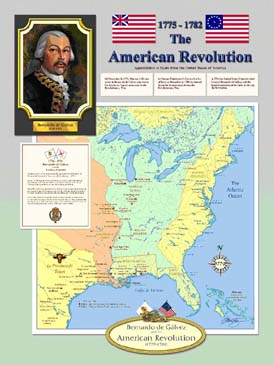 |
| Eddie's presentation
will be a series of illustrations highlighting key historical
events. This will be a very special event, a premier.
Since the Martinez family is relocating out of state, this presentation
may be the only time that it will be presented on the West Coast.
The National Archives are hosting a presentation on October 15th in
Washington, D.C..
|
|
|
|
|
|
| New Spanish language Materials Sent by Viola Sadler Vrsadler@aol.com Source: Carol Stone, City Librarian ANAHEIM, Calif. - (August 19, 2005) - More than 1,000 new Spanish language materials were purchased through a $25,000 State grant, will be highlighted as part of an Hispanic Heritage celebration on Wednesday, August 24, at 7 p.m., at the Central Library, 500 W. Broadway. The Spanish language books, music CDs and cassettes will be available to check out during the celebration, which will include refreshments and entertainment by Ballet Folklorico Project SAY dancers. With Hispanic residents now making up 47 percent of Anaheim's population, the Library needed to expand its collection in order to meet the needs of Spanish language readers. New titles include books, cassettes and compact discs on learning English as a second language, parenting, cooking, and other subjects recommended in a public survey of Spanish language library users. The collections of Spanish fiction, books to assist with school homework, large print books and popular music will be shelved at the Central and the Euclid Branch Libraries. The materials were purchased with the $25,000 Global Languages Materials Grant made possible by the Library Services and Technology Act of the California State Library. For more information, please call Carol Stone, City Librarian, at (714) 765-1710 or visit http://www.anaheim.net. . ABOUT ANAHEIM - Founded in 1857, the City of Anaheim is one of the nation's premier municipalities and California's 10th most populous city. As the oldest and largest city in Orange County, Anaheim covers 50 square miles, with more than 345,000 residents and 2,077 employees. The municipal corporation's annual budget is $1.298 billion. The city boasts world-class organizations such as the Anaheim Angels, Boeing, CKE Restaurants, Inc., L-3 Communications, the Mighty Ducks of Anaheim, Pacific Sunwear and The Walt Disney Company. Annually, Anaheim also welcomes millions of visitors to the city, truly making it where the world comes to live, work and play. For more information, please visit http://www.anaheim.net.. |
|
Sept 1st: CA 2025:
Is
California Prepared to Meet Its Latino Future? Sept 3rd: East L.A. Repertory Theatre Co. presents Romeo & Juliet Sept 4th: City of San Gabriel "Los Pobladores - Walk to Los Angeles" Sept 17th: Adventures in MesoAmerican Art and Culture Sept 17th: Viva Las Americas, Orquesta La Moderna Tradicion |
CA 2025: Is California Prepared to Meet Its Latino Future? Latino Issues Forum and the Public Policy Institute of California Invite You to a Discussion of the Recent PPIC report "CA 2025" on Thursday, September 1, 2005 from 10am - 12pm in Los Angeles, CA Panelists: Mark Baldassare, Director of Research, PPIC Antonio Gonzalez, President, Willie C. Velazquez Institute Katherine Perez, Executive Director, Transportation and Land Use Collaborative Jose Huizar, President, Los Angeles Unified School District Moderator: Luis Arteaga, Executive Director, Latino Issues Forum This free event will take place at: The University of Southern California Davidson Executive Conference Center Board Room 3415 South Figueroa StreetLos Angeles, CA 90089 For details or to RSVP to this event, please email rsvp@lif.org or call 415-284-7220 More Information email: lifcentral@lif.org http://www.lif.org phone: 415-284-7220 |
Adventures in MesoAmerican Art and Culture: Saturday, September 17 Hall of Liberty Auditorium, Plaza of Mesoamerican Heritage Admission and parking, FREE EVENT Forest Lawn-Hollywood Hills, 6300 Forest Lawn Drive, Los Angeles, CA 90068 |
|
Ancient/Contemporary
Play 10 a.m. to noon 
|
Aztec Stories, 2 p.m. to
3 p.m. For the entire family . . . .
|
East Los Angeles Repertory Theatre Company presents Romeo & Juliet by William Shakespeare, 3rd annual Free Shakespeare at East LA Parks Aug. 20 – Sept. 11, 2005 Saturdays and Sundays @ 11am *5 pm show on Saturday Sept. 3rd For the third consecutive year East LA Rep will tour a classic play to various parks in East Los Angeles, this summer the production of R&J will be seen from the edge of East Los Angeles in Boyle Heights and as far east as the city of Whittier. An ensemble of talented actors, Richard Andrade, Mariella Saba, Francisco Garcia, Fanny Garcia, Eva G. Rios, Sergio Villarreal, Karen Anzoategui, and directed by Jesus A. Reyes bring this tragic love story of young love, parental ignorance, and societal strife to life. East LA Rep invites you to join us in this new tradition of open-air performance at community parks. We encourage you to bring your blanket, lawn chair, and sunscreen and enjoy classic theatre under the LA sky. The season finishes with performances at the following East Los Angeles Parks: Sept. 3 @ Belvedere Park (lakeside stage) Sept. 4 @ Ruben F. Salazar Park Sept. 10 @ Saybrook Park (Montebello) Sept. 11 @ Sorenson Park (Whittier) Mission: East Los Angeles Repertory Theatre Company is dedicated to producing works by emerging and established playwrights of Latino heritage thereby promoting the essential role of Latino theatre to the American stage. East LA Rep also brings theatre to underserved communities with summer offering of classic plays as part of our Free Shakespeare at East LA Parks and theatre programming to educational and community organizations lacking arts support. for more info: (323) 788-3880 jreyes@eastlarep.com http:// www.eastlarep.com |
| City of San Gabriel SAN GABRIEL WELCOMES LOS ANGELES MAYOR ANTONIO VILLARAIGOSAS PARTICIPATION IN "LOS POBLADORES - WALK TO LOS ANGELES" SAN GABRIEL - San Gabriel and Los Angeles' shared, history come alive Sunday, September 4, 2005, with "Los Pobladores - Walk to Los Angeles" celebrating Los Angeles' 224th birthday. The annual Walk represents a key chapter in California's history, with the reenactment of the 1781 journey of the original Spanish settlers of Los Angeles, known as Los Pobladores' final, nine-mile trek from San Gabriel Mission to the Los Angeles River where, on September 4, 1781, they founded El Pueblo de la Reina de Los Angeles. The Walk coincides with Los Angeles' actual founding date and planned birthday festivities at Olvera Street on Sunday, September 4th. "The 'Walk to Los Angeles' is the peoples'-Walk", stated San Gabriel mayor Juli Costanzo. "San Gabriel celebrates its diverse, multi-cultural past, present and future, and the annual Walk to Los Angeles provides an opportunity to commemorate and honor the contributions of generations of people from all cultural and ethnic backgrounds, who have come to the region and made our community what it is today." Newly-elected mayor of Los Angeles, Antonio Villaraigosa, is scheduled to participate in the 2005 Walk to Los Angeles. Mayor Villaraigosa's participation in 2005 marks the first time an acting mayor of Los Angeles has joined the nine-mile trek from San Gabriel to Los Angeles since the initial reenactment was organized in 1981. "We are delighted to welcome mayor Villaraigosa to San Gabriel on September 4th," stated San Gabriel mayor Costanzo, "and we invite the entire Los Angeles city-family and surrounding communities to join us in the celebration." This early morning, moderate nine-mile walk from San Gabriel Mission begins at 6:00 a.m., heads west along Mission Road for nine miles, and ends approximately 3 hours later at El Pueblo Monument, home to the world famous Olvera Street. Walkers are greeted with a warm Los Angeles welcome celebrating Los Angeles' 224th birthday and day-long festivities. Transportation back to the mission is provided for all walkers. Everyone is invited to wake up early Sunday morning, September 4th, lace up their walking shoes and join the 6:00 a.m. Walk celebrating San Gabriel and Los Angeles' shared, living history. Join the descendants of the original settlers of Los Angeles, elected officials, San Gabriel and Los Angeles city officials and staff, walking clubs, residents, and others, as they reenact the historic walk from San Gabriel Mission to found the City of Los Angeles. Related festivities taking place over the Labor Day Weekend is San Gabriel Mission's three-day "234th La Fiesta de San Gabriel" from Friday, September 2 through Sunday, September 4, 2005. A variety of festivities will take place including rides, games, international foods and prizes. Thousands of people from Los Angeles and Orange counties attend the mission's three-day Fiesta to view the restored Mission, museum and grounds, and to visit and experience the historic San Gabriel Mission District. The events are free to the public. For information and to register for the Walk to Los Angeles, visit: http://www.sangabrielcity.com or http://www.lacity.org/ELP or telephone 213/485-8372 or 213/485-9769. Mission's 234th celebration information, Algis Marciuska at 626/457-3034.
|
| Viva Las Americas
Viva Las Americas celebrates Hispanic Heritage Month at PIER 39 on Saturday, September 17, 2005. This festive event will showcase Orquesta La Moderna Tradicion, and dance performances commemorating the artistry of Mexico, Central and South America. Mariachis strumming their guitars serenade visitors as they stroll throughout PIER 39. Fun for children includes traditional Latin American craft-making and face painting. For further information, please phone PIER 39 at 415.705.5500 Please contact me if you have any additional questions.
ellen@iarchitects.com (Ellen Griffith) |
|
Great-grandson
of last Mexican Governor of California Dies 22nd Annual Machado Family Reunion, Saturday, October 1, 2005 Web de Anza Vaca, Pena, Berryessa reunion The rise of Hispanic farmers The Moyza Family The Chavoya Family Southern California Yearbooks Mission Preservation In Baja California |
 Pio de Jesus Pico |
|
 |
|
Pico Hotel, 1869 |
|
A funeral Mass was held August 19th for Thomas Pico who died at 82 years old of cancer. He died in the presence of his niece, Nancy Pico, and other relatives at his residence in Pico Rivera-Whittier, California. He attended Whittier High School, was awarded the Ruby Key for graduating in the top 1 percent of his class, and came back from the war, to marry Elaine Pico. He survived by his wife, Elaine Pico and they had six children; a son, Skip Pico; a daughter, Lori Pico: a grandson Ritch Pico; 15 grandchildren, and 16 great-grandchildren. After the war he worked in the mail department at the Los Angeles Times. He was a great-grandson of Pio de Jesus Pico, the last Mexican Governor of California (born under Spanish control of California) supported the Pio Pico Mansion, was also an active member in the Senior Olympics, city veterans' posts, a community softball team member, the Pico Rivera Senior Center and the Pico Rivera Historical Society. He served in the Pacific Theater during WWII, in the US Army Air Corps (U.S. Air Force), from 1942 to 1944. A gunner with the 7th Air Force Central Pacific Area, 11th Bomb Group, 431st Bomb Squadron, was promoted to Sergeant in 1945. He flew 40 combat missions to targets His aircraft was hit by both ground fire and from Japanese pilots. Pico was accredited with shooting down 5 fighters, damaging an additional 3 Japanese fighters in 17 different times or missions. His awards included: (Still pending) the Purple Heart, the Air Medal, Good Conduct Medal, American Campaign Medal, Asiatic Pacific Campaign Medal, World War II Victory Medal and other awards. Burial at Rose Hills Memorial Park and Mortuary Robert E. Smith, Past President of the Los Pobladores 200, (310) 549-9819. |
| 22nd
Annual Machado Family Reunion, Saturday, October 1, 2005 10 am to 9 pm, Chevron Employees Park, 324 W. El Segundo Blvd. El Segundo, Calif. 90245 Jose Manuel Machado and his wife Maria Del Carmen Valenzuela came from Sinaloa, to California in 1781. If you are a descendant of, or related to this family, you are invited to our family reunion. Reservations are requested. Cost is minimal, Adult $12/ Kids $8/ over 70 free by September 21st. Please contact Ronnie Mendez, (310) 548-1818 RIME@cox.net
|
| Web de Anza
Portola Expedition, 1769-1770 Diary of Miguel Costanso, August, 1769 - January, 1770 Diary of Engineer Miguel Costansó of the exploratory expedition to northern California under the command of Governor Gaspar de Portolá (July 14, 1769 January 24, 1770), from San Diego to the vicinity of Monterey Bay and back. The purpose was to establish a settlement on Monterey Bay and although the Expedition bypassed their goal, they discovered the San Francisco Bay. The purpose of the diary, which Costansó compiled at San Diego from his notes on February 7, 1770, was to make an official report to the Viceroy of New Spain, Carlos Francisco de Croix, and ultimately the King of Spain, Charles III. This edition is based upon Frederick J. Teggart's The Portola Expedition of 1769-1770: Diary of Miguel Costanso, 1911. 7/14/1769 : The Portolá Expedition leaves the newly established Presidio of San Diego in search of |
|
| Vaca, Pena, Berryessa reunion Hi Mimi, My sister Helen and I attended the reunion. We flew to Oakland and rented a car and toured the Vacaville, Napa area for five days. We did not know anyone at the reunion; how- ever we met some distant Vaca cousins and interesting people. We are descended from the Berryessa family in the area. |
|
| The twelve year old Anthony Ray was certainly a surprise to a lot of us.
Fran Hicks is also a member of Los Californianos, but I had never met her before. I learned that she is a cousin of Marie Mann. She even called Marie on her cell phone and let me talk to her. It was very thoughtful of her to do this. I had not seen or spoken to Marie in about six or seven years. The setting of the reunion was in a lovely park. The mayor of Vacaville was there and spoke to us. We also attended the Descendants Day Meeting at Old Town. Mr. King was there, but we didn't see him, as he got there late. We have no ancestors that lived in San Diego, but I have always supported the group. Bye for now, Marciel Hart Wood, MarcielHWood@cs.com San Diego |
|
|
|
|
 Margarita Picon Sanchez, 1943 Mother of Carlos Ray Gonzalez |
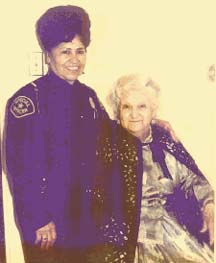
|
Margarita Sanchez, late 1960's.
It
was my mother's job as a
Security Guard to watch over the movie actress Sara Garcia, when
she was in the Los Angeles, Ca. area. Sara Garcia, seated was a Mexican movie actress for many years, having played with Cantinflas, known as Mexico’s Charlie Chaplin, in "Ahi Esta El Detalle"
|
|
Margarita Sanchez, was as an extra for many movie studios, having worked in the movie with Charleston Heston in " The Ten Commandments", very few movie clips show her in some movies she worked in, but in this one she can be seen, as the lady in black, dropping some straw in the mud pit that Heston was in as a slave, played Moses in this great movie. Legendary silent film director Cecil B. DeMille didn't much alter the way he made movies after sound came in, and this 1956 biblical drama is proof of that. While graced with such 1950s niceties as VistaVision and Technicolor, The Ten Commandments (DeMille had already filmed an earlier version in 1923) has an anachronistic, impassioned style that finds lead actors Charlton Heston and Yul Brynner expressively posing while hundreds of extras writhe either in the presence of God's power or from orgiastic heat. DeMille, as always, plays both sides of the fence as far as sin goes, surrounding Heston's Moses with worshipful music and heavenly special effects while also making the sexy action around the cult of the Golden Calf look like fun. You have to see The Ten Commandments to understand its peculiar resonance as an old-new movie, complete with several still-impressive effects such as the parting of the Red Sea.
|
||
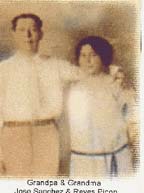
|
My mother was born in St. Joseph, Mo, in
1914. Her parents were Jose Lujan Sanchez and Reyes Picon. They both came from the state of Coahuila, Mexico, Jose born in Saltillo and Reyes in Torreon. After their marriage, Grandma Reyes told Grandpa Jose, I do not want my children born in Mexico, so they came to United States about 1909, left parents and other relations behind and never looked or came back, where they first came too is unknown, some of the lessons we all should learn, get to know who your Ancestors are, before it’s to late, by then you have lost a lot of your family history, that years later maybe very important to you. |
| Now that I have grown older, how I wish I
had asked more questions about the back ground of all my Grandparents,
my mother at her age, takes her a while to recall some of that past,
some too late to recall as the years went by.
Known is that the Sanchez family lived in the state of Kansas, after coming into the United States, working for the Railroad, and traveled, having children in Kansas, Wyoming, Missouri, Colorado and rested in Arizona, where Jose Sanchez became a business man, in the distribution of fuel products, Gasoline and Coal oil, best known as Kerosene, used to light up lanterns to homes without electricity in those days, in Tucson and the near by cities of Tucson, Arizona. Later by 1936, they came to Calif. having sold his business to the Elias Family, that also owned a Ranch in Arivaca, Az., mention in a story of The Moyza family and Moyza Ranch. In two of Somas Primos of Jan. 2004 and Apr. 2005, and the story on my father "Rafael Mejia Gonzalez" in July 2005. In California, in East Los Angeles on Michigan Aveue, he opened a business making tortillas, tamales, and sold mesa and all it’s products to make tamales. On Sundays my father prepared and sold Menudo. A touching story of their daughter Elvira Sanchez born Sep. 7, 1911, in Whitington, Kansas, died Jan. 9, 1922 in Tucson, Az. David Sanchez born Sep. 8, 1920, in Tucson, Az , died there on Feb. 16, 1922. The story goes that he died of sadness, before he was
born Elvira had asked Grandpa Sanchez for a baby doll, so he said
alright I will get you one, not long after that, David was born and
Grandpa Sanchez told Elvira, here is your doll, it’s yours to take
care of it, so Elvira from that day, took care of David, fed him, bathed
him, whatever David needed she was there Jose and Reyes Sanchez had Eleven children, all past on except one aunt and my mother, who now at 91years old is living with five generations. |
|
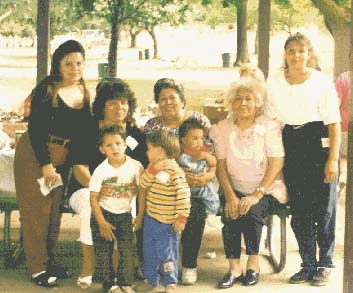
|
This was taken at our Family Reunion at the Grant Rea Park, in Montebello, Ca. 1992. Right to left, one of Christina’s daughters standing next to my mother Margarita Sanchez, her daughter Hortencia "Tencha" my sister holding the baby boy, Hortencia’s daughter Christina, and Christina’s daughter Roxanne mother of the baby boy and two other sons. Carlos Ray Gonzalez
|
|
Delegate Digest - Volume 12, No. 9 The Pomona Valley (California) Genealogical Society is celebrating its 50th year! They are one of the oldest in southern California. It serves many communities in the area and supports the fine genealogical collection at the Pomona Public Library. The Society has published numerous booklets of genealogical information gleaned from early California records. Its recent celebration party held at the Pomona Public Library included citations from nearby cities and politicians, guests representing other societies, dignitaries, current members, and two of the society's earliest members. Several display cases in the Library were available for the group's use for several weeks. Attendees were given tours of the library's special collections. It was a nice send-off into the next fifty years!
|
||
| Encarnacion's
Kitchen http://www.ucpress.edu/books/pages/9194/9194.intro.html Sent by Johanna De Soto who writes: excellent information on the history of this cookbook and significance of what the history shows. Mexican Recipes from Nineteenth-Century California California Studies in Food and Culture, A Curse of Tea and Potatoes The Life and Recipes of Encarnación Pinedo |
|
|
~~ The rise of Hispanic farmers ~~ By LISA HOFFMAN, Scripps Howard News Service Sent by Zeke Hernandez Apples & Oranges .... "con pico de gallo" August 4, 2005 The son of a migrant farmworker, Henry Vega is now a successful figure in Ventura County, Calif., where he is first vice president of the local farm bureau. That is no small post in a county that hosts a $1 billion agricultural industry. Vega, 43, owns a 65-acre lemon orchard and a farmworker- contracting company in Santa Paula. As such, he is representative of the rise of Hispanic farmers in America, where they now make up the fastest-growing segment of farm and ranch operators across the land. According to the U.S. Department of Agriculture, their numbers have more than doubled in the last decade. Every state has registered an increase, with New England seeing the biggest jump. States with the most Hispanic farmers are Texas, California, New Mexico, Florida and Colorado. "Historically, there have been pockets of Hispanics working in the fields as migrant workers for years, but now we are finding that this group plays a bigger role in the agricultural industry," said Hector Flores, president of the League of United Latin American Citizens. To be sure, the overall numbers remain a small shadow on America's agricultural map. Of the more than 3 million U.S. farmers, only about 50,600, or 2 percent, are Latinos. Even so, the population has reached a sufficient size to lead to the creation of the Association of Latino/Hispanic Farmers and Ranchers, a newly formed group that will hold its first national conference Aug. 25-28 in Las Cruces, N.M. Agriculture experts cite a number of factors that have contributed to the growing Hispanic farm presence, which are predominantly family farms. Unlike their counterparts in other demographic groups, Latino farmers are far less dependent on government or bank loans, which has left them without the crushing debt that has driven many smaller operators to sell and get out of the business. Their farms also are true family endeavors, where relatives work long hours together and pool resources. "Hispanics tend to be very entrepreneurial. You like to have your hand out less," Vega said, crediting his father with instilling in him a belief in the worth of hard work. In some cases, longtime Anglo farmers whose children have left for city jobs are selling their land to the workers - often Hispanic -who have labored long and hard on the farms for years. Vega and others said Latino farmers, who tend to have relatively small operations, also have a tradition of growing diverse crops so that a price drop for one doesn't bring doom. They also have been beneficiaries of America's expanding Latino population, which has brought a booming market for fruits and vegetables like those they ate in the "old country." Recognizing that mainstream America's palate also is broadening, some Latino farmers are taking advantage of new demand for specialty produce and organic products. Because of these trends and the growth in Hispanic ownership, association president Rudy Arredondo said it is time "to set an agenda for the Latino farmers instead of being on others' coattails." At least 150 farmers and ranchers are members of the group so far. Part of a migrant-worker family, Arredondo as a child picked cotton, potatoes, sugar beets, cherries and asparagus in a circuit around the country. He went on to become a founding figure in the United Farm Worker movement, and now, at 63, is turning his organizing skills to forming an association that can wield influence to level the field for Hispanics in such critical areas as obtaining loans and subsidies from banks and government programs, as well as marketing products and securing water rights. On another track, some Hispanic farmers have sued the federal Agriculture Department, alleging they have been victims of the same racial discrimination that black farmers have endured in the granting of loans. Black farmers won a landmark legal settlement in 1999 when the department acknowledged a historical pattern of bias and vowed to make things right. Arredondo said his organization hopes that it can develop a collegial, mutually beneficial relationship with federal agriculture officials, and has invited Agriculture Secretary Mike Johanns to the conference. "We would like to work with the (Agriculture Department) rather than take an adversarial approach," Arredondo said. (Contact Lisa Hoffman at HoffmanL@shns.com) |
|
|
MOYZA FAMILY |
|
|
|
|
|
Eufemiano DURAN MOYZA Angelita Miranda
Mejia |
|
| EUFEMIANO DURAN MOYZA DESCENDANTS Name: Eufemiano DURAN MOYZA Sex: M Birth: Oct. 31, 1855 in San Luis Obispo, Ca. Death: May 29, 1940 in Tucson, Pima Co. Az. Son of Mirjildo MOYZA and Maria Ramona DURAN. Marriage recorded as on Jan. 26, 1879, age 24, to Dolores ROBLES. age 18, daughter of Miguel ROBLES and Lorenza ROMERO, in Santa Inez, Witnesses was, Ricardo ROBLES and Micaela ROBLES. Note: Also recorded is the marriage of Ricardo ROBLES age 30, a native of Mexico, son of Miguel ROBLES and Laurensa ROMERO, to Maria Antonia GUEBARRA ( GUERRA ? ) age 19, of Santa Inez, Ca. daughter of Francisco GUEBARRA and Victoria CORDERO, witnesses was Gregorio LOPEZ and Martinia ESPINOSA. Father: Mirjildo ( Hermenjildo ) MOYZA b: abt. 1817 in Mexico. Mother: Maria Ramona DURAN b: abt. unkn in Ca. |
|
|
|
|
|
Children of: Mirjildo ( MOISA ) MOYZA and Maria Ramona
DURAN. Children of: Florencio and Martina BONILLA MOYZA. Daughter: Maria Ramona de Los Dolores, b: no age. Son: Jose Maria de Jesus b: Mar. 09, 1876. Baptism,
Apr. 01, 1876, Daughter: Maria Esperanza b: Dec. 29, 1877 to
Florencio and Martina ( Bonia ) BONILIIA. Baptism, Feb. 14, 1878. Petra DURAN ( MOISA ) MOYZA b: abt. 1840 in Ca. Petra ( Rita ) MOYZA, parents as Hermanegildo MOYZA
and Maria Ramona DURAN Marriage 1 of Eufemiano DURAN MOYZA ROSA Ramona ROBLES MOYZA, b: Aug. 08, 1880 in Santa
Inez, Ca. Ramon ROBLES MOYZA b: Feb. 23, 1883. Tubac, Santa Cruz
Co. Az. Other Related Moyza Families San Gabriel Marriages book III # 119.
Oct. 13,1866 LORENZO MOISES, 24, de Hermenegildo y Maria
Ramona Duran; con MARTINA BONILLA, 14, de Francisco y Leonicia
Mendez, natl. del Pueblo de Imures,
Sonora. Domingo Adrad or Arras?? y Paula Cruz, wits. Basso. MOYSA, JOSE MARIA DE JESUS, born Mar 9th, legitimate son of
Lorenzo Moysa and Martina Bonilla. Baptized by Rv. Juan
Basso. MOYSA, RAFAEL, legitimate son of Florencio Moysa and Martina Bonia (Bonilla). (Birthdate not given) Padrinos: Miguel Acosta and Petra Moysa. Looks like they moved back and forth, Santa Ines, to San Luis Obispo then back to Santa Ines, Mission San Luis Obispo Baptisms Book III Aug 4, 1871- MANUEL MARIA AGUIRRE, b. 21s Mayo, h.l. de Florentino y Rita Moyza, Hermanegildo Moyza y Ramona Duran, padrinos REV: Sastre AGUIRRE ANTONIO DE JESUS, born Feb 10th, legitimate son of
Florentino Agierre (Aguirre) and Petra Moysa. Padrinos: Justo
Lopez and Luisa Corrales. San Luis Obispo Baptisms book III
6097) With PETRA MOYSA DE AQUIEM, widow of Florentino Aquieme, aged 33,
native of Sonora, resident of Santa Ines, daughter of Esmerihildo Moysa
and Ramona Duran. 2nd wife Hortencia sister of Epolita after she died. |
|
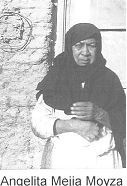 |
|
 Epolita Silva |
|
Marriage 2 of: Eufemiano DURAN ( MOISA ) MOYZA and Angelita MEJIA b: Oct. 1872 in Atil, Sonora, Mexico. d: Mar. 25, 1949 in Tucson, Az. Married at age 24. Her year of Immigration 1885. Daughter of Manuel MEJIA and Jesusita MIRANDA. Children of: Eufemiano DURAN MOYZA and Angelita MEJIA MOYZA |
|||
|
|
 Petra
MEJIA MOYZA Petra
MEJIA MOYZA b: Apr. 2, 1899 Pima Co. Az. d: Oct. 1986 in Pima Co. Az. Married: Ramon Badilla, by the 1930 Arivaca, Az census they live next to Lorenso Moyza and Eufemiano at the Moyza Ranch |
||
| Children
of: Ramon Badilla and Petra Mejia Moyza. Luis M. Son age 8, Erlinda Daugt. Age 7, Guadalupe Son age 5 And Dolores M. Daugt. Age 2 and 4 mo. 1930 Census Pima Co, Az. Valin MEJIA MOYZA b: abt. 1899 in Pima Co Manuel MEJIA MOYZA b: Nov. 17, 1900 in Pima Co. Az. d: Sep. 1965
|
|
|
|
| Uncle Miguel Mejia Gonzalez | |
|
Rafael MEJIA MOYZA |
|
|
|
|
 |
Magdalena Mejia Mozya b:Feb.15,1906 d:Dec.18,1941. Died in Coolidge, Az. of burns. Story goes that her husband was working on a cars carburetor, had a bucket of gasoline and it Caught on fire, he throw it out and away from the car, and sheWas in the way and all the gasoline set her on fire, she died three days later. Ignacio MEJIA MOYZA b: Aug. 1907 in Pima Co. Tucson, Az.d: Aug. 07, 1930 in Pima Co. Tucson, Az. |
|
|
|
|
|
The Chavoya Family By: Rosanne Gonzales-Hardy The Chavoya family is my mother’s paternal line. The name Chavoya has different spelling variations, Chabolla, Chavolla, Chaboya, Chevolla, Chebolla, Chevoya and Cheboya. Many articles have been written about the Chaboya family of Colonial California. But one of the most famous authors during the time was Mrs. Fremont Older "Cora Miranda Baggerly Older" (1875-1968). In her book "When Santa Clara Was Young" she writes of different events and descriptions regarding the Chaboya’s of San Jose. Antonio Chaboya owned the Spanish land grant "Yerba Buena" at Evergreen in Santa Clara County, California and joined the neighboring Bernal ranch. Don Pedro Chaboya also had a land grant known as "Rancho de la Posa San Juan Bautista" in which his daughter, Louisa Long owned a portion of the land. This grant was originally owned by Augustin Narvaez an Alcade in the early 1820’s. The Chaboya’s were known for their extreme in skin coloring. They were either very dark or very fair skinned. The ones that were fair skinned were nearly albinos and as they grew older, instead of their hair turning grey, it became black. (Upon a recent conversation with my cousin from Fresno, she stated this story was true. The older Chaboya women rarely grayed and when they did, they had no more than a handful of gray strands. This also applied to my grandfather Ernest Rios who had hazel eyes and has he grew older he had very little gray hair as well). In the early 1840’s the ranchers of the area lost many horses due to Indian horse thieves. The Chaboya ranchers included Antonio Chaboya of the San Jose Mission, Cruz Chaboya, and Anastacio Chaboya of the Pala ranch. Don Pedro Chaboya at last led the charge in which he gathered the ranchers of the area to hunt the thieves down through the Tehachapi Pass. It was said that Don Pedro knew how to care for the sick and was familiar with the ways of the Indians as they used poisoned arrows. At one point during the battle against the thieves the interpreter who accompanied Don Pedro and his men was shot with a poisoned arrow. Don Pedro sucked the poison from the wound and saved the man’s life. In the end Don Pedro killed the Indian Chief Juan de Jesus by shooting him through the forehead. He knew it was the only way to be rid of the horse thieves once and for all. During the fight Chaboya carried with him a three foot leather shield to protect himself, he advanced towards the Chief and when he was a few feet away shot Juan de Jesus. Don Pedro and his followers gathered their stolen horses and drove them back to the ranches and missions. Don Pedro Chaboya was also known as a bear hunter during the 1830’s and 1840’s. As were Don’s Secundino Robles, Antonio Bernal, Juan Pinto, Julio Valencia and Captain Juan Prado Mesa. Often Don Pedro and Don Antonio (who were related through marriage) hunted together and brought several horsemen with them. Both these men used Riata’s of twisted, green rawhide to snare the bears. Sometimes they captured the bears alive and used them in bull fights, which consisted of tying the bear to a bull separated by a few feet and having the two animals fight it out to the end. Eventually the bull would win. But it was Pedro’s brother Jose de la Cruz who was well-known as the "fearless bear fighter". Cruz accomplished this by wearing woolly chaps over his shoulders and scaring the bears out of the woods while the other hunters of the party stood guard and lassoed the bears as they emerged. Serenades were very common during Colonial California and Mrs. Luisa Chaboya Long was reminded of this when she was serenaded by her friends on her 80th birthday at her home on the Chaboya ranch near the Oak Hill Cemetery in San Jose. It was also a well known fact that Sixto Chaboya as a young man rode his horse every morning for ten miles to serenade his cousin, who he was madly in love with. During the 1840’s and 1850’s San Jose had its first horse race track. This was a gift that Don Antonio Sunol, the first postmaster gave to the city of San Jose. It was said that Don Pedro Chaboya raced his famous horse "Buckskin" there. The Chaboya’s were not immune to the squatters who took over their land. Many of Marcos’ sons were subjected to litigation over the rights of their land grants. There are numerous court documents which I could go over but the results ended the same, the owners were either left with very little or none of the original acreage in which they possessed. The family of Marcos Chavoya Marcos Chavoya, Spanish soldier on an Anza Expedition, the son of Pasquel de la Cruz Chavoya and Manuela Davila married on 27 February 1786 to Maria Teresa de Jesus Bernal, the daughter of Juan Francisco Bernal and Ana Maria Josepha Soto. According the 1790 census he was from Mexico City. He settled in San Francisco, CA. Later he moved his family to San Jose. In the year of 1796 he was the mayor of San Jose, CA. He died 15 December 1808 at Mission Santa Clara in San Jose, CA. 1) Pedro Regalado: born 21 May 1790, baptized 23 May 1790 at Mission Dolores in San Francisco, CA; he married Getrudis Ortega, the daughter of Ygnacio Maria Ortega and Maria Getrudis Arce on 27 February 1827; he died 3 August 1873 in Santa Clara County, CA. Mayor of San Jose in 1834 and again in 1846. He built his home on Tully Rd, near the Oak Hill Cemetery in San Jose in 1847. 2) Manuel Salvador: baptized 9 December 1791 at Mission Santa Clara in San Jose, CA. Died 22 October 1807. 3) Jose Luis: born 16 August 1793, baptized 26 August 1793 at Mission Dolores, San Francisco, CA; married Guadalupe Romero. 4) Maria Manuela Evarista: born 26 October 1794, baptized 26 October 1794 at Mission Dolores, San Francisco, CA; she married Jose Antonio Higuera, the son of Juan Jose Faustino Higuera and Maria Mariana Josefa Navarro on 26 May 1818 at Mission Santa Clara, San Jose, CA; she died 27 April 1832 and was buried at the Mission in Monterey. 5) Jose de la Cruz: born 25 March 1796, baptized 29 March 1796 at Mission Dolores, San Francisco, CA; he married Maxima Vasquez. 6) Maria de Guadalupe: born 19 February 1798, baptized 21 February 1798 in San Francisco, CA; died 3 October 1881 in San Francisco, CA. 7) Francisca Agustina: baptized 8 October 1799 at Mission Santa Clara in San Jose, CA. 8) Josef Loreto: born 10 December 1800, baptized 13 December 1800 in San Francisco, CA. 9) Manuel Gervasio: born 17 June 1802, baptized 19 June 1802 in San Francisco, CA; he married Michaela Linares, the daughter of Ramon Linares and Antonia Higuera on 11 October 1832 at Mission Santa Clara in San Jose, CA. 10) Francisco Javier Antonio: baptized 9 December 1803 at Santa Clara Mission in San Jose, CA; he married his first wife Maria Juliana Feliciana Rosario Buitron, the daughter of Sebastian Joseph Buitron and Maria Antonia Amesquita on 31 August 1826 at Mission San Juan Bautista. He married his second wife, Maria Ramona Encarnacion Higuera, the daughter of Jose Joaquin Valentin Higuera and Maria Bernarda Soto on 27 April 1846 at Mission Santa Clara in San Jose, CA.
11a) Jose Antonio: born about 1830, baptized at Mission Santa Clara, San Jose, CA. 11b) Jose Fernando: baptized in 1832 at Mission Santa Clara, San Jose, CA.
11d) Pacino: born about 1835. 11e) Jose Jesus: born about 1839. 11f) Maria Maximina Jacinta de la Trinidad: baptized 14 June 1840 at Mission Santa Clara, San Jose, CA. 11g) Maria Juana: baptized 20 March 1841 at Mission Santa Clara, San
Jose, CA. 1h) Maria Micaela Policarpia: born 8 May 1844, baptized 9 May 1844 at Mission Santa Clara, San Jose, CA. She lived with her uncle, Pedro Regalado after her father’s death. She later moved to the Los Angeles area near her brother
Fecundo. She married her first husband Jose Miguel Ortega on 11 November 1867 in the City of Los Angeles. She then lived with Santos Rios a sheep herder from the San Juan Capistrano Mission. She died 6 August 1926 in Santa Ana, California at the residence of her daughter, Adela Rios Morales. She is buried as Pauline Rios at the cemetery in Santa Ana, CA. |
| University of California Press now offers electronic versions of almost all of its journal titles and over 1400 books online, many of them out of print. http://www.ucpress.edu/ Sent by Johanna De Soto List of Electronic Distributors In addition to making ebooks available to the public through the downloadable ebook program, we also make ebooks available to academic and public libraries through many ebook distribution companies. E-Journals UC Press Journals is proud to announce Caliber--the online journals service from University of California Press. The link below will take you to the Caliber site. You can browse tables of contents for all journals, read abstracts, make detailed searches, sign up for alerts, and much more. |
Southern Californa Yearbooks http://www.4dw.net/socal/index.html Sent by Johanna De Soto The Students of Southern California (from yearbooks and rosters AT LEAST 50 years old!) For a very long time, we have been searching for some special people who once lived in the Southern California area. Hoping to find a name or familiar face, we have looked through thousands of pages of old high school and college yearbooks. Someone suggested that we create a web page to share the names (and a few of the photographs) of the many students we have seen listed in these wonderful old books. Clifford Street Elementary School, Los Angeles, 1954. Photo contributed and owned by Shawnee Brown Dennis. |
Re: Mission Preservation In Baja California Date: 8/15/2005 8:54:04 AM Pacific Standard Time From: michael_mathes@hotmail.com Dear friends and colleagues: Please forgive the impersonal nature of this message: it is designed to get as much information out as rapidly as possible and I hope it is of interest to you. As you may or may not know, corredor Historico Carem, A.C. is a
volunteer, non-profit group that supports projects of historical
preservation, principally of mission sites, in Baja California Working
with Inah, the Government preservation agency. in addition to special
fund-rising events, Carem can now receive Tax-deductible donations
through the icf in San Diego. Currently we are particularly interested
in rising funds sufficient to allow us to obtain a matching grant from
adopte una obra de arte in Mexico for the restoration of the great site
at mission San Borja. any help you can give us will be deeply
appreciated. please see our website at http://www.active.com/donate/historical |
|
First International Summit
Conferences, September 28th, 2005 on a Bilateral Immigration, Security and Development Agreement III Coloquio Internacional de Historia de Mujeres y de Género en México |
First International Summit conferences on a Bilateral Immigration, Security and Development Agreement Salt Lake will be the first city to host a series of conferences on the topic of immigration issues and border security. The Center for Non-Partisan Public Policy Development (CNPPD), Inc. a 501(c) (3) non-profit corporation with The New Coalition for Comprehensive Immigration and Security and Prosperity Reform is announcing a series of eight forums and two summit conferences in key cities and states in the U.S. and Mexico.
|
|
III Coloquio Internacional de Historia de Mujeres y de Género en México 22-24 de septiembre, 2005 Universidad de Utah, Salt Lake City Estimados Colegas, Me es muy grato comunicarme con ustedes para informarles sobre el "III Coloquio Internacional de Historia de Mujeres y de Género en México" que se llevará a cabo el 22-24 de septiembre, 2005 en Salt Lake City. Al pie de esta carta usted encontrará una forma para registrar para la conferencia. En esta carta espero darles la información necesaria para que su planeación para su participación en la conferencia sea lo más placentera possible. Si usted tiene cualquier pregunta, no duda en comunicarse conmigo: Susie Porter s.porter@utah.edu Registración para el coloquio: Al final de este mensaje usted encontrará una forma de registración para la conferencia. Es de suma importancia que lo rellene y lo devuelva antes del 1 de septiembre para que podamos planear la conferencia. Gracias. Transporte Salt Lake City: Llegando a la Universidad de Utah desde el aeropuerto Internacional de Salt Lake City en un taxi costarán aproximadamente USD$20. también hay un autobus público que les lleva a la Universidad que cuesta más o menos USD$2. Alojamiento: Tenemos cuartos reservados en el University Guest House,110 South Fort Douglas Boulevard, Salt Lake City, Utah, 84113-5036. Phone 801-587-1000. úX 801-587-1001. Pueden escoger varios opciones, cada uno a USD$69 por noche: 1. Una cama grande "king" (1 o 2 personas) 2. Dos camas dobles (1 o 2 personas, USD$10 por tercera o cuarta persona) No cobran por los niños menores de 13 años de edad Para registrar para el hotel vease el website: http://www.guesthouse.utah.edu La página esta en inglés. (Si usted tuviera cualquier problema no dude en comunicarse conmigo). Al lado izquierdo haga click en "Book With Us;" luego haga click en "Reservation Request." Rellene el formulario y mandarlo con hacer click al fondo de la página. Hay un espacio donde indique "comments" y si piden un cuarto con vista (a room with a view), quizás le pueden proporcionar uno. En la péagina del guest House hay mayor información sobre los servicios del hotel, incluyendo internet, amenidades en el cuarto, etcetera. USTED DEBIERA HACER SU RESERVACID3N DE HOTEL ANTES DE EL 6 DE SEPTIEMBRE, 2005 Si hay personas que vie en por cuenta propia y no pueden pagar el costo del hotel, yo y varios de mis colegas ofrecimos a hospedar a conferencistas, dependiendo del cupo que haya. Si a usted le interesa quedarse con uno de nosotros, por favor comuníquese conmigo s.porter@utah.edu). En cuanto llegue a la University Guest House en Salt Lake City, recibirán información sobre como llegar al sito de la conferencia, los sitios de nuestras reuniones, y sitios de interés en la ciudad (restaurants, sitios históricos, parques, donde hacer compras, etcétera) Cuidado de niños: Si usted necesite de cuidado de niños durante la conferencia, por favor escríbame lo antes posible, y antes del 1 de agosto para que yo pueda ayudarle hacer arreglos. Susie Porter s.porter@utah.edu Entrega de trabajos: Le pido que mande una copia de su trabajo lo antes posible, con fecha limite el 1 de agosto. El entregar su trabajo a tiempo le dará a la/el comentarista de su mesa el tiempo necesario para hacer una lectura consciente de su trabajo y preparar sus comentarios---requisito para un intercambio de ideas lo más fructífero posible. Los trabajos que lleguen a tiempo estarán incluidos, con su permiso, en un CD (complementario) de todos los trabajos de la conferencia. Formato del Coloquio: El coloquio está organizado en mesas, con 3 o 4 ponentes de veinte minutos cada uno, por mesa. Después de las presentaciones en cada mesa, habrá un moderador quien comentará sobre y discutir los trabajos. Cada mesa termina con discución del público. Otros Detalles: En cuanto usted llegue a Salt Lake City, le proporcionaremos con un mapa de Salt Lake City, información sobre sitios de interés, restaurants, centros comerciales, y transporte local. Por favor diriganse todas preguntas y correspondencia a s.porter@utah.edu y no a la dirección que apareció en la convocatoria. Eventos: El 21 de septiembre (miercoles) a las 4 de la tarde, habrá una muestra de la película Señorita Extraviada, despues de la cual tenemos el placer de una discussion con la directora de la película, Lourdes Portillo. Registration/ Registración---------------------- Name/ Nombre Form of participation/ Forma de participación (moderador/a, oyente, etc) 46inal title of presentation/ Título final de su ponencia Complete mailing address/ Dirección completa Email/ correo electrónico Will you need additional equipment? (slide projector, projector for power point, overhead, etcetera). If so, please list it above./ Usted necesitaría de equipo adicional? (proyector para diapositivas, proyector para power point, etcetera) Si así sea el caso, por favor anótalo arriba. If you are a presenter or moderator your breakfast and lunch are included. If you are neither a presenter or a moderator and you would like to join the group for these meals, please include a check for USD$25 per day. The conference will last three days./ Si usted es ponente o moderador/a su desayuno y almuerzo está incluido. Si usted no es ni ponente ni moderadora pero sí quiere comer con el grupo, se puede pagar USD$25 por día. El coloquio durará tres días. Por favor inclúyalo en su cheque para registrar. El cheque se debe escribir a "Department of History" y mandalo a Susie Porter, Department of History, 380 South 1400 East, rm. 211, University of Utah, Salt Lake City, 84112. Desayuno y almuerzo por -----------dias por un total de USD$------------ Conference registration fee/ Costo para registrar USD $20 -------- Si usted no puede mandar un cheque para la registración, por ejemplo porque usted viene de afuera de los estados unidos, solamente indique que pagará en cuanto llegue a Salt Lake City. gracias |
|
Susie S. Porter Associate Professor Department of History/ Gender Studies Program 801) 581-6121 |
University of Utah 380 South 1400 East, Rom 211 Salt Lake City, Utah 84112-0311 |
|
Arizona Department of health Services Archives of Primary Source Documents, Web de Anza, 1769-1779 Envisioning Bracero History Making history out of headstones |
|
|
|
Map Showing The Connection From San Antonio To San Diego
http://www.sanantoniocvb.com/old_spanish_trail.asp |
Arizona Department of health Services http://genealogy.az.gov/ Birth Years 1887-1929 Death Years 1878-1954 |
Archives of Primary Source Documents, Web de Anza, 1769-1779 Sent by Eva Booher EVABOOHER@aol.com http://anza.uoregon.edu/siteindex.html Portola Expedition, 1769-70, Exploratory Expedition, 1774, Colonizing Expedition, 1775-76 Comanche Campaign, 1779, Historical Maps, Modern Maps, Objects, People Diary of Engineer Miguel Costansó of the exploratory expedition to northern California under the command of Governor Gaspar de Portolá (July 14, 1769 January 24, 1770), from San Diego to the vicinity of Monterey Bay and back. The purpose was to establish a settlement on Monterey Bay and although the Expedition bypassed their goal, they discovered the San Francisco Bay. The purpose of the diary, which Costansó compiled at San Diego from his notes on February 7, 1770, was to make an official report to the Viceroy of New Spain, Carlos Francisco de Croix, and ultimately the King of Spain, Charles III. This edition is based upon Frederick J. Teggart's The Portola Expedition of 1769-1770: Diary of Miguel Costanso, 1911.
|
Envisioning Bracero History" The history department of the University of Texas at El Paso is looking for Mexican scholars working on braceros who might be interested in presenting their work at a conference, entitled "Envisioning Bracero History," to be held in El Paso in conjunction with the Smithsonian Institution. If you are interested or know someone who might be, please contact me or Michael Miller Topp at mtopp@utep.edu or (915) 747-5508. |
| Making history out of headstones By HEIDI LEWIS, Special to the Sun, 07/18/2005 http://www.azdailysun.com/non_sec/nav_includes/ At first glance, the large group of teenagers gathered around a gravestone at Citizens Cemetery in Flagstaff could be confused with a memorial service -- but only from a distance. Far from melancholy, these kids are there to perform a service of their own. Dressed not in black, the 120 youth of the Flagstaff Church of Jesus Christ of Latter-day Saints instead sport jeans, T-shirts and work gloves. Armed with digital cameras, rakes and wheelbarrows, they are prepared to take part in a unique history preservation project and extensive clean-up effort. In conjunction with the Arizona Gravestone Photo Project, they will photograph and transcribe over 500 tombstones before the day is through. PRESERVING THE PAST When Oscar Schultz robbed a country store in 1922, he was chased by a posse and shot dead. They flung his body over a horse but halfway back to town decided to bury him in remote Upper Coyote Creek. Nothing but a rustic wooden plank carved with his name, the word "shot," and the date he died, marks his isolated grave. The project's goal is ambitious: to compile an online photographic repository of every gravestone in Arizona with accompanying transcriptions of the tombstones. "The database is intended to be easily searchable and free for anyone interested in researching their family history or Arizona history in general," says Jarvis. "Genealogy has become perhaps the most popular hobby in the country and is certainly one of the fastest-growing segments of Internet use," he continues. "The tremendous popularity of family history combined with the technological revolution in digital photography have made this an idea whose time has come." The idea is simple but relies solely on "volunteer photographers" -- those willing to canvas cemeteries and snap digital pictures. The images are then uploaded, with accompanying transcription, to the project's web site. Some even give GPS coordinates. "We have individuals submit a single photograph of a family member and we have had a couple of volunteers who have taken literally thousands of photographs," says Jarvis. "We welcome any who would like to help." TEENS AND TOMBSTONES Service and family history are both fundamental to the Latter-day Saint faith. Combining the two seemed like a natural fit to event coordinator Brooke Chariton. "There is service that the kids can do, but they never see the results. We were looking for some service our youth could do in our community," says Chariton. "The minute I heard about this project, I knew that's what we were supposed to do." Susan Turnbull, youth coordinator for the Flagstaff Family History Center and Christine Bacon, the center's director, enthusiastically donated their expertise. "Just spending time in the cemetery makes the kids very aware of their community and the names of people who founded this community -- they make the connection," says Bacon. Richard Hearne has been the full-time cemetery specialist at Citizens for past 20-plus years. Although he was more immediately grateful for 240 extra hands cleaning, raking and clearing pine needles, he believes the Gravestone Photo Project is a necessary one. "I'm all for it. This is a modern age and it is great to record this history," says Hearne. He welcomes volunteers for both clean-up and taking pictures. "Let's face it, this is about people giving back and it helps me a lot," says Hearne. "The cemetery is not a money maker for the city by any means. I'd be hurting if we didn't have the support from the community." Citizens Cemetery handles more than 150 burials per year but provides much more in the form of grounds upkeep and family support. More than 25 digital cameras were loaned to the effort. After a brief orientation, kids fanned out across a wide section of the cemetery marked with small flags. Methodically, row-by-row, they tenderly traversed tombstones, taking photos and writing down the details of each. "We tried to get a good picture because of how important it is to someone else," says Kimberly Rowley, 16. "Some days you come to the cemetery and you are really sad. But this time you came and helped others and it was a lovely feeling," says Jessica McGuire, 14. She has an uncle and grandfather buried at Citizens. Jordan Gee, 14, recognizes the personal benefits of service as well. "We bonded as a group and got to know each other better. Service makes you stronger, it makes your spirit stronger," he says. While photographing gravestones, Jordan also found a marker that shares his last name. "I don't know who this is," says Jordan, "but I'm going to try and find out when I get home." AN ONGOING EFFORT Susan Turnbull assures that this is only the beginning. "All you need is a digital camera and access to a computer with the Internet. Or you can just bring your camera to the Family History Center after you've taken the pictures and we can do the rest," she says. "It is perfect for Eagle Scout projects, service clubs, church groups, family reunions and other groups." "This is a great way for people to help preserve Flagstaff history," adds Christine Bacon. "A lot of gravestones are deteriorating fast and they can help." Mike Jarvis says that since its inception two years ago, the project's efforts have already been far-reaching. "We've had individuals contact us from around the country, and as far away as Europe and New Zealand," he says. Jarvis claims the Web site has compiled almost 24,000 gravestones in Arizona so far. That may seem like a lot until you consider how many more are still left to photograph, a number he can't even guess at. Some of the teens participating have said they'd like to continue helping Jarvis with his goal. "It wasn't creepy or scary, but respectful. You started to wonder about the people who lived before," says Aaron Crouse, 16. "And it is something you can do by yourself." Jarvis agrees. He recently had a man submit a photo in person. "It was a photograph of his late wife's gravestone in a small family cemetery located in a remote area of the Santa Rita Mountains. She alone is buried there. Her extended family is all from the Midwest. It was touching to see how significant he felt it would be to share this information with others who will likely never see her grave in person." Sidebar: How to get involved Arizona Gravestone Photo Project http://arizonagravestones.org Contact: Mike Jarvis, Coordinator email: Mjarvis@Pobox.com You can photograph grave markers at any Arizona cemetery but contact them first. Always be respectful of mourners and cemetery staff. Flagstaff Citizens Cemetery 1300 San Francisco Contact: Richard Hearne, Cemetery Specialist Phone: 774-6725 If you need help organizing a gravestone photography service project contact the Flagstaff Family History Center 625 East Cherry Ave Contact: Susan Turnbull, Youth Coordinator Phone: 774-2930 |
|
DNA Debunking the Concept of 'Race' To Keep the Peace Memin Must Go Corps of Colonial Marines |
|
DNA Debunking the Concept of 'Race'
Sent by Irma Cantu Irmacantu@aol.com Black Americans who explore their family histories typically hit a dead end in the early 19th century, when black Americans who were slaves were not listed in the census by name. Now some black Americans are trying to fill in the gap with genetic screening tests that purport to tell descendants exactly where in Africa their ancestors came from. But, like most people, those who think of themselves as African-American will need to search well beyond Africa to find all of their origins. This point came through with resounding clarity recently at Pennsylvania State University, where about 90 students took complex genetic screening tests that compared their samples with those of four regional groups. Many of these students thought of themselves as "100 percent" white or black or something else, but only a tiny fraction of them, as it turned out, actually fell into that category. Most learned instead that they shared genetic markers with people of different skin colors. Ostensibly "black" subjects, for example, found that as much as half of their genetic material came from Europe, with some coming from Asia as well. One "white" student learned that 14 percent of his DNA came from Africa - and 6 percent from East Asia. The student told The Daily Collegian, the student newspaper, earlier this year: "When I got my results I was like, there's no way they were mine. I thought it was just an example of what the test was supposed to look like. Then I was like, Oh my God, that's me." Prof. Samuel Richards, who teaches a course in race and ethnic relations at Penn State, uses the test results to shake students out of rigid and received notions about the biological basis of identity. By showing students that they aren't what they think they are, he shows them that race and ethnicity are more fluid and complex than most of us think. The goal is to make students less prejudiced and more open to a deeper discussion of humanity. If the genetic testing fad pushes things in this direction, it will have served an important purpose in a world that too often thinks of racial labels as absolute - and the last word when it comes to human identity. |
To Keep the Peace Memin Must Go By Victor Landa: San Antonio Express-News, July 11, 2005 Source: HispanicVista.com http://www.hispanicvista.com/HVC/Opinion/Guest_Columns/071805ELanda.htm When I was a boy, there were three cartoons that I read as often as I could. At the time we lived in downtown Nuevo Laredo, and once a week I'd find an excuse to walk to the newspaper stands that stood along the nearby plaza. Every week I'd look for the latest issue of Los Agachados or Duda. Agachados was a satirical comic book written and illustrated by Eduardo Del Rio Garcia, who published under the pen name Riuz. He was admired because he tackled the controversial issues of the day. Mostly though, Agachados, meaning the crouched ones, was popular because it unmasked Mexico's political class pretensions. Most of what I read in Agachados was beyond my understanding, but I read it as a challenge and out of a pesky curiosity to find out what I didn't know. The other revista I looked for was Duda, which literally means doubt Dudawas about all things supernatural, and I loved it. It dealt with UFOs and unexplainable phenomena, psychics and oddities such as the Abominable Snowman. I read it because of the way it draped mystery with a veil of pseudo-science and intense drama. The third publication I read was a comic book about a mischievous little boy who managed to get himself into hilarious predicaments but always found a good-natured way to solve his problems. It was called Memin Pinguin, now considered a classic of the Mexican comic book tradition. There were others, of course. I remember Kaliman, a turban-wearing superhero dressed in white who wore a cape and fought evil with a combination of physical strength, mental prowess and strict moral values. I also remember Hermelinda Linda, a hideous and raunchy character who conjured potions and managed to turn every situation on its head. My favorite, though, was Memin Pinguin. My friends and I would smuggle the comics into our classroom and pass them around when the teacher wasn't looking. We'd trade issues with each other and talk about Memin's latest troubles and schemes. It never occurred to me that the character may have been racist. That's what leaders of the African American community in this country are saying now. Mexico has issued a commemorative postage stamp honoring one of its most beloved comic book characters, and the African American community finds it offensive. I clearly see why. Memin is a caricature of a black child. He is drawn in a style that mirrors the stigmatized Sambo of America's ugliest and most blatant racist history. In the context of America's past, Memin is clearly offensive. But Memin is not American; he is Mexican, and in the context of Mexico's past he is a classic. It's clearly a difficult situation, and it reveals interesting questions. There are those in Mexico who see the issue as another instance of Americans imposing their own values on the rest of the world. And there are others who understand the cross-cultural significance of images and the feelings they conjure. In the Mexican context, popular publications are ingrained in the social fabric. Mexico's humor, laden with satire, social criticism, self-deprecation and double-entendres, has always found an outlet in its comic characters. Within that context, Memin Pinguin is an iconic figure. And as such it was honored. I used to read Memin more than three decades ago, and the world is a very different place now. The line that separates the United States and Mexico was once a friendly border; it's now a line of contention. I've always maintained that borders are meant to be boundaries, but they are porous just the same. Commerce and contraband cross the border, as do culture and misunderstandings. Thirty years ago no one in this country would have noticed the little boy in the Mexican comic book. But 30 years ago he wouldn't have been on a postage stamp. Now he is, and some people find him offensive. As a gesture of cross border good will and acting as a good neighbor, Mexico should discontinue the stamp, but not because it is racist. Rather, the stamp should be discontinued as an acknowledgement that the ties that bind our nations are strong, and the offense taken by African Americans should be respected. Contact Victor Landa at: vlanda@sbcglobal.net HispanicVista Editor’s note The postage stamps were a one time
issue of 750,000. |
Corps of Colonial Marines http://www.mcnish-weiss.co.uk/ john@mcnish-weiss.co.uk Sent by Paul Newfield skip@thebrasscannon.com Four thousand African Americans in slavery took their freedom in the course of the War of 1812, half a century before American Emancipation. Several hundred of them chose to fight with the British against their ex-masters, as members of a new Corps of Colonial Marines, in return for settlement in Trinidad with their families after the war. There they founded in 1816 a community that maintains its identity today as the 'Merikens', near Princes Town in the south of Trinidad. A book is in preparation by John Weiss who also conducts research and document searches in UK archives and libraries for historians and others world-wide projects.
|
|
Tribal Art on the Web
Spanish & Mexican Indian Policy Some good things that happened on the Portola Expedition Cxlatina Digest, Vol 6, Issue 13 |
|
|
|
Tribal Art on the Web
|
|
|
|
Spanish & Mexican Indian Policy Texas State Library & Archives Commission http://66.102.7.104/search?q=cache:PRpoO4hk89MJ:www.tsl.state.tx.us /exhibits/indian/intro/page3.html+census+presidio+troops&hl=en&ie=UTF-8 Another great source, sent by Johanna De Soto During the period of Spanish rule (1716-1821), Texas was one of four provinces in New Spain, or colonial Mexico. Spain was unable to populate the area north of the Rio Grande; to maintain their claim on the territory, the Spanish relied on a system of Franciscan missions. Over the years, about two dozen missions were built in Texas, with the goal of transforming the Indians into Spanish subjects by teaching them the Roman Catholic religion and other aspects of Spanish culture. Native Texas Indians such as the Coahuiltecans and the Jumanos had little interest in adopting Spanish culture, and they suffered greatly from the epidemic diseases that the Europeans inadvertently brought into their midst. However, they did look to the Spanish to help provide protection from the Apaches and Comanches, two warlike tribes that had only recently entered Texas. Unfortunately, the Spanish seldom had a strong enough military presence to protect the missions from attack. One of the most notorious incidents occurred in 1758, when a force of 2000 Comanches and their allies attacked the mission of Santa Cruz de San Sabá, burning it to the ground and killing thirty-five people, including the head friar. In a follow-up attack, the Comanches killed twenty soldiers and stole 700 head of livestock. The next year, the Spanish sent a punitive military expedition from Mexico, but their forces were badly defeated by the Wichitas. Within another two decades, the Spanish had abandoned their missions in East Texas and pulled all settlers back to San Antonio and a few other outposts. Beset by many problems throughout their empire, the Spanish gave little attention to Texas in the years that followed. By the time of the Mexican War of Independence, the number of Tejano settlers in remote Texas had dwindled to as few as 2500. Mexican independence came at a time in which the population in Texas was in a period of great change. The Tejano population had declined because of war and increased Indian attacks. The Indian population had risen, bolstered by an influx of tribes pushed west by American expansion, including the Caddos, Cherokees, Alabamas and Coushattas, and many others. The American population in 1821 was tiny. However, one of the last acts of the tottering Spanish regime was to begin a colonization program to attract more settlers from the United States. This decision would have fateful consequences for the future of Texas and its Indians. By the end of 1821, colonists began arriving in Texas under the leadership of Stephen F. Austin. Over the next several years, Austin and other colonizers, known as empresarios, brought hundreds of American families to settle in Texas. By the time of the Texas Revolution, the white American population had reached 20,000, along with 5000 African Americans, most of them slaves. The Tejano population had also increased to about 6000. During this time, the Plains Indians such as the Comanches continued their traditional way of life, often raiding white or Tejano settlements, then trading the stolen goods to unscrupulous Americans for weapons. The Mexican government provided no protection from so-called “Indian depredations.” Instead, the colonists organized their own defense. The agricultural tribes such as the Caddos and Cherokees were politically aware and recognized the American hunger for the land they occupied. They spent great energy trying to gain legal title from the Mexican government for their lands, an effort in which they were unsuccessful. Both Plains and agricultural Indians were mentioned in an 1832 petition for reform by American Texans to the Mexican government; the petition included demands for better protection of the frontier and for the establishment of clear land titles for the Indians. 1793 San José y San Miguel de Aguayo Mission, founded in 1720, was one of six Spanish missions in San Antonio. Many different Indian groups were represented at the mission, many from the Coahuiltecan bands. These Indians farmed the area, worked as cattle and sheep ranchers, and mastered the arts of masonry, fresco painting, wood work, and metal craftsmanship. They also had time for cultural pursuits; in the 1780s, it was noted that "many play the harp, the violin, and the guitar well, sing well, and dance the same dances as the Spaniards." The mission was secularized in 1794 and closed in 1824. Nacogdoches Archives #299. Fray Jose Manuel Pedrajo, Mission of San Jose. December 31, 1793. Census of the Mission of San Jose. Padron de los hijos de esta mision de S.S. Jose de San Miguel de Aguallo [Matricula of Mision de San Jose]. |
Some good things that happened on the Portola Expedition Web de Anza Sent by Eva Booher EVABOOHER@AOL.COM http://anza.uoregon.edu/siteindex.html
Some of the good things that happened on the
Portola Expedition. "On November 28th 1769 they
camped near Carmel, where there was plenty of food for the
animals but little for the explorers. They could find neither fish nor
game and were forced to eat sea gull and pelicans. On November 30
about a dozen Indians from the interior ( Rumsen a sub group of the
Ohlone or Costanoan) visited bringing quanities of Pinole and seeds
and feather tipped rods. The Spanish took gifts and gave them beads
and ribbons in return. The Chief walked ahead of the rest, was painted a
shiny black. He promised to return with Venison in four days."
"After a trip to the harbor to see if the
ships were in, Portola ordered fires lighted as a signal. On their
return to Carmel, they were greeted by the same group of Indians
who true to their word, had brought three deer and enough Pinole to
fill a large bag."
Later in exploring San Francisco bay
in a letter from the Capt. of the San Carlos it says" he came
upon a Rancheria of 400 souls. I had dealing with them, but did
not buy anything, though I presented them with beads, which you gave
me for that purpose, and some old clothing of mine. Their acquaintance
was useful to my men and me as they presented us exquisite fishes,
amongst them Salmon, seeds and pinole. I had the opportunity visiting
them four more times and found them always friendly as the first time,
noticing in them polite manners and what is better,
modesty and retirement in the women. They are
not disposed to beg, but accept with goodwill what is given them
without being impertinent as many others have seen during the
conquest.
Now from the Log of the San Carlos under
command of LT. Juan Ayala . (Note: the first ship to enter Port
Of San Francisco, Trans. of a Cert. Copy of the original, now in the
Archives or of the Indies, at Seville Spain.)
" He called this harbor "Carmeita,"
because in it was a rock resembling a friar of that order. There was
in the vicinity an Indian Village, the inhabitants of which came out
from their huts and cried out and made signs for the ship to come near
the shore. they erected a pole, at the top was a large number of
feathers. They assured them by dropping their bows to
the ground and making a circle in the air with the arrows stuck in the
sand." They talked with the Indians but no one could understand.
They must not molest the Indians were their
orders, as they went to shore, they were invited to go to their
village where they could eat and sleep. They had already prepared
a meal for them on shore of Pinole, bread, from their corn and tamales
of the same. During the time the Spaniards were with the Indians, they
found that the latter repeated the Spanish words with great
facility. They taught them how to say bread in Spanish.
There are many places in these diaries where
the Indians and Spanish got on just fine. these are just a few of the
quotes from men on the Early California Expeditions.
|
| Cxlatina Digest, Vol 6, Issue 13 Sent by Rafael Ojeda RSNOJEDA@aol.com Cxlatina Digest, Vol 6, Issue 13 Send Cxlatina mailing list submissions to cxlatina@ecie.org To subscribe via the World Wide Web, visit http://www.ecie.org/mailman/listinfo/cxlatina or, via email, send a message with subject or body 'help' to cxlatina-request@ecie.org You can reach the person managing the list at cxlatina-owner@ecie.org Today's Topics: 28 Aug 2005 1. Interesting web articles (Richard Mahaffey) This first website talks of research that shows that the Nahuatl speaking peoples came from the Four Corners area in the US. http://www.azteca.net/aztec/nahuatl/map.shtml The second website is the one where the link to the first one is located. The ethincity study may be interesting to those who can understand the data. http://www.azteca.net/aztec/index.shtml |
|
The
Spanish-Jewish Connection: The Jews of the Basque Remmants of Crypto-Jews Among Hispanic Americans by Gloria Golden |
 |
Extract: The Spanish-Jewish Connection: The Jews of the Basque http://www.travel-watch.com/Basque.htm Since it opened in the fall of 1997, the Guggenheim Museum of Bilbao, a gleaming curvilinear ship of titanium, limestone and glass, has drawn a steady flow of tourists to this Basque seaport on the northern coast of Spain. |
|
We met Caraguegguie by chance in a hotel coffee shop. A portly securities attorney in his mid-fifties, he was the last of his family to be born in the Basque. Official records stored in the archives of Madrid document their presence in that region of Spain as far back as 1564, he told us. Unofficial records stored in the oral traditions of his family transmit something else: they are Jews. "Through the centuries, we’ve worked as sheep herders, steel workers, and pawn brokers." According to Caraguegguie, there have been Jews in the Basque all along. They never achieved the prominence Jews enjoyed in other parts of medieval Spain, he contends, but they also suffered little direct anti-Semitism. The region was more of a refuge, a place the Inquisition never reached. "At one time, I would say there were 60,000 Jews in the Basque," he says. "Right now, there are about 10,000. They might not publicize the fact, but they know who they are. Plain door synagogues have always been around, but you have to know where they are. No one is going to tell you. "The story of the Jews of the Basque adds yet another layer of mystery to this starkly beautiful and also prosperous mountainous region where high-tech and automotive industries, agriculture and scenic splendors amicably co-exist. "Everything about the Basque is different," Caraguegguie maintains. "We don’t know where we came from. Our language, which is one of the oldest in the world, is different from any other language. We don’t look like other Spaniards. Caraguegguie recalls a post-war childhood where his main memory of being Jewish was that it was something to be hidden. Still, he says, everyone knew. "We went to the public schools which were taught by the Jesuits. In order to register, you needed a certificate of baptism, and of course we didn’t have one. That was the tip-off that we were Jewish. But here in the Basque, they did nothing about it. The attitude was ‘OK, move on.’ We were raised to know . . " the Old Testament was our Bible, and every so often had a traveling rabbi come around to instruct us in Jewish laws and get a free meal." Still their connection to a Jewish life was limited. "We’d do the seders. If someone died, burial was immediate and we covered the mirrors. I remember my grandfather was buried in his tallit, an object we knew was sacred. But that was it. I didn’t know kosher food existed until I hit New York." From downtown Bilbao, one can see sheep grazing on the hills beyond the city. Caraguegguie’s family took their sheep-herding skills with them when they emigrated to the United States in the 1950’s. They settled in Nevada and brought fellow countrymen over to run with the herds they acquired across the great distances of the far west. Today Caraguegguie lives in Reno with his American-born wife who is of Spanish ancestry. "She is Catholic, but we married in a civil ceremony," he told us. "My two boys are Jewish. We had an arrangement: ‘The boys will be Jewish,’ I said to her, ‘the girls you can do what you want with.’" When Caraguegguie’s aunt who remained in Bilbao after the family emigrated died several years ago, a Basque lineage that lasted nearly 500 years came to an end. There is no Jewish cemetery in Bilbao, but Caraguegguie attests to Jewish tombstones in the Catholic cemetery near the airport. "I saw them when I was a kid," he says, "and to the best of my knowledge, they have never been defiled." When they left in 1492, the Jews extracted a promise from city leaders that their sacred burial ground would not be violated. This was a promise that was kept. Although tombstones deteriorated and disappeared over the years, the land was kept intact. All proposals for construction on the site -- from houses to markets to stables to parking lots -- were met with the same response: it is forbidden. Four hundred and fifty years later, a delegation of descendants of the Vitoria-Gasteiz exiles came to the city from Bayonne, France and presented officials with a formal release from the centuries’ old vow. But their offer was declined. Instead city officials elected to commemorate the place in perpetuity by erecting the tall, narrow monument inscribed with a Star of David that stands in the park’s center and informs passerbys of the special nature of the place. This was 1952, sixteen years before the Edict of Expulsion was finally revoked, twenty six years before freedom of religion was finally guaranteed to all Spaniards, forty years before the 500th anniversary of the Expulsion was remembered with attendant publicity showered on Jewish landmarks throughout Spain. The story of the burial ground in Vitoria-Gasteiz is little-known outside of the city. The story of a post-exile Jewish population in the Basque is nearly a secret. Perhaps now that the new Guggenheim has made not only Bilbao but all the Basque an international "hot spot," this modest but more humane chapter of the Spanish-Jewish connection will at last emerge for all the world to see. Photos by Harvey Frommer About the Authors They are also travel writers who specialize in luxury properties and
fine dining as well as cultural history and Jewish history and heritage
in the United States, Europe, and the Caribbean. http://www.travelwatch.com/bios.htm#Frommer
|
|
|
|
I always felt that there was something special about my family. I knew our last name was unique, but wasn't sure as to why I felt different. My father told me to always honor the Jewish people and to bless them. It wasn't until I was thirty-three years old that my uncle told me that we had a Jewish heritage. My aunt (his sister) confirmed this as well.
|
| I've
heard that my grandfather would not step into a church and disliked
icons. I believe mirrors were turned over after a death in the family,
but it is not something that the family practices today. As far as
kosher practices, we avoided eggs with blood spots. My mother mourned
the passing of my father for a year by wearing dark clothing.
As far as my connection to Judaism, I feel that I lost
thirty-three years of my life by not knowing of my heritage. When I go
to temple services, I love the prayers, reading of Torah,
and wearing a kippah.
I desire to embrace more of Judaism as I become aware of it. I want to
be part of the Jewish community. I want the blessings of the God of
Israel! The Proenza family migrated from Portugal to the Azore
islands. It is possible that they went to North Africa
before settling in the Caribbean (Cuba). The family surnames that
might have Jewish ties are Proenza (Proencas in Portuguese), Portelles,
Rodriguez, Vega, and Hernandez. |
|
|
Vaqueros, the First
Cowboys More than Half of Texans are People of Color A thank you to John Inclan Muy Estimado Alfonso Seguin Texan, 16th Annual Celebration Laredo History Conference October 13-15, 2005 Longoria Family . . Descendents of Governor Francisco de Urdinola Mexico in Newspapers - The 19th Century: Guide to the Microfilm Set 27- 29 de octubre, Coloquio Internacional: El Noreste Mexicano y Texas |
|
|
|
VAQUEROS Texas is famous for its cattle ranches, such as the King Ranch, the XIT, the 6666. and many others. The main characters associated with the ranch -- ranchers, cowboys, Indians, rustlers and outlaws -- are familiar and deeply seated icons who are ingrained into our history and heritage by thousands of books, movies, television programs, and by the direct experience of people who live in and have visited the southwestern United States. But despite all appearances, the ranch is not an invention of the United States; it is essentially Mexican in origin. The animals and equipment for ranching came from Spain: horses, cows, branding irons, riding equipment. But Spain did not develop a ranching tradition as we know it, although many landowners were devoted to the raising of fighting bulls for the ring. In general, Spanish vaqueros tended small herds of cattle in a manner similar to shepherds and goatherds. The first cowboys developed their skills in the haciendas of colonial Mexico. They were the charros, or vaqueros. This was a new breed of worker who was very different from the vaqueros of old Spain, who generally herded docile cows on foot. However poor and humble the lives of these new vaqueros may have been, they were horsemen! In the deserts of northern Mexico a man on foot was of little value. The vaqueros may have been poor and of low social status, but the fact of being horsemen gave them a sense of pride and power that no poor people had known before. They were skilled riders who worked with wild and dangerous animals and who regularly faced the many dangers of the frontier. Living on the frontier created both a culture and a and mythology. The basic attitudes of the charro, or vaquero hero, were founded on social or economic necessities, which became a genuine folk-culture. They valued bravery and disregard of personal danger; comradeship with peers; and loyalty to the hacienda and its brand; the determination to ride any horse that lived; skill with the rope; and a disdain for work that could not done in the saddle. For more on the subject: http://www.tpwd.state.tx.us/park/jose/vaquero.htm
|
|
|
| More than Half of Texans are People of Color By James Pinkerton, Houston Chronicle Rio Grande Valley Bureau, 8/10/2005 Sent by Howard Shorr howardshorr@msn.com HARLINGEN - A shift in the state's population to minorities as the majority presents a tremendous challenge in the areas of education and economic opportunity, experts said today as the U.S. Census Bureau released new statistics. Fueled largely by the burgeoning Hispanic population, Texas joins the ranks of California, New Mexico, Hawaii and the District of Columbia as areas where minority residents as a whole have become the majority. Based on estimates from the 2000 Census, about 50.2 percent of Texans are considered minorities compared to about 47 percent when the census was taken. A report last August noted the Anglo population has slipped to slightly less than 50 percent for the first time. At 32 percent of the state's population, Hispanics make up the largest minority group in Texas. Hispanics also are the largest minority group in California and New Mexico. The population shift as reported by the Associated Press comes as no surprise to demographers and educators who say that the growth pattern has major implications for Texas unless educational and professional opportunities for minorities are improved. State demographer Steve Murdock said Hispanics and blacks historically have low levels of educational attainment and high rates of poverty. He noted that in 2000, about 30 percent of the state's Anglo adults had a college degree, compared with 15.3 percent of blacks and 8.9 percent of Hispanics. During the same period, the incomes of blacks and Hispanics were two-thirds of Anglos, and two to three times more Hispanics and blacks lived in poverty. "If we don't change those kinds of socioeconomic differences, clearly Texas will be poorer and less competitive than it is today," Murdock said. "The challenge is really to ensure that all Texans have the education and skills they need to be competitive in the increasingly international marketplace." A statewide shift While Murdock said the state has made "some progress" in narrowing the gaps, there is a "substantial way to go." "Without it (improvements) we will be a state with lower consumer expenditures, which is important to the private sector, and fewer resources to spend in the public sector," he said. "While at the same time we'll have a population with increasing ... needs for state services." Murdock said it also is a common misconception that gains in minority populations are mostly in South Texas, or along the border. "The growth of the non-Anglo population is not a South Texas phenomenon; the biggest Hispanic city in terms of the number of Hispanics is Houston, not San Antonio," he said. "If you look at our four largest cities - Houston, Dallas, El Paso and San Antonio - the single largest ethnic group is Hispanic." Educators along the Texas border have long struggled to meet the challenge of educating residents of a region beset by some of the nation's highest rates of poverty. 'Unbelievable struggle' At Texas A&M International University in Laredo, President Ray Keck said the region's pervasive poverty is the major obstacle to education. Keck said only a quarter of Laredo's high school freshmen graduate and go on to some form of higher education classes. "It is a socioeconomic crisis," said Keck, who noted that 94 percent of the student body is Hispanic. "Our enrollment stops when we run out of scholarship money." And he disputed assertions that the Hispanic culture does not place a high enough value on education. "I've never met a parent of any child in Laredo who said, 'I don't want an education for my child.' What they tell you is the unbelievable struggle just to finish high school," he said. The college president said innovative state grant programs for poor college students are excellent, but severely under funded. "If we don't reach out and make the blessings of higher education available to this population, we're going to face a state that I think none of us wants to live in," he said. "It's not sound economically, socially or morally. We'll have lots of people who are unprepared to ... take a productive role in society."
|
| A thank you to John Inclan fromgalveston@yahoo.com From: George De La Garza george.delagarza@gte.net 6 Aug 2005 Mr. Inclan; My name is George De La Garza. I live in Carrollton, TX, a suburb north of Dallas. I am 72 years old and have been doing serious Spanish genealogy for 15 years now. Most of my genealogy I do at the Mormons LDS. I read the micro films in Spanish, translate them to English, paste them up and make copies and put them in binders. I have 85 binders on the De La Garza's and their links to other names, translated to English. I want to thank you for sharing your genealogy on the De La Garza's on Somos Primos, very much. You did a fantastic job. I copied all of it and found a lot of information I did not have. Any thing I find on what you posted and I post it on my data base I will be very honor to give you credit. I come from Marcos Alonso Garza and two of his sons, Blas and Francisco. Juan Alonso De La Garza Falcon and Ysabel Gutierrez de Lara were my 4th Great grandparents. Juan Alonso was brother of the Governor Blas Maria and the assistant Governor Clemente. Francisco De La Garza Falcon and Leonor de Renteria were my 5th Great grandparents. And of course they lead to the first Blas. My father and mother were first cousins, and both of them lead to the De La Garza's, that's why I have found so much. I keep in touch with Mimi Lozano, what a great lady. I have seen your picture with her on Somos Primos. I have emailed Danny Villareal several times, and like he said we do this for our children and grandchildren, to carry on the heritage. You have been very kind and generous in sharing so much. I want to thank you again a million times. I link to many names: DE LA GARZA, DE LA GARZA FALCON, RENTERIA, RAMON, VILLAREAL, GUTIERREZ DE LARA, TREVIÑO, GUERRA, ELIZONDO, CORTINAS, MENCHACAS, ARIZPE, VARELA, FERNANDEZ, RIOJAS (my mothers name), and others. My 2nd Great grandmothers are Ramons. My 2nd Maternal great grandmother was Lorenza Ramon who leads to Diego Ramon. My 2nd Paternal great grandmother was Maria Salome Ramon married to Jose Vital De La Garza in 1829 in Nava, Coahuila, he leads to Francisco. I am still doing research on Maria Salome trying to see how she connects to Diego. Thank you again Mr. Inclan for the fantastic job you have done. Truly yours, GEORGE DE LA GARZA |
| Muy Estimado Alfonso
. . . . From: Alfonso Rodriguez alfonso2r@hotmail.com Estimada Mimi: Buscando las citas del Almirante Rickover me he "tropezado" con esta maravilla de website. Diez familias canarias (Islas Canarias, Espana, de donde vine hace 49 annos) fundaron San Antonio de Bejar (hoy de Bexar)..Desembarcaron en Veracurz (Mexico) y les tomo un anno llegar al Presidio de San Fernando (hoy de San Antonio). Salieron diez familias y llegaron quince. Puedo conseguir en Las Palmas de Gran Canaria una publicacion con esa historia y enviarsela gustosamene como regalo a tan maravilloso trabajo. Ya lo estoy enviando a familiares y amigos que tendran mucho gusto leer todos esos detalles. Atentamente, Alfonso Rodriguez Ramos, San Juan de Puerto Rico Que bueno que conoces la estoria de las familias de las Islas Canarias que empesaron San Antonio civil en 1731. Es la historia de muchos de mis antepasados. Seria MUY interesante ver documentos de las Islas Canarias sobre las familias. Hay muchos en San Antonio que les gustaria tambien ver algo asi. Muchisimas gracias en pensar de Somos Primos. Cordialmente, Mimi Lozano Chapa |
| Seguin
Texan,
16th Annual Celebration Saturday,. October 29, 2005 @ 4:00 p.m. Juan Seguin Burial Site - Seguin, Texas. Open to the public - no admission charge Tell your family, friends and neighbors! Keynote Speaker and Honored Guest Ana Carolina Castillo Crimm Associate Professor of History at Sam Houston State University Please RSVP e-mail: aseguin2@aol.com |
| Laredo History Conference October 13-15, 2005 I think this would be a very worthwhile conference for social studies teachers to attend this coming school year. Just a personal opinion. It is said that more details will be forthcoming and will be posted once announcements are made. J.D. Villarreal juandv@granderiver.net October 13, 2005 Welcome Introduction of Keynote Speaker 7:15 -8:00 p.m. Keynote Address Dr. Henry C. Schmidt, Not the Border but Laredo: How Cultural Creators Give Meaning to an American City" 8:00-8:30 p.m. Cultural Event and Public Reception October 14, 2005 Session One: Settlement Era to Creation of the U.S.- Mexico Mary Jo Galindo, "Native Americans of the Lower Rio Grande During/ter Spanish Settlement" Armando C. Alonzo, "Rancheros' Economic Legacy: A Look at Their Wills and Testaments" Bro. Robert Wood, "How Laredo's Archive Came to be Preserved 11:00 a.m. -12:00 p.m. Session Two: Revolutions, Wars, and Border Conflict Session Two: Revolutions, Wars, and Border Conflict Stanley C. Green. "Laredo and the Mexican Federalist Wars, 1836-1845" Jerry D. Thompson, "Civil War on the Rio Grande" 12:00 p.m. - 1:00 p.m. Lunch 1:00-1:30 p.m. Cultural Event 1:45-3:45 p.m. Session Three: Identity, Economy, and PoliticsSession Three: Identity, Economy, and Politics Robert Wright, "Religion and Culture in Laredo's Early Development" Manuel Ceballos Ramírez , "Laredo: From Unity to Division, 1840-1915" Miguel González Quiroga, "Border Trade 1850 to 1900" Roberto Calderón, "The Few and the Many: Laredo's Political Evolution from Mexicano to Anglo Control, 1840-1910" 3:45-4:30 p.m. Cultural Event October 15, 2005 9:00-11:00 am Session Four: Modernization of Laredo and the Border James A. Garza, "Revolutionary Movements in Porfirian Mexico: Spilling onto the Border" Beatriz De La Garza, "Effects of the 1910 Mexican Revolution on Laredo" Ana María Juárez, "Class and Ethnicity in 20th Century Laredo: Myth or Reality?" Sonia García, "Las Políticas de Laredo: Women In South Texas Politics" 11:15-12:15 Roundtable Discussion: "Assessing Laredo's Cultural and Historical Legacies" The program is free of charge. Details on meeting rooms at Texas International University will be forthcoming. This program is made possible in part by a grant from Humanities Texas, a State partner of the National Endowment for the Humanities, and by contributions from Texas International University, Laredo Community College, the Webb County Historical Commission, and the Webb County Heritage Foundation. Information: Dr. José Roberto Juárez at (956) 724-6593 or juarez2045@sbcglobal.net |
|||||||||||||||||||||||||||||||||||||||||||||||||||||||||||||||||||||||||||||||||||||||||||||||||||||||||||||||||||||||||||||||||||||||||||||||||||||||||||||||||||||||||||||||||||||||||||||||||||||||||||||||||||||||||||||||||||||||||||||||||||||||||||||||||||||||||||||||
| Longoria Family
. .
Descendents of Governor Francisco de Urdinola Sent by George Gause: ggause@panam.edu Networking with and through the Genealogia-Mexico@googlegroups.com Victor, In my search for Villarreal roots in Zacatecas and in researching and trying to find out more about Urdinola I ran across an ancestor that I had been searching for. My father is a Villarreal Longoria and his mother is a Longoria Longoria. In south Texas there are two groups of Longorias. Los de Camargo y Los de Reynosa. I am from the Longorias de Reynosa. My Villarreal family received a porcion on the North side of the Rio Grande in 1747 and the Reynosa Longorias received a porcion on the South Side both came in with Escandon and both families ended up in South Texas. For many years we have been searching for the tie between both Longoria branches. The Camargo line has traced their roots to Lorenzo Suarez de Longoria. The Reynosa line hit a dead end and we are not tied in to Lorenzos line. I always assumed we were from the Pedro Suarez de Longoria Line. Here is some back ground. Two Longorias came to Mexico together Pedro Suarez de Longoria and Lorenzo Suarez de Longoria. Both departed Spain for Mexico on June 16, 1603. Pedro Suarez de Longoria was coming to New Spain to assume his position as "oidor de la Audencia de Mexico", or magistrate for the High Court in Mexico. Lorenzo Suarez de Longoria was only about 11 years old at the time and came as the servant boy for Pedro Suarez de Longoria. Lorenzo's father was Alonzo de la Pontiga. Lorenzo took the surname Suarez de Longoria. 1) I found Pedro Suarez de Longoria in Zacatecas. Pedro Suarez de Longoria ended up in Mazapil and Married Maria de Urinola y Lois daughter of the famous Governor Francisco de Urinola and Leonor Lopez de Lois y Gonzalez. 2) They had a son named Joseph who according to this information was born about around 1628 to 1630 who was a vecino of Santa Ollala in 1666 under the jurisdiction of Mazapil. 3) Joseph also called Jusepe marriage records indicate he was a vecino de Saltillo when he married Elena Flores de Aldaco in 1655. He had a son named Juan Rosas who was a Vecino of Refugio del Rio Grande in Coahuila and there is where my Longoria line begins. Thanks to you guys and our search for the Villarreal family the South Texas Reynosa Longoria klan may have found its roots and if that is the case then Francisco de Urdinola is my 10th great grandfather. Francisco de Urdinola had two daughters and the Daughter that married Longoria named one of their son's Francisco de Urdinola even though he was a Suarez de Longoria Urdinola. It is noted that Capt. Lorenzo Suarez de Longoria signed a codicil to the last will and testament of Francisco de Urdinola. This implies to me a very close relationship among Francisco de Urdinola, Pedro Suarez de Longoria, and Lorenzo Suarez de Longoria. Can anyone shed some light on my theory, or does anyone have more information in your research on Pedro Suarez de Longoria. Thanks in advance. Danny Villarreal Danny, I reviewed a couple of sources I have but it doesn't have much about Pedro Suarez de Longoria, except what you mention in your message. One of the book sources I'm referring to is "Libro del Cabildo de la Villa de Santiago del Saltillo", which has several references to Lorenzo Suarez de Longoria, as he was alcalde mayor in 1616. Another book, "Coahuila y Texas en la Epoca Colonial" has a lot on Urdiñola's daughter Isabel, but practically nothing about María. And here's an interesting link in Spanish about the history of Torreón, Coahuila: http://www.internetual.com.mx/llama/hist_torreon.html If I come across anything new I'll let you know. Victor Villarreal vic.villarreal@gmail.com |
|||||||||||||||||||||||||||||||||||||||||||||||||||||||||||||||||||||||||||||||||||||||||||||||||||||||||||||||||||||||||||||||||||||||||||||||||||||||||||||||||||||||||||||||||||||||||||||||||||||||||||||||||||||||||||||||||||||||||||||||||||||||||||||||||||||||||||||||
|
Independent Mexico in Newspapers - The 19th Century: Guide to the Microfilm Set Sent by George Gause ggause@panam.edu The University of Texas Libraries' Nettie Lee Benson Latin American Collection has preserved on microfilm 192,527 pages from 579 Mexican newspaper titles which date from 1807 to 1900. The project, which ran from October 2002 through March 2005, was supported, in part, by grants from the National Endowment for the Humanities (PA-24196-02) and the Latin American Microform Project (LAMP), a collaborative program of the Center for Research Libraries. In this microfilm set, the number of newspaper titles published within and outside of the Federal District is about equal: 280 (48%) published in the Distrito Federal, 299 (52%) published in Mexican cities from twenty-six states. The majority of pages, however, were published in Mexico City (81%). These newspapers trace the evolution of the modern newspaper format in Mexico through its often turbulent history: from its status as a viceroyalty of the Spanish Crown to its early experiment in a monarchical form of government to its long struggle to determine a federalist system of government, with concomitant religious, social and economic changes. [Paragraph omitted from original Abstract.] The arrangement of the newspapers within the microfilm is alphabetical by state and city there under (reels 1 to 43), with newspapers published in the Districto Federal following (reels 46 to 269). Addenda and errata appear in reels 270 to 284. This guide follows that arrangement and also contains an alphabetical list of the titles, which serves as an index to the newspapers. The reel and frame number in the alphabetical list refers to the first issue microfilmed, and, if applicable, to the reel of addenda and errata; different newspapers with the same title are listed separately. The microfilm is available for purchase or through interlibrary loan. http://www.lib.utexas.edu/benson/independentmexico/independent-mexico-guide.pdf Adán Benavides Librarian for Research Programs Benson Latin American Collection University of Texas Libraries, The University of Texas at Austin P.O. Box P Austin, TX 78713-8916 512-495-4588 (v) 512-495-4568 (fax) e-mail: a.benavides@mail.utexas.edu |
|||||||||||||||||||||||||||||||||||||||||||||||||||||||||||||||||||||||||||||||||||||||||||||||||||||||||||||||||||||||||||||||||||||||||||||||||||||||||||||||||||||||||||||||||||||||||||||||||||||||||||||||||||||||||||||||||||||||||||||||||||||||||||||||||||||||||||||||
Coloquio Internacional: El Noreste Mexicano y Texas, 27- 29 de oct de 2005 Sent by George Gause ggause@panam.edu Coloquio Internacional: "El Noreste Mexicano y Texas El Servicio de Parques Nacionales de los Estados Unidos de América, el Consejo Nacional para la Cultura y las Artes a través del Instituto Nacional de Antropología e Historia y la Universidad de Texas en San Antonio convocan a organismos, universidades y académicos a participar en el II COLOQUIO INTERNACIONAL "EL NORESTE, MEXICANO Y TEXAS" "Caminos Reales y Procesos de Poblamiento de la Época Prehispánica al presente" Que se llevará a cabo en la Ciudad de San Antonio, Texas, Estados Unidos, del 27 al 29 de octubre de 2005. Los trabajos propuestos deberán tomar en cuenta las siguientes líneas temáticas: I. Naciones y pueblos indios. II. Rutas y migraciones. III. Centros de población. IV. Cartografía histórica. V. Diversas formas de tenencia de la tierra. VI. Dinámicas fronterizas: confrontación, confluencia y colaboración. VII. Recursos históricos y culturales, preservación y beneficios. Para mayores informes comunicarse con el Comité Organizador en las siguientes sedes: En México: Instituto Nacional de Antropología e Historia, Coordinación Nacional de Centros INAH, Lic. Enrique Villa, Director de Evaluación. Córdoba 45 Col. Roma, Delegación Cuauhtémoc, C.P. 067000, México, D.F., teléfonos: 01 (55) 5514-1381, 01 (55) 5207-7064 ext. 245, fax: 01 (55) 5511-6167, correoelectrónicoevilla.cnci@inah.gob.mx En Estados Unidos: National Park Service, Steve Whitesell, Superintendent, San Antonio Missions National Historical Park, 2202 Roosevelt Avenue, san Antonio, TX 78210, Teléfono: (210) 534-8833, e-mail: steve_whitesell@nps.gov |
|||||||||||||||||||||||||||||||||||||||||||||||||||||||||||||||||||||||||||||||||||||||||||||||||||||||||||||||||||||||||||||||||||||||||||||||||||||||||||||||||||||||||||||||||||||||||||||||||||||||||||||||||||||||||||||||||||||||||||||||||||||||||||||||||||||||||||||||
|
In the 2000 census, the Latino population of Texas increased to 6,669,666 individuals, representing 32% of the total state population. This dramatic increase in population played a significant role in bringing about increased Tejano representation in the Texas State Legislature. Although Latino representation in Texas had been increasing steadily for half a century, the more recent increases impressed political analysts and demographers alike. To illustrate the extent of this representation, I have produced two charts giving the following information about the Latinos who presently serve in the Texas Legislature (House of Representatives and Senate):
Although the actual percentages of the district
populations are not given here, it is hoped that the reader will have an
interesting demographic perspective of Tejano representation in Texas
since the November 2004 election
The Texas Senate
To read about the century-long struggle to achieve
Tejano representation in Texas, please go to the following link http://www.houstonculture.org/hispanic/tejanorepprint.html |
|||||||||||||||||||||||||||||||||||||||||||||||||||||||||||||||||||||||||||||||||||||||||||||||||||||||||||||||||||||||||||||||||||||||||||||||||||||||||||||||||||||||||||||||||||||||||||||||||||||||||||||||||||||||||||||||||||||||||||||||||||||||||||||||||||||||||||||||
|
Three Flags Over St. Louis Regiment of Louisiana and the Spanish Army in the American Revolution Reenactment of Spanish Troopers at LSU Rural Life Mundo Hispano - Hispanic World" in Tennessee Hispanic Confederate Heritage |

Spain |
 France |
 United States |
|
Three Flags Over St. Louis The occasion marking the transfer of Upper Louisiana from Spanish authority to French to the United States has been known as "Three Flags Day". Actually this took place during a two day period, March 9th and 10th 1804. Since St. Louis' population at that time was primarily French extraction, the French flag, was allowed to fly for one day prior to the transfer to the United States. Originally the area was first owned by France, then came under Spanish rule prior to 1770, when the Spanish Lt. Governor, Pedro Piernas first arrived. |
||
"The Regiment of Louisiana & the Spanish Army in the American Revolution". Thomas E. DeVoe and Gregory J. W. Urwin. El Dorado. Sent by Bill Carmena JCarm1724@aol.com http://members.cox.net/spanishlouisiana/history.htm When the widening breach that had been growing between the Thirteen Colonies and the Mother Country exploded into a full-fledged rebellion in the spring of 1775, both the courts at Versailles and Madrid hailed the event as a godsend. Here was their chance to strike at their ancient enemy while her arms were tied and get some revenge for the humiliating defeats England had dealt them during the Seven Years War. On August 27, 1779, Bernardo de Gálvez Governor-General of Louisiana launched the first of his three brilliant campaigns. A violent hurricane had devastated his base at New Orleans only nine days before, spoiling, sinking or washing away nearly all the provisions and boats the enterprising governor had assembled for his expedition with such great difficulty. Undeterred by this grave setback, Gálvez quickly made good his losses or did without, and set out only four days after his originally intended date of departure. Gálvez marched out of New Orleans at the head of 170 veteran regulars drawn from the Regiments of Spain, Mallorca, Havana and Prince, 330 untested recruits from his own Regiment of Louisiana, twenty carabiniers, sixty white militiamen, eighty free blacks and mulattoes, and seven American volunteers. As they tramped along the Mississippi shore, they were accompanied by a flotilla of flatboats bearing four 4-pounders, one 24-pounder, and five 78-pounders. Forging on ahead, Gálvez mustered 600 additional men from the Acadian and German settlements and 160 Indians, bringing his hodgepodge force up to a grand total of 1,427 men-at-arms. The Spanish troops covered 105 miles in eleven days, losing at least a third of their number along the way to fatigue and disease before they caught sight of the first enemy post at the village of Manchac. At dawn the next day, September 7, Gálvez's militia rushed Fort Bute and took it from its shocked, twenty-seven man English garrison without the loss of a single Spaniard. Resting his soldados a few days, Galvez then pushed on to Baton Rouge, which was defended by 146 Redcoats, 201 Waldeckers, 11 Royal Artillerymen and 150 armed settlers and Negroes shielded by the walls of a stout fort with thirteen guns. By the time he reached there, September 12, fever and privation had pared his dwindling army down to 384 regular infantry, 14 artillerymen and 400 militia, Indians and Negroes. Utilizing a clever ruse on the night of the twentieth, Gálvez was able to place a battery unseen within musket shot of the British fortifications. At 5:45 A.M. the next day, the Spanish guns began to blast the palisade to splinters and level the earth-works. The English took this punishment for three and a half hours, and then they raised the white flag. Included in the capitulation agreement was the surrender of 80 Waldeck grenadiers staffing Fort Panmure at Natchez. For more history of Galvez's remarkable successes, go to the site. http://members.cox.net/spanishlouisiana/history.htm |
||
Reenactment of Spanish Troopers at LSU Rural Life,,, October 1-2 - "Baton Rouge - 1779" Baton Rouge, LA. - LSU Rural Life Museum hosts the first ever reenactment of the opening battle in Spain's campaign against the English along the Gulf Coast. Priority Event!!! http://members.cox.net/spanishlouisiana/history.htm Sent by Paul "Skip" Newfield III skip@thebrasscannon.com |
||
| "Mundo
Hispano - Hispanic World" in Tennessee http://www.mundohispanotn.com From: Dorinda Moreno dorindamoreno@comcast.net We, at Mundo Hispano - Hispanic World, are very happy celebrating our 5th year of publication. It's our pleasure to inform you of our continuous satisfactory experience as a mission-driven publication uniting the communities and helping integrate Hispanics in Tennessee. As the leading bilingual newspaper in East and Middle Tennessee, we are blessed to receive valuable information and articles from contributors. These dedicated people include professionals, politicians, law-enforcement agencies, university students and faculty, community organizations, workers, parents and students, all serving the community through news, information and educational articles that they submit.Since our first edition hit the store racks on September 5, 1999, the topics in Mundo Hispano - Hispanic World have been promoting the Hispanic population's general interest in education, business, health, social and cultural issues, science, sports, family, cultural integration, immigration, local, national and international news, and other topics "that readers can use right after they read them." Mundo Hispano - Hispanic World is also being used as a teaching tool in ESL (English as Second Language) schools in Tennessee and Georgia. Mundo Hispano - Hispanic World has become a resource of the community, informing, uniting and educating our readers. We thank the regular readers for their support and trust in us as their voice. It humbles us and strengthens us to give back more and provide better journalistic content. Also, while we grow as a communication business, we delight in presenting a product of superior print quality among all of the free Hispanic newspapers in Tennessee, which provides all Tennessee Hispanics with a newspaper that represents them appropriately. Mundo Hispano - Hispanic World offers both corporations and small businesses the POWER OF REACHING the rapidly growing Hispanic/Latino communities in Tennessee. While you review our Web site, please remember that we appreciate the opportunity to serve you in your advertising needs. Please review our 'media kit,' a pdf document full of pertinent information to help you begin an advertising campaign with us. Mission: The mission of Mundo Hispano- Hispanic World is to provide communities with information and promote participation in the integration process of Hispanics and other immigrants into the American culture thereby, uniting the dispersed Hispanic communities in Tennessee. |
||
Hispanic Confederate Heritage http://sterlingprice145.org/hispanic.htm Sent by Bill Carmena JCarm1724@aol.com, and Paul Newfield skip@thebrasscannon.com Bill writes: Hispanic Confederate Heritage Anthony ( Antoine Sanchez ) of the Donaldsonville Artillery ( CSA ) is my Great Grandfather . Table of Contents: Commissioned Hispanic Confederate Officers Hispanic Surnamed Missouri Confederates "Hispanics in Gray and Blue" The names below are only a sample of the total number of Hispanics serving in the Southern army. Nevertheless, it illustrates the significance of the Hispanic contribution to the Confederate armed forces. Alabama Division Commander of the SCV, David Toifel, correctly observes that, "For too many years the Confederate soldier was portrayed only as white, predominately Scotch-Irish and Protestant. New studies are not so much changing a myth as they are adding the color and diversity which has always existed in the South to its proper place in our history. "Not only was there diversity in Confederate ranks, but there was a broad racial makeup of Hispanics living in the Old South. Hispanics, then and now, include members of European, Indian, African races or even more commonly of mixed ethnicity. Note: It should not be forgotten that many more Hispanics served as non-commissioned officers and enlisted men. It should be emphasized that since Confederate records are frequently fragmentary, this list of officers certainly is not complete. The following includes officers serving in State units as well as those in regular CSA units. A few names may appear twice, if they served in more than one unit, been promoted, or if there were two soldiers by the same name. For a much more complete listing of Hispanic Confederates (officers and enlisted men), see a roster (ninety pages) compiled by Cuban exile, John O'Donnell-Rosales, (also a descendant of a Hispanic Confederate and member of the SCV). It has been called "a must for genealogist", especially if Texas, Lousiana, and Florida are your areas of interest. To get your own copy, order from: Clearfield Company, Inc., 200 E. Eager Street, Baltimore, MD 21202 or call (410) 625-9004. Request book number 9362. "You can send a check or call and use your credit card. Cost is $18.00 plus shipping ($3.50 first book, $1.25 each additional book). MD add 5% sales tax, MI add 6% sales tax.". (Ordering information given only as a courtesy, we make no benefit from sales) One special addition to this list, even though he has no Hispanic last name, is the Cuban revolutionary journalist John Thrasher, who was Superintendent of the Confederate Press Association. He had an American father and a Cuban mother. This and other information on Hispanic Confederates comes from Sterling Price Camp member Darryl Brock. Like John Thrasher, Darryl is of mixed Anglo-Hispanic roots (Puerto Rico) and has taken up the pen for the cause of the South. His upcoming book, "Hispanics of the Gray and Blue", due out in 1999, will bring light on a subject that has been far too long neglected. His fact sheet, by the same title, is a preview of some of that material. [[Editor: I've only included A-B on one of the lists. Please check it out!!]] 2nd Lt. Julien J. Acosta, Co I 8th Florida Infantry 1st Lt. Jose Albarez, Co 1 5th Reg't, European Brigade, Louisiana Militia Capt. T. M. Alonzo, Co. D, 4th Reg't, 1st Brig., Louisiana Militia Lt. Frank Angello, Co. C, Mosby's Reg't, Virginia Cavalry Lt. Col. J. M. Anquera, Cazadores Espanoles Regiment, Lousiana Militia Capt. Jose Anguera, Co 3, Cazadores Espanoles Regiment, LA Militia 1st Lt. Charles Arroyo, Co B, C.S. Zouave Battalion. LA 1st Lt. Feliz Arroyo, Co G, Orleans Guards Reg't, LA Militia 1st Lt. J. Barba, Co 1, European Brigade, LA Militia 3rd Lt. Antonio Barrera, Co. 5 5th Reg't, European Brigade, LA Militia 2nd Lt. Francis Baya, Co H, 2nd Florida Infantry Lt. Col. William Baya, Co. D, 8th Florida Infantry Capt. Cristobal Benavides, Co H, 33rd TX Cavalry Capt. Refugio Benavides, Co I, 33rd TX Cavalry Col. Santos Benavides, 33rd TX Cavalry 3rd Lt. Edward Bermudez, Co 3, 5th Reg't, European Brigade, LA Militia 3rd Lt. Jose Bernal, Co 3, 5th Reg't, European Brigade, LA Militia |
||
|
Castle Garden: American's First Immigration Center September Public Programs at the National Archives HISPANIC FAMILY HISTORY SYMPOSIUM, Sept 24 Reclaiming a Heritage Civil Rights Tour Teaches Understanding Invisible to Most, Immigrant Women Line Up for Day Labor |
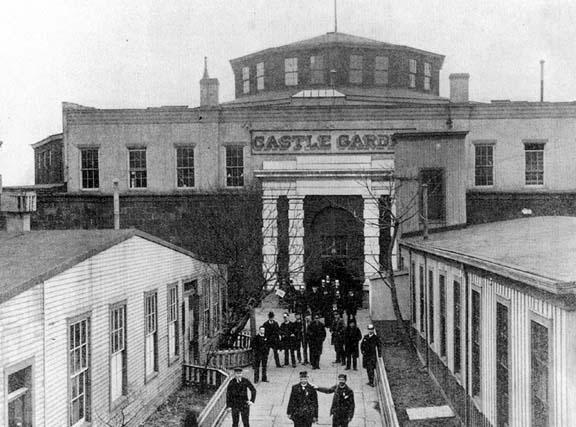 American's First Immigration Center http://www.castlegarden.org www.latinamericanstudies.org/ castle-garden.htm Source of photo and letter below Sent by Bill Carmena JCarm1724@aol.com CastleGarden.org offers free access to an extraordinary database of information on 10 million immigrants from 1830 through 1892, the year Ellis Island opened. Over 73 million Americans can trace their ancestors to this early immigration period. Castle Garden, today known as Castle Clinton National Monument, is the major landmark within The Battery, the 23 acre waterfront park at the tip of Manhattan. From 1855 to 1890, the Castle was America's first official immigration center, a pioneering collaboration of New York State and New York City. CastleGarden.org is an invaluable resource for educators, scholars, students, family historians, and the interested public. Currently the site hosts 10 million records, and support is needed to complete the digitization of the remaining 2 million records, beginning in 1820, from the original ship manifests. The Battery remains one of the oldest public open spaces in continuous use in New York City. American Indians fished from its banks, and the first Dutch settlers built a low, stone wall with cannons, a battery to protect the harbor and New Amsterdam. The transformations of The Battery and that of the Castle tell the history of New York and, by association, the growth and development of our nation. |
|
Letter from Ambrose
Elliott Gonzales to his
sister Harriett Rutledge
Elliott Gonzales, April
9, 1882, describing Castle Garden. Elliott-Gonzales Papers, Southern
Historical Collection, University of North Carolina, Chapel Hill.
My dear Hattie:
|
| September
Public Programs at the National Archives 700 Constitution Ave, NW Washington, DC 20408 September 1 – 13 at noon in the McGowan Theater The Constitution: That Delicate Balance The Charles Guggenheim Center for the Documentary Film and the National Archives present a 13-part series from the Annenberg/CPB Collection that will be screened in 1 hour episodes. Constitutional issues come to life in this 1984 Emmy Award-winning series. From presidential prerogative and congressional power to whether to disconnect the respirator of a dying relative, viewers are spurred to examine their understanding, beliefs and biases surrounding constitutional issues. The heated , roundtable debates in these programs, including such well-known figures as Ellen Goodman, Archibald Cox, Gloria Steinem and Bill Moyers, among many others, vividly demonstrate the relevance and power of this enduring document. No Reservations Required. September 1 – Executive Privilege and Delegation of Powers 2 – War Powers and Covert Action 3 – Nomination, Election, and Succession of the President 4 – Criminal Justice and a Defendant’s Right to a Fair Trial 5 – Crime and Insanity 6 – Crime and Punishments 7 – Campaign Spending 8 - National Security and Freedom of the Press 9 - School Prayer, Gun Control, and the Right to Assemble 10 - Right to Live, Right to Die 11 - Immigration Reform 12 - Affirmative Action versus Reverse Discrimination 13 - Federalism Thursday, September 15 at 7 pm in the McGowan Theater William G. McGowan Annual Forum on Communications and Technology “Checks and Balances in the Age of Instant Messaging: A Congressional Perspective” Noted historian Michael Bechloss will moderate a discussion with Congressman Steny Hoyer and Congressman Roy Blunt about the impact of high-speed communications, instantaneous news and public expectations of quick results on such basic constitutional principles as “separation of powers” and “federalism.” They will consider how can and should the Founding Fathers’ blueprint for deliberative democracy adapt to a world reshaped by communications technology. Reservations Required. reservations.nwe@nara.gov |
| HISPANIC
FAMILY HISTORY SYMPOSIUM Saturday, September 24, 2005, 10:30-4:00 National Archives and Records Administration 700 Pennsylvania Ave., NW, Washington, DC 20408-0001 For more information on this event see NARA's Web site http://www.archives.gov or telephone Jessie White 202-208-0781, ext 254. |
| Reclaiming a
Heritage Sent by Howard Shorr howardshorr@msn.com Young Portuguese-Americans study their roots By Sarah Schweitzer, Boston Globe Staff | August 9, 2005 DARTMOUTH -- Growing up in suburban Boston, Valeria Souza learned from an early age that her roots reached back to a place best not spoken of, its ways and language discarded by her family in favor of American habits. Her heritage remained so until the summer Souza was a teenager working at a doughnut shop. There the other workers spoke a tongue both foreign and beguiling. When she asked what it was, someone, noting her last name, shot back: ''Don't you know? You're Portuguese!" ''I'll never forget the way that felt," Souza said. ''Like all the air being sucked out of my chest as I realized I didn't even recognize the language. I felt profoundly robbed. How did this piece that is ostensibly a part of me go missing?" Today, Souza, 25, is fluent in Portuguese after a year living in Portugal and is working on a master's degree in Portuguese literature at the University of Massachusetts at Dartmouth. She is part of the growing number of Portuguese young adults embracing traditions that for years their elders sublimated to established New England cultures. At the university, which created a Center for Portuguese Studies in 1996, 270 students enrolled in Portuguese language classes last year, compared with 190 five years ago -- excluding continuing education. The number of students majoring in Portuguese studies has increased from 15 to 40 since 2000. Next year, the university plans to offer a doctoral degree in Portuguese studies, and a recent fund-raising drive brought in more than $1.5 million for the creation of Portuguese-American archives that will house letters, diaries, photographs, videos, films, and recorded music. Nationally, Portuguese language study is also on the rise. The number of undergraduates studying Portuguese climbed 21 percent between 1998 and 2002, according a survey by the Modern Language Association. The treatment of Portuguese as a serious academic focus is a remarkable shift from recent decades in America when the culture was maligned by some outsiders as unsophisticated, even as those within the community assumed it would remain vibrant. The swelling interest in Portuguese study in Massachusetts coincides with the arrival of Portuguese-speaking Brazilians, who made up one in five immigrants to the state between 2000 and 2003. But scholars note that the trend is explained by more than larger numbers of Portuguese speakers in the region. There is a hunger, scholars say, among third- and fourthgeneration Portuguese to reconnect with a past buried by parents raised in an era when repudiating an immigrant past was the means to success. ''There were many walking wounded -- children of immigrants wounded by their identities and doing their best to escape it," said Frank Sousa, director of the Center for Portuguese Studies and Culture at UMass-Dartmouth. ''Language was very much suppressed. Now, what we have seen is the children and grandchildren assuming the identity with less of a complex about it." Irish, French-Canadians, and other immigrant groups, too, suffered for their differences in New England. Yet among European immigrants, the Portuguese, with their darker skin and often rural and uneducated backgrounds, stood out. They were threatening to longtime residents as they settled in large numbers and swept up jobs. Multiple waves of Portuguese emigrated in the 19th and 20th centuries to work on fishing vessels and in textile mills, eventually making up more than one-third of the population in Southeastern Massachusetts, where they created vibrant but insular enclaves. Statewide, 280,000 people claimed Portuguese ancestry, according to the 2000 Census. ''There was a fear that they would not assimilate into the American way -- the WASP culture," said Maria da Gloria Mulcahy, a researcher in Portuguese studies at UMass-Dartmouth. ''So it was natural that once they could go unnoticed that they would not advertise their origin." The phenomenon of assimilation, she noted, was most pronounced nationally for all immigrant groups from the 1920s through the 1960s, ''when there was a strong anti-immigrant sentiment, and you were expected to be a true American and any hint of being a foreigner could be used against you." Ann-Catherine Ventura's family was typical. Her great-great- grandparents arrived from Portugal just after 1900, her great-grandfather in the 1920s. Her great-great-grandfather was a stowaway on a whaler, according to family accounts. Her grandparents spoke Portuguese, but not her parents, and not her. ''It wasn't passed down," said Ventura, 24, who grew up in Westport and learned French in high school. ''It's as though it was a backdrop to our lives." Her mother, Carlene Ventura, 57, a native of New Bedford, said that while Portuguese culture flourished -- with Portuguese bakeries, stores, and churches -- status was elusive for the Portuguese. Ventura recalls that her father's godfather, a leading businessman in New Bedford, was denied access to a prestigious club in the late 1950s, because, she says, he was Portuguese. And so her parents, in subtle but lasting ways, diminished the Portuguese imprint in the Ventura family. ''My parents spoke Portuguese, but only to each other, when they didn't want us to hear something," Carlene Ventura said. Now that's changed: Ann-Catherine Ventura traveled to Lisbon last fall and spent several months studying there, and this summer, she enrolled in an intensive Portuguese-language class at UMassDartmouth. Some scholars suggest that Portuguese culture increasingly carries a cachet in the United States because of the improved economy in Portugal, the awarding of the Nobel prize in literature to the Portuguese writer Jose Saramago, the financial success of Portuguese immigrants in the United States, and the growing interest in ethnic culture generally. Beyond the university, traditional Portuguese feasts in New Bedford and Fall River have seen larger crowds in recent years -- many from non-Portuguese backgrounds. Interest in Portuguese language classes at UMass-Dartmouth now extends beyond the student body; administrators say they receive inquiries from businesses around the region. Yet it is the curiosity from within the Portuguese community that scholars say is the predominant factor driving the public emergence of a culture once turned inward and celebrated privately in America. Nicky Tavares is among those speeding the evolution. The child of Portuguese immigrants, Tavares grew up in a Dallas suburb where she learned little of her parents' homeland or native language. Last year, Tavares, 24, moved to New Bedford to learn Portuguese and photograph the elderly Portuguese community, including her 80-year-old grandmother, a seamstress who speaks little English. ''I had a kind of longing," Tavares said. ''A feeling like I missed out on this Portuguese culture by not being raised in the community." Tavares has since abandoned five years of vegetarianism to eat Portuguese delicacies. She has learned the tradition of tending backyard grapevines. And of keeping two dressers in a bedroom, one topped with religious icons and a shorter one reserved for family photographs. Bedrooms figure largely in her photography: A portrait of her grandmother shows her sitting on a pale pink bedspread, flanked by two dressers. She has also learned her family's history -- like the story of her grandparents' meeting, relayed by her grandmother, in Portuguese. ''Stories have been swapped for so many generations," she said. ''And now I get them." |
| Civil Rights Tour Teaches Understanding For Jewish and African-American Students Sent by Howard Shorr howardshorr@msn.com Civil rights tour teaches understanding By Erica Pippins , Montgomery Advertiser, July 19, 2005 Tommy Hall and Josh Walker have a great deal in common. Both 17-year-olds are leaders at their respective schools, churches and communities. And before they met, Hall and Walker believed the so-called facts" about the other's culture and religion. The two stood side by side on Monday at the Troy University Montgomery Rosa Parks Museum as they glanced at pictures and read the biographies of the men and women who worked to promote racial equality and break down social barriers in the 1950s and'60s. The boys are among 29 Washington-area teens who are part of Operation Understanding, a group whose goal is to engage young people in a dialogue that leads to increased understanding. "Before I began this program, I didn't know much about Jewish people and I will admit that I believed the stereotypes. It just shows the overall ignorance of people when they buy into that," said Hall, who is black. "We are gaining a better understanding of each other, an understanding that we, like the leaders of the civil rights movement, can use to shape the world." The high school seniors are in Montgomery this week as part of a monthlong civil rights tour with Operation Understanding. Mirroring the route of the Freedom Riders, the students -- 15 blacks and 14 Jews -- are meeting with movement leaders and visiting places of significance to the black and Jewish communities. Walker echoed Hall's remarks. "I think in the beginning, we all came in with these class stereotypes that Jewish kids are rich and that the black students involved would be from the 'bad' part of town. But we're from all over the D.C. area and have a high level of education," said Walker, who is Jewish. "We are really seeing the bridges that connect the Jewish and black struggle in America and worldwide," Walker said. "By visiting the places where history in both our communities happened, I think it helps us realize what we as young people need to do to carry on the legacy begun by Rosa Parks and others." Rael James, program director of Operation Understanding DC, said the group focuses on black and Jewish youths because the two groups have similar histories of being discriminated against, feared and maligned. In addition to the summer tour, the teens meet on weekends throughout the year to discuss various issues and to participate in community outreach activities. When the students graduate from the year-long program, which is in its 10th year, they will have a better appreciation for each other's similarities and differences, James said. An alumna of Operation Understanding, she said that was the case for her. "When I was in the program, it shaped my world views and core values through the things I learned and the people I met," James said. "What we are doing with this group is just ripples on the pond. Our hope is that they (the students) take their experiences and share them with others so that they can have a larger impact on their communities." While in Alabama, the delegation is also slated to visit historic sites in Tuskegee and Selma. They've already toured places that were key to the civil rights movement in New York, North Carolina and Georgia. Liane Alves says the program has been an eye-opener in more ways than one. She's learned "what the history books have left out and what you can't learn from a book." "I knew about Rosa Parks and that she didn't refuse to give up her seat on the bus just because she was tired, which is the way it is often presented. The museum and some of the places we have been definitely clears up misconceptions," said Alves, adding Parks is one of her role models. "The fact that she could have lost her job or even her life really makes you realize how much she had at risk," Alves said. "It makes you wonder as a young person whether or not I would have the courage to do that." Through the program, Alves, who is black, has learned that she can. "I am really lucky to be with all of these kids. We don't go to school together and I don't think we would get to know so much about each other in depth even if we did," Alves said. "By learning about our differences, hopefully we can help shape a better future." |
|
Invisible to Most, Immigrant Women Line Up for Day Labor By NINA BERNSTEIN, Published: August 15, 2005 Sent by Howard Shorr howardshorr@msn.com The women are not noticed by the weekday morning crowds that rush past Eighth Avenue and 37th Street, in the heart of Manhattan's fashion district. They arrive in twos and threes after 8 a.m., shrinking against the buildings on both sides of the avenue, until scores of them are waiting, small, dark-haired Mexicans, Ecuadoreans, Hondurans. By noon they have vanished. In swift, discreet sidewalk negotiations, perhaps half have been hired for a day's work at the minimum wage or less in some of the neighborhood's last struggling garment factories. The rest have given up until tomorrow. A few miles away in Williamsburg, commuters on the busy Brooklyn-Queens Expressway are equally oblivious to the similar scene unfolding on an overpass above them. There, the work at stake is $8-an-hour housecleaning, and those vying for a day's scrubbing, mainly for Hasidic homemakers, stand in a crude ascending hierarchy of employer preference: Mexican and Central American women in their 30's at the back, Polish immigrant women in their 50's and 60's in the middle, and young Polish students with a command of English at the head of the line. At a time when male day laborers have become the most public and contentious face of economic immigration to the United States, these two rare female shape-ups have doubled in size almost unobserved in recent years. Their growth reflects a larger overlooked reality: Women make up 44 percent of the nation's low-wage immigrant work force, and worldwide, studies show, more and more women are migrating for work. Often invisible and undercounted, experts say, female economic migrants are an increasing presence, especially in big cities like New York, where the demand is not for men to pick lettuce or process poultry, but for women to pick up the scraps of a collapsed manufacturing sector, or to serve in the vast underground economy of domestic service. Although more women across the country are showing up in day-labor hiring halls, often run by grass-roots labor groups, experts say that these two female shape-ups may well be the only significant ones of their kind in the nation - places where women are willing to put their personal safety in jeopardy for a few hours of work. "What else is there to do if you have nothing to eat?" asked Rosario Jocha, 49, still standing on Eighth Avenue at 11 a.m. on a recent Wednesday. She said she had recently grabbed a day's work cutting threads from jackets even when the employer, a Chinese immigrant subcontractor, insisted he could not pay more than $5.75 an hour, 25 cents below the state minimum wage. "I've been here 11 years, and I still haven't found a stable, steady job." At both locations, some of the women waiting for work had been in the country as little as a few months; others, like Ms. Jocha, a Queens resident from Ecuador, were old-timers who spoke of better jobs lost when small-business employers could not pay rising rent. On Eighth Avenue, merchants said that 100 to 150 women regularly sought work six mornings a week year round - double or triple the number when the intersection first emerged as an informal female hiring site about six years ago. Yet May Chen, a vice president of Unite, the garment workers' union, whose headquarters is only a dozen blocks away, said she was unaware of the shape-up's existence until she was asked about it for this article. And Aaron Adams, a veteran garment center landlord who passes by every day, said he had assumed the women standing there "were just shooting the breeze." Rhacel Salazar Parreñas, a sociologist who has written extensively about the feminization of migration, said she was not surprised. "The space that these women occupy, the public spaces in the city, are just like fleeting moments," she said. "They don't really have a place in the city that's visible, so it's easy to ignore them." Even the discussion of legal guest worker proposals in Congress centers on male migrants, she said. But though nationally men account for about two-thirds of labor migration among illegal immigrants, primarily because of agricultural demand, she said, global patterns indicate that women are easily half the immigrant workers flowing to large metropolitan areas like New York.
|
|
My
Father, Ernesto Nava Villa, Son of Pancho Villa Archivos de Coahuila El debate sobre los Archivos de Coahuila The New York Times - The Mexican Evolution The Genealogy of Mexico Explorando el Camino Real de Monclova, Coahuila Festival Latino! Celaya, Guanajuato researcher seeks and receives assistance Information distributed by Genealogia-Mexico@googlegroups.com and eventos@genealogia.org.mx Informacion relacionada Monterrey, Nuevo Leon La identidad perdida Libro: Bolaños, "La identidad perdida" Libro: Primeros Conquistadores y Poblador es Españoles Los Cavazos Testamento de Juana de Treviño Testamento del regidor Juan de Treviño Codicilo de Juan Bautista Chapa Testamento del C. José de Ayala Communicaciónes entre el grupo |
|
By Raul Nava Villa My father, Ernesto Nava Villa, is the son of Pancho Villa, and this is my story of our trip together to Mexico, where he had not gone back for 70 years. We flew to Durango and drove to Gomez Palacio, Durango, and Torreon, Coahula. We spent the night in Torreon. The next day we went to Gomez Palacio and saw the statue of Pancho Villa on his famous horse. |
|
|
Later, we met with the towns people of Gomez Placio, who recounted stories of the revolution. The people were very hospitable and asked us to stay, but we had to leave for Chihuahua. On the way we were pulled over by the police, who told us to open the trunk. We had collected some adobes (bricks) as mementos from the home in Gomez Palacio, on top of the mountain where the statue of Pancho Villa on his horse stands. "What's This?" they asked, again, we explained, "adobes", a keepsake made from Dad's land of his birth. They called yet more police and repeated what we had and what we were doing. When they realized they were in the presence of the son of Pancho Villa, they joyously shook our hands and said we were fine to go. This welcome defined our journey to my father's Terra Natal. We then drove to Parral, Chihuahua, and checked in at a hotel for the night. In the morning, we visited the "Francisco Villa" museum, the location at which Pancho Villa and Colonel Trillo and men were gunned down while driving in a 1919 Dodge the museum staff had lots of information and dad felt at home in Parral, we arrived at the 'LA Turista Hotel', and asked dad if I could tell the janitor that he was the son of Pancho Villa? As far as I am concerned, with my father's affirmation of this question, our mission has just begun. At learning of this, the janitor was speechless and became the first person in Mexico to know that Ernesto Nava was the son of Pancho Villa. This opened the question which became the backdrop in the eyes of those meeting us, "How could Ernesto Nava Villa keep his identity private for so many years?" The janitor, Christovo, called Jose Socorro Salcido Gomez, the owner of the hotel, who coincidentally had written a book on Pacho Villa Titled, "Luzy Sombras En La Muerte Del General Francisco Villa." Don Jose told us that they present yearly festivities in July and Invited us to bring our family. We continued our journey to Canutillo, Coahuila where Villa and his men set up, 'Hacienda De Canutillo,' which is now a museum. We met with the care taker and had a long conversation about the history of Mexico. There, people commented on how much dad looked like Pancho Villa. Dad Told how he left Mexico and his two uncles, at 14 years of age on his own, just to be where his father once was: to feel the wind and the sand of the mountains and rancho's that whistled stories that were lost in his past. His mother, Macidonia Ramirex Nava, Took her baby at 2 years old out of Mexico because after the Revolution, she feared the government might kill her child. My Grandmother told her son never to tell anyone in Mexico or in the U.S. about his father. Well as the story goes, together we returned to his birthplace, Nazas, Durango, which he had not seen in 70 years. Many memories flashed before his eyes, for instance, the church was still exactly here he said it would be. This was a dream come true. We left across the mountains before dark, to the city of Durango, to rest at the hotel, and catch out flight back home, Leaving beloved Mexico which is our never forgotten past and proud it is very much part of our present. That’s my story, and my father's journey home. Raul Nava Villa |
|
|
|
| No. 1. Antecedentes
(Historical background) 1898. Por el decreto No. 762 del 12 de enero de 1898, se mandó establecer en Saltillo una oficina que se denominó “Archivo de Coahuila” para concentrar todos los documentos antiguos y modernos existentes en las oficinas públicas, facultando al Ejecutivo del Estado para reglamentar el orden de la oficina, la entrega de expedientes y la expedición de copias. Esta oficina formó parte de la Secretaría General de Gobierno. 1978-1989. El Archivo General del Estado se encontraba resguardado en el Recinto de Juárez. No obstante se trabajó elaborando diversos instrumentos de consulta, como guías e inventarios. Dispersión del acervo en diversos edificios, descuido y maltrato. 1989. Entre 1989-1990 en el Archivo General del Estado, dependiente de la Secretaría de Gobierno se observaba un estado de caos pues los documentos se encontraban en total abandono, desorden y deterioro. Los documentos de la Tesorería del Estado, por ejemplo, se encontraban regados por el piso de un local que albergaba al Periódico Oficial, no tenían techo y para colmo se empezaron a quemar. Durante varios meses se rescataron cientos de documentos sueltos, paquetes y cajas y, se concentraron, provisionalmente en el edificio del Archivo Municipal de Saltillo. Posteriormente se procedió a desinfectar, organizar y clasificar aproximadamente 4 toneladas de papel. 1994. En mayo de 1994 se expidió la Ley General de Documentación para el Estado de Coahuila, por medio de la cual se creo el Instituto Estatal de Documentación de Coahuila (IED) como un órgano desconcentrado de la Secretaria de Gobierno. Se le asignó por comodato el edificio Farmakon en la ciudad de Ramos Arizpe. Tenía por objeto normar, regular y preservar acervos, expedientes, registros y en general todos aquellos documentos administrativos e históricos de la dependencia y entidades del poder ejecutivo. 2003. Nueve años más tarde, el 14 de agosto del 2003, el Congreso del Estado, promulgó tres leyes en materia de información pública: 1) Ley de acceso a la Información Pública; 2) Ley del Instituto Coahuilense de Acceso a la Información Pública y 3) Ley de Archivos Públicos. La ley que crea al Instituto Coahuilense de Acceso a la Información Pública (ICAI) en su artículo 9º establece que es un organismo público autónomo frente a cualquier órgano de los gobiernos federal, estatal y municipal. Entre sus propósitos destacan la promoción, fomento y preservación del fortalecimiento democrático del derecho a la información pública; asimismo establece la rectoría del sistema de administración, conservación y preservación de la documentación pública, así como impulsar la cultura de la transparencia informativa. Entre las tareas del nuevo Instituto destacan la “organización, coordinación, supervisión y evaluación de las acciones referentes a la administración, conservación y preservación de archivos públicos”. En el artículo Quinto transitorio, de la misma ley, se establece que los “recursos humanos, financieros y materiales del IED, se transferirán y pasarán a formar parte del patrimonio del Instituto Coahuilense de Acceso a la Información Pública”. En la Ley de Archivos Públicos en el artículo tercero de los transitorios se establece que los “archivos públicos de las entidades que se encuentren en resguardo del IED, pasarán, al entrar en vigor la Ley del Instituto Coahuilense de Acceso a la Información Pública, a ser resguardados por éste, en los términos de los convenios que para tal efecto se hayan celebrado y de las disposiciones aplicables”. 2005. La información con la que contamos un grupo de ciudadanos (académicos, archivistas, historiadores, maestros, patronatos de archivos, etc.) sobre el destino del Archivo Histórico es la siguiente. Por un lado funcionarios del ICAI señalan que la Secretaría de Gobierno, después de un año aún no ha llevado a cabo la entrega del Archivo Histórico al Instituto Coahuilense de Acceso a la información. Por su parte, la Contraloría del Estado ha creado recientemente una Dirección Estatal de Archivos dependiente de la Subsecretaría de Modernización. El Proyecto, que aparece en internet (http://contraloria.sfcoahuila.gob.mx/contraloria/), no es más que una presentación en power point, de las medidas que se propone tomar la referida Dirección en relación con los archivos, sin ninguna disposición legal que las ampare. Esas medidas incluyen la creación de una Subdirección de Archivos Históricos. Además la Contraloría dispone ya de una parte del personal, en otro momento adscrito al Archivo, y se encuentra realizando un inventario para recibir toda la documentación, como lo tiene contemplado en el Proyecto. Desde el día 8 de mayo, la Secretaría de la Contraloría, argumentando la realización de un inventario al Archivo Histórico, cerró el servicio al público. Hasta el día de hoy el Archivo Histórico continúa cerrado. El grupo por la defensa y preservación del patrimonio documental del Coahuila está preocupado por esta situación que ha dejado al Archivo Histórico sin recursos legales y financieros y bajo la responsabilidad de instituciones cuyos fines no tienen correspondencia con los de los Archivos Históricos de carácter civil. Cabe aclarar que ningún Archivo Histórico del país depende de los Institutos de Acceso a la Información, ni tampoco de las oficinas de la Contraloría. |
|
| No.2 Resumen
(Current situation and three recommendations) Resumen de la situación que vive actualmente el Archivo Histórico. Desde su creación, el Archivo del Estado permaneció bajo la responsabilidad de la Secretaría de Gobierno. Por disposiciones legales (Ley de Acceso a la Información Pública; Ley del Instituto Coahuilense de Acceso a la Información y Ley de Archivos), el Archivo pasó al Instituto Coahuilense de Acceso a la Información. Sin embargo, el mismo aclara que, hasta el día de hoy, la Secretaría de Gobierno no se lo ha entregado formalmente. Por su parte, la Secretaría de la Contraloría creó recientemente una Dirección Estatal de Archivos en la que se pretende integrar todos los Archivos de la administración pública, incluyendo al Archivo Histórico. Por lo anterior desde hace varios meses a la fecha, la Contraloría ha tomado medidas en relación a la documentación, al personal y recursos de la institución, e inclusive suspendió los servicios al público. La posición del grupo por la defensa del patrimonio documental de Coahuila. El grupo de ciudadanos interesados en la defensa del patrimonio documental de Coahuila está integrado por personas que cuentan con experiencia y conocimiento de los archivos públicos de Coahuila, de México y del extranjero. Por ello, el grupo considera que las medidas que se han tomado no son pertinentes y violan las leyes de Coahuila. De manera enfática, manifestamos nuestro desacuerdo con las decisiones que se están tomando respecto al patrimonio documental de Coahuila. Asimismo, hacemos manifiesta nuestra intención de luchar porque el Archivo Histórico mantenga su identidad como una institución de cultura, conserve su adscripción a una dependencia compatible con sus propósitos, mejore su organización y servicio y recupere e incremente sus recursos materiales, humanos y documentales. Argumentos Por nuestro acercamiento a la situación del Archivo Histórico, una de las dependencias de la Secretaría de Gobierno, observamos que: a. El gobierno no se ha ocupado de él durante 5 años y medio. Ni la Secretaría de Gobierno ni la de la Contraloría han apoyado y supervisado el trabajo. Ello se deduce del diagnóstico de la Contraloría que considera que en el Archivo Histórico había un alto índice de ineficiencia. Nos preguntamos si el gobierno y sus dependencias no tienen ninguna responsabilidad ante esta situación. b. Las leyes se hicieron sin la debida fundamentación y conocimiento de causa. c. Las leyes vigentes que ordenan y norman el Archivo Histórico no se cumplen d. Las instituciones responsables legalmente –Secretaría de Gobierno, ICAI– no asumen sus responsabilidades. e. Otra institución –la Secretaría de la Contraloría–, en abierta falta de respeto a las leyes, suplanta a las instituciones responsables en sus atribuciones y funciones. Propuesta: 1º. Que se declaren vacatio legis las disposiciones legales referentes al Archivo Histórico, mientras se consulta con especialistas, se decida de manera sustentada y cuidadosa el futuro de esta institución y se propongan las adecuaciones legales pertinentes. 2º. Que la Secretaría de la Contraloría suspenda las actividades que no son de su competencia en el Archivo Histórico. 3º. Que, como acción inmediata, se abra el Archivo al público y se designe un director especialista en archivos históricos. |
|
|
|
|
|
|
|
| A mediados del siglo XIX un dictador nuevoleonés confiscó varios archivos públicos: el de la Secretaría de Gobierno, el Municipal de Saltillo y el del Pueblo de San Esteban de la Nueva Tlaxcala). También expropió la imprenta de Saltillo. Daba, con ello, un doble golpe a la ciudadanía: privarla de su memoria histórica y de su voz —su pasado y su presente le fueron incautados en un solo golpe—. Durante ocho años los archivos de Saltillo y el Estado permanecieron fuera de Coahuila. Algunos saltillenses y personas de otros municipios estuvieron presionando para que su documentación regresara a sus dueños. Cuando los reintegraron ya no estaban completos como era de esperarse. En cuanto a la imprenta ésta jamás volvió a la ciudad. El pleito por los papeles viejos ha vuelto a surgir recientemente y muestra que, a pesar de todo, los ciudadanos se dan cuenta de que son importantes para reconocerse, para luchar contra el olvido y como asidero con el pasado. Aún quienes habitan en Coahuila sin haber nacido aquí tienen interés en que se preserve la documentación que tan celosamente se había conservado. No hace mucho que el ejecutivo envió al Congreso del Estado una iniciativa para cambiar la ley relativa al destino y administración de los documentos. La Secretaría General de Gobierno perdió su ancestral papel de garante de la conservación, organización e información que había tenido durante un siglo y medio. Ahora se privilegiaba a la Contraloría y al Instituto Coahuilense de Acceso a la Información (ICAI). Este cambio drástico al que no se le encuentra justificación seria se aprobó en la Cámara de Diputados sin discusión, debate o búsqueda de información suplementaria. Los diputados del PRI votaron como era de esperar pero, sorprendentemente, los del PAN, PRD, PT y demás, también levantaron la mano sin saber bien a bien lo que estaban dictaminando. Nuestros legisladores legislaron sin empacho, sin siquiera una consulta al Archivo General de la Nación (AGN) o, ya cuando menos, a los expertos locales (los hay). Uno de los diputados, un buen historiador, el profesor Jesús Alfonso Arreola, presidente del Colegio de Investigaciones Históricas, no manifestó opinión crítica sobre el destino de la materia prima de los historiadores (los documentos). Poco después de crear una ley que se diferencia de todas las del resto del país, tuvo lugar algo que quizá pareció necesario a nuestra contralora, la señora Garza Orta. Para que el cambio fuera radical y no nada más legal ella pensó que debería deshacerse de una buena parte o de todos los archivistas. Vino entonces la etapa (muy conocida en tiempos de la Inquisición) de intimidación de las personas, de difundir entre la comunidad todos los pecados en que habían incurrido. Se informó que el cambio se justificaba porque el personal del Instituto Estatal de Documentación (IED) conservaba en un estado lamentable los manuscritos y periódicos, porque casi nadie consultaba el acervo, porque los trabajadores habían organizado nada más el diez por ciento de la documentación, en fin, porque el director no había hecho nada y las analistas estaban robando documentos y certificando actas sin permiso. Esto se dijo cuando menos frente a 13 personas, yo incluido. Las inquietudes causadas por la nueva legislación coahuilense sobre archivos, los ataques contra el personal del Instituto Estatal de Documentación, el desmembramiento del acervo del Archivo Histórico, las acusaciones de robo de documentos... merecerían que el público conociera algo que le atañe directamente. Pero no, no sucedió nada. Hubo más desinformación, tanta que ahora sí historiadores extranjeros y el AGN escribieron o llegaron a Saltillo para enterarse de lo que sucedía. Es curioso que el número de extranjeros interesados en nuestros archivos históricos es mayor que el de coahuilenses. Vayamos por partes. Aceptemos sin conceder que lo que la Contraloría del Gobierno del Estado afirma es verdad: había un desorden enorme en el IED. ¿No cree usted que descubrieron esta aberrante conducta a los 5 años y meses de que se había instaurado?, ¿Por qué no hicieron un cambio a tiempo?, ¿Por qué no llamaron la atención del Secretario General de Gobierno, responsable directo de la descomposición generalizada de su personal? Antes de intentar alguna respuesta a lo anterior, permítame que le informe dos cosas. Ese personal flojo, descuidado, abusivo, corrupto... había recibido e1 Premio al Mérito Archivístico que otorga una vez al año el Archivo General de la Nación al mejor archivo mexicano (entre 2500). Traigo a la memoria del lector una segunda información: el Gobierno del Estado se vanaglorió de tener un IED que obtuvo el reconocimiento ISO-9000, galardón que implica no sólo que tiene una extraordinaria organización interna y una eficiencia absoluta en todos sus procesos sino también que domina todas las redes sociales e institucionales que se relacionan con sus objetivos y metas. Bueno pues la Contraloría informó al ICAI que el IED era la vergüenza del Gobierno. ¿Advierte usted alguna contradicción? Si el instituto que ganó un premio nacional y uno estatal es tan pernicioso ¿cómo estarán las demás dependencias? Por supuesto que el gobierno sabía lo que tenía. Entonces la lógica debe andar por otro rumbos. Piense usted cuál será la necesidad de ese cambio o la de denostar a sus magníficos trabajadores. Inténtelo y seguro encontrará alguna respuesta, tendrá una intuición, vamos... anímese a pensar. Entre las acciones inesperadas que se implementaron está la ruptura de la unidad del acervo histórico. Extrajeron de éste las actas del Registro Civil del siglo XIX. Tanto Contraloría como ICAI y la directora del Registro Civil defendieron esta expropiación. La lógica, de nuevo, fue contundente: si, como su nombre lo indica, eran papeles del Registro Civil, no se puede decir que se sacasen de allá sino que se reintegraron acá. Siguiendo estos silogismos entonces nuestras autoridades deberían enviar a Tlaxcala todos los documentos de San Esteban de la Nueva Tlaxcala, a Roma todo las actas sacramentales de cuatro siglos, a Madrid todo lo referente a leyes y decretos (pues los sancionaba su majestad el Rey). Aprovechando la oportunidad, la directora del Periódico Oficial también quería que le restituyesen todos los periódicos que salvaguardaba el IED porque (de nuevo la lógica) ¿dónde deberían estar sino en su propia sede? Yo le informo a ella que el único acervo completo del Periódico Oficial en Coahuila lo tiene, ¡oh contradicción!, el Archivo Municipal de Saltillo y no el del Estado. Se lo digo porque ahí se cuenta con los periódicos del siglo XIX de que carece el IED. ¿Aceptarían los saltillenses que se los expropien también? Que lo intenten. Quiero pasar en revista la acusación de corrupción de los analistas y del ex director del IED, Alfonso Vázquez. Nos dijeron que éstos vendían certificaciones del Registro Civil del siglo XIX ¿A alguien se le ha ocurrido pedir que le certifiquen una fotocopia de una acta del siglo XIX? No lo creo porque no hay nada qué certificar. Dijeron que cobraban “hasta 600 pesos” por hacerlo. Lo dudo. Cuando fui director del Archivo Municipal certificábamos nada más los papeles que nos pedían de Presidencia, con una excepción: a las personas que buscaban la propiedad de un lote en los panteones les ayudábamos a localizarlo y les certificábamos el mapa para que el encargado del camposanto les permitiese enterrar a su deudo. Cobrábamos cincuenta centavos (hoy aumentó a un peso que es lo que cuesta la fotocopia). Dudo, sinceramente, que alguien pague 600 pesos por un sello sobre una fotocopia que no sirve para nada. Retomo otra de las acusaciones más contundentes: cortaron en un libro del Registro el acta de matrimonio de don Venustiano Carranza. De que alguien lo robó no debe caber duda. De que lo hicieron las analistas o Alfonso Vázquez es de demostrarse. Primero porque un documento como ese no es de gran importancia para un historiador; segundo porque el personal al que me refiero, al que conocí en el trabajo (compartimos generosamente nuestro edificio municipal con el IED sin que el Gobierno del Estado haya pagado jamás un centavo al municipio; convivimos unos seis años) al contrario de robar o maltratar los documentos los preservaron. Por los años de convivencia sé que los analistas del IED no nada más eran honestos sino que se preocupaban por aumentar su acervo con donaciones. Lo cual indica que en vez de robar aportaron. Todavía dudoso pregunté al mejor especialista en Carranza, que lo es Javier Villarreal Lozano, quien me informó que esa acta de matrimonio él no la conocía en original sino en copia. Quiero añadir algunos datos de mi cosecha sobre robos y faltantes. Yo conocía un larguísimo y fundamental documento sobre las fundaciones de muchas poblaciones del norte de Coahuila desde Monclova hasta las misiones tejanas. Lo había leído en un libro publicado en Saltillo en 1886. Busqué el original en el Archivo del Estado pero no aparecía. Años después, escrutando documentos en la Universidad de Berkeley, California, el azar o mi olfato me llevó al documento mencionado. Lo habían robado y ahora estaba en los Estados Unidos. Luego encontraría que un prestigiado historiador americano lo había sustraído de la Secretaría de Gobierno del Estado de Coahuila en 1916. Esa universidad lo conserva en un acervo que lleva el nombre del coleccionista. Nosotros lo conservábamos ya editado aunque siempre es preferible el original. Comprobé que al publicarlo acá había sido perfectamente paleografiado incluyendo los errores ortográficos. Pues bien, yo denuncié ante el AGN ese robo, aunque sabía que el delito, quizá, había prescrito. Debo declarar, también, que ni el acervo histórico municipal ni el estatal han quedado al margen de robos. Del municipal sabemos que ya en el siglo XIX habían sustraído todo lo referente a denuncios de minas. También sustrajeron en 1976 el primer Libro de Actas de Cabildo (1596-1607): tuve la suerte (gracias al historiador americano José Cuello) de tener en mis manos una copia microfilmada de ese Libro y entregué al Alcalde de Saltillo una reproducción. El archivo General del Estado también tuvo la mala suerte de ser saqueado en varias ocasiones. Además de lo que extrajeron algunos “historiadores”, en 1974 (si mi memoria no me falla) el norteamericano John Micheletti fue sentenciado a varios años de prisión por robo de documentos. Yo leí su expediente judicial completo. Declaraba el delincuente que había vendido, antes de ser atrapado, muchos papeles con firmas de Ramos Arizpe, Zaragoza y Carranza. ¿No sería él quien robó el acta de Carranza en vez de Alfonso Vázquez?, ¿Por qué el Gobierno jamás recuperó los documentos vendidos en Texas, Colorado y Nueva Orleáns cuando sabía por confesión del propio delincuente quiénes habían sido las instituciones compradoras? Por otro lado puedo decirle que poseemos ahora todos los libros de Actas de Cabildo de Saltillo desde 1596 hasta 2005, con una excepción, nos falta uno de los años setenta (siglo XX, por supuesto). A mi, en Presidencia Municipal, cuando me hicieron director del Archivo, me indicaron el nombre del notario que lo había robado y las razones del robo (una donación de terrenos aprobada por el Cabildo pero que perjudicaba los intereses del notario). ¿Se hizo algo para recuperarlo? No, porque ¡lástima! también había prescrito el delito. Tras esta larga perorata el lector debe estar aburrido, sorprendido o indignado. Déjeme decirle que a mi entender los cambios legislativos realizados no sirven de mucho; que el poner en manos de la Contraloría los archivos del pasado y el presente no puede deberse al amor que sienten por ellos sino a otras razones que no alcanzo a entender pero que de seguro existen. Cambiar todo al cuarto para las doce significa algo más que echar por tierra la labor incansable de dos directores y unos cuarenta analistas durante 15 años. Atribuirle al recién inaugurado ICAI la salvaguarda del Archivo Histórico es doblemente problemático: ellos están ahí no para apoyar al ejecutivo en sus obligaciones sino para representarnos a nosotros, los ciudadanos, frente al poder y frente a las posibles desviaciones de los recursos y de la información. El ICAI por vocación y dignidad debe ser independiente de los poderes de las secretarías del Estado y del ejecutivo mismo para ayudarnos a resolver las dudas, informarnos, darnos acceso a la información trucada, disfrazada, desviada... El ICAI es nuestro, no del poder ejecutivo, ni del poder legislativo. Cuando dialogamos con sus miembros nos sorprendió su conciencia clara de que su papel no era el de custodios de los archivos sino el de vínculo con la ciudadanía. Creo que su desafío será el de demostrar su desvinculación del poder burocrático. Considero que el ejecutivo todavía puede regresar las aguas a su curso y resolver algunos de estos problemas. Deberá controlar a la contraloría, liberar al ICAI de la carga documental, propiciar que cada dependencia (y no la Contraloría) sea quien organice y preclasifique sus propios documentos entregando al final del sexenio una guía para su control, liberar de sospechas a algunos de sus mejores burócratas (Premio Nacional, ISO-9000), regresar los documentos sustraídos del Archivo Histórico, apoyar con recursos a los acervos documentales del Estado (municipales, parroquiales, institucionales), catalogar en lo posible los expedientes de los archivos de trámite y concentración y transparentar todo, en especial la documentación. La Contraloría no tiene y nunca podrá tener la capacidad física y técnica para organizar la documentación; le falta feeling y amor por los documentos del pasado y presente. Es, además, parte interesada. Sería de desear que se enteren de que los documentos son nuestros aunque los haya generado el gobierno. Los humanos somos seres de tiempo. Sin temporalidad no percibiríamos nuestro existir (San Agustín, Heidegger). Por ello requerimos la seguridad de nuestra memoria histórica. Por ello queremos que regresen los archivos a quienes los conocen y no los hagan peligrar con ordenanzas curiosas (por decir lo menos). Si nosotros nos desinteresamos ahora de lo que sucede, nuestros nietos sabrán que en 2005 por tales y cuales razones se puso en peligro la memoria de su pasado y que no luchamos por preservar lo que es herencia común y no propiedad particular. |
|
|
The New York Times - The Mexican Evolution By Matthew Dowd, August 1, 2005 Austin, Texas With nearly six million Mexicans living illegally in the United States, some Americans, particularly those in border states, are greatly worried about the costs of illegal immigration and have demanded that more be done to stem it. Modern-day "minutemen" patrol the border. Voters pass measures limiting the rights of illegal immigrants, and senators debate legislation to establish guest-worker programs. Certain elected officials and pundits focus on the perils of illegal immigration to score political points. But chances are that there will be a substantial decrease in illegal immigration from Mexico in the next 20 years, and it won't be because of civilian border patrols, laws being passed, pronouncements by politicians, or as some would like, "building a wall on the border." Instead, the cause will be demographic trends within Mexico itself, trends that have been largely ignored in the debate over immigration. Mexico's population growth rate has dropped by more than 50 percent during the last five decades, according to the United Nations. The annual growth rate has declined from approximately 3 percent in 1960 to 1.3 percent today. And it is expected to continue to fall in the first decades of the 21st century; by 2050, the United Nations predicts, the rate will be negative. The fertility rate in Mexico has had a corresponding significant drop, from 6.9 children per woman in 1955 to 2.5 today. The population growth rate of Mexico is now only slightly higher than that of Canada, where recent data shows it to be 1 percent. Twenty-five years ago, Mexico had a growth rate more than twice that of Canada. So what is the significance of all this? The aging of the population in Mexico coupled with Mexico's economic expansion mean that jobs in Mexico will be more plentiful, thereby prompting fewer young people to come to the United States in search of work. Studies have shown that as the population growth rate in countries worldwide slows, migration drops. This is especially true for an expanding economy like Mexico - in one telling statistic, youth unemployment there dropped to 4.1 percent in 2001 from 9.6 percent in 1995. A recent Pew Hispanic Center study highlights some of the change in immigration to the United States from the south. Pew predicts that the share of first-generation immigrants in the total Hispanic population in the United States will drop from about 40 percent in 2000 to closer to a third by 2020. Thus first-generation immigrants will decline by almost 20 percent as a share of the total Hispanic population in the United States. If the trend continues, it could be that we've already seen the high-water mark of illegal Mexican immigration - put simply, the issue may be resolving itself. What would be the practical effect of all this? It suggests that any long-term project to close off the United States-Mexico border may use up money that could be more useful elsewhere. What's more, businesses that depend on a steady supply of low-paid illegal immigrants to keep costs down - restaurants, farms, construction companies - will most likely need to adapt by increasing salaries and benefits so they can attract legal immigrants or citizens as workers. And as these trends become more apparent to the public, politicians running on an anti-Mexican-immigrant platform will be seen as out of step. While these politicians may seem successful in the short term, by the next decade the facts will definitely get in their way. Does the United States need to continue to worry about border security and terrorism? Absolutely. Do we as a society need to figure out how to handle illegal immigrants and their families already living and working in the United States? Of course. But legislators and government agencies should spend more time and resources addressing the problems of immigrants already here and our direct security needs, and much less time on prescriptive laws aimed at stemming illegal immigration from Mexico. We should be aware of the historic transformations occurring in Mexican society so that we aren't fighting a war that is already ending. (Matthew Dowd, who was the chief strategist for the 2004 Bush-Cheney campaign, is the senior adviser to the Republican National Committee.) |
| The Genealogy of
Mexico.. . .WOW!! http://members.tripod.com/~GaryFelix/index1.htm Site Contents: The Conquistadors - A list of almost 2000 individuals that served the King with Cortes and stayed in Mexico (with some notable exceptions). The conquest of the Mexico lasted from 1519 to 1521. 5 pages. New! Coats of Arms - Conquest of Mexico - A list of 145 of the individuals that received coats' of arms for their part in the conquest of Mexico from 1525 to 1589. 1 page The Conquistadors of the Yucatan - A list of 160 of the individuals that served the King with Francisco de Montejo from 1526 to 1546. 1 page The Conquistadors of Nueva Galicia - A list of 280 of the individuals that served the King with Nuno de Guzman in 1530. Many went on to settle the area and had links to the earlier Conquistadors. 1 page Early Settlers of Nueva Galicia - 137 settlers arriving after the conquest of the area. Some had links to the earlier Conquistadors. 2 pages The Coronado Expedition - A list of 322 settlers that served with the Captain Francisco Vazquez de Coronado. The expedition set out for New Mexico and Arizona but made it as far north as Kansas from 1540 to 1542. 1 page The Luna Expedition - A list of the 251 settlers that served with the Captain Tristán de Luna y Arellano. The expedition set out to settle Florida in 1559- 1564. 1 page The Onate Expedition - A list of the 336 settlers that served with the Captain General Juan de Onate. The expedition set out to settle New Mexico in 1598- 1600. 1 page New Spain - 433 surnames of the early settlers making their way north into Northeastern Mexico. Many descendants of the early Conquistadors. Their date of first mention in public records for the area is listed in most cases. 8 pages 1700-1726 - New wave of settlers to Northeastern Mexico. Some details are given on 81 surnames. 2 pages California 1769-1800 - A list of names of over 1,700 of the earliest recorded male settlers of Alta California. 1 page Surname Research - Here are Hispanic resources traceable to 320 surnames found in the American Southwest or Mexico. 3 pages New! The Genealogy of Mexico DNA Surname Project - Find relatives using DNA technology. With DNA it is possible to find out if you share a common male ancestor within 7 generations at a probability of 50% or 23 generations (around the time of the Conquest) at a 90% probability. This project is open to anyone with ancestors in Mexico along their father's father's .... line. 1 page Personal Genealogy - Personal family surnames of Felix, Loera, Santoscoy, Moran, Vejar and Castro are discussed or mentioned. Additional links of cousins doing research on these names are provided as well as other links. 1 page Photo Gallery - Old family photos. 1 page |
|
Explorando el Camino Real de Monclova, Coahuila http://www.caminorealdemonclova.com Source: Mickey Margot Garcia MMG8938@aol.com Sent by George Gause ggause@panam.edu |
| FESTIVAL LATINO! Celebrate Hispanic Culture! Celebremos la cultura hispana! Habra musica, comida, baile, arte, y mas... detallas mas tarde. Saturday, October 22, 2005 Moore Multicultural Center, 1519 Clearlake Road Cocoa, FL 32922 321/433-7355 Festival Latino - http://www.wftv.com/events/4647753/detail.html S. Wendy Pérez perezw@brevardcc.edu Sent by Benecio Samuel Sanchez, eventos@ancestros.com.mx El Instituto Nacional de Antropología e Historia convoca al II Congreso Internacional sobre Salud - Enfermedad de la Prehistoria al Siglo XXI en el Sureste Mexicano y el Caribe que se llevará a cabo del 5 al 7 de octubre de 2005 en el Hotel Fiesta Americana de la Cd. de Cancún, Quintana Roo Temas: 1. Condiciones de salud, enfermedad, métodos curativos y terapéuticos durante la época prehistórica y/o prehispánica. 2. Condiciones de salud, enfermedad, métodos curativos y terapéuticos durante la época colonial. 3. Condiciones de salud, enfermedad, métodos curativos y terapéuticos durante los siglos XIX al XXI. 4. Impacto social de la medicina moderna, los métodos curativos alternativos y los avances científicos y tecnológicos para las condiciones de salud de las poblaciones actuales. A los interesados en particular se les invita a enviar el nombre del trabajo y un resumen de su ponencia, no mayor de media cuartilla en arial cpi a doble espacio, antes del 8 de agosto del presente año a las siguientes direcciones: emalvido.deh@inah.gob.mx colonial.deh@inah.gob.mx direccion.qroo@inah.gob.mx De ser aceptada su ponencia, será necesario que los ponentes envíen el texto de su ponencia completa antes del 8 de septiembre del año en curso. Dirección de Estudios Históricos, INAH Allende 172, esq. Juárez, Tlalpan 14000, México, D.F. Tels. 54 87 07 00 al 18; fax 54 87 07 15 Atención: Mtra. Elsa Malvido, Coordinadora del Proyecto Salud-Enfermedad, de la Prehistoria al Siglo XXI. Centro INAH Quintana Roo Insurgentes 974, Col. Forjadores, C.P. 07870, Chetumal, Quintana Roo Tels. y fax 01 983 83 724 11 y 83 70796 Nota: Sólo serán aceptados trabajos de investigación originales que no hayan sido publicados. El Comité Organizador se reserva el derecho de aceptar los trabajos presentados, así como de publicarlos. |
| Celaya,
Guanajuato researcher seeks assistance Friday, 17 Jun 2005 From: sdbarrios@msn.com To: mimilozano@aol.com I am interested in getting a little help in doing some genealogical research and wd like to contact Mr.Schmal and Ms. Morales by email Can you provide this ? Thank you. David Barrios Friday, June 17, 2005 From: mimilozano@aol.com
To: sdbarrios@msn.com Tuesday, 7/26/2005 From: sdbarrios@msn.com To: mimilozano@aol.com Tueday, 26 Jul 2005 From: mimilozano@aol.com To:
sdbarrios@msn.com |
|
|
Informacion relacionada Monterrey, Nuevo Leon Fondo: Ciudad Metropolitana de Monterrey (segunda época) Sección de Fondo: Agua Serie: Usos Título: Venta de horas de agua con su tierra de labor y sitio de agostadero correspondiente. Lengua: ESPAÑOL Lugar: MONTERREY Fecha: 22/May/1781 Fojas: 2 Colección: PROTOCOLOS Volumen: 19 Expediente: 1 Folio: 142 NO 73 Notas: (POR NO SABER FIRMAR EL OTORGANTE LO HIZO A SU RUEGO JUAN JOSÉ RODRÍGUEZ). Descripción: José Cristóbal de la Garza, vecino de la hacienda de San Francisco, de esta jurisdicción, como albacea testamentario de doña María Josefa de la Garza Falcón, su madre, viuda de Agustín Salvador de la Garza Falcón, difunto, vende a Jacinto Guerra, vecino de esta jurisdicción y "heredero comunero" de la hacienda del Espíritu Santo de Pesquería Chica, de esta jurisdicción, doce horas de agua con su tierra de labor y sitio de agostadero correspondiente, en dicha hacienda de Pesquería; y que su madre heredó de José Teodoro de la Garza, abuelo del otorgante. En 200 pesos en reales, de contado. Ante José Ignacio Treviño, Alcalde Ordinario de primer voto, protector del pueblo de Ntra. Sra. de Guadalupe. José Marcos de Arredondo y Manuel María Guajardo. De asistencia, José Mariano Rodríguez y Antonio Ramos. Fondo: Ciudad Metropolitana de Monterrey (segunda época) Sección de Fondo: Tierras Serie: Compra-venta Título: Venta de agua con su tierra de labor y agostadero. Lengua: ESPAÑOL Lugar: MONTERREY Fecha: 19/Oct/1798 Fojas: 3 Colección: PROTOCOLOS Volumen: 24 Expediente: 1 Folio: 90 NO 39 Notas: Descripción: José Manuel de la Garza, vecino de la hacienda del Espíritu Santo de la Pesquería Chica, vende a José Antonio Guerra, su cuñado, de la misma vecindad, un día y una noche de agua con su tierra de labor y agostadero, en la misma hacienda, y que heredó de José Elías de la Garza y de María Antonia de Quintanilla, sus padres, difuntos. Colinda por el oriente con tierras de Eugenio de Elizondo, difunto; por el poniente con las de Pedro Guerra, también difunto; por el orte con las de Marcelo de Almaraz y por el sur con el río. En 250 pesos. Ante Fernando de Uribe, Alcalde Ordinario menos antiguo. Testigos, José María Careaga, Valentín Galindo e Ignacio Navamuel. De asistencia, Santiago Vedia y Pinto y José Vicente Fonseca. Por no saber firmar el otorgante lo hizo a ruego suyo Esteban López Palomo. Fondo: Capital del Estado Sección de Fondo: Agua Serie: Usos Título: Venta de agua en la Hacienda del Espíritu Santo Lengua: ESPAÑOL Lugar: MONTERREY Fecha: 22/Jun/1827 Fojas: 3 Colección: PROTOCOLOS Volumen: 34 Expediente: 53 Folio: 0 Notas: Descripción: 53. Escritura de venta. Certificación de venta jurídica que realizó Ana María Antonia Elizondo, de un día de agua sin noche, sito en la Hacienda del Espíritu Santo, Jurisdicción de Pesquería Grande, a favor de Adauto (sic) Guerra, por la cantidad de 450 pesos; incluye la certificación jurídica de la venta firmada por Pedro Nozeda (sic ) y fechada el 23 de junio de 1827. Firman: Luis Zambrano, María Antonia Elizondo. De asistencia, Bartolomé García, Tomás e Ponce. Nota.- Una cara de foja es blanca. Fondo: Capital del Estado Sección de Fondo: Asuntos legales Serie: Información y declaración Título: Información sobre conciliaciones Lengua: ESPAÑOL Lugar: MONTERREY Fecha: 24/Feb/1829 Fojas: 21 Colección: PRINCIPAL Volumen: 7 Expediente: 18 Folio: 0 Notas: Descripción: Cuaderno de las conciliaciones que en el expresado pasan por ante el C. José Alexandro de Uro y Lozano regidor decano del Ayuntamiento de esta capital y Los CC. Regidores Carreño y Juan José Zambrano y Rafael (Chávez) del año de 1831 1.- En la ciudad de Monterrey a los 24 días del mes de Febrero de 1831 ante el C. Jose Alejandro de uro regidor decano se presento el C. Tomás Zambrano vecino de Salinas Victoria demandando a D. León García el cumplimiento de una obligación extrajudicial en que confiesa deberle la cantidad de doscientos pesos procedentes de la venta que le hizo con escritura pública, que existe en poder del demandado. De una acción o derecho que el demandante tiene en la tierra del Agostadero de San Francisco Guínala. Firma:José alexandro de uro y lozano, Lic. Luis Martínez, Francisco Mier, José Tomás Arrambide. 2.- En la ciudad de Monterrey a los 26 días de febrero de 1831 se presento ante el juez de paz conciliador José Alexandro de Uro y Lozano María Ana Sansero contra D. Ramón Treviño demandándole a una hija suya que hace quince meses le dio en calidad de hija para que la criase y cuidase en su educación, exponiendo que con la voluntad con que se la dio se la reclama. Firman: José Alexandro de Uro y Lozano, Juan Nepomuceno Reyes, Treviño. 3.- En la ciudad de Monterrey a 2 y 6 días del mes de Marzo de 1831 se presento ante el regidor decano Alejandro de Uro y Lozano tres conciliaciones y a nombre del juzgado de Obras Pías el presbítero José Ángel Benavides promotor fiscal de la curia eclesiástica contra el C. Andrés Ruiz Quiroga reclamándole trescientos pesos en reditos vencidos que le asegura debe éste al juzgado eclesiástico. Firma: José Alexandro de Uro y Lozano, Manuel María de llano, Francisco de Mier, José Ángel Benavides. 4.- En la ciudad de Monterrey a los 18 días del mes de marzo de 1831 ante el C. José Alejandro de Uro y Lozano regidor decano y juez de paz compareció Enemecio Guerra y sus compartes y el C. José María Garza Martínez y sus compartes a fin de intentar el medio de la conciliación. Sobre demanda de la posesión y propiedad de tierras de agostadero en la hacienda del Espíritu Santo de Pesquería Chica. José Alexandro de Uro y Lozano, Lic. Luis G. Martínez, Antonio de Ayala, José María de la Garza y Martínez, Enemecio Guerra. 5.- En la Ciudad de Monterrey ante el C. José Alejandro de Uro y Lozano regidor del Ayuntamiento de esta ciudad y juez conciliador se presentaron hoy 22 de Marzo de 1831 el C. Antonio Roel, a nombre suyo y de su compartes todos vecinos del Topo de los Ayalas y son los siguientes: Los C. Juan José García, Fernando Saldaña, Luciano de la Garza, Juan de Dios Ramírez, José Anastasio Saldaña, José Dionisio García, Vicente Cavazos, Antonio Saldaña, Serapio Ayala, Florentino Saldaña, Valentin Lozano, José Ma. Ayala, Apolinar Lozano, Juan Bautista lozano, Joaquín Lozano, José ángel Ayala, Albino Villarreal, Albino Lozano, Juan Garza, Juan francisco Ayala y Máximo Villarreal contra D. Julian Elizondo D. Rafael Tijerina y D. Jesús Guerra sobre que los últimos dejen correr las aguas manza del río del Topo de los Ayalas para el uso domestico del vecindario. Firman: José Alexandro de Uro y Lozano, Lic. Luis G. Martínez, José Antonio Roel (en representación de sus compañeros), José de Jesús Elizondo. 6.- En la ciudad de Monterrey a los 23 días del mes de Mayo de 1831 ante el C. José Alexandro de uro y Lozano regidor decano del Ayto. de esta ciudad y juez de paz se presento D. María Josefa de la Garza viuda del finado D. Vicente Sepúlveda, y vecino de la hacienda de san Rafael de Tierra Dura de esta ciudad contra D. Miguel Sepúlveda su hijo político, y albacea de su esposo demandando la porción de la tierras y aguas de su testamentaria. Firman: José Alexandro de Uro y Lozano José Miguel Sepúlveda su hijo político y albacea de su esposa, demandando la partición de las tierras del agostadero de su testamentaria. Firman: José Alexandro de uro y Lozano, José Miguel Sepúlveda, Rafael Sepúlveda (firma por su madre), Lic. Luis Martínez, pedro Gómez. 7.- En la ciudad de Monterrey, a los 26 días del mes de Marzo de 1831 ante el C. Alexandro de Uro y Lozano Regidor decano, y juez de paz compareció Don Francisco Treviño vecino de la hacienda de San francisco demandando a Don (Reon) García relativo a tanteo de una compra que el demandado hizo a D. Tomás Arrambides vecino de Salinas de Agostadero en san Francisco y Guínala. Firmaron: José Alexandro de Uro y lozano, Francisco Treviño, Juan García. Antonio de Ayala 8.- En la ciudad de Monterrey a los 18 días del mes de julio de 1831 ante el C. Regidor Juez de paz Rafael Sánchez se presento el C. Manuel María de Llano de esta vecindad contra el C. Felipe de Mier responsable del impreso en la gaceta de gobierno con fecha 14 de julio de 1831. Se expone los asesinatos de D. Francisco Bruno Barrera cometidos por el abuso de la facultad medica que ejerce dicho D. Manuel María de Llano. Al tiempo de firmar esta acta espuso D. Felipe Mier no ser el convenio que ambos tuvieron y que por lo tanto que no la firmaba: en tal concepto queda nula y de ningun valor ni efecto que así firmo para constancia. José Rafael Sánchez En la ciudad de Monterrey a los 20 días del mes de julio de 1831 ante el C. Regidor juez de paz Rafael Sánchez se presento el C. Manuel María de Llano de esta vecindad contra el de igual elace Felipe de Mier responsable del impreso inserto en la gaceta de Gobierno de fecha 14 de julio de 1831 que comienza por que ara al antagonista tenia mal estomago y que fue declarado inferior a solicitud del presentante en el juzgado 2º y en consecuencia remitido al responsable a reconciliarse en el juicio conciliatorio que prescribe la ley y habiendo la parte ofendida arrastrando al juicio al C. Felipe de Mier pidió al Sr. Juez en términos de justicia que el demandante le extendiera un certificado reparando su honor por las gratuitas injuria conque anteriormente a herido y de no probarse bastantemente por el orden de las leyes la verdad de sus aciertos, a lo que contesto el referido Mier que no constando el papel determinando injuria contra la persona de D. Manuel María de llano, y solo estaba reducido a manifestar los perjuicios que se siguen a la humanidad de ejercer con tanta amplitud la facultad medica los curanderos en general y la legalidad y justicia de que el honorable Congreso tuvo para dictar la providencia de despachar jóvenes a estudiar medicina a Guadalajara, no podía dedicarse de lo constante en el citado periódico y si solo hacen ver a la luz pública que no hablaba de la persona de . Manuel María que gratuitamente se quiere identificar con la del antagonista que si a esta accediere esta pronto hacerlo y si no que se presente ante quien convenga, y habiendo contestado D. Manuel María de Llano que semejante ardid tal cual propone D. Felipe Mier no es más que un simulado modo de eludir la cuestión dejando vulnerado su honor después de que alevosamente le ha inferido graves injurias le han sido personalmente inferidas y que el reparante de honor le dele igualmente a mi persona el juicio por todos los tramites hasta en conciliación: a lo que contesto el acuerdo que deacuerdo evitar palabras y modo así que D. Manuel maría de llano ha de comunicar con lo que le viene propuesto repite se presente a donde le convenga por no haber abesimiento; con lo que se concluyo este acto que firmaron con migo los hombres buenos que lo fueron por el actor el C. Francisco Dávila y por el demandado el de igual clase José maría García, ylas dos partes Doy fe. Firman: José Rafael Sánchez, Manuel García, Francisco Dávila, Felipe de Mier, Manuel M. de Llano. 9.-En la ciudad de Monterrey a los 21 días del mes de julio de 1831 ante el C. Juan José Zambrano juez de paz se presentaron los CC. Luciano Jesús Treviño Rafael Lozano y Garza demandando contra Doña maría teresa de la garza injurias vertidas por la demandada contra el honor de la hija del primero y las esposas de los segundos. Firma: Juan José Zambrano, Francisco Dávila, Francisco de Mier, José Jesús Treviño, Rafael lozano Garza. 10.-En la ciudad de Monterrey a los 21 días del mes de julio de 1831 ante el C. Juan Zambrano Juez de Paz se presento el C. Cristóbal Sánchez siendo procurador de la misma demandando contra Manuel María de llano. Firman: Miguel Nieto, Cristóbal Sánchez, Francisco de Mier, Manuel Ma. de llano. (Checa bien) 11.- En la ciudad de Monterrey a los 16 días del mes de julio de 1831 ante el C. José Zambrano regidor y juez de paz se presentaron los ciudadanos: Eusebio Gutiérrez, Francisco y Esteban Villarreal por sí a nombre de sus compartes accionistas a la Hacienda nombrada de San Nicolás de Lijeros, representando también por dichos accionistas su apoderado general C. Lic. Luis Gonzaga Martínez demandando al C. Camilo Gutiérrez sobre el retracto de comunicación o sociedad que hubieron intentado ritualmente de once día de aguas con su correspondiente tierra que este compro en la referida hacienda de Lijeros. Firman: Juan José Zambrano, Manuel ma. de llano, G. Zambrano, José Eusebio Gutiérrez , Camilo Gutiérrez, Lic. Luis G. Martínez. 12.- En la ciudad de Monterrey a los 11 días del mes de Octubre de 1831 ante el C. José Alejandro de Uro Regidor Decano y Juez de Paz compareció el C. Lorenzo Rodríguez contra el C. Rafael Arcola reclamando la cantidad de 110 pesos que en recibos tenia. Recibidos a nombre de su esposa. Firman: José Alexandro de Uro, Manuel M. De Llano, Francisco de Mier, Rafael de Arreola. 13.- En la ciudad de Monterrey a los 24 días del mes de noviembre de 1831 ante el C. José Alexandro de Uro y Lozano juez de paz por la ley compareció el presbítero José Ángel Benavides como fiscal del juzgado reclamando un solar con un jacal que se haya grabado con especial hipoteca hecha al mismo juzgado de obras pías por D Ignacio Calderon de esta vecindad.Firma: José alexandro de Uro y Lozano, José Ángel Benavides, José de JesúsCardenas, Manuel maría de Llano. 14.- En la ciudad de Monterrey capital del Estado de Nuevo León a los 2 días del mes de Mayo de 1831 se presento ante el C. Pablo Carreño Juez de paz, el C. Manuel Maria de Llano, demandando injurias contra el C. Juan Antonio González, debido a expresiones que el dicho González había vertido en la plaza de gallos de esta ciudad contra el demandante y su familia. Firman: José Pablo Carreño, Francisco de Mier, Juan Antonio González, Manuel Ma. de Llano. 15.- En la ciudad de Monterrey a los 30 días del mes de mayo de 1831 ante el C. Pablo Carreño regidor y juez de paz se presento María Gertrudis Tijerina contra su marido Vicente San Miguel manifestando que no quiere hacer vida con él. Firman: José Pablo Carreño, José Ma. Martínez, Vicente San Miguel. 16.- En la ciudad de Monterrey a los 20 días del mes de Agosto de 1831 ante el C. Pablo Carreño refidor y juez de paz se presento D. Carlos Jaso demandando injurias contra Doña Inés del Bosque por haberlos injuriado públicamente 17.- En la ciudad de Monterrey a los 31 días del mes de Agosto de 1831 ante el C. Pablo Carreño juez de paz se presento el C. José maría González vecino de pesquería Chica a fin de conciliarse con el presbítero D. José María González vecino de la misma relativo a un litigio de la construcción de una casa que esta fabricándole primero en propiedad del segundo. Irman: José Pablo Carreño, Juan Antonio Nepomuceno canales, Damián Tijerina, José Ma.González, José Ma. Martínez 18.- En la ciudad de Monterrey a 1 de Septiembre de 1831 ante el C. Pablo carreño juez de paz comparecieron los ciudadanos Francisco Mier Damaso Tijerina como abogados, el primero de los de san Francisco y el segundo de los de Pesquería Chica con fin de conciliar ambos con relación a tres (regadios ) de agua que poseen los representados del segundo. Firman:José Pablo Carreño, Damaso Tijerina, Francisco de Mier, Pedro Gómez. 19.- En la Ciudad de Monterrey a los 10 días del mes de octubre de 1831 ante el C. Palo Carreño regidor y juez de paz se presento el C. Damián Villarreal por sí y a nombre de sus hermanos reclamando el capital que su señora madre introdujo a su matrimonio y el que se resistía a entregar la segunda esposa de su finado padre. Firman: José pablo Carreño, Lic. Te. Villarreal, Ma. García, Juan de Llano. 20.-En la ciudad de Monterrey a los 12 días del mes de Septiembre de 1831 ante el C. Pablo Carreño regidor y juez de paz se presento el C. Joaquín Quiroz demandando de Don Isidro Guerra el cumplimiento del contrato de venta que expuso había celebrado con el de la casa de su morada que le pertenezca en propiedad, en cantidad de tres mil y doscientos pesos libres de escritura y alcabala. Firman: José Pablo Carreño, José María Martínez, Lic. Luis G. Martínez, Joaquín de Quiroz. 21. En la ciudad de Monterrey ante el C. Juan Zambrano juez de paz a los 12 del mes de Noviembre de 1831 comparecio el C. José María García a fin de conciliarse con Manuel Ma. de Llano relativo a injurias contra él vertidas en el No. 29 del agonista. Firman: Juan José Zambrano, Manuel María de llano y Antonio de Ayala. 22.- En la ciudad de Monterrey a los 6 días de 1831 ante el C. Juan José Zambrano regidor Juez de Paz compareció el C. José María Martínez exponiendo como apoderado de D. Alejo de Ancira de D. Manuel Pilar de Amaya vecinos de Sabinas Hidalgo que el presbítero D. Manuel Fernández de (Montemayor) como albacea del finado D. Santiago de Villarreal otorgo ante el escribano público de esta capital una escritura de fundación de una capellania que mando eregir su encomendado por la cual se les ha inferido notablemente perjuicio en razón de haberse señalado para dote de la capellania dos días de agua y sus (asueros) en la hacienda de San Francisco Xavier jurisdicción de Sabinas en que son comuneros debiendo ser su valor que es el de tres mil y pico de pesos contra de la cláusula 6ª. De su testamento. Firma: José María Martínez, Felipe de Mier,José Antonio Benavides, José de Jesús Cardenas. Haz tu Árbol Genealógico... El árbol más hermoso de la Creación Benicio Samuel Sanchez Garcia Presidente La Sociedad Genealogica del Norte de Mexico Rancho San Javier 109 Nueva Aurora Guadalupe, Nuevo Leon 67190 Mexico samuelsanchez@genealogia.org.mx tel: fax: (81) 1340-0000 (81) 1340-0000 ext. 117 |
| LIBRO:
Bolaños, "La identidad perdida" El Instituto Nacional de Antropología e Historia a través de la Dirección de Estudios Históricos invita a la presentación del libro La identidad perdida y otros mitos, de Laura Bolaños Comentaristas Guadalupe Elizalde Gallegos (Premio de Poesía Sor Juana Inés de la Cruz 1987) Carmen Anzures Bolaños (Academia Mexicana de Antropología e Historia) Moderador Juan Matamala Vivanco Jueves 21 de julio de 2005, 19:00 horas Sala de Usos Múltiples Laura Bolaños señala que, por diversas razones de su origen, el mexicano vive una aguda contradicción de sí mismo. "Ya en este siglo, la Revolución...reforzó el rechazo a la Conquista y la Colonia. Profundizó la posición de independentistas y liberales y la exaltación del pasado indio en detrimento de los españoles, sin que eso fuera obstáculo para seguir manteniendo las condiciones de opresión y marginación de los grupos étnicos existentes. El resultado ha sido dejar huérfano al pueblo mexicano, sumido en un sentimiento de inferioridad y de no aceptación de sí mismo. Se dice que padecemos el trauma de la Conquista. Muchos creen sinceramente que de allí deriva nuestra falta de identidad.Lo más grave de esta posición son los resultados desnacionalizadores. Si un pueblo no tiene de qué enorgullecerse, si por el contrario, sólo le cabe la vergüenza de sí mismo, es presa fácil de la penetración cultural extranjera. En vez de un erudito tratado de historia lleno de citas y documentos, se intenta aligerar asunto tan serio a través del lenguaje coloquial, el habla mexicana. Se ha querido crear un espejo donde el mexicano se reconozca con algo que nos falta con gran frecuencia para encarar nuestro origen: amor y humor". Dirección de Estudios Históricos del INAH Allende 172 esq. Juárez, Tlalpan Centro Informes. 54870700 al 18 ext. 107, 108 y 126 Responsable de Difusión: Luz María Santos del Prado Gasca lsantos.deh@inah.gob.mx Primeros Conquistadores y Poblador es Españoles - Libro Recomendado por : José Antonio Isla O. antonioisla@yahoo.com José Antonio Isla O. Escribió: Libro "Sumaria relacion de las cosas de la nueva España" "con noticias individuales de los primeros conquistadores y primeros pobladores Españoles "de Baltasar Dorantes Carranza, Editorial Porrua 1987. |
| Los Cavazos Mr. Sanchez Garcia has compiled an extensive pedigree, 46 pages. The line starts with Gabriel Cavasos born in 1590 in Villa de Santa Maria, Castilla La Vieja, Spain and concludes at 14 generations with current descendents in Monterrey, Mexico and El Paso, Texas. Readers with lines in either of the two locations, might do well to contact Benicio Samuel. . . 148 extensive and clear, source-inclusive notes. Benicio Samuel Sanchez Garcia Presidente La Sociedad Genealogica del Norte de Mexico Rancho San Javier 109 Nueva Aurora Guadalupe, Nuevo Leon 67190 Mexico samuelsanchez@genealogia.org.mx tel: fax: (81) 1340-0000 (81) 1340-0000 ext. 117 |
| Testamento de Juana de Treviño Fondo: Ciudad Metropolitana de Monterrey (segunda época) Sección de Fondo: Testamentos y Herencias Serie: Testamentos Título: Testamento de Juana de Treviño. Lengua: ESPAÑOL Lugar: MONTERREY Fecha: 17/Jun/1693 Fojas: 3 Colección: PROTOCOLOS Volumen: 5 Expediente: 1 Folio: 97 NO. 50 Notas: LA OTORGANTE MURIÓ EN MONTERREY, EL 28 DE JULIO DE 1693. Descripción: Testamento de Juana de Treviño, vecina de esta ciudad y viuda de Juana de Olivares. Dispone ser enterrada en la parroquial, con novenario de misas rezadas. Hijos: José, Diego, Blas, Bartolomé, Alonso, Beatríz, Juana y Anastacía, " de las cuales son difuntos José, Blas, y Anastacia". Bienes: Dos sillas de ganado mayor y dos de menor y cuatro caballerías de tierra, "de a otra banda del río de la Pesquería Chica, hacía el norte, donde fundamos labor". Declara que en 1686 se hizo partición, a la muerte de su esposo, quedando ella con 4 caballerías y un sitio, el cual vendió al Alférez Francisco de Treviño, para pagar lo que Bartolomé de Olivares, su hijo, debía a la Cofradía de San Nicolás de Tolentino. De las caballerías, una vendió al alférez Pedro de Almandos, con la parte de José, su hijo, "que murió en la Nueva España, sin herederos...le tengo por difunto, según diferentes nuevas que han venido a este reino". Pide que con otra se pague al Capitán Francisco Botello y herederos de Diego Rendón. Declara que deben a su marido los herederos del Capitán Diego de Villarreal y los del Capitán Gonzalo Fernández de Castro. Deja tres caballerías de tierra, para su funeral. Albacea Juan Bautista Chapa, "mi yerno". Ante el Alférez José de Ochoa, Alcalde Ordinario y Regidor de esta Ciudad. Testigos Francisco de la Garza, anuel de Mendoza y Antonio de Santiago y Medina. De asistencia Gaspar de Chapa y Juan Domingo de la Gándara. |
| Testamento del regidor Juan de Treviño Fondo: Ciudad Metropolitana de Monterrey (segunda época) Sección de Fondo: Testamentos y Herencias Serie: Testamentos Título: Testamento del regidor Juan de Treviño Lengua: ESPAÑOL Lugar: MONTERREY Fecha: 07/Abr/1691 Fojas: 4 Colección: CIVIL Volumen: 23-B Expediente: 25 Folio: 49 Notas: Descripción: Testamento del regidor Juan de Treviño, hijo legítimo del caudillo José de Treviño, ya difunto, y de María Navarro, vecina de ésta ciudad. Dispone ser enterrado en la parroquial de ésta ciudad, donde tiene eñalada sepultura, aunque tres cláusulas más adelante pide ser sepultado en la iglesia del convento de San Francisco, junto a la pila del agua bendita, "con toda la pobreza y humildad posible". Primeras Nupcias: declara que fué casado en primeras nupcias con Ana de Maya y que procrearon a Josefa, Juana, Catalina, José, María, Agustina e Isabel. Expresa que a Josefa la casó con Bernabé González Hidalgo; a Juana, con Antonio González Hidalgo; a Catalina con don Francisco de Treviño; a María con Marcos González Hidalgo y a Isabel con Pedro Almandos. Segundas Nupcias: declara estar casado en segundo matrimonio con Nicolasa de Escamilla, con quien ha tenido a sus hijos Miguel, Agustín, María, Gertrudis, Rafaela y Juan Crisóstomo. Bienes: caballería y media de tierra, con sus casas de vivienda; ganado, herramientas, etc. Otros dos sitios " de la otra banda del río de la Pesquería Chica", y otro del de la Pesquería Grande, colindando con tierras de los herederos de Hernando de Mendiola. Seis caballerías de tierra que compró a Bartolomé y a Antonio de Olivares y a la viuda de Blas de Olivares, incorporados a la hacienda que fué de Juan de Olivares, difunto. Doce y medio sitios de ganado mayor y menor y "ciertas caballerías de tierra" en el puesto de los Ayancuaras y que María Navarro, su madre, los hubo por herencia de Sebastián García, su marido y que ella dió al testador con el compromiso de pagar su funeral. Albaceas: José de Treviño, su hijo, y Nicolasa de Escamilla, su mujer. Ante Bartolomé González, alcalde ordinario. Hacienda de San Agustín, primero de abril de 1691. Agregada cláusula sobre algunas deudas y sobre ser suyos los esclavos, Juana, mulata; Jerónima, morena; Pascuala, mulata, y dos hijos suyos llamados Antonia y Miguel; Juan y Pedro, mulatos. A Juana, mulata, "por ser vieja y enferma y por lo bien que me ha servido", le da la libertad. (Testimonio autorizado por el mismo alcalde, a petición de los albaceas. |
| Codicilo de Juan Bautista
Chapa Fondo: Ciudad Metropolitana de Monterrey (segunda época) Sección de Fondo: Testamentos y Herencias Serie: Testamentos Título: Codicilo de Juan Bautista Chapa. Lengua: ESPAÑOL Lugar: MONTERREY Fecha: 18/Ene/1694 Fojas: 3 Colección: PROTOCOLOS Volumen: 5 Expediente: 1 Folio: 67 V. NO. 28 Notas: CUMENTO AUTÓGRAFO. VER. NO. 390. Descripción: Codicilo de Juan Bautista Chapa, Bienes: la viña de su padre, Bartolomé Schiapapría, en Arbisola (sic por Albísola), que heredó en unión de Nicolás y Francisco, sus hermanos. Dice que Nicolás pasó a Cádiz, en busca de Juan Bautista, su tío, " y allí tomó el hábito", y que Francisco falleció. Declara que ha escrito a Juan, su tío el menor autorizándole para disfrutrar la viña. Esta carta la hizo "cuando pasé a Nueva España, que fue por el año de cuarenta y siete, y no he tenido razón". La viña de su padre valdrá 400 escudos. Señala también como bienes: "una silla jineta, ya traída, unas espuelas, un freno, Item, un alcabuz de rastrillo, usado, y una daga vieja, una cama de tablas con sus bancos y un colchón viejo, una frazada medio camera, una sábana y dos almohadas. Una mesa, una banca y tres taburetes viejos. Un escritorcillo muy maltratado y una cajuela donde tengo is papeles; una caja grande con su llave, una silla de espaldar... y un cuadro de San Jerónimo." Además, 30 sitios de ganado menor y ocho caba llerías de tierra en la PiedraParada, jurisdicción de Cerralvo; dos solares en dicha villa, dos metates... un cazo de 10 libras, otro cacito pequeño, una bacinica de cobre (que se la den a Juana), dos cucharas de plata, con los nombres suyo y de su esposa, uno en cada una, que se las dan a Gaspar. Declara que María casó con Francisco de Treviño, a la que dotó, y que le den el San Francisco y la virgen de Guadalupe. Señala ropa suya y 40 libros que deja a Gaspar; los italianos a Francisco Capurro Risso, de México, yerno de Juana de Vargas, cirujano; y que los latinos "que algunos son de mucha estima", se vendan y apliquen por su alma. De las dos caballerías en San Antonio de la Pesquería Chica, que fueron de Juana de Olivares, se den una a María y otra a Juana, sus hijas. Ante el General Antonio Fernández Vallejo, Teniente de Gobernador. Testigos el Alférez Pedro de Almandos, el Alférez José Sáenz y Lázaro de Ávila. |
| Testamento del C. José de Ayala Fondo: Ciudad Metropolitana de Monterrey (segunda época) Sección de Fondo: Testamentos y Herencias Serie: Testamentos Título: Testamento del C. José de Ayala Lengua: ESPAÑOL Lugar: HACIENDA DE SAN NICOLAS DEL TOPO Fecha: 14/Abr/1666 Fojas: 0 Colección: CIVIL Volumen: 16 Expediente: 12 Folio: 14 Notas: Descripción: Testamento del capitán José de Ayala. Declara ser natural de éste reino e hijo legítimo del capitán José de Tremiño y Leonor de Ayala , difunta. Pide ser sepultado en la iglesia del convento de San Francisco de Monterrey , "en el lugar donde se han enterrado mis padres" . Pide se procure buscar a Juan Nava, de quien trajo una yegua ensillada viniendo a Indé (dice hindeje) "hará 45 años" y que valdría 15 pesos. Deudas: a Juan de Cázares, 50 pesos , valor de 240 cabezas de ganado cabrío que le dió a guardar ; a fulano Carvajal 10 marcos de plata, que le debía José de Treviño, su padre; a Juan Martín Zarco , mercader en Monterrey; a José Canales , 120 pesos; a fray Juan de Salas, guardián 16 pesos; a fray Antonio Caldera una misa , dos bautizos y un entierro; al beneficiado Francisco de la Cruz , 30 pesos , del casamiento de don Luis de Arredondo y 20 del entierro de José , mulato. Le deben: Diego Rendón , 20 pesos; Lucas de Zúñiga , minero en las Salinas , 50 pesos ; don Gregorio de Alarcón , vecino y minero de Concepción (¿del Oro?) 42 y medio pesos; José Salcedo , 40 pesos , abonado 10 arrobas de plomo a 20 reales quintal el capitán Miguel de Otalora, mercader , 33 pesos; Francisco Hernández , viandante , un cintillo de 100 pesos . Debe a don Ramón de Alza mercader de Monterrey, "cierta cantidad". Bienes : ocho caballerías de tierra en la labor en que vivo; cuatro por merced a su padre y cuatro por compra de éste a Manuel de Mederos, y un sitio de ganado mayor , contiguo , con saca de agua del río de la Pesquería Chica. Cuatro caballerías las heredó con Alejo de Treviño , su hermano , pero éste le traspasó una parte; bueyes , herramientas , yeguas , vacas , mulas , 20 caballos , una sementera de 46 fanegas de trigo , y otras 7 fanegas de Lorenzo de Ayala , " mi hijo" ; encomienda de indios alazapas y borrados; seis sitios en el Corral de Piedra , hacia el Charco delas Ranas ; un solar en Monterrey, en la calle que va al convento; un sitio y cuatro caballerías de tierra en el río de la Pesquería Grande , que fué de su padre por merced de Diego de Montemayor lo deja a Lorenzo , su hijo natural- Declara ser casado con Ana de Benavides , hija legítima del capitán Francisco Báez de Benavides , difunto y de Isabel (Martínez?) .Hijos: Josefa , Catalina , casada con el alférez Alonso de Treviño , María Antonia, Jusepe , Agustina , Micaela , Juana , Margarita " y que la dicha mi mujer está asimisma preñada". A Catalina le ofreció en dote , 1,000 en carbón , a cuatro reales carga; maíz , a 14 reales fanega , y leña , a cuatro reales carga. A Luisa de Ayala , su hija natural , que casó con Bartolomé de Montes de Oca, 350 pesos en ropa. Albaceas: su esposa , Alonso de Treviño , su yerno y Lorenzo , su hijo. Ante Juan Bautista Chapa, juez comisionado |
| Communicaciónes
entre el grupo
José Román González López jrgl01@yahoo.com.mx Hola María Luisa: Soy originario de la ciudad de Monterrey, N. L., Mex., pero radico en la ciudad de México, D. F., Mex. desde hace algún tiempo tengo como actividad la investigación de historia familiar, primero para obtener los datos de mis propios ancestros, después dividiendo mi tiempo productivo en dos actividades principales, 1) soy analista de sistemas de informática, y 2) investigador de genealogía. Mi principal lugar de búsqueda es el Archivo General de la Nación de la capital, pero también utilizo los recursos de un Centro de Historia Familiar. Si entiendo bien tu mensaje, tienes una fuente de información concisa sobre la que quieres obtener un documento. Si en algo te pueden ser útiles mis servicios, me pongo a tus ordenes. Jose R. Gonzalez Lopez.
Maria Luisa Caica marilucaica@hotmail.com
escribió: |
|
The World of 1898: The Spanish-American War Home Page LCAT Conference Update: Mi lengua no está muerta: La poesía neo-taína de "Gina" Rosario |
 |
The World of 1898: The Spanish-American War Home Page http://www.loc.gov/rr/hispanic/1898/ Sent by Johanna De Soto |
|
"The war of the United States with Spain was very brief.
Its results were many, startling, and of world-wide meaning."
--Henry Cabot Lodge Hispanic Division, Library of Congress |
|
|
This presentation provides resources and documents about the Spanish-American War, the period before the war, and some of the fascinating people who participated in the fighting or commented about it. Information about Cuba, Guam, the Philippines, Puerto Rico, Spain, and the United States is provided in chronologies, bibliographies, and a variety of pictorial and textual material from bilingual sources, supplemented by an overview essay about the war and the period. Among the participants and authors featured are such well-known figures as Presidents Grover Cleveland, William McKinley, and Theodore Roosevelt, as well as Admiral George Dewey and author Mark Twain (United States), together with other important figures such as Antonio Maceo and José Martí (Cuba), Román Baldorioty de Castro and Lola Rodríguez de Tió (Puerto Rico), José Rizal and Emilio Aguinaldo (Philippines), and Antonio Cánovas del Castillo and Ramón Blanco (Spain). Bibliography To learn more about the war, a suggested reading list follows. There is also a list of sources used for obtaining images that appear within this site. Suggested Readings: Puerto Rico Cruz Monclova, Lidio. Historia de Puerto Rico (Siglo XIX). Río Piedras: Editorial Universitaria, 1970. Delgado Pasapera, Germán. Puerto Rico: sus luchas emancipadoras. Río Piedras: Editorial Cultural, 1984. Estades Font, María Eugenia. La presencia militar de Estados Unidos en Puerto Rico 1898-1918. Intereses estratégicos y dominación colonial. Río Piedras: Ediciones Huracán, 1988. Jiménez de Wagenheim, Olga. El Grito de Lares: sus causas y sus hombres. Río Piedras: Ediciones Huracán, 1984. Luque de Sánchez, María Dolores. La ocupación norteamericana y la Ley Foraker (la opinión pública puertorriqueña), 1898-1904. Río Piedras: Editorial Universitaria, 1980. Picó, Fernando. Historia general de Puerto Rico. Río Piedras: Ediciones Huracán, 1986. _____ 1898: La guerra después de la guerra. Río Piedras: Ediciones Huracán, 1987. Rivero, Angel. Crónica de la Guerra Hispanoamericana en Puerto Rico. Río Piedras, Edil, 1972. Rosario Natal, Carmelo. Puerto Rico y la crisis de la Guerra Hispanoamericana. Hato Rey: Ramallo Brothers, 1975. Scarano, Francisco A. Puerto Rico. Cinco siglos de historia. Santafé de Bogotá: McGraw-Hill Interamericana, S.A, 1993. Serrano, Carlos. Final del Imperio. España, 1895-1898. Madrid: Siglo XXI, 1984. |
|
|
LCAT Conference Update: 4th National Latino Conference on Tobacco Prevention and Control September 15-16, 2005 Caribe Hilton, Puerto Rico New! Pre- conference Workshop Wednesday, September 14, 2005 “Increasing the Utilization of the Puerto Rico Quitline through Outreach” At the conclusion of this workshop, participants will have a broader understanding of the impact of tobacco use on public health, tobacco industry strategies and global issues in tobacco control. Also, they will learn about the smoking cessation project in Puerto Rico, which promotes the quitline ¡Dejalo ya! through outreach. Participants will be updated on the demographic and epidemiological profiles of Puerto Rico quitline callers. For more information or to register for this event today, visit http://www.nlcatp.org or call (202) 265-8054. Sent by dmarquez@nlcatp.org |
| Mi
lengua no está muerta: La poesía neo-taína de "Gina"
Rosario
Por Sonia Migdalia Rosa La literatura taína El imperialismo virtual Estas páginas representan lo que se ha denominado en inglés como "the great American divide". Este gran divisor americano es la tecnología y el acceso a la misma. Todo aquel que tiene el poder adquisitivo para poseer la nueva tecnología (computadoras, rastreadores, platos de satélite, etc.) se encuentre en una ventaja ya que esta tecnología provee acceso casi instantáneo al canjeo más valioso del siglo XXI que es la información. Esto ha divido a la nación americana en dos grupos, los que tienen y los que no tienen acceso a la tecnología y a la información. El Dr. Maximiliam Forte1clasifica todo este proceso de propagación en la Internet como propenso a un imperialismo virtual. Los grupos en particular de "nuevos taínos" a los que nos referimos, pertenecen a ese primer grupo privilegiado. En su mayoría, se mueven en este círculo de información y muchos de ellos se dedican a promover el acceso rápido y relativamente gratuito a ésta. Poseen el conocimiento tecnológico y el acceso a este nuevo medio de comunicación. Estos no son los pobres emigrantes de la primera oleada de la diáspora; los nuevos taínos tienen visibilidad, están afiliados y son reconocidos por los grupos nativos de EE UU y Suramérica, las Naciones Unidas y hasta el Congreso de Estados Unidos. Podemos pues, inferir que ellos son parte de la fuga de cerebros y ya no son los emigrantes agrícolas de comienzos del siglo XX. 1 El Dr. Maximilian Forte es antropólogo especializado en el área caribeña de las Antillas Menores con especial interés en la etnia caribe y el resurgimiento de movimientos neo-indigenistas en estas islas. A tono con sus intereses científicos y antropológicos creo el portal de Internet conocido como Caribbean Amerindian Centrelink, http://www.centrelink.org/Review.html>, que básicamente es una muy completa base de datos y artículos sobre el tema indígena taino y caribe. |
| Las páginas de Internet sobre el
tema taíno varían en calidad y en propósito y van desde la página
personal de corte autobiográfico que proclama el "soy taíno"
y narra vivencias sinceras, personales sobre folclor familiar, hasta los
trabajos científicos de antropología, arqueología, etnohistoria, etc.
También tienen mucha visibilidad las páginas de grupos que se
autodenominan como tribus o "naciones taínas", cada una de
ellas presentando un énfasis particular. Pudimos ver las páginas de grupos que buscan revivir una espiritualidad taína, la cultura y el arte. Están en primera plana los controversiales y resonados grupos políticos taínos. La gama es tan amplia que podemos ver desde la página del artesano que hace reproducciones de cemíes hasta las páginas de artistas que han sido exhibidos en el museos Nativo americanos del este de Estados Unidos. Están las páginas literarias, entre las cuales se encuentran las que se pueden calificar como tesoros educativos junto a las. páginas (demasiadas) que eluden a todo intento clasificatorio. Entre las páginas de Internet de corte literario pudimos descubrir una variedad de poemas escritos en su mayoría en inglés, por autores de diversas partes de dentro y de fuera del entorno antillano. En esta amplia periferia escritores conocidos y desconocidos elevan sus voces en un grito desgarrado de reclamo de identidad. Ya no es el verso indigenista idealizado que tanto gustó en el siglo pasado es un verso personal y lleno de historia.
Entre las múltiples páginas de tema taíno se encuentra la página
de Biarakú.com2, creada y mantenida por Gina Rosario. Criada
en las duras calles de Nueva York, Virginia "Gina" Rosario es
un dínamo de energía y creatividad. Es petitte, de larga cabellera
oscura, mirada intensa y ojos negros penetrantes que como ojos de buena
artista parece que urgan lo profundo de tú alma. Si, Gina se gana la
vida como artista gráfico, pero su casa es un museo de sus obras de
arte mayormente de tema taíno. Sus obras han visitado famosos museos de
universidades y museos corporativos. Vestida totalmente de negro,
mientras se mueve rápida a su computadora, nos cuenta de las diversas
etapas de su vida. El pequeño Diego, su hermoso nieto, nos dedicó su
mejor sonrisa mientras Gina se movía entre sus pinturas y nos hablabla
de todas sus pasiones.
|
| La nueva poesía taína de Gina
Rosario
Gina Rosario escribe una nueva poesía de tema taíno. Es una poesía históricamente correcta, que reclama que se re-escriban las verdades de los conquistadores y que se escuche la voz de los taínos, la primera etnia del encuentro fatal. Gina está activa en los círculos neo-taínos y también en los grupos de nativo americanos del este de Estados Unidos. Su propósito es hermanar a grupos que ya estaban emparentados, estudiar e integrar los aspectos en común de estas etnias a su obra literaria y gráfica. Es en los versos de esta artista donde se reclama que la lengua taína no está muerta. Este poema en sus últimos versos hace alusión a los dioses y héroes de la mitología taína. Invocando la presencia del tan temido Huracán, la autora evoca el recuerdo de las vidas heróicas de Agueybaná, Hatuey, Guarionex y Anacaona. entre otros. My language is not deadBy Virginia Robles-Rosario It lives in the rustling leaves of the ausubo, the tabonuco, the caoba and the sacred ceiba tree whose deep roots reach into the caves of my heart. The yuca, maiz and batata still grow in the conucos where we once buried unmarked cemis to inspire the land to be even more fertile. The sweetness of the guayaba fills me with memories of the joyous freedom and abandon of the time before the others arrived. The colibrís, bijiritas and guatibirís flit about the emerald green manigual while guaraguaos soar above in the resplendant blue sky searching for the truth. Huracanes with their swirling winds cleanse the land of contamination. The yagrumos and palms bend and sway to the will of the torrent. My people are the Boricua, people of the high lord, the Quisqueya, from the land of high mountains, the Ciboney from Cubanacan, the sacred light around the center, and the strong Caribs. The Jibaros and Guajiros sing and drum to the stars of night sky in their mountain retreats. In my bohio of brick and steel, hamacas lull me to sleep while the sounds of the coquis fill the tropical night air. The caciques lead the people to the batey and danced at the areito singing the praises of Yucahú, the sacred, holy spirit of the land, whose breath brought us to life. We remember our great ones in song and dance: Agueybaná, Anacaona, Caguax, Orocobix, Guarionex, Hatuey and Uroyoán. As I visit the ancient bateyes now covered by the cement of the Spanish plazas, I remember that my language is not dead. Estos son temas nuevos explorados por los poetas neo-taínos. Es
cierto que en ellos existe un grado de idealización del taíno, pero se
le trata con el respeto con que se trata a un ancestro venerado. Es la
reaparición del taíno visto con otra óptica, trayendo a las arcas de
la literatura un particular enojo por las injusticias del pasado: una
voz apasionada por las consecuencias de esas injusticias. Mientras
leíamos esta poesía no pudimos evitar el sentir el temblor de la
emoción de quinientos años de opresión. Es una nueva voz que no se
había escuchado la voz de una sobreviviente del holocausto taíno. Más
que la historia de un pueblo parece ser la voz del más añejado
inconsciente colectivo hablándole a hombre del siglo XXI. |
Esta poesía también recoge un
nuevo bilinguismo. Ya no es la ecuación español/arahuaco, es el
bilinguismo de inglés/arahuaco creado por la diáspora del Caribe ya
antes mencionada. Los defensores de la cultura taína no solo se
comunican en español como lo hizo padre Las Casas, presentan de manera
elocuente en inglés una defensa apasionada de la necesidad de sacar de
las garras de la invisibilidad e ignorancia colectiva a nuestro pasado
taíno. El poema de Rosario, es bilingue en contenido, pero no está
escrito en inglés coloquial más bien vemos el uso de un inglés culto.
El poema a pesar de su cadencia y musicalidad, es un ensayo que intenta
probar la teoría esbozada en el título. Es como si la autora hablara
con su lector y le dijera:- Mi lenguaje no está muerto. ¿Cómo yo lo
sé? Y ella misma contesta:
El poema tiene la resonancia de un rezo, porque Rosario continúa
enumerando los lugares, vocablos, momentos que evocan todo aquello que
sigue viviendo en nosotros que es y siempre será taíno. Otro de su poemas titulado Bilingual Lengua toca el tema de la identidad dual. La autora menciona el sincretismo necesario para sobrevivir con dos identidades en un proceso constante de fusión. Bilingual Lengua Lengua, tongue of my birth, my soul Undulating rhythms of the sounds that brought me forth. Swaying and singing words– racial memories of mystical rain forests and moonless nights. Mami, Papi, sounds of home and a fierce love. Nena, nene, m'hija, m'hijo -- affection with a tinge of sadness for a destiny that is unknown. Swaggering macho orgullo that proclaimed a difference -- a special tongue known only to a few. But my other tongue is of the streets -- the bread and butter of my days. Crisp meanings accentuate the material pride of accomplishment. At first, this foreign tongue was harsh and confusing. It left my mind a blank -- which was which, why, porque, ¿yo no sé? A profound silence overtook me until I could compartmentalize their two meanings. My two souls -- one forever yearning a never lived existence. The other one facing an unclear future. Slowly, lentamente, a fusion of sorts. At times one tongue gets sacrificed for the other, neither being entirely forgotten just put on hold for a little while. Sometimes my mind searches for the right word, but finds it only in the other lengua. A mezcla in my mind, my bilingual lengua seeks a unity that is nowhere to be found. Perhaps it is time for a new lengua. Esta vez el bilinguismo es el choque entre el español versus el inglés. Es ese constante cambio de códigos (code switching) a nivel cerebral, las neuronas en fusión y fisión necesaria para comunicarse en una existencia donde ambos idiomas son importantes. Una es la lengua de la supervivencia y la otra la lengua del alma. Rosario se pregunta si ya es hora de crear una nueva lengua. Nos preguntamos como ella: ¿será el spanglish la lengua del próximo siglo o el próximo milenio? Gina Rosario no solo escribe de su indianidad, herencia e identidad taína sino que también toca los temas profundos y dolorosos del amor y el desamor. My fantasy My fantasy is that you love me Willing to give me the stars and the moon. You are my dream come true My fantasy is that you don’t care for her. She means nothing to you. My reality is that she exists and I mean nothing to you. Otherwise, you would treat me more kindly, My reality is that I seek what is not mine to take or receive. My reality is ugly truth compare to the crystalline fragile fantasy. The muck of everydayness intrudes upon the unreal in my mind. Would that my fantasy becomes my reality – but that is why it is a fantasy. Amores prohibidos, identidades en conflicto, la resurección de todo lo taíno, un arte colorido, brillante y sincrético donde un cuadro de una Virgen del Cobre descansa al lado de un misterioso Deminán Caracaracol, héroe de la mitología taína, habitan el mundo lleno de palabras y constante creación de Virginia "Gina" Rosario3. Nunca olvidaré sus palabras que suenan a ecos de grito de guerra: -"No creo que los españoles nos conquistaron y españolizaron creo que los taínos taínizamos inmediatamente a los españoles y ellos tuvieron que adaptarse a nuestro estilo de vida" "Tainizada", nunca había escuchado la palabra pero le cae
a la artista a la medida. Gina Rosario es una mujer tainizada, una mujer
obsesionada con un renacer de todo lo taíno, una mujer que revive a
diario su pasado taíno. 3 Pueden ver algunas de las obras de Gina Rosario reseñadas en la página Soy única, Soy Latina ubicada en: http://www.soyunica.gov/guests/grosario.aspx o visitar su catálogo de obras en línea en:
|
|
Archivo de Fotografia Historica de la FEDAC La Expedicion De Magallanes, 583 years ago, September 8, 1522 Hijos Naturales de los Reyes Vergara Apellido Ministerio de Cultura, Spain |
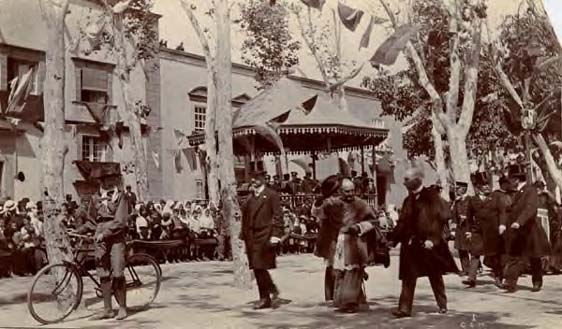 1913 Recepción de los Boy Scouts en la Alameda de Colón |
|
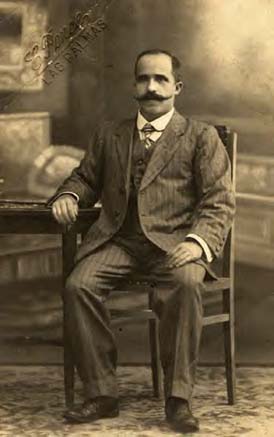 1912-1915 Gran Canaria Título Bigote Enhiesto |
Sent by Bill Carmena who writes:
|
|
LA EXPEDICIÓN DE MAGALLANES Fue el 20 de septiembre de 1519, cuando un portugués, Fernando de Magallanes, al servicio de la Corona española partió desde el puerto de Sanlucar de Barrameda, al mando de unos 250 hombres distribuidos en las naves, "Trinidad", San Antonio","Concepción", "Santiago" y "Victoria", con el objetivo de descubrir una nueva ruta entre Europa y Asia, a través del continente americano, buscando un paso por mar entre el Atlántico y el Pacifico. |
|
|
|
La expedición duró tres años, dieron la vuelta al mundo y el 8 de septiembre de 1522 llegó al puerto de Sevilla la nao "Victoria" y solo con 17 hombres. En el trayecto hubo de todo, unos murieron a manos de los nativos, entre ellos Fernando de Magallanes, otros desertaron en diferentes puertos, otros murieron de las mas diversas enfermedades, aunque muchas de las muertes la produjo el escorbuto y hubo motines, ahorcamientos para ejemplarizar al resto de la tripulación, y todo lo que se puede producir en una singladura de tres años de duración. Esta expedición tuvo mucha importancia en la actual provincia de Huelva, porque Magallanes escogió para captar tripulantes a un portugués residente en Ayamonte y a vecinos de Palos y Huelva y por lo tanto fueron muchos los naturales de esta provincia que formaron parte de la expedición. En una de las listas de tripulantes que ha llegado a mi poder encuentro 2 de Ayamonte, 1 de Bollullos, 2 de Aroche, 9 de Palos de la Frontera, 1 de Trigueros, 14 de Huelva, 3 de Moguer, 1 de Lepe, 1 de Aracena y 1 de Almonaster, Pero en esta lista faltan muchos por dos razones. La primera que muchos de los tripulantes alegaban que eran de Sevilla para encontrar facilidades para poder embarcar, ya que era allí donde se hacían lo que podríamos llamar la inscripción y la otra es que, muchos de los pueblos que actualmente pertenecen a la provincia de Huelva, pertenecían entonces a Sevilla y por lo tanto se incluían en su zona. Poseo tres listas y no coinciden ninguna, e incluso los nombres a veces difieren y es que en aquella época había tan pocos que sabían leer y escribir, que los documentos pocas veces estaban completos. Angel Custodio Rebollo Barroso |
||
Hijos Naturales de los Reyes Odiel Informacion: Edición 27 de julio de 2005 En la antigüedad entre los reyes, no solo los españoles sino los de otros países, era muy normal tener hijos fuera del matrimonio, aunque, por lo general eran reconocidos y sus padres les hacían donaciones de mucha importancia. Por ejemplo, el Emperador Carlos I de España y V de Alemania, le conocemos dos hijos naturales; Juan de Austria, que nació en Ratisbona en 1548 y Margarita de Parma que vino al mundo el 18 de enero de 1522 en Oudenarde. Ambos fruto de los amores con Janine Van der Gheenst. Felipe II nombró a esta dama flamenca, gobernadora general de los Países Bajos y ella intentó una política de concordia entre el rey y aquel territorio, pero aunque era una persona muy prudente, de gran talento y muy trabajadora, fracaso totalmente. Cuando envió el rey, al Duque de Alba con amplios poderes para restablecer allí la unidad religiosa. Margarita consideró que había sido sustituida y dimitió, retirándose a Italia, donde murió en 1586. Otro rey que también tuvo hijos naturales reconocidos fue Fernando El Católico, que fruto de sus amores con Aldonza Iborra, de una ilustre y noble familia catalana, nació Alonso de Aragón en 1470. Pero sobre este personaje hay mucho que contar, porque cuando solo tenía siete años de edad, fue nombrado arzobispo y perpetuo administrador de Zaragoza y su diócesis, con el premio de las rentas del Maestrazgo de Alcántara, la Camarería del Pilar de Zaragoza, las abadías de San Victoriano, San Cucufate y de Monte Aragón, el priorato de Santa Ana en Barcelona y muchas prebendas mas. Alonso de Aragón tuvo dos hijos, Juan y Fernando que le sucedieron unos tras otro en su dignidad. Alonso de Aragón, se ordenó sacerdote en 1501, y se cuenta que solo dijo la primera misa, por considerarse indigno de este ministerio. Fue también arzobispo de Valencia. Era hombre culturalmente muy formado y escribió algunas obras, entre ellas; "Cartas Latinas" y "Epístola sobre el Cardenal Ximenez de Cisneros". Durante seis años fue diputado y a la muerte de su padre se hizo cargo de la regencia de Aragón hasta que el Príncipe Carlos gobernó el reino.
Angel Custodio Rebollo Barroso custodiorebollo@terra.es
|
| Vergara Odiel Informacion: Edición 26 de julio de 2005 Hay apellidos que para averiguar su origen los genealogistas tienen que afinar mucho, especialmente en los apellidos que tienen nombre de ciudades, ya que siempre hay la duda si el apellido ha venido de la ciudad o la ciudad del apellido. Hay ejemplos muy claros, como Constantinopla que viene del Emperador Constantino o Barcelona, que lo es de Amilcar Barcino. El origen del apellido Vergara fue tomado del antiguo lugar de Viguera y posteriormente lo pasaron a la villa de Vergara, cuando fue fundada en 1268. Nació este apellido en el palacio de Don Gimeno, rey de Navarra y se extendió por Aragón, Castilla, Valencia y Andalucía. Destacaron los Vergara en la Batalla de las Navas de Tolosa, de 1212 y en la conquista de Baeza en 1227. En la conquista de Granada se distinguieron los hermanos Pedro y Francisco de Vergara. Este último hizo la aventura americana, mereciendo que el inca Garcilaso de la Vega, lo mencionase por su valor en su Historia del Perú. Otros Vergara pasaron a América demostrando sus meritos en Chile, prueba de ello es que Alonso de Ercilla en su poema "La Araucana" y lo confirma Ovalle en la Historia de Chile, que los caballeros de la casa de Vergara se señalaron en la batalla en que fueron vencidos los araucanos por García Hurtado de Mendoza. Gómez Ruiz de Vergara y Salazar fue oidor en las Islas Canarias, cargo para el que fue nombrado por el emperador Carlos V y se casó con Elvira de Zurita, siendo los progenitores de la gran rama de Vergara que se estableció en las Islas Canarias y que se extendió por toda la zona. Martín de Vergara, hermano del Obispo de León, Rodrigo de Vergara, fue Abad de San Millán de la Cogulla y otro hermano llamado Diego Ruiz de Vergara, fue Abad perpetuo de San Pedro de Cerdeña. También hubo un Pedro Ruiz de Vergara, sobrino de los anteriores que fue inquisidor apostólico de Sevilla, Arzobispo de Mesina y Consejero del rey Fernando el Católico. Posteriormente fue Inquisidor General de Nápoles y Sicilia. Y esta es a grandes rasgos la reseña del apellido Vergara, del que tenemos muchos en nuestra provincia. Angel Custodio Rebollo Barroso custodiorebollo@terra.es
|
| Ministerio de Cultura, Spain http://www.cultura.mecd.es/archivos/oa/ae/files/carta_archiindias.pdp Bill Carmena JCarm1724@aol.com |
|
|
Categories: Archivos Bibliotecas Cine y Audiovisual Libro Museos Música, Danza y Teatro Patrimonio Histórico Agenda Cultural Centros de Documentación Cooperación Cultural Cultura en Internet Fundaciones Propiedad Intelectual |
The following are: Links for Centros de Documentación Red de Centros de Documentación CENTRO DE DOCUMENTACIÓN CULTURAL CENTRO DE INFORMACIÓN DOCUMENTAL DE ARCHIVOS CENTRO DE DOCUMENTACIÓN DE LA FILMOTECA ESPAÑOLA CENTRO DE DOCUMENTACIÓN DEL LIBRO CENTRO DE DOCUMENTACIÓN DE MÚSICA Y DANZA CENTRO DE DOCUMENTACIÓN TEATRAL CENTRO DE DOCUMENTACIÓN DEL INSTITUTO DEL PATRIMONIO HISTÓRICO ESPAÑOL CENTRO DE DOCUMENTACIÓN DE PROPIEDAD INTELECTUAL |
|
XIII Reunion Americana de Genealogia - en Guatemala Muerte de doña Inés de Castro, poema antiguo Las Culturas.com Emérito Cronista de Pampán Don Gilberto Quevedo Segnini, Archivo General de Indias 14 Generaciones de Guadarrama Canarios, El Hierro Venezuela Jewish names in Suriname between 1666 and 1997 |
| XIII Reunion Americana de Genealogia - en Guatemala Sent by Lorraine Hernandez Lmherdz@hotmail.com Porfavor avisen aquellos que puedan estar interesados CO N V O C A T O R I A 1. La Academia Guatemalteca de Estudios Genealógicos Heráldicos e Históricos convoca a la XIII Reunión Americana de Genealogía que, Dios mediante, se celebrará del 7 al 11 de noviembre de 2005 en la ciudad de la Antigua Guatemala, República de Guatemala. 2. La XIII Reunión Americana de Genealogía es un evento científico internacional, de carácter privado, al que pueden asistir todas las personas individuales que así lo deseen y completen, para el efecto, el proceso de inscripción que dispone este Reglamento. 3. Se hace una especial exhortación a la asistencia de los genealogistas, heraldistas, historiadores, aficionados y, en general, a la intelectualidad de origen iberoamericano que viven en toda la extensión de América y sus islas adyacentes, la península, Ibérica, antiguas posesiones españolas y portuguesas en África, Asia y Oceanía, y a todos los interesados en nuestras ciencias sobre la faz de la Tierra. 4. El idioma oficial de la Reunión es el español Actualmente ya hay participantes de suramerica, centro america y España. Sin embargo queremos tener participacion de especialistas e interesados de Mexico y Estados Unidos y en fin queremos que la informacion de esta Reunion Americana de Genealogia pueda llegar a todos aquellos que podrian y quisieran participar. Para informacion adicional dirigirse a http://www.genealogica.com.gt/ con su servidor. Saludos cordiales desde Guatemala. Mario Ruben Ayala historiafamiliar2005@yahoocom |
| Muerte
de doña Inés de Castro autor anónimo Según relato de los herederos de Juan Solís, en los campos algodoneros de Barcelona, España y, en que se refiere la vida, y lastimosa muerte de doña Inés de Castro, llamada la Garza de Portugal, y las Majestuosas Exequias con que la honró, después de su muerte, el Rey Don Pedro de Portugal.
Desafotunadamente
la publicación no incluye fecha de autoría, pero ha de ser muy
antiguo por la forma del idioma castellano que utiliza.
Carlos
Martín Herrera de la Garza
Licenciado en Ciencias de la Educación
Universidad
Autónoma de Tamaulipas
Ciudad
Victoria, Tamaulipas, México
cherrera1951@hotmail.com
|
|
Biografía
Pedro I, called
"the Severe" (1320-1367), son of Alfonso IV, was born at
Coimbra, Apr. 19, 1320. He succeeded his father to the trone in
1357. He took part in the wars between Castile and Aragon and,
as king, dealt severely with the nobles, but was respected by the
people for his strict sense of justice. An unfortunate love affair
with Inéz de Castro added a tragic note to his personal life.
He died at Estremoz, Jan. 18, 1367. ( Collier's
Encyclopedia, Volume 18/24, The Crowell-Collier Publishing Company,
1963)
D. Pedro I
Oitavo rei de
Portugal, quarto filho de D. Afonso IV e de Beatriz de Castela.
A ligação amorosa entre o infante D. Pedro e Inês de Castro foi imediata o que provocou forte conflito entre D. Afonso IV e seu filho e provocou a morte prematura de Constança Manuel. Temendo o monarca a nefasta influência dos Castros em seu filho, resolveu condenar à morte Inês de Castro, o que provocou a rebelião de D. Pedro contra si. Contudo a paz entre o pai e o filho foi estabelecida em breve e D. Pedro foi associado aos negócios do Estado, ficando-lhe desde logo incumbida uma função, que sempre haveria de andar ligada à sua memória – a de exercer justiça. Durante o seu reinado evitou guerras; logrando aumentar o tesouro. Cunhou ouro e prata. E exerceu uma justiça exemplar, sem discriminações, julgando de igual modo nobres e plebeus. Os documentos coevos e o testemunho de Fernão Lopes definem-nos D. Pedro como justiceiro, generoso, folgazão, amado pelo povo e de grande popularidade. A sua morte o povo dizia que «ou não havia de ter nascido, ou nunca havia de morrer». Ficha genealógica: D.
Pedro I nasceu em Coimbra a 8 de Abril de 1320 e morreu em Lisboa a 18
de Janeiro de 1367. Casou em 1328 com a princesa D. Branca de Castela,
não se consumando o matrimónio por doença da noiva. Em 1334 tratou-se
de um novo consórcio com a infanta D. Constança, que nasceu em data
incerta e morreu em 1345, filha de D. João Manuel, infante de Castela.
Tiveram a seguinte descendência: 1.
D. Maria, nasceu em Évora a 6 de Abril de 1342; casou em 1354 com o
infante D. Fernando de Aragão; morreu em Aveiro depois de 1363,
ficando sepultada no Convento de Santa Clara de Coimbra; 2.
D. Luís, nasceu em 1344 e morreu uma semana depois; 3.
D.
Fernando, que herdou a coroa. De
uma nobre castelhana, D. Inês de Castro, nascida ao redor de 1325,
tendo morrido em Coimbra em 1354, foi sepultada em Alcobaça em 1361,
filha de D. Pedro Fernandes de Castro a de D. Aldonça Soares de
Valadares, teve os seguintes filhos: 4.
D. Afonso (morreu de tenra idade); 5.
D. João, nasceu em data incerta c. 1349; faleceu em Salamanca após
1385, tendo sido candidato ao trono português; 6.
D. Dinis, nasceu em data incerta por volta de 1350, foi aclamado rei
em Santarém, no ano de 1384, mas já tomara o partido de Castela;
fundou a casa de Vilar no reino vizinho, tendo morrido em data incerta; 7.
D. Beatriz, nasceu em Coimbra c. 1351; foi educada em Santa Clara de
Coimbra; casou com D. Sancho, conde de Albuquerque, irmão de D.
Henrique II de Castela; morreu em data incerta. De
uma Teresa Lourenço, nasceu em 14 de Agosto de 1356: 8. D. Joao, que veio a ser Mestre de Avis a primeiro rei da segunda dinastia. ( http://www.arqnet.pt/portal/portugal/temashistoria/pedro1.html
|
| Las Culturas.com http://www.lasculturas.com/lib/libGenealogy.htm Sent by Bill Carmena JCarm1724@aol.com Bill comments that there are many good links to the Canary Islands, Genealogy, and Hispanic/Latin American Genealogy and Family Research. Al Sosa's Hispanic Genealogy Page A beginners guide to genealogy research, information about Spanish surnames, current news, Spanish and Portuguese heraldry and book reviews. [English/Español] Anillo de Genealogía Hispana A excellent collection of links and information about Spanish family research. [Español] AOL Hispanic Surnames Database and Genealogy Interest Group A database of surnames, FAQ, bibliography, and links to articles and sites. They have a downloadable list of parish list and demographic registrars. Canary Islands Descendants Association The purpose of this group is to document the traditions associated with their Canary Island heritage and identify those traditions to others. Castilla Genealogy research for the Castilla surname. [Español] Cuban Genealogy Center Information to get started, surname information, and links to several resources. [English/Español] Genealogía de Venezuela (Venezuelan Genealogy) Bilingual family research for those of Venezuelan ancestry. [English/Español] Genealogía de El Salvador Genealogical, historical and cultural information about El Salvador. [English/Español] Genealogía de Las Islas Canarias (The Genealogy of The Canary Islands) Family history and culture from the Canary Islands. [English/Español] Genealogía de Puerto Rico (The Genealogy of Puerto Rico) An abundance of information from various sources about Puerto Rican ancestry. [English/Español] Genealogía Española Excellent resources including tips and resources. There is also information about Northern Mexican and Sephardic research and history. [English/Español] The Genealogy of Mexico An excellent resource and history for researching Mexican Spanish ancestry back to the Conquistadors. Hispanic Genealogy Center The Hispanic Genealogical Society of New York contributes by providing the knowledge of where we come from on a historical as well as a genealogical level. PRRoots.com Boricua Message Boards provide a place for Puerto Rican researchers, genealogy enthusiasts, families and friends to post messages, information and queries. Sephardi Connection A huge resource for Sephardic study. It contains forums, articles, research tools, history, mailing lists, genealogy, music, and a lot more. [English/French] Sephardic Genealogy Sources Resources for culture, history and family research. Sephardim.com Information on history, lore, recipes, heraldry and links about Sephardic family history. Spain - Researching Your Family Roots Message board, maps, flags, and beginners resources. Somos Primos An online monthly magazine dedicated to Hispanic Heritage and Family Research. Tulier's Genealogy & Puerto Rico Home Page A great collection of links and resources for Puerto Rican, Taino, and Hispanic family research. The Villarreal Family and the Spanish Inquisition A Villareal examines his Jewish ancestry. Were Your Ancestors from Toledo? A list of Jewish surnames in Spain, before the 1492 expulsion of the Sephardim. |
| Pampán su Historia, resumen Libro: Pampán y sus Gentes, (Estelas Perdurables) de Don Gilberto Quevedo Segnini y su Fundacion San Benito Pampán Sent by Roberto José Pérez GuadarramaValencia - Edo. Carabobo04143403350 Cel0058-241-8432029 Hab perezfru@telcel.net.ve En el día 19 de Julio de 2005 falleció el Respetado y Culto Escritor Pampanero Don Gilberto Quevedo Segnini: Cultor de las letras y sempiterno cronista de Pampán Alejandro J. Calderón Hurtado/Cronista de Pampán - El pasado martes 19 de julio entregó su alma al creador el Emérito Cronista de Pampán Don Gilberto Quevedo Segnini, quien se distinguiera como un ilustre ciudadano, cultor de las letras, miembro de la Real Academia de la Lengua y del Centro de Historia de Trujillo como Individuo de Número, siendo uno de sus fundadores y propulsores. Títulos y honores que supo ganarse por su dilatada trayectoria en el campo de la cultura, dejando un gran legado para la historia y proyectándose como un insigne hombre de aquilatados dones, los cuales puso al servicio de sus semejantes. Comenzó sus avatares de escritor, investigador y poeta en su natal Pampán y a la postre convertirse en su cronista, oficio que le permitió imbuirse en el campo investigativo del quehacer cotidiano y costumbrista del gentilicio pampanense, el cual supo llevarlo y proyectarlo en una gran obra que quedó para la posteridad como lo es: Pampán y sus Gentes (Estelas Perdurables). Libro que escribió en dos tomos o entregas y que lo catapultó como osado escritor en el campo de las letras, antes ya había escrito algunos ensayos y pequeñas obras. En este libro dedicado a Pampán plasmó lo cotidiano y vivencial del Pampán de antaño, desde su fundación hasta finales de los años 60. Dándole e imprimiéndole un toque muy personal como resultado de su acuciosa investigación, apoyado en archivos y narraciones de gentes que vivieron parte de esa época del otrora Pampán, colonial, postcolonial, el Pampán de su época de niño, adolescente y adulto, obra de gran contenido social que dedicó a su querido terruño y en el que proyectó los orígenes, la vida y pasión de un pueblo que supo sortear todos los obstáculos habidos y por haber, para constituirse en el pueblo que es hoy. Cumplió Don Gilberto Quevedo Segnini con lo que se prometiera a sí mismo como buen hijo de este pueblo y como cronista sempiterno que siempre será para todos nosotros, quienes le estamos muy agradecidos y donde deja una huella imborrable. Se destacó también esta eximia figura como articulista en este prestigioso Diario, publicando regularmente su muy leída columna "Palique de Altozano" con temas socio-histórico-culturales de gran interés. En esta pequeña crónica quise rendir un homenaje póstumo a mi homólogo, coterráneo y amigo Don Gilberto Quevedo Segnini, quien hoy ya no está con nosotros ya que se marchó a rendirle cuentas al Creador, pero nos queda su recuerdo, su insigne obra y legado que pasarán a la posteridad y las futuras generaciones tendrán conocimiento de su importancia y existir. En mi nombre y a nombre del pueblo de Pampán reitero mis palabras de condolencia a su esposa, hijos, hermanos, demás familiares y amigos. Paz a sus restos. Sent by perezfru@telcel.net.ve Pampán Orígenes: Después de haberse escogido el 9 de Octubre de 1957 para la celebración cuatricentenaria de Trujillo, el Hermano Nectario María logró establecer que fue un día indeterminado de Marzo o Abril de 1558 se fundó la Ciudad de Nueva Trujillo en la meseta de Escuque de la Gran Nación Cuicas, luego el Maese de Campo Don Diego García de Paredes, por tres veces consecutivas repitió la formula de su intención de poblar la Ciudad en el Nombre de Dios y de Su Majestad, sin que nadie lo contradijese; y que después Francisco Ruiz, al repoblarla en 1559 le cambio por el de Mirabel, para que Paredes en el mismo año la rebautizara como Trujillo de Salamanca, cuyo Nombre conservo mientras permaneció en el valle de Boconó (hoy La Encomienda) , desde la ultima quincena de Marzo de 1560 hasta Junio de 1563 y parte del 65 por las disconformidades que trajo, pero consumada por el interés de los miembros del Cabildo que buscaban estar próximos a sus encomiendas, subestimando lo fértil y propicio del clima boconés, nombre que no perdió al fijar su asiento en la quebrada o sabana de Motatán . No obstante “ Desde que el licenciado Alonso Bernáldez se encargo por segunda vez de la Gobernación, en Enero de 1564, muchas quejas llegaron a su despacho de Coro sobre las malas propiedades del asiento de Motatán” Así las cosas, a principios de 1565 Bernáldez acompañado de su Teniente Francisco de la Bastida visitó personalmente los diversos lugares propicios para un nuevo traslado y escogió el de Pampán, y “ al correr del año 1565 o principios de 1566 mudáronse de Motatán para Pampán”, dándosele el nuevo Nombre de Trujillo de Medellín, y donde por el 1568 la Ciudad de Trujillo principió a denominarse de Nuestra Señora de la Paz.Por tanto la “Ciudad Portátil” permaneció en el valle de Pampán hasta los primeros meses de 1570, cuando se completó el ultimo traslado a su asiento definitivo en la Quebrada de los Cedros, quedando allí el embrión de lo que más tarde sería la población de Pampán . Fundación: El historiados Trujillano Dr. Amílcar Fonseca, establece que la data auténtica de la fundación de la población de Pampn es en el año de 1679 cuando “el Cabildo, Justicia y Regimiento de la Cuidad de Trujillo, hubo donado las tierras de Pampán, al Licenciado Don Alonso Sánchez de Aponte, para que hiciese ranchos en ellas” ... Traslado y Repoblación: El núcleo urbano comenzado en 1679 con los ranchos construidos por el encomendero Licenciado Alonso Sánchez de Aponte, tuvo una vida comunitaria de apenas 165 años, pues en 1844 al grato acontecimiento de que la Diputación Provincial de Trujillo lo eleva a la categoría de Parroquia Civil dependiente del Cantón Carache al cual venía perteneciendo desde 1803 por decisión delas autoridades Españolas se contrapone en el mismo año el calamitoso azote de haber sido devastado por las fiebres, habiéndose disgregado el resto de pobladores salvados de la desolación.Entonces la señora Isabel Peña resolvió donar un terreno en el sitio llamado Entrada de Catalina, y los señores José Benito Raga y José Manuel Niño, compensándola, compartir con Ella tan noble gesto, ... Los donantes del terreno: Isabel Peña, Benito Raga y José Manuel Niño. Pobladores Autóctonos de Pampán: Juan Pablo Rondón, Encarnación Urdaneta, Francisco Rosales, Ignacio Ramírez, Juan de Dolores Raga, Eulogio y Lucio Peralta, Juan Antonio Bastidas, José Dolores Pérez, Ignacio Terán, Santos Briceño, Rafael y Miguel Moreno, Luciano Márquez, Benito Aponte, Ángel Barreto, Antolino Briceño, Idelfonso Vásquez, Vicente Raga, Zoila Barreto, Hilaria Araujo, Juana Raga, María Peralta, Adela Márquez, Carolina Peña, Juan Antonio Morón, Evarista Morón, Luis Márquez, Florencio Artigas, Candelaria Guerra, Fernando León, Candelaria Bastidas, Concepción Ramírez, Lisandro Arias, Pablo Núñez, Santos Segovia y Candelaria Peña ... Venidos de Afuera:Abigaíl Castillo, Agustín Mateos, Francisco de Paula Quevedo, Carlos Villegas, Manuel Villegas Briceño, Miguel Briceño, Francisco Javier Pimentel, Rosalía Pimentel, Pablo Macías, Neptalí Macías, Francisco Villegas, Ambrosio, Lucio y Trino González, José del Rosario López, Francisco Javier Urbina, Tobías Miliani, José Antonio Mauriello, Rodolfo Mazarri, Esteban Miliani, José Paolini Miliani ( Inmigrante Italiano de la Isla de Elba ), Fidel Perozo, Mamerto Morillo, N. Villafañe, Cantalicio Gutiérrez, Ruperto Hurtado, Dr. Ramón Briceño, Emeterio Briceño, José Antonio Segnini Lupi, Sebastián y Juan Antonio Segnini Miliani, Germán Mendoza, Fernando Segnini Lupi, Luis Rivas, Arcadio Chirinos, Ángel González, Tomás y Miguel Castro, Manuel Camacho, Rafael Paredes, Ciriaco Carmona, Isaías Barrios, Manuel Calderón , Ulises Paolini, Eulogio Colmenares Hipólito Carrillo, Pedro Segnini y su Hijo Antonio. Después del año 1880, llegaron las siguientes Personas:Leopoldo Pérez y Ramón Manuel Pérez Escalona , Ulises Cabrera , Luis Rivas , Heliodoro Rey , Rudesindo Mora , Manuel Bastidas , Gregorio Crispín Coronado, Juvenal Coronado, Juan Miguel y Gabriel Briceño Ravello , Orestes Urdaneta , Enrique y Carlos Pío Anzola , Pedro Castro, Juan Bautista Paredes, Enrique Pimentel , Juan Godoy Peña, Francisco Yépez , Bartolo Briceño , Rodolfo Pimentel , Dr., Víctor Manuel Pérez , Alfredo González , Nícomedes Cornieles , Juan Bautista Barroeta . Y en el primer cuarto del Siglo XX:Pedro Antonio y Maximiliano La Riva, Torello Mazarri, Emilio Paolini, Juan y Teodoro Mazzarri, Héctor Mazzei Braschi, Ismael Barreto, Br. Rafael Barroeta, Dr. Rafael González, Sinforiano González, Juan Alejandro Pietesz, Dr. Antonio José Carrillo Márquez, Pedro Carrillo Márquez, Ildefonso Vale, Carlos Pannaci, Miguel Duarte, León Gásperi, Eliseo Peña, Amadeo Bracamonte, César Briceño Matos, Marcos Bianchi, Nicolás Murzi, Simon Abreu, Juan Godoy, Pedro A. Vásquez, Erhard Vieweg, Narciso Calderón, Miguel García, y Rafael García . Localización: Pampán, capital del Municipio homónimo, es la cuarta Ciudad Trujillana, y está situada a 13 kilómetros al oeste de la Ciudad de Trujillo, Capital del Estado, a 29.8 kms. de Valera y a 71 Kms de Boconó, que le anteceden y a 597 kms. de la Capital de la Republica,... Escala de población: En el Primer Censo Nacional del 7 de Noviembre de 1873 aparece la parroquia de Pampán con 405 casas en ocho sitios, cinco de ellas sin habitar y 2.422 habitantes; para la época el Estado tenia 108.672 habitantes y la Republica 1.784.194 h. Para el Segundo Censo Nacional de 1881, la población de la parroquia de Pampan se había elevado a 3.263 h. Entonces el Gran Estado Los Andes registra 293.108, la Sección Trujillo 131.406 y la Republica 2.075.245 y de los 361 extranjeros radicados en la Sección 25 son Italianos.Para el Tercer Censo Nacional del País en 1981 la población de Pampan sufre una ligera baja, pues registra solo 3.066h., cuando la Republica ya llega a 2.200.000, el Gran Estado Los Andes 336.146 y la Sección Trujillo 146.585 . En 1926 la población del Municipio totaliza 4.831 h., el Estado Trujillo 218.780 y la Nación 3.020.000Para el Censo del 7 de Diciembre de 1941 el Municipio Pampan tiene 7.543 h. Y la capital 1.969 h. Para el 26 de Noviembre de 1961 el resultado es 11.065 el Municipio y 3.143 h. la CapitalPara consulta de Población y Censos recomiendo la siguiente Pagina: http://iies.faces.ula.ve/censo90/poblacion.htm Leopoldo Pérez: Oriundo de Ospino, Estado Portuguesa, Don Leopoldo era rubio, buenmozo, de impotente presencia varonil y dotado de una connatural vocación para el trabajo supo incrementar una cuantiosa Fortuna; fue de los valiosos Personajes que las consecuencias de la Guerra Federal aventó del llano o Los Andes. Se caso en Pampan con Doña Amelia Rueda Godoy, natural de Pampanito, y fundo un hogar tan prolífico y multiplicado que junto con los que constituyo su paisano y pariente Don Ramón Manuel Pérez Escalona son fuente, sepa y linaje cuyas ramificaciones en nuestro terrazgo le han dado el cognomento de “Pueblo de los Pérez”. La descendencia matrimonial de Don Leopoldo y Dona Amelia, fue: Coromoto, Rafael Epaminonda, Ramón Manuel, Leopoldo, Pedro Pablo, Ángel Maria, Baudilio, José de Jesús, Néstor, Soila Soledad, Margarita, Nicida, Juana Maria, Gilma y Maria de la Trinidad. Don Leopoldo que había nacido alrededor de 1850, murió en Pampan en 1905 y lo sobrevivió Doña Amelia hasta el 28 de Julio de 1931. Nombres y Apellidos de Pampanenses: Alberto Briceño Márquez, Benito González, Militares Nombrados en el Libro: 1843-1844 General Cruz Carrillo. Gobernador de la Provincia ( 2da. Vez )1871 General Juan Bautista Araujo, General Fuerzas Conservadoras.1871 General Inocencio Carvallo, General Fuerzas Liberales, Presidente Provisional del Estado .1871 General Víctor de Jesús González ( Alias El Tuerto), General Fuerzas Conservadoras1871 Dr. y General José Emigdio González.1897 General Rafael Rojas Fernadez.1899 Octubre Dr. y General Rafael González Pacheco (Partidario de Cipriano Castro ).1899 General Benjamín Ruiz y/ Doctor Y General Rafael Bolívar 1899 Coroneles Miguel Contreras ( Miquelon )1899 León Chirinos, Coreano y sus Hermanos son: Ezequias y Arcadio ChirinosDr. y General Leopoldo Baptista. Partidario del Gobierno de turno y 1910 ocupa un puesto preferente al lado del Benemérito General Gomez. El 18 de Agosto 1899 General Cipriano Castro entra a Pampan . De Pampan lo siguieron: Lucio Peralta y Luis Valera Hurtado.1904 General Carlos Liscano, Presidente del Estado Trujillo ( Gobierno de Cipriano Castro)1904 General Manuel Salvador Araujo( Trujillano), Presidente del Estado Lara ( Gobierno de Cipriano Castro )1904 General Clemente Echegaray . Palabras al lado de Cipriano Castro.1910 General Colmenares Pacheco.1910 General Víctor Manuel Baptista. Presidente del Estado Trujillo ( Gobierno Gomez )1916 General Timoleon Omaña, Presidente del Estado Trujillo (Gobierno Gomez)1916 General Leonidas Vivas (Gobierno Gomez )1916 General Joaquín Gabaldon (Gobierno Gomez )1916 General Martín Márquez ( Gobierno Gomez, Presidente del Concejo Municipal )1924 General Vincencio Pérez Soto, Presidente del Estado Trujillo1924 General Amador Uzcategui1924 General Pablo Briceño Iturriete1924 Coronel Pedro Pinto Salvatierra1924 Coronel Pedro Luis Duno Heres1926 General Amador Uzcatequi , Presidente del Estado Trujillo1929 General Federico Araujo, Presidente del Estado Trujillo.1930 General Emilio Rivas , Presidente del Estado Trujillo1930 Coronel Gustavo Fonseca1930 General Emilio Rivas , Presidente del Estado Trujillo 1864 al 17 de Mayo 1875 Estado de los Andes. ( Presidente Guzmán Blanco )José Miguel Pimentel tiene una casa en La Aguadita 1871.( Padre de Roberto Pimentel Troconis) Autoridades Civiles de Pampan, correspondiente al periodo 1874 a 1944 Vicente Raga 1874, Pablo Macias 1874-1877-1878 y 1880, Francisco Méndez 1875 al 1879, José del Rosario López 1875 al 1890, Temistocles Márquez 1876, Ildefonso Vásquez 1877, Manuel Villegas Briceño ( alias El Poncho ) 1878-1886-1887-1892-1893-1897, Rafael Carrillo 1878-1879, Francisco Villegas 1878-1892-1893, Lisandro Arias 1879-1880, Alfredo Castellanos 1880, Eulogio Colmenares 1880-1883-1884, José Loreto Quevedo Raga 1881,1882,1886,1888,1893,1897,19,1908 y 1909, Lisandro Matheus Raga 1884 y 1885, Leopoldo Pérez 1885-1886-1889-1890-1891 y 1893, Rosendo Baltasar 1887, Mamerto Morillo 1887, Manuel Camacho 1887 y 1888, Manuel Camacho 1887 y 1888, Manuel Antonio López 1889-1887 al 1890, José Ignacio Torrealba 1891, Enrique Pimentel 1892, Froilan Saavedra 1892, Jorge Isaac González 1893, José Agustín Matheus Raga 1892,1893-1894-1898 y 1915, Ruperto Hurtado 1895-1896-1899, Eladio Perdomo 1897-1989, Luis Rivas 1898, Alfredo González 1898-1902, Ulises Cabrera 1899, German Mendoza 1899, Félix Ignacio Terán 1899-1900-1914-1915, Miguel Maria García Morón 1899 al 1900-1902-1903-1904-1908, Juan de Dios Colmenares 199, Euripedes Román 1901, Ildefonso Vale 1902-1909, Nicasio Méndez 1902, Julio Barroeta 1902-1904, Santos Méndez 1902, Trino Santos 1906, Guillermo Pimentel Troconis 1906, Francisco Araujo 1907, Ángel Maria Albarran 1908, Miguel Maria García Morón 1908, Francisco de Paula Quevedo Guerra 1910-1911, Faustino Dura 1911-1912, Pedro Pablo Pérez Rueda 1912-1913-1926-1927, Juan Francisco Urbina 1914-1937-1938, Antonio Maria Ramírez 1915 al 1918, Jesús Maria Olivares 1918, Alejandro García 1919, Vicente Carrillo Heredia 1919 a 1921, Antonio Maya 1921, Antonio Quintero Bastidas 1921-1922-1923, Filadelfo Araujo 1923, Felipe Bastidas 1923-1924, Pedro Luis Duno Heres 1924, Rafael Rivas Perdomo 1924-1926, Maximiliano Pineda León 1926, Roberto Pimentel Troconis 1927, Ramiro Cardozo Montero 1927, Marcos Aurelio Morales 1928, Rafael Antonio Pérez Vivas 1928 al 1931,1933-1936-1939, Heli A. Torres 1931-1932, José Rafael Maradey 1932, Eleuterio Casado Gomez 1932, José Antonio Castro 1933-1034, José de Jesús Pérez Rueda 1939-1940, Manuel Sánchez Benítez 1939-1940, Eduardo Pannaci Vásquez 1941-1943-1944-1948-1949, Miquel Abreu 1942, Demetrio Villegas 1943 al 1945, Ángel Maria Pérez Rueda 1944, Cesar Augusto Cegarra 1945-1946, Isilio Picon M. 1946-1947, Antonio J. Álvarez 1947-1958, Rafael Hernández 1947, Rubén Darío Pacheco Araujo 1947, Eladio J. León Calderón 1947-1948, Arquímedes Álvarez M. 1948, José del Rosario Ruiz Araujo 1950, José Agustín Matheus Viloria 1950, Lucio Rincón 1950, José Francisco Vásquez 1950-1951, Helio Humberto Cegarra 1951-1952, Enrique Gásperi 1952, Ángel Maria Pérez Rueda 1952 al 1957, Asisclo Arajo B. 1957, Ramón Urbina 1957-1958, José Juan Colmenares 1958, Jorge Fonseca Gutiérrez 1958-1959-1964 al 1966, José del Carmen Quevedo 1959, Eliseo Carrillo 1959-1960, Ermito Antonio Cabrera 1961 al 1964, Antonio Araujo León 1966 al 1968, Pablo Antonio González 1968, Rafael Darío Parra Bastidas 1968 al 1970, José Luis Araujo 1970 al 1972, Humberto Cabrera 1972 al 1974, Mario García 1974. Regentes de la Escuela Publica hasta 1921:José Antonio Dupuy, Ramón Castellano, Francisco Javier Urbina, José Rosario López, Esteban Urbina, Rafael Quevedo, Azarias González, Abraham González, Manuel Briceño Valero, Pedro Antonio Vásquez, Indalecio Domínguez, Fernando Segnini Lupi, Florencio Monreal, Lorenzo Valero, Rafael Antonio Pérez Vivas, Segundo Ramón Castellano, Enrique Henríquez, Fernando Segundo Segnini, José Briceño Rueda, Miguel Salas, Argimiro González y José Cornelio Urbina. De escuelas de niñas han sido preceptoras hasta 1921:Candelaria Martínez, Rita Matheus, Juana de Núñez, Agripina Baptista, Maria Cristina Segnini y Carmen Cortes de Salas. Otras Escuelas regentadas por:Una Escuela Federal de Varones, regentada por José Cornelio Urbina; una Federal de Niñas, regentada por Maria Cristina Segnini; una del Estado de Varones; una de labores regentada por Melida Valecillos; y una Mixta particular, regentada por Josefina Dupuy Isla de Elba y Apellidos Elbanos:En el mar Tirreno entre la isla de Córcega y la península italiana, a once kilómetros de esta se encuentra la isla de Elba, la mayor del archipiélago toscano, tiene 224 Kmts2. y alrededor de 30.000 habitantes que se multiplican pasando del medio millón en la alta temporada de turismo. Forma parte de Italia ( Reino y Republica ) desde 1860, antes los etruscos de Populonia explotaron su hierro; fue colonizada por los bocences y ocupada por los romanos; estuvo en poder de Pisa en el medioevo y tambien de Génova; de 1596 a 1709 perteneció a España y después al reino de Nápoles; en 182 fue adjudicada a Francia: y por cerca de diez meses ( Mayo 1814-Febrero 1815) constituyo un pequeño reino cuando en ella permaneció desterrado Napoleón Bonaparte, después fue anexada al ducado de Toscana hasta la unificación de Italia. Fue llamada Aehalia y Elba por los griegos, los señores del Lacio la denominaban Ilva o Alba, los etruscos y los fenicios Ilipa.En la segunda mitad del siglo xix hubo desde esta bella isla hacia Venezuela y principalmente hacia el Estado Trujillo una corriente migratoria que por toda la geografía regional: El Morro ( Campo Elías ), Bocono, Pampan, Torococo, Las Virtudes, Monte Carmelo, Escuque, Valera, San Lázaro, etc. Afinco ramosamente y con honda raigambre los apellidos del lugar, a saber: Cherubini, Canata, Paolini, Mazzarri, Braschi, Murzi, Zoppi, D Apollo, Fontana, Ferrini, Velazco, Tagliaferro; así como Provenzali, Sardi, Anselmi, Pardi, Garbati, Poggioli, Retali, Massini, Spinetti, Miliani, Dini, Garvi; además de Parilli, Montano, Romano, Elbano, Rossi, Balestrini, Ravello, Burelli, Berti, Mibelli; tanto como Mazzei, Selvi, Lombardi, Batoni, Gori, Tachella, Ginnari, Ciangherotti, Mauriello, Greco; igualmente Ricci, Carnevali, Magi, Luciani, Giacopini, Pisani, Lupi, Corci, Tori, Quintini; y tambien Gentili, Vita, Carradini, Bochechiampe, D Alta, Valeri, Gásperi, Lombardi, Testa, Mannucci, Leonardi, Brigneto, y tantos mas que se escapan de entre la vasta patronímica insular, entre los cuales se nos pueden haber colado procedentes de la península. |
Archivo General de Indias http://www.mcu.es/archivos/urbanismo/index.html Paisajes urbanos de America y Filipinas Sent by Johanna De Soto http://www.mcu.es/archivos/urbanismo/#">América del Norte http://www.mcu.es/archivos/urbanismo/seg_nivel/box-canada.html">Canadá http://www.mcu.es/archivos/urbanismo/seg_nivel/box-usa.html">Estados Unidos HREF="http://www.mcu.es/archivos/urbanismo/seg_nivel/box-mexico.html http://www.mcu.es/archivos/urbanismo/#">América del Sur http://www.mcu.es/archivos/urbanismo/seg_nivel/box-ecuador.html">Ecuador http://www.mcu.es/archivos/urbanismo/seg_nivel/box-colom.html">Colombia http://www.mcu.es/archivos/urbanismo/seg_nivel/box-peru.html">Perú http://www.mcu.es/archivos/urbanismo/seg_nivel/box-chile.html">Chile http://www.mcu.es/archivos/urbanismo/seg_nivel/box-bolivia.html">Bolivia http://www.mcu.es/archivos/urbanismo/seg_nivel/box-argen.html">Argentina http://www.mcu.es/archivos/urbanismo/seg_nivel/box-parag.html">Paraguay http://www.mcu.es/archivos/urbanismo/seg_nivel/box-urug.html">Uruguay http://www.mcu.es/archivos/urbanismo/seg_nivel/box-brasil.html">Brasil http://www.mcu.es/archivos/urbanismo/seg_nivel/box-guayana.html">Guayana http://www.mcu.es/archivos/urbanismo/seg_nivel/box-vene.html">Venezuela http://www.mcu.es/archivos/urbanismo/#">Islas Antillas http://www.mcu.es/archivos/urbanismo/seg_nivel/box-cuba.html">Cuba http://www.mcu.es/archivos/urbanismo/seg_nivel/box-repub.html">República Dominicana http://www.mcu.es/archivos/urbanismo/seg_nivel/box-haiti.html">Haití http://www.mcu.es/archivos/urbanismo/seg_nivel/box-puerto.html">Puerto Rico http://www.mcu.es/archivos/urbanismo/#">Islas Filipinas |
| Subj: 14 Generaciones de Guadarrama Canarios, El Hierro From: perezfru@telcel.net.ve Muy Buenos Días: Comparto con Ustedes información que me llega desde Las Islas Canarias, Isla de El Hierro, España, donde actualmente vive la Sra. Rosa M. Guadarrama García. Quien manifiesta tener 14 Generaciones de Guadarrama, Canarios, de El Hierro en sus registros Familiares. Por Mi parte Yo solo tengo 6 Generaciones de Guadarrama (aproximadamente 1825/1830), Venezolanos, registrados hasta la fecha, establecidos en la Península de Paraguaná. Además de los nombre de 2 Hermanos Canarios( D. Marcos Pérez Guadarrama y D. Juan Miquel Rodríguez Guadarrama ) que se establecieron en la Península de Paraguana en Venezuela en 1753 y 1760. Desconozco ¿Si algunos de los Descendientes de esta Familia Guadarrama Canaria emigro a Venezuela, México, Puerto Rico, Cuba, Republica Dominicana,...??? Y ¿Si esta Familia Guadarrama Canaria es la Fundadora o el Núcleo del Apellido: Guadarrama en España, en América, en Venezuela,...? Si les gusta la Buena Información (Económica, Política, Historia Empresarial Venezolana,...) le recomiendo el Periódico Descifrado, sale todos los Jueves, cómprenlo hoy antes que se acabe, esta Excelente "Edición Aniversaria" Roberto José Pérez Guadarrama perezfru@telcel.net.ve Urb. Trigal Norte, Avenida Del Antártico Conjunto Residencial Valle Escondido, Casa # 10, Valencia, Estado Carabobo, Venezuela 2001 0058-241-8432029 Hab 04143403359 Cel e-mail: perezfru@telcel.net.ve MIS ANTEPASADOS DIRECTOS generaciones MIGUEL DE GUADARRAMA (LLEGADO DE CASTILLA LA VIEJA)(CABALLERO DE SANTIAGO) 14 BARTOLOMÉ DE GUADARRAMA (ESCRIBANO PUBLIDO)(VECINOS DE LA PALMA) 13 CATALINA GOMEZ JUAN BRAVO GUADARRAMA 12 CATALINA NUÑEZ (6 HIJOS) BARTOLOME GUADARRAMA NUÑEZ 11 INES DE SIMANCAS (5 HIJOS) DIEGO SIMANCAS Y GUADARRAMA (TESTAMENTO 1695) (CASO 2 VECES) 10 ANDREA ESPINOSA ( 1 HIJA ANA)(CASADOS 1654) MARIA GONZALEZ QUINTERO (CASADOS 1691) (6 HIJOS) MATEO GUADARRAMA QUINTERO (CASO 2 VECES) - COBRADOR EN 1705 9 MARIA ARMAS QUINTERO ( 2 HIJOS) MARIA PADRON GONZALEZ (CASADOS 22.07.1753) (2 HIJOS) MATHEO GUADARRAMA PADRON (VALVERDE) (CASADOS 22.07.1753) 8 MARIA QUINTERO O (MARIA FUENTES) O (MARIA DE FEBLES) JUAN JOSEF GUADARRAMA(20.03.1760/ ) GUARAZOCA 7 MARIA PADRON (CASADOS 14.06.1783) (4 O 5 HIJOS) FRANCISCO ANDRES GUADARRAMA PADRON (CASO 2 VECES)CASAS DEL MONTE 6 MARIA DOMINGA MORALES(CASADOS 26.11.1810)(2 HIJOS) MARIA CONCEPCION ARMAS (3 HIJOS) JOSE MARIA GUADARRAMA ARMAS (1825-1889) - CASAS DEL MONTE 5 RUFINA ARMAS QUINTERO?(NUÑEZ?) (3 HIJOS) JOSE FRANCISCO GUADARRAMA ARMAS (1868-1939) - LAS MONTAÑETAS 4 Mª DE LA CRUZ PADRON GONZALEZ (1867- ) (7 HIJOS) VIDAL GUADARRAMA PADRON (1900 - 1979) 3 CESAREA JOVITA PADRON ARMAS (5 HIJOS) (CASADOS 1920) GREGORIO GUADARRAMA PADRON (1926-1998) 2 MARIA ANTONIA GARCIA LIMA ( 3 HIJOS) (CASADOS 28.02.1951) ROSA M GUADARRAMA GARCIA (1955- ) 1 |
Jewish names in Suriname between 1666 and 1997 http://www.cq-link.sr/personal/debye/names/ Sent by Johanna De Soto A AALSMEER, ABARBANEL, ABENACAR, ABENATAR, ABENDALAK, ABENDANON, ABOAB, ABRAHAMS, ADELAAR, ALBERGA, ALEN VAN, ALETRINO, ALEXANDER, ALITENSIA, ALVARES, ANAVIA D', AQUILAR D', ARON, ARONS, ARRIAS, ASIVEDO D', ASSER, AVILAR D', AZIJNMAN, AZULAY. B BACHRACH, BAEZA, BALLIN, BAREND, BARENDS, BARNETT, BARRIOS DE, BARUCH LOUZADA, BARZELAY, BAS, BECK, BEER DE, BEHR, BELLA DE LA, BELLO, MESQUITA, BELMONTE, BENJAMIN, BENJAMINS, BENLISA, BENTO, BERENBLUM, BERG VAN DEN, BERLINER, BERNHOFF, BIENVENISTA, BLANES, BLANK, BLUMOWITSCH, BOAS, BOAS DE VRIES, BONN, BOOMWIJK, BOON, BRANDON, BRAVO, BREEBAARD, BRITTO DE, BROEKHOVEN VAN, BROMET, BROOK, BRUIN DE, BRUINING, BUENO BIBAS, BUENO DE MESQUITA. C CABENDA, CAHANET, CALISCH, CAMPEN VAN, CAMPOS DE, CAHANET NASSY, CANHO, CAPADOCE, CARDOSO BAEZA, CARRILHO, CASTILHO DEL, CASTRO DE, CEDERO CORCOS, CHARLOUIS, CHUI HUNG, CITROEN, COENRAADS, COERLAND VAN, COHEN, COHEN A, COHEN DELMONTE, COHEN LOBATO, COHEN NASSY, CONTENT, COREA, CORONEL, CORTESSAZ, COSTA DA, COSTER, COTINO (COUTINHO), CRASTO, CRESPO, CRONIE, CURIEL. D DANIELS, DAVIDS, DELMONTE, DINIM, DOEL VAN DER, DONK, DORT VAN, DOVALE, DRIELSMA, DURKHEIM, DUYM. E EINHORN, ELIAS, ELIASER, ELKIN, EMANUELS, EMDEN VAN, EMMEN VAN, EINSTEIN, ENTEL, EPHRAIM, ERGAS, ETTEN VAN, EZECHIEL, EZECHIELS. F FALÇAO, FARIA DE, FARRO, FAULBORN, FERARES, FEREYRA, FERNANDES, FERRI, FONSECA, FONSECA D', FORTUYN, FRANZIE, FUENTA DE LA, FURTADO, FUZIGEMIAS. G GABAY, GANS, GARCIA, GELDER VAN, GENTILLEZ DE, GEZIAS, GOEDMAN, GOEDSCHALK, GOMES, GOMPERTS, GOSEN, GRACIA, GRADIZ, GRADIZ DA FONSECA, GRANADA DE, GRAND LE, GRATTO, GROEN, GROL VAN, GUEDES, GUIDION. |
|
Dichos by Ophelia Marquez |
1) Díme con quien andas te diré quien eres. Tell me who you associate with, and I will tell you who you are 2) Dios dice ayudate, que yo te ayudaré. God says help yourself and I will help you. 3) Entro por lana y salio esquilado He went after wool and came out sheared. 4) Con la vara con que medes seras inedio With the same criteria that you judge you will be judged |
|
Insignia of Hereditary Societies Napoleon, The Internment Camp And Tejanos Vietnam Vets Gaining Back Pride, Medals The Homestead Act Southern Claims Commission- Disallowed Claims |
|
NAPOLEON, THE INTERNMENT CAMP AND TEJANOS By Richard G. Santos, Chairman Zavala County Historical Commission richardgsantos@yahoo.com Sent by George Gause ggause@panam.edu
In 1803, Napoleon Bonaparte issued a decree through which France detained British citizens within the Empire. The détenu law differed from the then accepted rules of war which allowed a country to kill, enslave or allow a captured citizen of an enemy nation to be rescued for ransom. Napoleon's law allowed him to trade French military officers held by England for British non-combatants held in the French Empire. The British were slow to react but by 1810 social and political pressure forced them to trade. By that year, France held 11,458 British citizens and England held over 65,000 French military prisoners of war. Napoleon was able to get back a great number of captured senior officers in exchange for non-combatant British citizens caught behind enemy lines while touring Europe. In retrospect, Napoleon Bonaparte got the better end of the trade for the exchanged officers were able to rejoin the French military forces. Through Napoleon's détenu the trading of civilians, spies and wounded prisoners of war became a facet of war. |
Vietnam Vets Gaining Back Pride, Medals Associated Press | August 05, 2005 Sent by Willie Perez gillermoperez@sbcglobal.net PROVIDENCE, R.I. - Still in his Army greens, William Tallerdy barely had both feet back on American soil when a man came up to him, demanding to know if he was returning from Vietnam. Then, right there in the airport, the heckler punched the veteran in the face. Tallerdy exploded. The police and his relatives had to restrain him. Soon after, he threw out his war ribbons. That was 1967. "I was always proud of my military service," said Tallerdy, who is now 57 and lives in Cheyenne, Wyo. "It was just that people made me feel like scum." Tallerdy wasn't alone. Many returning Vietnam veterans, faced with a hostile public, threw out their medals. Some, like former Democratic presidential nominee John Kerry, even did it in public as an act of protest. Others simply tossed them in drawers and foot lockers - if out of sight, perhaps out of mind. Four decades and a nation friendlier to the military, though, have helped a number of veterans come to terms with their service. Now, they regard their medals with a renewed sense of pride - and are replacing them or dusting them off. "We made peace with the former enemy," said Bob Kerrey, a former Nebraska senator who earned the Medal of Honor in Vietnam. "And we made peace with a former enemy that had defeated us, which is extremely hard to do." Tallerdy requested his Purple Heart medal a few years ago. Today, the replacement is in a cabinet alongside eagle figurines, dog tags and other war memorabilia. The Pentagon doesn't keep statistics on replacement medals, according to spokeswoman Lt. Col. Ellen Krenke. The anecdotal evidence from the veterans themselves, however, suggests the numbers are high. While Tallerdy displays his Purple Heart in his living room, William Muns shows off his honors - among them the Good Conduct and Vietnam service medals - on the wall of his office in Beaver County, Pa., where he is the county's director of veterans affairs. Muns had stashed his medals and his uniform inside a foot locker when he came home in January 1968. He wanted to move on. He never talked about the war, not even with his family. Then, five years ago, his wife brought his medals out and created a shadow box for him. "'You were there. You were exposed. You were put in harm's way,'" Muns recalled her telling him. Many who served in Vietnam, Muns said, are in the process of "coming out" as the passage of time has changed feelings about that war. "Today we're showing ourselves because we want those men that are active right now to know that they are welcome and they are being supported," Muns said. Honored though he was, John Wallace packed up his medals because he just didn't want to relive that moment when he helped men out of a downed helicopter before a B-52 strike. That changed in 1989 when Wallace began doing advocacy work for veterans. "The doors started opening up in my mind," Wallace said. "I was feeling better, I was relating more to my brothers in arms than I was to the civilians." Now, he's president of the Vietnam Veterans of America state council in Maine and keeps his medals, which include the Bronze Star and Air Medal, on the wall in his computer room. "They see that and it sort of makes them feel better," Wallace said of younger veterans from Iraq and Afghanistan. "They can ask about how I got them, I can explain to them how I got them. It makes them feel better because what I went through was maybe worse than what they went through." Tallerdy traveled to Branson, Mo., last month for the first Operation Homecoming USA, a weeklong tribute to Vietnam veterans. The experience moved him profoundly. "I think now," he said, "it's almost become prestigious to say that you're a Vietnam veteran." |
| The Mini Page by Betty Debnam Sunday August 7, 2005 The Homestead Act Have you been enjoying your summer vacation? If so, you're not alone. Most American school kids get
t1o take the summer off. But for kids living on frontier homesteads in the mid 1800's, summer was probably their busiest time. Everybody in the family had to work from sunup to sundown to pt food on the table. But most people did not feel bad about working this hard. They felt lucky because they were working for their chance to own their own land. |
Excerpt: Federation of Genealogical Societies FORUM Volume 17 Number 2, Summer 2005 Pg. 13 Southern Claims Commission- Disallowed Claims Southern Claims |
|
Ancestors at Rest Find free USA death records online "We Are The Chosen" - Author Unknown Family Tree Sourcebook Introducing Learning Centers Hello Mr. Inclan Online Genealogy Workshops Search 105 Million Names on FindYourFamilyTree.com! NewspaperARCHIVE.com |
|
|
| Find free USA death records online Sent by Janete Vargas http://www.ancestorsatrest.com/funeral_cards Find your ancestors in death records. Search free databases such as coffin plates, death cards, funeral cards, wills, church records, family bibles, cenotaphs and tombstone inscriptions on AncestorsAtRest.com Find links to other great death records like cemeteries, vital stats, and obituaries. Learn where to find death records off the net. These are links to topics on this site: Coffin Plates ~ Funeral Cards ~ Cemetery Records ~ Family Bibles ~ Obits ~ Vital Statistics ~ Wills ~ Funeral Homes ~ Church Records ~ Military Deaths ~ Cenotaph Records ~ German Death Cards ~ Articles ~ Funeral Cards by Elizabeth Kelley Kerstens, CGRS Uncovering death information about an ancestor can frequently reveal details about his or her life and family that would be difficult to find in any other source. Obituaries frequently include birth, marriage, and death dates and places of the deceased, the maiden name of a wife, children’s names, parents’ names, occupations, places of residence, and highlights of his/her life. Unfortunately, not every ancestor had an obituary published revealing these details for the benefit of descendants. Instead, some people discover printed memorial or funeral cards in collections of their parents or relatives. While these cards don’t give the range of detail often found in obituaries, they can still be of great value in furthering research. Funeral cards have a long history–with social customs attached. These cards were to be distributed to family members, friends, and the surrounding community in a timely manner to alert invitees to the date and time of the funeral. Recipients of a funeral card were expected to attend the funeral or risk offending family members. Conversely, those who did not receive an invitation would have been insulted, whether it was intentional or an oversight. Funeral cards are an overlooked genealogical resource. They often contain both the Birth date and Death date and can be used as a substitute for vital records. (Well technically they are not a substitute for vital records as the person giving the info might not have known for sure when the deceased was born or died. But it's a good place to start.) If you want to know more about what things qualify as a true Vital Records there is a good article at the Olive Tree. Unfortunately these valuable resources are scattered and there has not been a single repository for this resource until now. It is my intention to create the largest funeral card database on the net. |
|
|
| Elmwood
funeral street car, built by International Railway Co of Buffalo NY in
1895. If you have a transcription or a photo of death records (cemetery listings, funeral cards, death cards, coffin plates, church records etc) help build this database by submitting your death records submissions@ancestorsatrest.com |
| "We Are The Chosen" - Author Unknown Sent by George Gause ggause@panam.edu
In each family there is one who seems called to find the ancestors. To put flesh on their bones and make them live again, to tell somehow they know and approve. |
| FGS Delegate digest - Volume 12, No. 9 ONLINE GENEALOGY WORKSHOPS If you know of any others please let me know. starrcamp@aol.com http://www.MyFamily.com offers workshops in genealogy. These appear to be a good value and each course is taught by an expert of that particular subject. Enrollee's obligation is to commit a few hours each week during the 4-week course and pay $39.50. Included in the fee is a 30-day subscription to http://www.Ancestry.com , which has more than 2 billion names and online census images. There are eight written lessons from the instructor. Some instructors assign homework. Enrollees can share stories and exchange information. Computers need the Microsoft Explorer browser with Java capability. Each enrollee will receive an official e-mail invitation to the class site including an ID password to provide access. Access to class material is 24 hours a day. Brigham Young University also offers 26 free online genealogy courses. They include "Finding Your Ancestors," "Introduction to Family History Research," "Helping Children Love Your Family History" and "Family Records." Go to this web site: http://home.byu.edu and on the left side of the page, click "courses online," then click "free web courses." The university also offers genealogy classes for credit. Click "courses online," then "university courses," then "history." (This information was taken from Aulena Scearce Gibson's columns Tree Tracers published in the Lawton Constitution on 10 and 22 January 2005) |
| Search 105 Million Names on
FindYourFamilyTree.com! Sent by Genealogia-Mexico@googlegroups.com
Dear Genealogists,
|
| NewspaperARCHIVE.com Sent by Janete Vargas magnaguagno@gmail.com http://www.newspaperarchive.com/DesktopDefault.aspx http://genealogy.about.com/b/a/179386.htm
|
|
Possible Pattern Found in Incan Strings CARAL, Huacho, north of Lima, Peru |
|
|
Possible Pattern Found in Incan Strings By RANDOLPH E. SCHMID, AP Science Writer Aug 11 http://news.yahoo.com/s/ap/20050811/ap_on_sc/knotty_tales WASHINGTON - Three figure-eight knots tied into strings may be the first word from the ancient Inca in centuries. While the Incan empire left nothing that would be considered writing by today's standards, it did produce knotted strings in various colors and arrangements that have long puzzled historians and anthropologists. Many of these strings have turned out to be a type of accounting system, but interpreting them has been complex .Now, Gary Urton and Carrie J. Brezine of Harvard University say they have found a three-knot pattern in some of the strings, called khipu, that they believe identifies them as coming from the city of Puruchuco, about seven miles north of modern Lima, Peru. They used computers to analyze 21 khipu found at Puruchuco and divided them into three groups based on the knot patterns. Their findings are reported in Friday's issue of the journal Science.One group seems to be for local use and the other two groups — each with the three-knot pattern — may have been used to report local activities to higher authority, or to receive messages from those authorities. Details of the information from the local khipu was coded onto the others intended for travel.In this case, the researchers believe they have found a place name in the three knots. "If that's the case, we should ideally be able to look around at other khipu and see if we see this arrangement," Urton said. "We suggest that any khipu moving within the state administrative system having an initial arrangement of three figure-eight knots would have been immediately recognizable to Inca administrators as an account pertaining to the palace of Puruchuco," the researchers said. "For the first time, really, we can see how information that was of interest to the state was moving up and down in a set of interrelated khipu," Urton said in a telephone interview. "We assume it has to do with tribute, the business of the state, general census taking or what resources existed or what activities were taking place," he said. Identifying a place-name, they said, could provide the first foothold for interpreting the knots. Potentially, Urton said, they might be able to build up an inventory of place names, the first time khipu knots have been directly associated with words rather than numbers. There are between 650 and 700 khipu in museums, he explained, and about two-thirds of them have the knots organized in a decimal system indicating their use in some sort of accounting. But the remaining khipu have knots in other patterns, perhaps a form of written language, if the researchers can work it out. |
|
|
||||
 |
 |
 |
 |
 |
| Human beings began populating the planet five million years ago, but it was only six thousand years ago that they started to build urban centers and form part of networks of interaction that functioned over long distances. Only six societies in the whole world were able to change their life style and create the right conditions for civilization, the State, and the forming of cities to flourish: Mesopotamia, Egypt, India, Peru, China and Mesoamerica. It is important to be acquainted with each of these civilizations, because they influenced the development of other contemporary peoples and played a fundamental role in the growth of the societies that succeeded them in time. But unlike the Old World civilizations, which maintained a system of interaction and exchange of goods and knowledge among each other, enabling each to take advantage of the experiences of the group, in Peru the process took place in total isolation, since Caral was at least 1,500 years ahead of Mesoamerica, the other center of civilization in the New World. Caral is the oldest civilization in the Americas, having developed almost simultaneously with the civilizations of Mesopotamia, Egypt, India and China. The inhabitants of Peru were ahead of those of Mesoamerica, the other center of civilization (of the six recognized worldwide) by at least 1,500 years. The Sacred City of Caral is located in the Supe valley, province of Barranca, 182 km north of Lima,in the north-central area of Peru. Because of its size and its architectural complexity, this is the most outstanding urban settlement of all that have been identified on the American continent from 3000 to 2000 B.C. Caral extends over 66 hectares, and consists of a nucleus and a peripheral area. The former boasts monumental architectural structures, four kinds of distinctive residential complexes, residences of the elite, two sunken circular plazas and spaces for mass public assemblies. The area in the periphery has many housing units distributed rather like an archipelago, with “islands” of dwellings grouped the length of the terrace adjacent to the valley. HALLAN REGISTRO CODIFICADO O ESCRITURA DE HACE 5,000 AÑOS Testimonio será presentado en exposición museográfica de la Civilización Caral-Supe junto al rostro de un habitante que fue sacrificado por motivos religiosos en el Templo Mayor Este 19 de julio a horas 7:00 pm en la Sala Plenaria del Museo de la Nación. Definitivamente la Historia del Perú está cambiando tras los sucesivos y sorprendentes hallazgos de elementos técnicos, científicos y culturales en la ciudad sagrada de Caral, ubicada a 182 kilómetros al norte de Lima, en el valle medio de Supe. Durante la exposición denominada “La civilización de Caral – Supe, 5000 años de identidad cultural en el Perú” –que tendrá lugar durante los meses de julio y agosto en el Museo de la Nación- se presentará una ofrenda dentro de la cual se encontró un registro codificado o escritura –a manera de quipu- que ubica al Perú como una de las civilizaciones más antiguas y brillantes del mundo, contemporánea con Mesopotamia, Egipto, India y China. Este testimonio del conocimiento humano hallado en Caral –que requerirá de un profundo estudio y análisis científico para su desciframiento- devuelve a la memoria los jeroglíficos egipcios, descifrados por Juan Francisco Champollion (1,790-1,832) y la escritura cuneiforme de asirios, persas y medos en los albores de la Humanidad. En la ofrenda también se hallaron tres antaras que confirman la importancia que tuvo la música entre los caralinos, como se pudo apreciar en anteriores exposiciones de 32 flautas traversas fabricadas con huesos de Cóndor y Pelícano y 36 cornetas de huesos de venado y camélidos. Así mismo se mostrarán, por primera vez, bloques de sal de piedra, fibras vegetales que se utilizaron como combustible, piezas elaboradas con fibras de algodón y caña, utensilios de diversos materiales, herramientas agrícolas, productos de procedencia marina, alto andina, selvática y del área ecuatorial etc. ,que evidencian la presencia de Caral en el amplio territorio interregional norcentral , así como en el norte de Perú y Sur de Ecuador, y corroboran la compleja organización de la sociedad y la sistematización de los procesos productivos. La exposición tendrá seis secciones. En la sección dedicada a “Ciencia y Tecnología” se mostrarán los avances en la producción intelectual, los conocimientos de Astronomía, Medicina, Genética, Matemáticas, Ingeniería, Arquitectura ; y en la de ideología y la de religión estarán su concepción del mundo ,creencias , ritos y ofrendas , que fueron plasmados en expresiones materiales de la cultura. En la sección “Sistema social ”, se presentarán los objetos suntuarios utilizados por la elite y los contextos de los entierros... |
||||