|
|
|
|
|
Dedicated
to Hispanic Heritage |
| TABLE
OF CONTENTS
MARCH 2001, Issue 3
Editor: Mimi Lozano, mimilozano@aol.com |
|
". . . . . immigrants make us more, not less, American." Inaugural address by President George W. Bush, January 20, 2001 |
|
Features: |
San Diego Indians San Francisco Genealogy Portuguese Voters, 1872 Old Radio Broadcasts Texas El Paso Border Crossings San Elizario Society Remembering the Alamo Abandoned Cemeteries Confederate Statues Roma Historic District Website Villarreal Website Hogar, Dallas, Texas Mugs and caps Trevino Website Southwestern United States History of Mexican-Americans Bisbee Deportations Decade of Betrayal Land Grants Reviewed Center of Southwest Studies Gallop Diocese History/Genealogical Books East of the
Mississippi |
Mexico Locality Analysis Zacatecas Baja California Mexico City National Cemetery Caribbean/Cuba Study Medicine in Cuba Colonial Possessions and Slave Populations International History |
|
|
Calendars
of activities websites: http://members.aol.com/shhar MARCH 24, SHHAR Quarterly Meeting: Orange Family History Center, 674 S. Yorba, Orange California Beginning Family History: 9 A.M. General Meeting: 10 A.M. Click for Details Questions: 714-894-8161 |
SHHAR
Board Members: Bea Armenta Dever Edward B. Flores Mimi Lozano Holtzman Carlos Olvera Gloria Cortinas Oliver Peter Carr Charles Sadler Laura Arechabala Shane |
|
Sources
and Contributors: |
Dr. Jaime Gomez George Gause Greg Hernandez Lorraine Hernandez Dr. Granville Hough Iris Jones Alex King Cindy LoBuglio Frank Longoria Elaine Macey Judy Mann Judy Mann Rueben Martinez |
Donie Nelson
Dr. Nancy Porras-Hein Sam Quito-Padilla Iris Rodriquez Dr. George R. Ryskamp Antonio Sacre Susan Sharpe Sister Mary Sevilla John Schmal Mira Smithwick Edward Soza Stephen Townsend Elvira Zavala-Patton |
In a move that deepens ties between the Bush administration and the high-tech industry, the White House announced on Wednesday the appointment of the CEO of Joint Venture: Silicon Valley to serve as a deputy assistant to the president and director of the office of intergovernmental affairs. In a brief phone interview, Ruben Barrales, who will assume duties March 5, said he will serve as "a portal" between the Bush administration and state governors and mayors of larger cities. Among his pressing concerns, Barrales said, will be coordinating efforts between the states and the federal government in addressing the West's energy crisis. Building up the nation's broadband infrastructure, Barrales said, is "an emerging issue" that will be another priority. Barrales, the bilingual son of Mexican immigrants, also adds to the diversity that has distinguished this administration from its Republican predecessors. In 1992, Barrales became the first Latino elected to the San Mateo (Calif.) County Board of Supervisors and was re-elected in 1996. Tabbed as a rising star by GOP leaders, Barrales ran for state controller in 1998 but was defeated by incumbent Kathleen Connell. He was later named president and CEO of Joint Venture: Silicon Valley in December 1998, overseeing an organization of business, government and education leaders that conducts research and creates programs designed to enhance the region's economy and quality of life. Barrales, who lives in Redwood City, Calif., with his wife, Kelly, and two children, is the latest individual with strong Silicon Valley roots to take on official duties in the Bush White House. Stanford University Provost Condoleeza Rice is national security adviser; former San Jose Congressman Norman Mineta is transportation secretary; former TechNet co-CEO Lezlee Westine oversees the White House office of public liaison; and Margita Thompson left duties with National Venture Capital Association to become press secretary for Vice President Dick Cheney's wife, Lynne. As an elected official and activist, Barrales is known for his efforts in addressing crime in East Palo Alto, Calif., and for helping to create of one of California's first public charter schools. He has served as a member of the Speaker's Commission on the California Initiative Process, and as an adviser for the Stanford Institute for Economic Policy Research. The appointment was saluted in bicoastal press releases. President Bush said he is "pleased that a former local elected official, who brings such a strong background in the policy issues facing state and local governments, has agreed to head the office of intergovernmental affairs." San Jose Mayor Ron Gonzales said, "Washington will be an excellent opportunity for Ruben, and I look forward to having him in the White House as a Silicon Valley contact to help us with critical issues that affect the people in our communities." Visit www.thestandard.com for The Industry Standard's full coverage, news, and analysis on the Internet Economy. Get free email newsletters at www.thestandard.com/newsletters. Forwarded by Theresa Arzate, Executive Assistant to Chairman Cynthia
P. Coad, Chairman, |
| This
article was up-loaded from the online Politico magazine, excellent
resource, available free. Politicomagazine.com delivers timely news and analysis of political events and culture impacting the Latino community nationwide. An online magazine and weekly e-letter, Politico brings you features, spot news and analysis about events from your home town to the halls of Congress. To receive our free e-letter, contact us at Politico1@aol.com. |
|
Edward and Phyllis Soza Scholarship Endowment |

|
1915 Portrait: The Sevilla family was kidnapped by Villa and taken to Chihuahua |
|
The Orange County Register ACCENT Friday, Nov. 17, 2000 |
|
|
The Wedding of Manuel
and Rita Sevilla |
|
|
"I'm greatly enjoying your
book, Sister. And as a librarian, I'm impressed with all your research
and the photos you were able to find . . . Regards," A few remaining copies are available
for sale. Please contact her directly MaryS1256@aol.com |
| Through
a donation, a limited numbers of Spanish Patriots in the American
Revolution by Granville and N.C. Hough are available free to Family
History Centers. The studies which are available are Texas,
Arizona, New Mexico, and Louisiana. Each book is about 180
pages.
Family History Directors may select
two volumes. Please send postage cost of $3.95,
a mailing address, and the name of the Family History Center where
the volumes will be placed to: |
|
|
| THE
LATINO VOTE: Here are the five states with the most Latino registered
voters in the U.S. http://www.HispanicTrends.com Chronicle Graphic |
California:
2,550,000 Texas: 2,190,000 New York: 896,000 Florida: 761,000 Illinois: 387,000 |
| If you want to call the Congress or Senate here is a toll free number. When the operator answers just ask for the name of the Member you wish to
speak to and you will be connected to the Washington, D.C. office. (877)
762-8762, a toll free number checked on February 6, 2001. Return to Table of Contents |
|
POW-MIA
RECORDS Cold War: http://www.dtic.mil/dpmo/pmcold/ Other records contributed by the Orange Co., California CAGENWEB Project http://userdb.rootsweb.com/pow_mia/ Sent by Johanna de Soto |
|
Great things ahead for Family History Research |
| March
3, We Give Thanks The first We Give Thanks Menudo/Pozole Breakfast fundraiser to be held Saturday, March 3rd from 9:00-11:00 a.m. at: Casa 7 Mares Restaurant 802 W. La Palma Avenue, Anaheim, CA |
Tickets are $10.00 each and will go for youth scholarships.
Saturday Breakfasts will be held every month. Everyone is invited. You may purchase your tickets in advance by emailing your request to Frank Dominguez, Executive Director ThankyouOC@aol.com |
|
March 15 . . . If you
live in Orange County and are not receiving the series of Free lectures, readings,
book signing and activities offered at Libreria Martinez, you are
missing out! On Thiursday March 15th at 7pm: Art Rodriguez, author of "East Side Dreams," and "The Monkey Box," will be here for a book signing and reading from his books. |
|
March 17. . . "Libros Para
Ninos" Bookstore, Santa Ana Located next door to its parent bookstore, Libreria Martinez,at 1200 N. Main St., Libros Para Ninos is dedicated to promoting children's love of reading and a tolerance for diversity. The grand opening on January 20th was a huge success, with shoulder to shoulder attendees. Another Free family fun day is planned for March 17, with storytelling, games, and book signing. Libros Para Ninos, 1200 N. Main St Suite 100D, Santa Ana, CA 92701, (714) 479-0600 |
|
Spring 2001
Genealogical Workshops |
| Introduction
to Military Records at NARA Wednesday, March 21 - 9:30 AM A course for beginners and experienced researchers in basic military resources for genealogy, from the Revolutionary War through conflicts of the 20th century. Call to reserve a place, $5. per workshop |
Intro
to
Naturalizations and Ships' Passenger Arrivals,
Thursday, March 29 - 9:30 AM A course for beginners and experienced researchers in immigration and citizenship records, with particular attention focused on naturalization records. Bill Doty, (949) 360-2641 |
|
La Voz de Aztlan,
Los Angeles, Alta California,
February 8, 2001 (ACN) La Voz de Aztlan has learned that the extremist Anti-Mexican group American Patrol led by white supremacist Glenn Spencer is holding a contest for what they call the "best" photo or video of Mexican migrants crossing the US/Mexico border. "FIRST PRIZE $ 1,000.00 !" says a flyer that was distributed to anti-immigrant and white supremacist groups throughout the United States. The purpose of the contest, La Voz de Aztlan has learned, is to collect material for the production of a propaganda documentary designed to incite hate against migrants of Mexican descent. According to Glenn Spencer the documentary is to show white America that an invasion of the US is occurring by Mexicans! He does not seem to get it into his brain that Mexicans were here way before his ancestors from England came to this region. The rules of the contest instructs participants to "Go to the border between February 24 and March 31 (When border crossings are at their highest) and "shoot" a video of intruders. Submit your clips to American Patrol by April 7. The First Prize of $1,000 will be awarded on April 22 during a special viewing of the best video clips. To qualify, video clips must show when and where the "shot" was taken. We would like to see shots of as many people in a group coming in as possible. We are also interested situations where intruders are doing harm to property or the environment." The instructions ends with "Find a good hot spot." |
|
CITIZENS'
RESTORATION COMMITTEE William Mulholland's great St. Francis Dam broke at three minutes before midnight on March 12, 1928, sending a 180-foot-high wall of water crashing down San Francisquito Canyon through the fertile, peaceful Santa Clara Valley, down through the historic Newhall Ranch, over a portion of the city of Santa Paula and onward to the sea. The disaster claimed approximately 470 lives by the time the floodwaters reached the Pacific Ocean at Ventura. Fifty-two million tons of water, imprisoned at a height of two hundred feet, suddenly was released to spill down the narrow canyon, carrying with it power houses, derricks, homes, dynamos, rails, livestock, bridges, and hundreds of human beings trying vainly to fight their way to safety. The Counties of Los Angeles and Ventura went into immediate action. After emergency measured were taken, two Restoration Committee were established, one in each county, funds were allocated. This site has lists of people who made claims against the counties, in addition to those that were killed or were never found. Three hundred and forty-eight (348) wrongful death claims were presented, which covered two hundred and ninety-four (294) deaths; and sixty-five (65) claims were filed for personal injuries. Many people never filed claims. CLICK TO CONNECT:
Editor's note: I found the data on this tragedy of particular interest. In 1947 my sister, Mom and I stayed with Grandmother Petrita for a short period. She lived in a small, single story, old wooden house, somewhere north of Los Angeles. I remember wondering and then asking my Grandma why the houses all around seemed so much newer than the house she was in. There were no other houses that even seemed close to the age of the old house. Grandma explained that about twenty years before a dam had broken and
the water had washed all the other houses away. The house
had been saved by a huge boulder that stopped resting against the back
of the house. It parted the water and saved the house from
destruction. In that area, the huge boulder, which was the size of
one-car garage and the old house was all that had
remained. |
|
St. Francis Dam Floodpath http://www.scvhistory.com/scvhistory/gr0840.htm 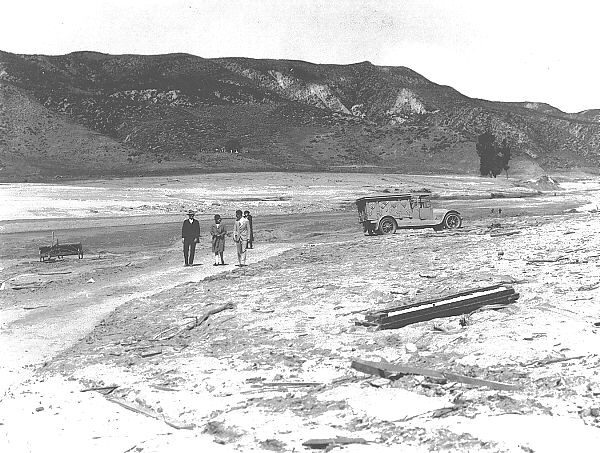
|
|
2002 NATIONAL CONFERENCE of the CALL FOR PAPERS ---- A copy of the FGS Conference Speaker Compensation Policy can be sent upon request. Please send a self-addressed, stamped-envelope with your request to the FGS Business Office, P.O. Box 200940, Austin, TX 78720-0940, or
fgs-office@fgs.org |
| National Council of La Raza Receives Historic $6.7 million grant from Gates Foundation to establish 15 new schools, most of them in California. By the end of the five-year grant period, NCLR hopes that the new schools will be serving historically-underserved communities in San Diego, Oakland, Los Angeles, and San Jose. |
California Council for the Humanities "The humanities explore human histories, cultures, and values. They inform the conversations that are vital to a thriving democracy. . . The purpose of the California Council for the Humanities is to create a state in which all Californians have lifelong access to this shared inheritance. A free newsletter is available. The website also has a calendar of events that can be explored by date. http://www.calhum.org/learn/index.html |
|
Free Family History Day at the California State Archives Family History Day at the California State Archives is scheduled for Saturday, March 17, 2001 from 10:00 am - 4:30 p.m. at the California State Archives and the Golden State Museum , 1020 O Street, Sacramento, California. The event is co-sponsored by California State Archives, ROOT CELLAR [Sacramento Genealogical Society] and the Genealogical & Historical Council of Sacramento Valley. Family History Day will include Classes on Research and Resource Information, Computer Demonstrations, Preservation Techniques, along with displays by Genealogical, Historical Societies, Heritage Organizations and Preservation Centers. Introductory Classes will be offered on basic Genealogy, English, German, Hispanic and Scandinavian research, as well as classes on records preservation, how-to use the Family History Center and how-to use the State Archives for research. For more information log onto ROOT CELLAR, Genealogical & Historical Council of Sacramento Valley, call (916) 331-4349 or Email, Iris Jones at ijones@ns.net http://www.rootsweb.com/~carcsgs/rootcellar.html Return to Table of Contents |
|
March 6-11, 8th Annual Over 65 outstanding programs representing the
best of Latino Cinema
Hazard Center, San Diego's Mission Valley area at
7510 Hazard Center Dr. |
Ticket prices are $7.50 General Audience and $5.50 Student/Seniors. A Film Pass can be purchased for $65 (includes entrance to 11 films, FREE souvenir festival poster, and no waiting in lines). A Festival Pass can be purchased for $165 (includes all 65 programs, no waiting in lines, FREE t-shirt, VIP seating, and entrance into Opening Night Friday Night Gala Celebrations). Festival Pass and Film Pass are transferable. |
California Indians in San Diego
County, California
|
| ACOSTA | ROSALIE CHAVEZ | AND ONE CHILD | PALA | San Diego | 4647 |
| AGUAIRE | PASIANO | AND TWO CHILDREN | BOX 241 SILVA, EL CAJON | 4776 | |
| Aguirre | Felicita Mary | and one child | Dehisa | 2451 | |
| Albanas | Vicente | Valley Center | 2378 | ||
| Albanas (Albanes) | Jose Oribus | Valley Center | 2366 | ||
| Alto | Rosalie | Spring Valley | 2457 | ||
| Alto | Domingo | and one child | Spring Valley | 2456 | |
| Alto | Fernando |
Sent by Johanna de Soto Return to Table of Contents
| University of California, at
Riverside Museum of Photography
http://www.cmp.ucr.edu/photo/collections.html
An amazing gathering of photographic collections. |
|
The California Birth & Death indices: (1905-1995 for births &
1940-1995 for deaths). Found on fiche at many Family History Centers is now available online http://userdb.rootsweb.com/ca/death/search.cgi Sent by Donnie Nelson |
Sent by Johanna de Soto Return to Table of Contents |
Portuguese Voters of 1872
in California
|
| Old
Radio Broadcasts Available for purchase: Ranchos Become Cities and Death Valley Days
I would love to say I was but an infant when the following aired, but in
reality I was seven and eight years old, and well remember hearing
these wonderful programs--all of which I thought were 100% accurate
and factual, just as most listeners did. They were very popular, and
because they were on KNX, well listened to. It is possible that they
influenced many an "Old California Family." |
I recently found out that the El Paso border crossing records for 1903 to 1924 have not been worked on. The El Paso records, consisting of 482 reels from 1903 to 1952, are only available for purchase from 1924 to 1954. The woman at the National Archives who was processing them for publication was pulled off of that task to work on the 1930 census and will return to them in March, but she only works two days a week. So the Mexican border-crossing records have been put on the back burner. And yet, passenger arrival films are available for all the ports of the United States. If your ancestors were German, Russian Jewish, Italian, Hungarian or Irish and they came through New York, New Orleans, or Baltimore, you have complete access to those records. But then we have the largest port of entry for Mexican Americans (El Paso) being put on the backburner and ignored. I guess this is the result of budget-cuts, but they sure picked a poor time to cut funding on the processing of Mexican border-crossing records. This is the site discussing these records: http://www.nara.gov/genealogy/immigration/mexican.html#eaglepass
And a quote at the end of the site reads as follows: |
|
The San Elizario Genealogy &
Historical Society
The Society has a full schedule of activities, monthly meetings,
community projects, annual conference, website, and assistance in doing
family research. |
|
Rio Grande River Project |
|
Sent by Johanna de Soto Return to Table of Contents |
|
“Important Legislation Pending related to Genealogy & Texas History” |
HB 953 - Removal of Confederate Statues from the University of Texas at Austin State Rep. Lon Burnam (D) of Fort Worth <e-mail: lon.burnam@house.state.tx.us >introduced HR 953 that will permanently remove, from public view, all Confederate statues at the University of Texas at Austin. There are no joint sponsors of this bill and it was referred to the State, Federal and International Relations Committee. “The University of Texas of Austin shall remove from public view all statues of Jefferson Davis, president of the Confederate States of America; Robert E. Lee, General in Chief of the Armies of the Confederate States; John H. Reagan, Postmaster General of the Confederate States; and Albert Sidney Johnston, General of the Confederate States Army, located on the campus of the university. The statues may be placed in storage away from public view or disposed of in any other way considered appropriate by the board of regents of The University of Texas System.” Sent by Mira Smithwick
Return to Table of Contents |
|
Roma Historic District http://www.esconett.org/tx2k/theroma.htm Source: J. D. Villarreal juandv@vsta.com |
Villarreal web page http://www.vsta.com/~juandv/rio.html Source: J. D. Villarreal juandv@vsta.com |
|
http://members.aol.com/mrosado007/mexico.htm
Source: Pres. Arturo Garza,
HOGAR de Dallas |
New from the Hispanic Genealogical Society http://www.hispanicgs.com
mugs and caps with Spanish coat of arms. http://www.brokersys.com/~joguerra/cap.html |
| Pedro T. Rodriguez, has an excellent site and makes connections to Bartolome Trevino. He also has the will of Bartolome under the section "Wills".
His website address is: http://home.att.net/~PTrodriguez.ptrinform/
Sent by Mira Smithwick, SagaCorpus@aol.com |
|
A History of the Mexican-American People by Julian Samora and Patricia Vandel Simon http://www.jsri.msu.edu/museum/pubs/MexAmHist/toc.html
The entire book is available on this Internet site. Our study of Mexican-American history stems from an interest in the subject which spans many years. During this time, the authors have been deeply concerned over the inadequacies of American history as it is taught in schools throughout the United States, whether at the elementary, secondary, or college level. Invariably, this history is biased because it begins with the Pilgrim fathers and English colonists, and emphasizes the - westward movement of English culture. It neglects almost entirely events which occurred on the North American continent prior to 1600. . . . It is our belief that any history of the United States - and specifically the southwestern United States - is incomplete and fails to provide a basis for understanding contemporary society unless the Mexican-American contribution is fully covered. Present-day American society is a consequence of fusions of various cultures which have occurred over a period of several hundred years. In order to understand the present, it is necessary to understand the factors contributing to its development. Sent by Johanna de Soto Return to Table of Contents |
|
Bisbee Deportation http://digital.library.arizona.edu/bisbee/index.php Cindy LoBuglio writes, "I don't know how much you know about this black eye on Arizona History, but my Paternal Grandfather (Lovre Skochelich) was one of the deportees, Bisbee Deportation & the People Involved - 1917: Lists of Special Federal Census of Columbus, New Mexico, Defendents, Plaintiffs, Juries, Deputies, Lawyers, Attorneys, Volume I (Tucson, Arizona: Arizona State Genealogical Society, 1990)
My Dad always told me about this, and I only wish he was here
to read all this material, and the other great books that have been
published since his death in 1974. He was two days away from his
7th birthday when he saw his Dad for the last time and the
final view was of him being rounded up and packed into a cattle car. Here is the
breakdown of the 900 identified. I believe there were many more actually involved, but only 900 identified (some were lucky
and escaped into Mexico before they were actually rounded up; some escaped
in the march to the cattle car transport; and others escaped enroute to the
Concentration Camp in Columbus, New Mexico, etc.--my paternal grandfather, a
Croatian, was #7 on the list, was a property owner,
had a bank account, had taken out his second and final papers for
citizenship, etc. as had so many others as shown below).
The make up of the deportees was: |
||
| Americans 167 Armenians 1 Australians 40 Austrian 40 Bohemians 3 Bosnians 1 British 32 Bulgarians 2 Canadians 6 Croatians 35 Dalmatians 14 Danish 5 |
Finnlanders 76 French 3 Greeks 1 Germans 20 Hungarians 4 Hollanders 2 Irish 67 Italians 8 Lituanians 3 Mexicans 229 Montenegrens 24 |
Norwegians 4 Polish 2 Russians 7 Scotch 3 Sevians [sic] 82 Slavonians 3 Spanish 7 Swedish 18 Swiss 4 Ukranians 1 Welshmen 7
|
| Alex
King reported that "Officials later discovered,
the scholars found, that 60% of those deported had been born in the United
States." and recommends the following site: http://www.latimes.com/print/metro/20010225/t000017090.html Return to Table of Contents |
|
Decade of Betrayal: Mexican Repatriation by Francisco E. Balderrama and Ray Rodriguez "As the Depression engulfed the United States in the early 1930s, fear and anxiety spread that Mexicans were taking jobs and welfare benefits away from "real" Americans. Local, state, and national officials launched massive efforts to get rid of the Mexicans. Eventually more than a million were shipped back to Mexico. In this book the impact of the forced relocation on both sides of the border is carefully appraised." Summary by the publisher, shared by Rueben
Martinez |
|
|
|
CENTER OF SOUTHWEST
STUDIES The Center of Southwest Studies' World Wide Web
site address is: Preface to the site Fort Lewis College has a distinctive history in the field of public liberal arts education. For over one hundred years, it has been a first-string player in helping to educate Indian students (academically qualified Native Americans attend tuition-free). Originally established as a military post at Pagosa Springs, Fort Lewis in 1879 was moved to Animas City, now north of Durango, Colorado. The next year the garrison migrated sixteen miles southwest to a site on the La Plata River. In 1892, the fort became an Indian boarding school. After being sold to the state of Colorado in 1911, Fort Lewis evolved from a rural high school to a junior college (1933). In 1956, the campus was removed to its present location overlooking the City of Durango, and six years later became a four-year liberal arts college. The Center of Southwest Studies was established in 1964 to serve as a museum and a research facility and to develop an interdisciplinary Southwest curriculum (a separate Department of Southwest Studies was established in 1992). The Southwest curriculum at Fort Lewis College draws from courses in anthropology, art, biology, literature, history, sociology, and other departments. Southwest Studies departmental offerings include courses in oral history and archival theory and practice. In 1990, the Colorado Commission on Higher Education recognized the Center of Southwest Studies as a program of excellence in state-funded higher education. The Center's collections are cataloged along with Reed Library holdings in the College's TALON Public Access Catalog, searchable on the Web at http://opac.fortlewis.edu/screens/opacmenu.html . The Center's holdings, which focus on the Four Corners region, include over 8,000 artifacts, about 15,000 volumes, numerous periodicals (listed in the Reed Library periodicals holdings printouts), and nearly 500 special collections dating from prehistory to the present. These include 3,500 linear shelf feet of manuscripts and unbound printed materials, over 7,000 rolls of microfilm (including about 3,000 rolls of historic Southwest region newspapers), over 600 oral histories, and more than 35,000 photographs. Strengths in the Center's collections of artifacts (which, with Anthropology Department holdings, amount to more than 4,000 linear shelf feet of objects) include more than 2,000 Ancestral Puebloan ceramic vessels, 300 Navajo textiles, 140 items of Southwestern basketry, numerous military objects from the days of the old Fort Lewis, and about 200 pieces of antique photographic equipment. Most of the materials in the Center's collections were donated, from nearly 700 documented sources. The collections are a resource for every member of the community and beyond. The Center's mission includes preserving and making accessible this resource for all who are interested in the history of our region. These collections are located at the Center of Southwest Studies in the Reed Library building on the campus of Fort Lewis College. Interested researchers should phone the secretary at 970/247-7456 or the archivist at 970/247-7126, or send electronic mail to the archivist at Ellison_T@FortLewis.EDU on the Internet. An inventory is also sold
by the Center of Southwest Studies, Fort Lewis College, |
|
Gallup Diocese Sacramental
Records Open
If you have ancestors in what is now the Gallup diocese (Ácoma, Zuñi,
Laguna, Seboyeta or Cebolleta, San Rafael, Gallup, Blanco, Farmington, Cuba,
Lumberton, Tohatchi, San Fidel, Shiprock, Aragón, Grants, Aztec, Bloomfield,
Crownpoint, Navajo, Waterflow, Milan, Thoreau, Chichiltah, Church Rock,
Quemado, Pinehaven, Fort Wingate, San Mateo, Tinaja and Flora Vista in New
Mexico; St. John, Springerville, Winslow, S. Michaels, Chinle, Fort |
|
Southwestern History and Genealogical Books Readers of your publication, with historical, genealogical academic inquiry into 18th century vintage Arizona and Northern Sonora history will find interest in the books listed below. One book, Arizona Pictorial Biography .... is on the University of Arizona website: www.library.arizona.edu/soza The books by Edward Soza are: 1993 Mexican Homesteaders in the San Pedro River Valley 1994 Hispanic Homesteaders in Arizona 1870-1908 1995 New World Odyssey, A Search for Roots 1996 Arizona Pictorial Biography: Antonio Campa Soza 1845-1915 1998 Affidavits of Contest Vs. Arizona Hispanic Homesteaders 2000 A Walk Through The Past: Soza Family Newsletters 1972-2000 Some or all hard copies are at the following research libraries: Altadena Public Library, Altadena, CA Arizona Historical Society, Tucson, AZ Arizona State University, Tempe, AZ Arizona, University of, Tucson, AZ California, University of, Berkeley, CA (Bancroft Library) California, University of, Los Angeles, CA (UCLA Young Library) Huntington Library, San Marino, CA Library of Congress, Washington, DC Los Angeles Public Library, Los Angeles, CA New Mexico, University of, Albuquerque, NM Pennsylvania State University, State College, PA Sosa-Carrillo-Fremont Mueseum, Tucson, AZ Tempe Historical Museum, Tempe, AZ Texas, University of, Austin, TX Tubac Historical Society, Tubac, AZ Tubac Presidio State Park, Tubac, AZ Tumacacori National Historical Park, Tumacaccori, AZ Southwestern Mission Research Center reviewed the books in their SMRC NEWSLETTER. Their address is: Arizona State Museum, The University of Arizona, Tucson, AZ 85721 Respectfully submitted Edward Soza ed_soza@hotmail.com Return to Table of Contents |
|
Limited English
Proficiency Population and Percent Change |
| State Alabama Arkansas Georgia Missouri North Carolina South Carolina Tennessee |
1992 2,000 1,377 7,190 2,000 8,900 1,574 3,450 |
1997 6,000 8,000 16,485 6,000 28,535 3,373 8,500 |
percent change |
|
Hispanics Emerging In Raleigh, N.C. Political
Circles Winston Salem Journal writer Dana Damico reports that Hispanics are becoming more prominent in North Carolina "halls of power." There's now a liaison for Hispanic and Latino affairs in the state Senate. Lobbyists now push for better education, housing, health care and workers' rights for Hispanics. Gov. Jim Hunt has also created a 25-member advisory council on Hispanic affairs. Read more at http://www.politicomagazine.com |
|
The
Blurred Racial Lines of Famous Families http://www.pbs.org/wgbh/pages/frontline/shows/secret/famous/galphin.html One
of the early roots of the film "Secret Daughter" was
FRONTLINE's research into the growing debate over racial classification
and the social phenomenon commonly known as "passing." The following is only one of the many family stories included on this website. In addition there are suggestions for successful family history research, and other resources as well. Galphin Researched and Written by Mario de Valdes y Cocom Interestingly, although Galphin's second wife was a quadroon, the illegitimate daughter of Moses Nunes, a wealthy Jewish merchant and Indian trader like himself, this particular African American line of his I am currently researching are, in fact, descended from an extra-marital relationship. A daughter he recognized as a result of this liaison was married to John Holmes, an Irishman who had worked with him in the fur trade. Whether there were more children or not I have not yet discovered but a son of John Holmes recently pointed out to me was: Dr. Thomas Galphin Holmes 1780-1852, who moved to Alabama
where he practiced his profession for fifty-two years. As
assistant surgeon, he served during both the Creek Indian War
the War of 1812. In 1820, Dr. Holmes married Elizabeth, the
daughter of George Weakley, one of the surveyors who assisted in
laying out the states of Mississippi and Alabama. His children
and grandchildren I have identified to date, were: Mary Elizabeth, m. Henry Ausphrea Hand Sent by Mary Ayers
Return to Table of Contents |
| March
14, Cuban-Irish-American Storyteller in Washington, D.C. Storyteller's Theatre in Takoma, MD (301) 891-1129 Antonio Sacre is a nationally touring bilingual storyteller. His stories celebrate his bicultural upbringing (Cuban and Irish-American) while encouraging family audiences to share their own stories and celebrate their own heritages. His award winning audio tapes include "Looking For Papito" (Winner of a Parent's Choice Gold Award) and "Water Torture, the Barking Mouse, and Other Tales of Wonder" (ALA Notable Recipient Award). He performs in festivals and schools across the country. He also is currently touring a solo theater production of "Eleven Dollar Prophet" that is for mature audiences only. For more information, contact him directly at: Antonio Sacre, P.O. Box 3444, Hollywood, CA 90078-3444 (888) 654-6436 www.antoniosacre.com Asacre@earthlink.net |
| LOCALITY
ANALYSIS FOR MEXICO By George R. Ryskamp, J.D., AG Assistant Professor of History Brigham Young University http://www.hfhr.com/locality-mexico.htm Locality analysis plays an essential part in determining the objectives for family history research. It should be done as soon as a specific new place of origin or residence is identified, and, of course, must be completed before step two of the records analysis can be completed. Locality Analysis involves two processes. The first is to locate the exact place or places from which one's ancestors came and determine the various jurisdictions to which that place belonged. (This is, in effect, an answer to one of the initial questions asked in the People Analysis: Where did the ancestor live?) The second goal of Locality Analysis is to learn as much about that particular place as one can. This includes not only the physical location and the geographical features of the place, but, to better understand the life of the ancestor, also requires a knowledge of its history and physical appearance. SELECTED BIBLIOGRAFY OF LOCALITY REFERENCE WORKS Modern Atlases and Maps
Gazetteers
Geographical Dictionaries
Historical Atlases, Maps and Materials
Ecclesiastical Directories
Encyclopedia
1. Atlases and Maps. Individual atlases that exist for most Hispanic countries can help locate ancestral towns and establish the proximity of ancestral towns to other towns found during the research. Typical of these is one for Mexico, Nuevo Atlas Porrua de la República Mexicana (Editorial Porrua: Mexico, D.F., 1980), available in many local libraries. This small volume contains maps of each state, historical maps, ad a general country-wide index, as well as various geographical entity lists. Maps in these should be in a scale of at least 1:250,000. Another useful geographical tool for the Latin American genealogist will be the Index to the Map of Hispanic America, published by the American Geographical Society. (Washington: 1945). As this is an index to a collection of maps, scale 1:1,000,000, it will generally only be found in a large public or university library. It covers all Latin American countries in good detail. Also of value for locating especially small hamlets and for recreating geographical details of local life are the United States Army Map Service Select Series and Topographical Maps produced for all of these countries. Any place, no matter how small, will appear on these detailed maps (scale 1:50,000). Unfortunately, these maps have no direct index, and locating places can only be accomplished by using latitude and longitude references in the gazetteers such as those published by the U.S. Office of Geography. (See the following section on gazeteers). Maps and atlases are being digitalized for computer storage at an incredible rate. As that process continues these will become increasingly available on CDROM and on the Internet and World Wide Web. Currently, for example, the University of Texas at Austin Perry Castaneda Library Map Collection has placed many atlases and maps from the CIA on the Internet. Check with the library for the current address and the countries available. 2. Gazetteers. Gazetteers are long lists of place names with a minimal amount of information to identify and locate each particular place. Since many of these gazetteers list geographical subdivisions smaller than the parish or municipality, and other features such as rivers and mountains, they can be of great help when the particular place to be located does not appear in the atlases or geographical dictionaries available to the researcher. Many countries also publish postal guides and political divisions guides. Gazetteers, such as the United States Board on Geographical Names Gazetteer, prepared by the Office of Geography of the Department of the Interior, are frequently more readily obtained in the United States than local geographical dictionaries and detailed atlases of Hispanic countries. The Hispanic countries covered by the U.S. Board on Geographical Names series and their numbers in that series are:
3. Geographical dictionaries. These vary in size, from one and two volume dictionaries to large series containing sixteen to twenty volumes. In the United States, those covering Hispanic countries are generally found in the Family History Library Catalog or in large public or university libraries which have map collections. Nearly every country has at least one such dictionary, although these can vary dramatically in the amount of detail they contain. Some of the large countries such as Mexico even have state or regional geographic dictionaries. Whether national or regional, these are most helpful in locating a particular town, and usually provide a written description of the town, or other geographical unit. These descriptions, as well as individual place name entries, can be used to identify the larger geographical unit (where records would usually be found) to which a smaller unit, whose name is the only one the family remembers, belongs. These dictionaries also often provide information in developing the history of the ancestral locality as a background to the family history. 4. Ecclesiastical guides and directories. Many Catholic dioceses, publish directories listing the various parishes, seminaries, and convents which make up the diocese. These directories always include the names of local parishes and the priests who serve there. They also may contain maps and other aids, and interesting and pertinent information about local history, including even local jurisdictional changes. Many of these are available through the LDS Family History Centers and in libraries having the CIDOC Collection of Latin American church documents on microfilm. For at least four countries, Spain, Puerto Rico, Mexico, and Argentina, such guides exist which also indicate at least the beginning date for parish registers in nearly every parish in the country. 5. Historical Atlases, Maps and Materials. In the list above a special category has been created for geographic reference tools that were printed before 1900 but are still widely available or were written to deal with geography during an historical period, most often the colonial period. The use and format of these materials parallels that of their contemporary counterparts described in other sections above. 6. Local histories. As the name implies, these are histories that deal entirely with a particular town or region, found both as books and as articles in periodicals. Scholarly historical journals such as The Americas and Hispanic American Historical Review are particularly valuable. These do not help in locating exact places, but can be extremely valuable in helping to understand the history of that locality, and especially to trace its jurisdictional changes. FOR FURTHER INFORMATION SEE FINDING
YOUR HISPANIC ROOTS For a place in Mexico, click here. |
|
Zacatecas Researcher
A joint effort of Frank Longoria who set up
the website and John Schmal who prepared the text. This
website is developed for beginning Zacatecas researcher. It's under the header, January 2001 Newsletter.
John will be adding more Zacatecas information to this website |
Register ofDenton Ranch Collection (Jacume, Baja California
Norte, Mexico) 1864 -- 1993
|
Mexico City National Cemetery
|
| STUDY MEDICINE IN CUBA Application forms are now available for African-American, Latino/a, Native American and other poor and underserved youth between the ages of 18 and 25 to study medicine in Cuba, free. IFCO/Pastors for Peace is asking its network to help spread the information about this opportunity to study medicine, free, and return to provide health care to underserved ("third world") areas within the U.S. Please email us at ifco@igc.org and we will send you a copy of the organizing materials. More info at http://www.ifconews.org Source: LatinoLA.com |
|
Colonial Possessions and Slave Populations
How European colonial powers came to possess the territories in the West Indies and Latin America and
how those powers switched oversight for those territories through wars, trades and purchases is too
complex a tale to attempt to cover for this article series. Thus, the following list highlights which European
powers had a predominant hold on specific territories in Latin America and the West Indies (1). |
||
|
Change in African Slave Importation Patterns (2) Between > 1601-1700 1701-1810 |
||
| Portuguese America British Caribbean French Caribbean Spanish America Dutch Caribbean British North America |
560,000 263,700 155,800 292,500 40,000 10,000 |
1,891,000 1,401,300 1,348,400 578,600 460,000 348,000 |
|
1 Bennett Jr., Lerone. Before the Mayflower: A History of Black Americans, 5th ed. New York: Penguin Books, 1982, pp. 50-52. Franklin, John H. From Slavery to Freedom: A History of Negro Americans, 5th ed. New York: Alfred A. Knopf, 1980, pp. 43-53. 2 Nash, Gary B. Red, White, and Black: The Peoples of Early America, 2nd ed. Englewood Cliffs, NJ: Prentice-Hall, 1982, p. 148. Return to Table of Contents |
||
|
FOR IMMEDIATE RELEASE: The inaugural collection encompasses 50 reels of rich and varied manuscripts. While Mexico and Peru are the focus of the collection, the rest of Latin America is included as well. Series II will include 191 bound manuscripts covering Latin American and particularly Mexican and Peruvian history from the 16th through the 19th centuries. Many of these relate to Catholic church missions, such as one volume of original letters dating to 1649 from the diocese of Los Angeles -- now the city in California, then an outpost of New Spain -- detailing the first Spanish settlements there. The collection also includes original records of tributes paid by Indians that evidence the early colonial economy of the Americas. Government documents include account books of the first mining industries and richly illustrated volumes recording early explorations of the Andes. Among the rarest and most valuable materials are original, signed letters from the liberators of Latin America: Simon Bolivar, Bernardo O'Higgins and Jose de San Martin. A printed guide -- with original essays by Sabine P. Hyland, Ph.D. and Noble David Cook, Ph.D. that detail the use of this collection by students and faculty -- will accompany publication of the microfilm. Latin American History and Culture: An Archival Record is available by standing order from Primary Source Microfilm, an imprint of the Gale Group. For more information, contact the publisher: in the US and Canada, contact sales@galegroup.com; in Japan, contact sales@yushodo.co.jp; all other parts of the world can contact sales@psmedia.co.uk. US media contact:
Beth Dempsey (248) 699-4253 or beth.dempsey@galegroup.com # # # The Gale Group (http://www.galegroup.com) is a world leader in reference and research publishing in both print and electronic formats for libraries, businesses and researchers. In the library market, the Gale group imprints include such noted library reference publishers as Macmillan Reference USA, Charles Scribner’s Sons, Primary Source Microfilm and UXL. A unit of the Thomson Corporation, Gale Group is based in Farmington Hills Michigan, with additional offices in the US and also in the UK, Australia and Malaysia. Return to Table of Contents |
|
Diccionario de calo y palabras indigenas de America
Latina
|
| Ines Lozano Perez Pedigree Tree http://www.chez.com/geneandalucia/ines.htm Sent by Mira Smithwick |
To get a free subscription to "Avotaunu" the Jewish Genealogy Magazine
go to: http://www.incor.com/avotaynu.htm Sent by Donie Nelson |
|
Children of Columbia. Dr. Gomez writes that this
non-declared civil war of more than fifty years has left a tragic legacy
of several million orphans. The Children of Colombia have united to request
Peace in their homeland. They have gathered in a movement that has
brought them media attention and has even reached
UNICEF. If you would like to join Dr. Gomez in this
effort, please contact him. He is hoping that there is a warm and positive response to the message of the
Children of Colombia whose plea is Peace for their
homeland.
|
 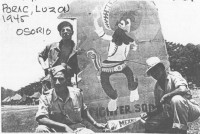 The
201st Mexican Fighter Squadron of the "Fuerza Aerea
Expedicionaria Mexicana" (Mexican Expeditionary Air Force or MEAF)
has the honor of being the only Mexican military unit that has seen
combat outside Mexico. This Squadron fought during the liberation of the
Philippines, while assigned to the 58th Fighter Group, 5th Fighter
Command, 5th Air Force. The MEAF arrived in the Philippines in May 1945,
under the command of Col. Antonio Cardenas Rodriguez (1905-1969), with
the Squadron 201 headed by 1st Cpt. Radames Gaxiola Andrade (1915-1966). The
201st Mexican Fighter Squadron of the "Fuerza Aerea
Expedicionaria Mexicana" (Mexican Expeditionary Air Force or MEAF)
has the honor of being the only Mexican military unit that has seen
combat outside Mexico. This Squadron fought during the liberation of the
Philippines, while assigned to the 58th Fighter Group, 5th Fighter
Command, 5th Air Force. The MEAF arrived in the Philippines in May 1945,
under the command of Col. Antonio Cardenas Rodriguez (1905-1969), with
the Squadron 201 headed by 1st Cpt. Radames Gaxiola Andrade (1915-1966).The 201 flew its first combat missions in Support of American ground troops, during the advance against Japanese forces in Northern Luzon, from June to July 1945. The 201 flew various subtypes of the Republic P-47D Thunderbolt fighter-bombers. These aircraft had been borrowed from the 58th Fighter Group initially, and some other were 'veterans' from the 348th and 35th Fighter Groups (Since they converted to the North American P-51D, leaving the 58th as the only unit operating the P-47 in the 5th Air Force), but later on, their own P-47s were delivered under the Lend-Lease program. In July 1945, the 201 flew long range "Fighter Sweeps" from the Philippines to the Island of Formosa (known as Taiwan today), and in August, a dive-bombing mission over the Port of Karenko, Formosa. The MEAF lost two pilots while training in the United States (Texas 1944-1945); five more were lost in the Pacific during training and ferrying missions; one ground crew member died in a military hospital in the US due to illness acquired in the Philippines and two more pilots, attached to the Replacement Group in training in the United States (1945), also died. 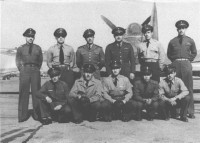 In
September 1945, the MEAF was assigned to the 13th Air Force. With
the end of the war, it returned to Mexico by November 1945. After its
return the MEAF was disbanded by a Presidential Decree dated on
December 1st, 1945, under which, the 201 Fighter Squadron was returned
to the Mexican Air Force's control. Later on, the squadron was
re-equipped with a new batch of Republic P-47D-35- RAs, since the
aircraft used on the Philippines were left on the islands after WWII. In
September 1945, the MEAF was assigned to the 13th Air Force. With
the end of the war, it returned to Mexico by November 1945. After its
return the MEAF was disbanded by a Presidential Decree dated on
December 1st, 1945, under which, the 201 Fighter Squadron was returned
to the Mexican Air Force's control. Later on, the squadron was
re-equipped with a new batch of Republic P-47D-35- RAs, since the
aircraft used on the Philippines were left on the islands after WWII.The Historical tradition of the MEAF is still carried by "Escuadron Aereo de Pelea 201", as part of the "4/o. Grupo Aereo" (4th Air Group), based at Cozumel, Quintana Roo, and operating the Pilatus PC-7 for COIN / CAS duties. This unit saw action again during the Chiapas Rebellion of January 1994. One of the few Mexican pilots to leave a written account of his wartime experiences was the former 1st Lt. Amador Samano Pina. Born in July of 1919 in Metepec, State of Mexico. Click on to the site and read a first hand account. http://www.laahs.com/art08.htm Editor's note: We each should be responsible for writing our history to share with the future. Sent by Greg Hernandez Return to Table of Contents |
Ships Passenger Lists on the Internethttp://www.genealogylinks.net/geneology/vitalrec/passengerlists.htm Over 4,200 passenger lists complete with passengers names for UK & Ireland, Canada, USA and Australia from 1700s to 1890s can be found at the following websites that have been reviewed (largest collections at top of page):
Sent by Johanna de Soto Return to Table of Contents |
|
I know I'm not the only one who feels the urge to pull over when I see an old cemetery. What to do when you do not have easy access to your
ancestors' cemetery? This site will help you find someone to visit the
site, get a picture, etc. It's great! http://www.headstonehunter.com/ |
|
My Cousin, My Self by Duane F. Alwin Missing Links, Vol. 5, No. 38, Sept. 20, 2000 Sent by Carol Anthony The word “cousin” has a variety of meanings, some of which are more precise than others. We often use the word in a general way to refer to any collaterally related persons more distant than siblings who share a common ancestor. When we want to be more specific, we use the term in a different way: cousins (or first cousins) are the children of siblings. First cousins have the same grandparents. That is to say, the children of my aunts and uncles are my first cousins. Second cousins, on the other hand, are the children of first cousins, and third cousins are the children of second cousins, and so on. While first cousins have the same grandparents, second cousins have the same great-grandparents, but not the same grandparents. Third cousins share the same great-great grandparents, but not the same great-grandparents or grandparents. In other words, my second cousins are the children of my parents’ first cousins, and my third cousins are the grandchildren of my grandparents’ first cousins. The degree of cousiness, thus, simply follows generational lines, given kinship relations defined by a common ancestor. By contrast, when one crosses generational lines to express relationships among cousins in an adjacent generation or across several generations, one normally expresses these cousin relations as “once removed” or “twice removed” according to how many generations separate the related individuals. Thus, one is a first cousin once removed to his or her parents’ first cousins, or to the children of his or her first cousins. The latter relationships are sometimes (and I think erroneously) also called second cousins, which adds even more confusion to discussions of kinship. I have always gotten a kick out of telling people that I am a cousin to myself. My maternal grandparents were first cousins once removed -- my grandfather married the daughter of his first cousin. His cousin was 15 years his senior and he was a few years older than my grandmother. In any event, following the above definitions -- second cousins are the children of first cousins -- we can see what may appear to be a contradiction. Because they are both daughters of first cousins, my mother is a second cousin to her own mother. This makes me a third cousin to my mother, as she and I are both children of second cousins in the same ancestral lineage. And of course, to myself I am a third cousin, once removed! Thus, when I use my Family Tree Maker genealogy software to print out the descendants of Samuel Chacey (our common ancestor) I appear twice (and in different generations) -- once as a descendant of my grandfather and once in my grandmother’s line. What better proof that I am my own cousin. Matings between cousins are called consanguineal, meaning that the members of the pair have one or more common ancestors. In some geographical areas at some times such matings can be quite common. Whether we know it or not, each of us has many a consanguineous marriage in their pedigree. Most cultures have rules that regulate the degree of relationship permitted between two individuals who wish to marry. In many societies, including our own, marriages between first cousins, uncles and nieces, and aunts and nephews, are typically discouraged or in some cases outlawed. Although it would mean fewer grandparents to keep track of, such matings are probably not a good thing. Individuals with rare recessive sex-linked traits are often the offspring of such matings. On the other hand, such consanguineous matings are not necessarily undesirable. Charles Darwin married his first cousin Emma Wedgwood, and the entire Darwin-Wedgwood lineage was highly inbred. Some have speculated that the pre-eminence of this lineage in the arts, sciences and the professions may have resulted from some inbred genetic trait. But this is probably the exception, and genetic diversity in families is probably healthier over the long run. Author’s note: Duane F. Alwin is Professor of Sociology at the University of Michigan, where he teaches social psychology, the family and research methods. © Copyright, 2000. Duane F. Alwin. All rights Return to Table of Contents |
|
Family Tree Magazine Family Chronicle Magazine http://www.familychronicle.com has an article on research tips for using Family History Centres. http://www.familychronicle.com/25fhc.html I have added both links for both articles to the “Bookmarks” section on the website for future reference. http://groups.yahoo.com/group/LDS-FamilySearch-Website/links Source:
Judy Mann |
|
ROOTSWEB IN THE NEWS: Ancestry.com and RootsWeb.com garnered the highest Nielson ratings for "the largest unique audience among Web surfers" of genealogy sites for October 2000. The top 10: 1. Ancestry.com 2. RootsWeb.com 3. Genealogy.com 4. Familytreemaker.com 5. FamilyHistory.com 6. FamilySearch.org 7. CyndisList.com 8. Genealogy.org 9. Gendex.com 10. Surnameweb.com If there are some of these that you haven't looked at, you may want to give them a try. SOURCE: Elaine Macey Return to Table of Contents |
|
Hispano America USA, Inc. While looking for something entirely different, I ran across a web site that is entirely new to me, HISPANO AMERICA USA, INC., which includes an article by Ivonne Figueroa, entitled "Latinos or Hispanics?" which can be read at: http://www.neta.com/~1stbooks/texas6.htm A little different a slant, and worth reading, and the site is also worth exploring. Sent by Cindy LoBuglio |
| Genealogical Graphics I found a couple web pages that have some pretty good genealogy graphics that you can use for free. If you don't already know this - you right click on any image on a web page you can then save it to your own disk. The sites are: http://www.geocities.com/heartland/estates/7923 http://www.citynet.net/mostwanted/gengifs/gengifs.htm ggause@panam.edu George Gause Return to Table of Contents |
|
Translation Services For your information and kind release... We feel humble and proud at the same time. There is so much to do still. Thanks! Martha E. Galindo >mgalindo@ix.netcom.com |
Galindo
Publicidad, Inc. 1515 University Drive, Suite 204 C Coral Springs, FL 33071 Tel. (954) 255-5620 Fax (954) 255-5615 Toll Free 1-800-572-9446 http://www.translationsandmore.com |
|
Connection between your surnname and your DNA, Abstracts from a report by ~~ Robin McKie
Sunday January 14, 2001 |
| DNA Home Collection &
Storage Kit Order Form: Info@dnaidsys.com DNA Identification Systems PO Box 130159 Birmingham, AL 35213 (205) 970-5501 (205) 970-5502 fax |
http://www.dnaidsys.com/Order.htm
|
| DNA Preservation - GeneSaver Create your own family's private DNA bank. All services by mail. No refrigeration needed. Knowing what DNA they inherited may one day spare family members from serious medical problems. Tel/Fax (603) 863-3665 P.O. Box 544, Grantham, NH 03753 dna2go@genesaver.com |
Memory Trees Plant a tree to commerate births, deaths, and weddings. Cuttings from the last known apple tree planted by Johnny Appleseed have grown into small, direct-offspring apple trees. They are ready for you to plant. For more information, visit: www.historictrees.org |
|
HAY DIOS MIO |

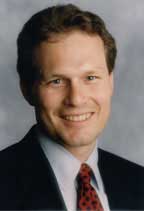



 Daphney
State Normal School and State Senator
Daphney
State Normal School and State Senator