|
Somos Primos Dedicated
to Hispanic Heritage and Diversity Issues |
|
|
|
|
|
Somos Primos Dedicated
to Hispanic Heritage and Diversity Issues |
|
|
|
|
|
|
| Content
Areas Feature: From the Barrio to Washington United States National Issues Action Item Education Bilingual Education Culture Business Anti-Spanish Legends Military & Law Enforcement Heroes Patriots of American Revolution Cuentos Literature |
Surname Orange County,CA Los Angeles,CA California Northwestern US Southwestern US African-American Indigenous Sephardic Texas East of Mississippi East Coast Mexico Caribbean/Cuba |
Spain
International History Family History Archaeology Miscellaneous Networking SHHAR Meetings Jan 26: Mar 22: Conference April 26 May 24: Aug 23: End |
|
Letters to the Editor : |
| Estimada Mimi Lozano:
Le envio un caluroso saludo y gran felicitación por su magnífica y expléndida página de Somos primos, que veo con asiduidad e interés cada mes, es una valiosa cotribución a mantener unidos nuestros lazos familiares y a reecontrarnos con nuestros primos y gran familia. Le envío por si le resulta de interés un pequeño trabajo que he titulado "los Fundadores y Pobladores de la Ciudad de Salvatierra, Guanajuato. 1644", aunque el título que va en el correo adjunto sea algo diferente, lo pongo a su consideración y ojalá sea de alguna utilidad. Le enviaré antes de navidad una tarjeta virtual extensiva para usted y la gran familia mexicana de Estados Unidos. Reciba un fuerte abrazo. Si lo desea, puedo adjuntar luego algunos
gráficos. Dear Mimi... Once again, I MUST extend my total and sincere congratulation's to you for a marvelous issue of SOMOS PRIMOS. How on earth do you find the time.
|
| The names listed as
contributors in each issue have contributed to that issue specifically. Big Thank you for sharing with your Primos!! |
| ------------------------------- Somos Primos Staff: Mimi Lozano, Editor Mercy Bautista Olvera Bill Carmena Lila Guzman Granville Hough John Inclan Galal Kernahan J.V. Martinez Armando Montes Dorinda Moreno Michael Perez Rafael Ojeda Ángel Custodio Rebollo Tony Santiago John P. Schmal Howard Shorr Ted Vincent Contributors: Rudy Acuña Judge Fredrick Aguirre Linda Aguirre Jake Alarid Ruben Alvarez Dan Arellano Dr. Armando A. Ayala Elaine Ayala Mercy Bautista-Olvera Joseph Bentley Juan Blackaller Granada Belia Buenavbentura Reveles Roberto Calderon, Ph.D. Bill Carmena Henry J. Casso, Ph.D. Gus Chavez Yolanda Chavez Magdaleno |
---------------------------------- Manuel Caro PhD Jim Carr Dr. Henry P. Casso Rafael Castellanos Cristina Castillo Grace Charles Elena Cortaza Jack Cowan Boyd Delarios Sal Delvalle Leticia Duran Charlie Erickson Armando M Escobar O Lupe Fisher Lynne Furet Doherty Willie Galvan Daisy Wanda Garcia Granville Hough, Ph.D. John Inclan Galal Kernahan Carlos López Dzur Pat Lozano Larry Luera Gilbert "Magu" Lujan Enrique Maldonado Quintanilla Manny Marroquin Lucas Martínez Prof. Juan Marinez Dorinda Moreno Carlos Muñoz, Jr. Ph.D. Mª Ángeles O'Donnell Olson Rafael Ojeda Gloria Oliver Jose Luis Orozco Patrick Osio Jose M. Pena Roberto Perez Guadarrama |
--------------------------------- Lauro E. Garza Henry Godines Lila Guzman, Ph.D. Laura E. Gómez, Ph.D. Rafael Jesús González Eddie Grijalva Prof. Manuel Hernandez Willie Perez Jess Quintero Ángel Custodio Rebollo Armando Rendon, Ph.D. Rogelio Reyes, Ph.D Alfonso Rodriguez Dr. Armando Rodriguez Héctor Javier Rodríguez García Christy Rodriguez Rosa Rosales Lupe Saldana Verle E. Salinas-Wenneker US Congresswoman Loretta Sanchez Tony Santiago John P. Schmal Howard Shorr Frank M. Sifuentes Greg P. Smestad, Ph.D. CA Assemblyman Jose Solorio Alva Moore Stevensson Ernest Uribe Ricardo Valverde Janete Vargas Dr. Santos C. Vega Cris Villasenor Pepe Villarino Ted Vincent Martin Wisckol afriampub@aol.com rgrbob@earthlink.net saballod@bellsouth.net |
| SHHAR
2008
Board: Bea
Armenta Dever, Gloria Cortinas Oliver, Mimi
Lozano Holtzman, Pat Lozano, Yolanda Magdaleno, Henry Marquez, Michael Perez, Crispin Rendon, Viola Rodriguez Sadler,
John P. Schmal. |
||
|
|
|
|
Rodriguez rose through the United States educational system to become the first Hispanic principal of a junior and senior high school in San Diego. He became only the second Latino to be a college president in California and served in the administrations of four U.S. presidents. His list of honors and accomplishments is long and impressive: Rodriguez received two honorary doctorates of letters, served as the nation’s first director of the Office for Spanish Speaking American Affairs and as U.S. Assistant Commissioner of Education. Inspired by the courage of giants like New Mexico Senator Dennis Chavez, his commitment to social reform and equality motivated him to become a leader in politics and civil rights. He was a leader in the 1966 Equal Employment Opportunity Commission Walkout in Albuquerque, a pivotal moment that sparked change in federal policy. Twelve years later Rodriguez was appointed as EEOC Commissioner. Rodriguez was influential in shaping education on local and national levels. A Latino pioneer in the world of electoral politics, a mentor to leaders of burgeoning Latino advocacy groups, an international reformer, and a labor rights activist, Armando Rodriguez is the hero in the story of a boy from the barrio who became an instrument of change for his community and country. His life’s lessons are not those of a bygone era but are important to today’s youth.
|
|
Armando Rodriguez will speak at the following venues and all events are free and open to the public.
Armando Rodriguez lives in El Cajon, California, with his wife of fifty-nine years, Beatriz. The book was edited by Bettie Baca, a former government executive, and is a community activist and editor in the public and private sectors and Keith Taylor, a retired U.S. Navy officer and a long time columnist for The Navy Times. Lionel Van Deerlin, who wrote the foreword, is a former U.S. Congressman from San Diego, California, and is professor emeritus of journalism at San Diego State University and a columnist for The San Diego Union-Tribune. From the Barrio to Washington: An Educator’s Journey is available at bookstores or directly from the University of New Mexico Press. To order, please call 800-249-7737 or visit www.unmpress.com. ISBN: 978-0-8263-4381-9- MEDIA NOTE: For more information or to schedule an interview with Armando Rodriguez, please contact Amanda Sutton, UNM Press publicity, at 505-272-7190 or asutton@unm.edu
|
| Close
Encounters with Dr. Hector P. Garcia The Journey to Latino Political Representation Legacy: Spain and the United States in the Age of Independence Smithsonian Latino Center just got a big-time sugar daddy Slim and the Smithsonian Latino Center Pew Hispanic Center: Research and Surveys on the U.S. Hispanic Population |
|
Part I
|
|
|
|
|
|
During the early days, Forumeers would travel to
far away places to meet with potential members. Through the decades,
these members remained loyal and worked hard for the organization
following Dr. Hector’s example. Dr. Hector kept their loyalty because
he gave them an investment and a role in his organization, the American
G.I. Forum (AGIF). The
WILLIE GALVAN The AGIF was growing tremendously during the late 50's with chapters being organized throughout Texas and the United States. Dr. Garcia came to Victoria, Texas, a small town between Corpus Christi and Houston on the Gulf Coast, for the first organizing meeting of the AGIF Victoria Chapter in 1958. There were about 13 Veterans assembled at a local Mexican restaurant anxiously awaiting Dr. Garcia's arrival to clue us in about the American GI Forum. He arrived soon enough, and with his driver carrying his briefcase, introduced himself and talked nonstop for about 20 minutes about the GI Forum. When he finished talking, he said, "Okay, let's appoint officers," and pointed to me and said, "Willie, you're the Chairman..." and continued pointing to others, appointing all the officers. Then Dr. Hector said, "You are a duly organized chapter" and then asked us what our plans were and what we were going to do. We were stunned, of course and had no answers. "Well, I've been told that you have a lot of problems here in Victoria, like all the other Texas cities with a majority of Latinos. Okay", Dr. Hector said, "do you have Latinos on your City Council?" Of course, we did not, so he said, "Willie, you're running for City Council in the next election", and he pointed to another person and said, "You're running for the school board", another for County Commissioner and another for the College Board of Trustees. We were completely overwhelmed and thought he was out of it. Well, three of us ran for public offices, all of us lost. I lost by 87 votes running for City Council. We were surprised that after a few years some Hispanics were elected to various offices, this due to Dr. Garcia's message to get involved to change conditions and do something in our community. He stayed for about 30 minutes at the organizing meeting because he had to go to another organizing. He said, "Willie, ask me some questions about the Forum." I answered "Doctor, I don't know what to ask." He seemed annoyed, and said, "You will next time. And by the way, you are meeting every two weeks until you get this chapter up and going, and report to me." He waved goodbye and left. We sat there, completely baffled, myself, mostly, as I did not know the first thing about running a meeting. I finally learned and have been at it since 1958; and am proud to say that the Forum has been my extended family since then. Willie Galvan, State Commander
WILLIE PEREZ, EL COYOTE I may or may not have shared this episode or incident of Dr. Hector and me. As you know, I was once in charge of programs and assemblies at Miller High School. On one occasion Dr. Hector agreed to come to Miller High School and speak to our high school student body (mostly 10, 11, and 12th graders) about the GI Forum, the Mexican-American Civil Rights Movement, and Mexican=American military heroes. Needless to say, the auditorium was full---standing room only. The auditorium held between 600-700 warm bodies. Not only was the audience receptive but also they gave Dr. Hector a standing ovation at several intervals. After the program, I asked Dr. Hector what he thought about the students and the school. Of course, he said he was glad to have been asked to speak. However, he said that he was sadden by the fact that his work and name were a household word at Yale, Harvard, etc. but in Corpus Christi students knew very little about him or his work. Anyway, after that thought and comment, I invited him to have lunch with me at the school cafeteria. Very tactfully, Dr. Hector said he had had his share of school cafeteria lunches and invited me to lunch. So, I was privileged and honored to have been invited to lunch by Dr. Hector to the Chicken Shack on Leopard Street. I will never forget this treat. This took place sometime in 1989. But the day after Dr. Hector and I had lunch. He went to his car and took out two copies of the book "among the valiant" by a Mr. Morin and donated them to Miller High school. Recently, I went back to miller and the books were still in the library. I am glad that Dr. Hector shared these books with our students and that they are still being read and enjoyed by our students Incidentally, we, the Longoria Chapter, are presently working with the school administration so that CCISD incorporates Dr. Hector's legacy into the curriculum. Guillermo Perez, Commander of the Pvt. Felix Longoria Chapter, Corpus Christi, TX and State Secretary for the Texas American G.I. Forum
I first met Dr Hector P. Garcia in the late 1970's at a AGIF conference in Los Angeles. I was instantly impressed by his charisma, passion and his ability to motivate the audience. I did not really get to know him until I became Vice Commander of the AGIF in 1982; the late Jose Cano was the National Commander at that time. Mr. Cano, being from Texas, was real close to Dr. Garcia and on many occasions he invited me to meetings where Dr. Garcia would be present and, therefore, I became acquainted with Dr. Garcia. One of the first things Dr. Garcia asked me when I first met him, "Alarid, do you know where the name Alarid came from?" He proceeded to give me a history lesson on the origin of my name. The version was correct; apparently he had read the book "Origins of New Mexico Families" by Fray Angelico Chavez. I became National Commander in 1983 and during the one year that I held that position I had the occasion to travel with Dr. Garcia and attend meetings with him. No matter who his audience was, he was prepared and knew how and when to deliver his message and motivate his audience. His agenda was veterans, education, civil rights and the youth. He had to have a little humor in his message and he was good at telling a joke. Dr. Hector would have people laughing before he delivered the punch line. He also wouldn’t miss the opportunity to tell a good Texas Aggie joke.
Jake Alarid [[Editor: If you recognize any of
the individuals in the photos, please let Wanda Garcia know. Thank you to Lupe Saldana for responding, he wrote:
|
|
| Book: The Journey to Latino Political
Representation By John P. Schmal |
|
|
|
|
| The Latino Vote: An Introduction
The first chapter summarizes the problems that Latino voters in the U.S. faced in the nineteenth and early twentieth centuries. It highlights the beginning of a new era and a new generation that emerged from World War II to galvanize Latino voters and fight for their rights as citizens. The chapter also gives a summary of the Voting Rights Act of 1965 and how it enhanced the voting rights of Latinos. California (1848-1899) This section of the book outlines the political transition from Mexican California to a California managed by the U.S. It describes the significant representation of Hispanics during the first few decades, but also follows the gradual erosion of Latino voting rights that started in the 1870s and reached its nadir with the passing of the English Literacy Requirement in 1894. California (1900-1964) The third chapter details the slow process in which Latinos began to make their way back into the political system of California. With the end of World War II, Edward Roybal became a catalyst for change as he made his name on the Los Angeles City Council. However, overall Latino representation in California in 1964 was still just a dream. California (1965-1975) This chapter follows the Chicano movement as Latinos make strides towards representation in various parts of California. Although the progress is slow, it continues, and the establishment of the Chicago Legislative Caucus marks a turning point. Texas (1836-1964) This chapter details the early Latino representation in Texas as the rights of Mexican-Americans begin to erode, culminating in the Poll Tax of 1902. As in California, a new generation of Latinos comes forward after World War II to begin the process of regaining representation in their communities. Texas (1965-1980) This chapter details the election of key Latinos to office in the Texas State Legislature across the three decades that followed the enactment of the Twenty-Four Amendment and the Voting Rights Act. This chapter details the somewhat sporadic representation of Latinos in the U.S. Congress across a 137-year period. The elections of representatives from Florida, New Mexico, California, Puerto Rico and Louisiana are described. The U.S. Congress (1960-2005) This chapter summarizes the obvious lack of Hispanic representation in Congress up to 1960 and explains the revival of the Latino voting voice with the election of key individuals to the U.S. Congress starting in the 1960s and accelerating in the subsequent decades. Texas: Moving into a New Century This chapter follows the path of Texas elections as Tejano representation in various parts of the state increases dramatically. Los Angeles City Government This chapter explores Los Angeles city politics as it evolved from 1848 into the twentieth century. For more than six decades, Latino representation in the City Council essentially disappeared. With the arrival of Edward Roybal in 1949, representation was restored. But when Roybal resigned from the Council to run for Congress in 1962, Hispanic representation essentially disappeared again until 1985. There is considerable discussion about the lawsuits that brought Gloria Molina and other personalities to the City Council. California (1978-2005) The final chapter in this book summarizes the steady increase in Chicano representation in the California legislature. There is discussion of the landmark 1982 election that brought Gloria Molina, Richard Alarcon and others into key state positions. This chapter also illustrates how the passing of Proposition 187 in 1994 served as a catalyst to promote Latino political involvement, leading to significantly increased representation by the beginning of the New Millennium. Available through: http://heritagebooks.com/ |
|
| Legacy: Spain and the United States in the Age of Independence |
|
George Washington at the Battle of Princeton by Charles Willson Peale (1741 – 1827) Oil on canvas, 1779. Private Collection. WASHINGTON, DC.-The National Portrait Gallery and the Smithsonian Latino Center, together with the Sociedad Estatal para la Acción Cultural Exterior and the Fundación Consejo España-Estados Unidos, present the exhibition “Legacy: Spain and the United States in the Age of Independence, 1763-1848,” which examines the story of Spain’s role in the history of the United States. Although it is widely known that France was a key partner in the fight for American independence from Britain, few are aware that independence was only possible with the financial and military support of Spain. “At the heart of the National Portrait Gallery is our goal to ensure that the country remembers its past,” said Marc Pachter, director of the Portrait Gallery. “The aptly named exhibition ‘Legacy’ explores the role of Spain and Mexico in the development of this nation with that goal in mind.” The exhibition brings together stunning portraits and compelling original documents to explore Spain’s role in the American Revolutionary War and the development of the United States. It begins in 1763—when the Treaty of Paris was signed and Spain controlled approximately one-half of the land that is now part of the United States—and continues through 1848, when the Treaty of Guadalupe Hidalgo was signed to end the Mexican-American War. The exhibition also will illustrate the social, cultural and political influence of Hispanic culture through 1848. “This exhibition invites people to immerse themselves in this era and learn more about Spain’s key role in the Revolution and the early days of the American republic through extraordinary portraits, original treaties and maps,” said Carolyn Kinder Carr, deputy director of the National Portrait Gallery and “Legacy” exhibition co-curator. “The political and geographic changes that happened during this 85-year period still reverberate in American culture today.” Some of the individuals represented by renowned artists include names familiar to the American story: “George Washington” by Charles Willson Peale, “Benjamin Franklin” by Joseph Siffred Duplessis and “Davy Crockett” by Chester Harding. But the exhibition also demonstrates the connections between these Americans and political figures in Spain during the American Revolution and later the individuals, both Americans and individuals of Hispanic descent, who led Florida, Louisiana, the Upper Mississippi, California and the southwest. For example, three men who determined Spain’s foreign policy during the time of the American Revolution were King Carlos III, who is portrayed by court painter Anton Raphael Mengs; José Moñino, the Count of Floridablanca, who was prime minister and is portrayed by Folch de Cardona; and Pedro Pablo Abarca de Bolea, the Count of Aranda, who was a longtime champion of the American cause and was painted by Ramón Bayeu, brother-in-law to the famed Francisco de Goya. The exhibition includes five portraits by Goya: those of the Conde de Cabarrús, King Carlos IV of Spain, Felix Colón de Larriategui, King Ferdinand VII of Spain and el general don José de Urrutia. “Few Americans realize that Hispanics have played an important role in our country since its founding,” said Pilar O’Leary, director of the Smithsonian Latino Center. “The fact that Hispanic-Americans fought alongside Anglo-Americans to help obtain independence from Britain, for example, is not often taught in U.S. classrooms or history books today. This exhibition will raise public awareness of the historical role and roots of Hispanic-Americans in U.S. society.” Sent by Lila Guzman, Ph.D. lorenzo1776@yahoo.com |
| Slim and the Smithsonian Latino Center |
|
December 05, 2007 Slim and the Smithsonian Latino Center http://latino.si.edu/ Smithsonian Latino Center just got a big-time sugar daddy. The center announced yesterday that it signed a memorandum of understanding with Fundación Carso. It's an important connection. The Mexican foundation is the philanthropic arm of Grupo Carso, which runs the Museo Soumaya in Mexico City. More importantly, Grupo Carso is owned by Carlos Slim, a Mexican businessman who's reportedly one of the richest men in the world. The partnership will lead to "a series of exhibitions, public programs, educational materials" and other events at the Smithsonian. This is exciting for several reasons. Some of the programming will be scheduled around a historic moment in the Americas — the 200th anniversary of Mexico's independence in 2010 and that of other Latin America countries. A virtual museum could be in the works to bring the Smithsonian's Latino and Latin American collections to the world, and the Latino Center has agreed to emphasize distance learning, which may bring live concerts, lectures and other programs to virtual viewers via pod casts or satellite in museums throughout the country. But this announcement also may help the Smithsonian Latino Center reach an even bigger goal national Latino museum on the Washington Mall. There's still a spot open on that prestigious row, one that Hispanic Americans so deserve. Pilar O'Leary, the center's director, said it right about what Grupo Carso's support can lead to in even more important ways. "The Smithsonian Latino Center and Museo Soumaya share the belief that art — in all its mediums — is an important tool in fostering understanding between cultures." Amen. Elaine Ayala http://blogs.mysanantonio.com/weblogs/latinlife/2007/12/slim_and_the_smithsonian _latin_1.html http://blogs.mysanantonio.com/weblogs/latinlife/ http://blogs.mysanantonio.com/weblogs/latinlife/2007/12/
|
| Pew Hispanic Center: Research and Surveys on the U.S. Hispanic Population | |
http://pewhispanic.org/ |
|
|
Adopted Valor:
Immigrant Heroes |
|
FOREIGN BORN MEDAL OF HONOR RECIPIENTS PRIVATE FIRST CLASS SILVESTRE HERRERA - WWII Upon receiving his draft papers, Silvestre Herrera, a 27-year-old father of three, learned for the first time that he was not an American citizen, rather, that he was born in Mexico, adopted by his uncle after his parents died. Because he wasn’t an American citizen, Silvestre wasn’t obligated to serve in World War II. Silvestre’s reply was defiant, he said, "I'm going anyway." He didn't want anybody else to die in his place. He said, "I am a Mexican-American and we have a tradition, we're supposed to be men, not sissies." As a member of the Texas National Guard, 36th Infantry Division, Silvestre found himself fighting in France on March 15, 1945. Advancing with his platoon along a wooded road, they were stopped and pinned by heavy enemy machinegun fire. As the rest of the unit took cover, he made a 1-man frontal assault on the German strongpoint, shooting three and capturing eight enemy soldiers. But Silvestre's day was just beginning. When the platoon resumed its advance, Silvestre’s unit was subjected to fire from a second emplacement, beyond an extensive minefield. Herrera ran forward, intending to take cover behind a boulder, when he stepped on anti-personnel landmine that blew him into the air. When he came down, he hit another mine. He lost both legs just below the knee. Despite his violent injury, Herrera somehow managed to hold onto his M-1 rifle. After applying a bandage to his legs he braced himself against the boulders for cover and began firing at the enemy. He hit at least one of the Germans and forced the others to stop shooting and take cover. Later Silvestre said, "I was protecting my squad. I was trying to draw their fire. I was fighting them on my knees." Despite intense pain, two severed legs and an unchecked loss of blood, he pinned down the enemy with accurate rifle fire allowing another squad the enemy gun by skirting the minefield and rushing in from the flank. Silvestre returned stateside to recover from his wounds and five months later he was decorated with the Medal of Honor personally by President Truman. His service both during World War II as a soldier, and as a patriot since that fateful day in France, brought him continued honors and distinction. An elementary school in Phoenix bears his name, and he is the recipient of several community awards. Herrera died at his home in Glendale, Arizona, on November 26, 2007. 715 OF THE 3,410 CONGRESSIONAL MEDAL OF HONOR RECIPIENTS IN AMERICA'S HISTORY - MORE THAN 20 PERCENT - HAVE BEEN IMMIGRANTS TO THIS NATION.
Silvestre Herrera Sent by Ricardo Valverde |
|
Herrera men who served in the U.S. Military |
|
Source: Undaunted
Courage: Mexican American Patriots of World War II |
| Bartolomeo de Herrera was a 20 year old
soldier in New Mexico, making muster roll in 1598 under the
leadership of Juan Onate. In Pensacola, Florida in 1781, during the American Revolution, Spain's forces in support of the American colonists included a Juan Herrera, commanding the galley San Peregrino. |
Dr.
Granville Hough's (retired West Point) identified 25 Herrera serving
during the American Revolution
in the present day Southwest. During the Civil War Hispanics served on both the Union and Confederate side. Two Herrera's were identified. During WW I, 1,548 draft cards were filled out by Herrera men. |
| During World War II, 5 Herrera brothers from
Placentia, California served, Augustine, Ignacio, Peter, Manuel, and
Emilio. During the Korean War, Sgt. Robert Herrera received the Bronze Star, in addition to a Purple heart, and Korean SVC Medal. Vietnam Wall includes the following Herrera's
|
The numbers of Hispanic-Americans who have served in
the nation's major wars are:
American Revolution (1775-1783): 4,000 Civil War (1861-1865): 10,000 World War I (1914-1918): 18,000 World War II (1939-1945): 500,000 Korean War (1950-1953): 43,400 Vietnam War (1963-1973): 80,000 Persian Gulf War (1990-1991): 25,000 SOURCE: U.S. Department of Defense
|
|
|
|
|
I am a former Marine Corps Infantry Rifleman who served in Vietnam until I was wounded in April of 1967. In October of 1988 Newsweek published my article " A Chicano in Vietnam" that later served as the impetus for my dissertation- FROM HOMER TO HOMEBOY: Heroism, War and Memory in Chicano Life and Letters (1999) In that work I explored the theme of war in Chicano literature and examined within that theme how the idea of heroism- as service to country, to home and homeland, to family and oneself, was expressed. In this frame, I also compared the idea and definitions of masculinity and manhood in Latino culture against the stereotypical, distorted and emasculating images and myths of Latino men in American literature. I chronicled the experiences of Chicano/Mexican American War Veterans who served in the U.S. Military - from the Civil War through Vietnam. I examined the narratives of these veterans, and the racial, economic, social-political realities that reflected their participation in this country's wars. Sincerely, Manuel Caro PhD mcaro3@gmail.com Editor: Dr. Caro said that the University of Michigan maintains an index to Ph.D. http://www.lib.umich.edu/find/databases.html Another resource is the East Los
Angeles Library. The library is host to the Chicano
Resource Center, established in 1976, ...They maintain a
collection of dissertations written by/about
Hispanics/Latinos/Chicanos, etc. |
|
| A Website called: Ken Burns Hates Mexicans | |
|
Six months after starting this blog, and two days before Ken Burns broadcasts his epic WWII doc this Sunday, it's as good a time as any as to explain why I titled this ongoing project Ken Burns Hates Mexicans. A recent TV column critiquing Burns and his upcoming series, The War, began with a reference to this blog suggesting I'm implying the PBS filmmaker actually hates Mexicans. My bad for not explaining my intentions more precisely -- and for not including a definition of the concepts of metaphor and satire somewhere amongst my Led Zeppelin posts. For the record: of course I don't believe Ken Burns actually hates Mexicans. Vato may have an issue with over-fried chimichongas (as I do) or derivative roc en espanol (as should everyone), but who knows?, I never met the guy. When I say "Ken Burns" I don't literally mean the so-called liberal white guy with the dorky bowl haircut who makes tedious so-called "American" documentaries for PBS. Instead when I say "Ken Burns" I'm talking about the total, whole, and collective so-called liberal white media bloviating across the multicultural landscape. About Latinos, about race and class, about "the other." This includes not only those with dorky bowl haircuts, but those making movies called...oh, I don't know, Quinceanera. And when I say these types "hate," I don't literally mean dislike intensely, or having aversion towards, but instead I'm talking about the ignorance, simplistic reductions, misunderstandings, and/or condescension that generally define these gringos' opinions, statements, and, yes, even their documentaries about Mexicans. That is, of course, those few times these well-intentioned do-gooders actually turn their fickle gaze on Brown people. Indifference being another variation of the "hate" metaphor. And when I say "Mexicans" I mean Raza in general. Brown people. Mi gente. U.S. Latinos primarily, but not always. Finally, this is not to say that I don't disagree with much of the Latino criticism of the Burns series, because I don't. For me, a Burns film is like an Ansel Adams photo, middlebrow, pretty to look at, but devoid of real thought or analysis. But the issues raised by his latest series go much deeper than that. Stepping back for a moment from the metaphoric and into the specific, for me Burns' The War embodies all of the issues mentioned above -- and more. Throughout his long career Burns has constantly talked about his films as being stories about "America." Sure they may ostensibly be stories about about Jazz, or baseball, he would maintain, but on a larger level they are stories about "us," "our history." But with Burns's simplistic and retro Black/White reading of race in America and a filmography that demonstrates an inability to see Brown people as active participants in American history, these self-describe stories about America have always felt incomplete. And while this wouldn't be a problem if his documentaries were relegated to obscure film festivals, a Burns documentary series, instead, is a well marketed media event, complete with $55 dollar coffee table books for sale at Barns and Noble, study guides available for high school history teachers, and appearances on Keith Olbermann. So the series starts on Sunday. I'll be TiVoing the episodes and will have more to say in the week or so to come, but with Ugly Betty starting again, and the finale of Top Chef coming up, no promises. For now I'll leave you with a couple of reviews and opinions: LA Weekly weighs in here (with a brief yet sympathetic nod to the controversy), Carlos Guerra opines from a Tejano perspective here, and for an especially thoughtful piece in the New Yorker (which pans the series) go here. http://brownstate.typepad.com/ken_burns_hates_mexicans/ken_burns_watch/index.html
|
|
| The sweet stuff, Zero calories developed by Tim Avila, California | ||
| The Orange County Register Tuesday, April 17, 2007 A Dana Point man develops a natural zero-calorie sweetener with an emphasis on taste. By Anne Valdespino, contributing writer First there was saccharine. Then came Sweet'N Low, followed by Equal and Splenda. And there have always been a host of natural sweeteners: stevia, sugar in the raw, agave and the favorite of the ancients, honey. But for sheer taste and texture, none could replace that gritty, grainy, shiny blast of heaven known as white sugar. Until … Zsweet? Foodies take notice: It feels like sugar on the tongue, looks crystalline in the spoon and explodes with sweetness in your mouth, leaving no chemical aftertaste. Open the packet and shake it into your hand as if it's Lik-M-Aid. You'll feel like the kid who sneaked a spoonful from the sugar bowl when no one was looking. And you might find it hard to believe that with Zsweet there's zero guilt, zero calories and zero effect on your blood sugar. Zsweet is available online and at Whole Foods, Mother's Markets, Henry's Farmers Markets and other health-food stores, and is coming soon to Costco. Though its product is made in Minneapolis, Zsweet is headquartered in San Clemente. Its inventor, Tim Avila, 41, lives in Dana Point with his wife and kids. His philosophy? Just because it's good for you doesn't mean it has to taste bad. "I call it incurring the taste sacrifice," Avila said. "We want people to have hedonistic foods that are healthy. That's what's driving the acceptance of Zsweet." Tasting is believing. Zsweet made a big splash with those who sampled it at Expo West 2007, a natural-products show held at the Anaheim Convention Center in March. Its distinctive taste comes from erythritol, which is derived from fermented glucose. The erythritol is then blended with fruit extracts as flavor enhancers, not carriers that are really sugar, Avila said. "In addition to the sweetener, sucralose in Splenda, or aspartame in Sweet'N Low, most of the powdered products have a carrier: they use dextrose or maltodextrin, and those are 99 percent sugar. Most doctors are telling diabetics to be aware of that. Dr. (Robert) Atkins, when he was alive, was saying watch even 1-3 packets a day," Avila said. The problem is that consumers think of those products as completely safe and begin to use them too freely, he added. Avila has no science degree but sounds like a scientist because he gained a lot of on-the-job training while working for a nutrition company called Metagenics in San Clemente. For years he had the know-how to make the product, but he was always looking for someone else to take it on. But in 2003 he reached a turning point. His father-in-law's Type 1 diabetes worsened; eventually he underwent amputation and kidney surgery. "It was very, very devastating," Avila said. But it gave Avila the vision and passion he needed to start Zsweet's parent company, Ventana Health Inc., in 2004. "My aunt also has diabetes, Type 2. I had this realization that this was becoming a problem, not only for adults but for children. I looked at the statistics and saw what was happening not just in the minority population (especially among Latinos) but all across this country and in other Western countries." For that reason he has helped organize Lifestyle Initiative for Education (LIFE), a nonprofit organization committed to diabetes and obesity research. About 1 percent of sales of Zsweet goes to LIFE. "We want to be able to care for not only our families but try to help everyone who is battling health concerns," he said. Zsweet may be socially aware, but it's also big business. At about $10 a box for 50 one-teaspoon packets, it's more expensive than sugar but about the same as a 1-ounce container of stevia. After Expo, Avila was fielding calls from small businesses, grocery chains and big-box retailers. He's developing a no-bulk version with higher sweetening power. "We have another branch of our company working on products made with Zsweet for diabetics," he said. Avila says his business is part science and part culinary art. "We've seen chefs using it in things like polenta and other foods, and they say it's worked fine. We have a culinary board and a chef, LaLa, who is Cordon Bleu-trained." The Zsweet Web site – there's also a Spanish version – includes recipes by Chef Lala (Laura Diaz Brown, a certified nutritionist and author of "Latin Lover Lite") for mock mojitos, hot chocolate and other goodies like strawberry cheesecake and chocolate chip cookies. There are diabetic friendly recipes, too. For Avila, it's all about taste. "I know people change habits very slowly. When I looked at other sweetener alternative options I felt they didn't taste very good and I decided to develop my own. There's no excuse for having something that doesn't taste good." Avila is confident that when consumers try his product, they'll like it. "When I walk into a Starbucks, I leave some," he says with a smile. "Guerrilla marketing!"
|
||
| ACTION ITEMS |
| Defend
the Honor Activities in Orange County, California Arlington Cemetery, Washington, DC U.S. Citizenship and Immigration Services is setting up a genealogy program Corrido: Los Soldados Olvidados De La Segunda Guerra Munidial Resource information from the Defense Link Military The Worm in my Tomato by Dr. Santos C. Vega Segundo Barrio Locating our veterans buried at National & community cemeteries. |
| Defend the Honor | ||
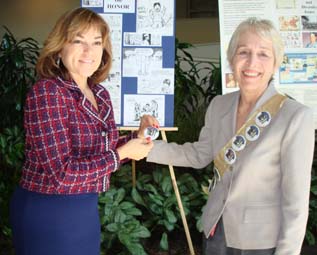
Congresswoman Loretta
Sanchez receives a Defend the Honor button at an event at California
State University Fullerton event, November 10, 2007. Your editor and
Congresswoman Sanchez stand in front of the SHHAR display.
|
||
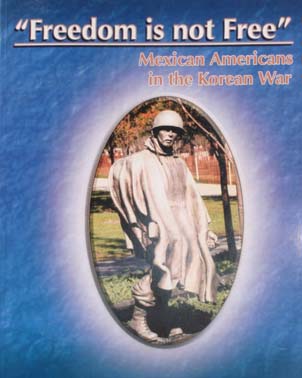
 The accompanying book to the event was also published by Latino
Advocates for Education. The book is a 268 page,
8½ by 11½ glossy covered and page format. Copies are still
available. For information on how to purchase, please go to www.latinoadvocates.org
The accompanying book to the event was also published by Latino
Advocates for Education. The book is a 268 page,
8½ by 11½ glossy covered and page format. Copies are still
available. For information on how to purchase, please go to www.latinoadvocates.org
|
|
|
| Arlington Cemetery, Washington, DC | |
| Jim Carr Hispaniks@aol.com
Sends . . .Good news! "They have added some additional names I suggested to the Arlington National Cemetery (ANC) web site. Go to http://www. arlingtoncemetery.org Click on Historic Information Click on Prominent Figures in Hispanic History Editor: If you know a Hispanic/Latino buried at Arlington, please contact Jim.
|
|
| U.S. Citizenship and Immigration Services is setting up a genealogy program. | |
|
As you know, Immigration is a hot issue nowadays; as a result, a new
program is being organized. I have some information that may be
news to you. The U.S. Citizenship and Immigration Services is setting
up a genealogy program. They will provide information for a fee.
Here is what they have posted on line: This portion of the
USCIS.gov website will contain information about the future USCIS
Genealogy Program. USCIS has records, which document the arrival and
later naturalization of millions of American immigrants. If you have
an ancestor who immigrated and arrived in the United States after 1892
and was naturalized between 1906 and 1956, the future USCIS Genealogy
Program wants to help in your family history research. The USCIS
Genealogy Program will be a fee-for-service program designed to
provide genealogical and historical records and reference services to
genealogists and historians. To make a request for copies of
historical records now, contact the USCIS FOIA Program at mailto:USCIS.FOIA@dhs.gov
USCIS.FOIA@dhs.gov If you would like to contact us by email, send a note to this address: mailto:Genealogy.USCIS@dhs.govGenealogy.USCIS@dhs.gov I shall be requesting information about my great grandmothers. In my case, they were the ones who were valiente enough to leave Mexico and start new lives.
|
|
| Dec. 7 Day of Infamy: Corrido: Los Soldados Olvidados De La Segunda Guerra Munidial |
|
| Friends and Supporters of the
Defend The Honor Campaign: Corrido: Los Soldados Olvidados De La Segunda Guerra Munidial Ode To Our Forgotten Soldiers of WWII (see attached CD Cover) A historic educational, cultural and social justice tribute to our elders and warriors of WWII as written and sung by Los Romanticos. Listen to sound bite www.lanmusical.com/corrido. We are excited to announce the first ever CD recording of a NEW Latino and Latina WWII corrido that incorporates the history, emotions, coraje, and hope as felt and experienced by our WWII warriors and supporters of the Defend The Honor Campaign. The "artistic decisions" made by the musicians in creating the corrido are of the highest quality and pay deep respect to our WWII elders and their families. Our history is being recorded by our own gente in books, research articles, voting booth, teatro and always through the use of music and the corrido. You can join all of us celebrate and experience the new corrido by purchasing one or more CD's for yourself, friends, organization, library or school. It is a keepsake memento in honor of all Latinos and Latinas who served our country before, during and after WWII Please contribute to our "WAR" effort by mailing a $20.00 check payable to: Pepe Villarino 5775 Amarillo La Mesa, CA 91942 Sent by Gus Chavez guschavez2000@yahoo.com Defend The Honor Campaign |
|
| Resource information from the Defense Link Military | |
A suggestions for displays, include the Military Academies cadets and graduates. The web site below included the names of cadets from the four academies plus AF Brig. Gen Maria Owens. John M. Molino, acting undersecretary of defense for EO and their BIOS. You can search the Defense News archives by using the google search "Defense News" and clicking the News archive folder. http://www.defenselink.mil/news/newsarticle.aspx?id=25303 http://www.defenselink.mil/news/newsarticle.aspx?id=25295 Sent by Rafael Ojeda RSNOJEDA@aol.com |
|
|
The
Worm in my Tomato |
|
|
Thousands of Mexican Repatriates of the 1930s no
doubt can relate to the suffering and hardship endured by the Vega
family in the story. Indeed, the story shows how the Repatriation
prompted personal, cultural, psychological and theological decisions.
Is the experience of the
Repatriation to be repeated again? Abrazo Enterprises E-Mail: abrazo@qwest.net
|
|
| Segundo Barrio | |
| A common theme in Chicano
history and literature has been identification with place in form of
the barrio and the struggle to preserve memory. Generally,
Mexicans were poor and lost the battle to developers, i.e.,
Sonoratown, Chavez Ravine. Echo Park in LA, Humbodlt, Lincoln Park,
the Near West Side in Chicago and countless other barrios across the
nation. The great Lalo Guerrero advertised the struggle in
Tucson with his song Barrio Viejo. A group of activists in
El Paso have recently banded together in El Paso to save one of the
oldest barrios in the U.S. --Segundo Barrio as it is known. Led by
activists such as Yolanda Leyva and Donald Romo the community is
taking on Mexican and U.S. mega investors who want to wipe out
"blight" and convert the space into profit making "Taco
Bell" much like what has happened in San Diego's Old Town. With
it goes memories of the Magonistas, Teresa de Urrea etc.
Unfortunately, from my vantage point, few Mexican Americans have
supported the fight. It has fallen to the same few. Rudy Acuña Sent by Dorinda Moreno |
|
| Locating our veterans buried at National & community cemeteries. | |
| From: jaq1000@verizon.net Mr. Ojeda, Rafael y Mimi Thank you for including me in your emails, we greatly appreciate you continued drive and efforts on behalf of all Hispanic Veterans and their families. This is one of the Websites Col. Jim Carr is utilizing. Permit me to tell you a little more about the work that Col. Carr has been doing on the Arlington Cemetery Project. He started this project over a year ago and has done a lot of research, met with VA and Arlington Cemetery Officials. As our HWVA Historian, he decided to take on the most known of all Veterans Cemeteries, which is Arlington. With the support of key HWVA Officers, such as our HWVA past national Executive Director, General Erwin “El Sueco” Huelswede, he is still working with officials to identify our Warrior Heroes and is still working with them to get it right on their Website ID listings of Minorities. As you are aware, having gone through many projects yourselves, this is a never ending process. Jim has established great rapport with these officials and it is only a matter of time before the officials get it right. It is also a very frustrating process, but Jim is determined that once this project is accomplished, the HWVA will then tackle additional Veteran Cemetery issues. Jim also found out that many of our Hispanic Hero Warriors, be they men or women are not identified as Hispanic for one simple reason, they do not have a Hispanic surname due to ancestral or marriage. And there are other reasons, for example at Arlington, they buried several parts of bodies in one grave because it was difficult to identify which body part belonged to who and they may have even missed a person because they really didn’t know who or how many were actually blown up together. This is where his research really becomes important because this is one of his biggest research hurdles. Government staff as you know is only dedicated to what they can identify, few do background research, which means that these veteran identity sites may or may not list all of our Veteranos or Veteranas. We greatly appreciate you keeping us in the loop of your emails. Semper valor y honor!!! Jess Quintero HWVA Secretary jaq1000@verizon.net 202-439-8028 From: RSNOJEDA@aol.com [mailto:RSNOJEDA@aol.com] My Dear Friends, Not only does the VA keep the names of those veterans buried in our National Cemeteries, but in any community cemetery as long as the VA delivered a VA marker. The web site below gives instructions on how to find them both in English and in Spanish. Thanks. Rafael Ojeda http://gravelocator.cem.va.gov/j2ee/servlet/NGL_v1 |
|
| EDUCATION |
| The
State of Education in California Youth, Identity, Power, The Chicano Movement CA Philanthropy Roundtable Speakers' Bios & contact info. Full Ride College Application - please share! Scholarships Directory UH Center for Mexican American Studies - Visiting Scholars Program 2008 White House Internship Program Latino Awards, Fellowships, internships, and research grants |
| The
State of Education in California, Source: Assemblyman Jose Solorio E-newsletter |
|
 Nearly
200 people attended our Education Town Hall meeting, "The State
of Education in California," that I hosted on November 14th in
Santa Ana. The meeting brought educators, administrators and
community leaders together to discuss the results of recent studies
regarding California's educational system and ways to finance,
reform, and improve schools. I was
impressed that more than 30 community members provided public
testimony and many people expressed an interest in holding
additional town hall meetings to discuss education in California. Nearly
200 people attended our Education Town Hall meeting, "The State
of Education in California," that I hosted on November 14th in
Santa Ana. The meeting brought educators, administrators and
community leaders together to discuss the results of recent studies
regarding California's educational system and ways to finance,
reform, and improve schools. I was
impressed that more than 30 community members provided public
testimony and many people expressed an interest in holding
additional town hall meetings to discuss education in California.
Thomas Timar, Ph.D., research director for the Governor's Advisory Committee on Education Excellence and professor of education at the University of California, Davis, provided a presentation of the 23 studies that comprise Getting Down to Facts. These studies were completed under the auspices of the Institute for Research on Education Policy & Practice (IREPP) at Stanford University and can be viewed online at www.irepp.net. Getting Down to Facts provides a groundbreaking analysis of the resources needed to adequately educate a child, as well as how our state's educational system can be reformed. I hosted the town hall meeting because it is important for our communities to have an understanding of this information so they can help improve our schools. I also wanted to hear from you about how you think the state's education system should be improved. I also want to invite you to our Anaheim District Office's 1st Annual Holiday Party on Tuesday, December 18, from 5 p.m. to 8 p.m. Refreshments and hors d'oeuvres will be provided. Our district office is located at 2400 E. Katella Avenue, Suite 640, Anaheim (immediately north of Angel Stadium). Let's celebrate our first successful year in the Legislature and discuss ideas for 2008. To RSVP or for more information, please contact Mayela Montenegro at (714) 939-8469 or by email at mayela.montenegro@asm.ca.gov. As always, please do not hesitate to contact me at Assemblymember.Solorio@assembly.ca.gov if you have any ideas or need assistance with any other matters. Sincerely, E-Newsletter www.assembly.ca.gov/solorio |
|
| YOUTH, IDENTITY,
POWER, The Chicano Movement by Carlos Muñoz, Jr. Ph.D. UC Berkeley |
|
|
Revised and Expanded Edition: YOUTH, IDENTITY, POWER The Chicano Movement By Carlos Muñoz, Jr. An essential record of the Chicano movement and an important addition to the history of the American social protest.' -San Francisco Chronicle' A very important and powerful book, documenting American History·without question, one of the lodestones in reference to the 'movimiento'.' -- Luis Valdez, founder of the Chicano Teatro Campesino' The first major book on the Chicano movement by one of its leaders, who is also a first-rate scholar. Youth, Identity, Power is certain to be a benchmark for all future work on the subject. An important contribution to the history of the 1960s,
it· should be
required reading.'- Clayborne Carson, Stanford University. In the
revised edition of YOUTH, IDENTITY, POWER (Verso, distributed by W.W.
Norton, PB, $23.95), scholar-activist Carlos Muñoz, Jr extends his
classic study of the 1960s Chicano civil rights movement with a
groundbreaking after word that brings the imperative of multiracial
democracy to a new level of clarity. This analysis of Chicano thought
and struggle in America bridges the movement's involvement between
civil rights, social progression and the ever-pertinent history of
Mexican-American tensions. Muñoz chronicles the evolution of the
1960s' Chicano radical leaders from their student activist precursors
of the 1930s, and evaluates how the progress of their combined labors
have formed the many American Latino communities of today. The
contribution of such a necessary study from one of the influential
leaders of the Chicano movement provides for an empowered and crucial
estimation of the struggles confronting the burgeoning Latino
community.
|
|
| CA Philanthropy Roundtable Speakers' Bios & contact info. | |
Here is a great resource for Keynote Speakers. Many of these or our "Orgullos Hispanos" that we know of. As you can see many of them are "Experts and Advocate" for our Children k-20 education. Hopefully this will be a great resource info for you and your organizations or to network with other organizations that may call on you to recommend "keynote speakers" for their events. Rafael Ojeda RSNOJEDA@aol.com http: www.philanthropyroundtable.org/files/SantaMonicaBios.doc
|
|
| Full Ride College Application - please share! | |
Cynthia Robinson wrote: Please share noting that HBC’s will also consider applications from any ethnicity….not just Blacks…. Do you know any high school seniors that will graduate by May 2008, and would like to attend a Historically Black College or University? The Tom Joyner Foundation is offering "full ride" scholarships for graduating high school seniors. Deadline for Applications (attached) is January 18, 2008. http://www.blackamericaweb.com/site.aspx/foundation/fullride Sent by rgrbob@earthlink.net
|
|
| Scholarships Directory | |
|
Our office received a 2007-2008 scholarship directory for Latino students; below is the website to access the directory online. The directory is for high school, undergraduate and graduate students. Please forward this information along: www.latinocollegedollars.org
Diann G. Maldonado Cosme |
|
UH Center for Mexican American Studies - Visiting Scholars Program, 2008-09 |
|
|
Source:
"Carlos Munoz, Jr." <cmjr@berkeley.edu>
Center for Mexican American Studies Office of the Director The Center for Mexican American Studies (CMAS) at the University of Houston is soliciting applications for its Visiting Scholars Program for the 2008-2009 academic year. All interested scholars from relevant disciplines are encouraged to apply. Visiting Scholars receive a salary appropriate to rank and are expected to be in residence during the academic year. Priority consideration will be given to applicants who
a.
have specializations in both Mexican and Mexican American Studies
b.
may have an interest in remaining at the University of Houston in a
tenured or tenure track position after their one year residency as the
CMAS Visiting Scholar is completed.
Applicants
must have earned a PhD and submit the following materials.
a. current resume b. two page description of a proposed research project that will undertaken while in residence c. three letters of recommendation Materials may be submitted via electronic mail to ladame@uh.edu. The deadline for submission of materials is April 15, 2008. More information about the CMAS Visiting Scholars Program can be obtained by visiting the following website www.class.uh.edu/CMAS. The University of Houston provides equal treatment and opportunity to all persons without regard to race, national origin, sex, age, disability, veteran status, or sexual orientation except where such distinction is required by law. This statement reflects compliance with Titles VI and VII of the Civil Right Act of 1964 and Title I of the Educational Amendments of 1972 and all other federal and state regulations. Learning. Leading. 323 Agnes Arnold Houston, TX 77204-3001 713/743-3136 Fax: 713/743-3130 Sent by Dr. Roberto Calderon beto@unt.edu
|
|
| 2008 White House Internship Program | |
|
Dear LULAC Friend: Please click on the following link to download the 2008 White House Internship Program application (PDF Format). Also, please feel free to forward the application to anyone you know who is interested in interning at the White House next summer or fall. http://my.lulac.org/site/R?i=QD3gSmHOFlpQDQMa2QKOVw Application packet deadlines are: February 26, 2008, for Summer 2008 Term June 3, 2008, for Fall 2008 Term To be eligible, an applicant must be: At least 18 years of age on or before the first day of the internship Enrolled in an undergraduate or graduate program at a college or university, or have graduated the previous semester, and is a United States citizen For more information, please go to: http://my.lulac.org/site/R?i=gv2G28IffC1jzuMblZfLSQ . Thank you. Sincerely, Rosa Rosales LULAC National President Sent by Larry Luera luckylarry77@earthlink.net
|
|
Many Latino Awards, Fellowships, internships, and research grants Sent by Roberto Calderon, Ph.D. beto@unt.edu |
| Latino Studies Fellowship Program | |
| Sponsor: Smithsonian Institution SYNOPSIS: Fellowships provide opportunities for U.S Latino predoctoral students and postdoctoral and senior scholars to conduct research related to U.S. Latino history, art and culture in association with members of the Smithsonian professional research staff, and utilizing the resources of the Institution. Predoctoral fellowships offer a stipend of $25,000 per year plus allowances and postdoctoral and senior offer a stipend of $40,000 plus allowances. Deadline(s): 01/18/2008 Title: Latino Studies Fellowship Program E-mail: siofg@si.edu http://www.si.edu/ofg/Applications/LSFELL/LSFELLapp.htm |
|
| Harold T. Pinkett Minority Student Award | |
| Sponsor: Society of American Archivists SYNOPSIS: The sponsor provides an award to recognize minority undergraduate and graduate students, such as those of African, Asian, Latino or Native American descent, who through scholastic and personal achievement manifest an interest in becoming professional archivists and active members of the sponsor's organization. Deadline(s): 02/28/2008 Title: Harold T. Pinkett Minority Student Award E-mail: info@archivists.org Web Site: http://www.archivists.org/recognition/awards.asp Program URL: http://www.archivists.org/governance/handbook/section12-pinkett.asp |
|
| National Museum of American History--Lemelson Internships Archival Internships | |
| Sponsor: Smithsonian Institution SYNOPSIS: The sponsor offers full time, ten week, archival internship opportunities for graduate students each summer. The internship stipend is $4,000 plus a travel allowance. The stipend is not taxed and housing and benefits are not provided. Deadline(s): 03/03/2008 Title: National Museum of American History--Lemelson Internships Archival Internships E-mail: oswalda@si.edu Program URL: http://invention.smithsonian.org/resources/research_interns.aspx |
|
| Phillips Fund Grants for Native American Research | |
| Sponsor: American Philosophical Society SYNOPSIS: The sponsor provides support for research in Native American linguistics, ethnohistory, and the history of studies of Native Americans in the continental United States and Canada. Eligible applicants are younger scholars who have received the doctorate, and graduate students. Grants average $2,500 for one year. Deadline(s): 03/03/2008 Title: Phillips Fund Grants for Native American Research E-mail: LMusumeci@amphilsoc.org Program URL: http://www.amphilsoc.org/grants/phillips.htm |
|
| Mini-Grants | |
| Sponsor: Humanities Texas SYNOPSIS: The sponsor provides Mini-grants of up to $1,500 to support public programs that draw upon the humanities to increase understanding of any aspect of human experience. These grants are available for both program planning and implementation. DEADLINE NOTE Applications should be submitted no later than six weeks prior to a project's start date. Title: Mini-Grants E-mail: grants@humanitiestexas.org Web Site: http://www.humanitiestexas.org/grants/applications/minigrant.pdf Program URL: http://www.humanitiestexas.org/grants/applications/guidelines.pdf |
|
| Community Project Grants | |
| Sponsor: Humanities Texas SYNOPSIS: The sponsor provides community project grants for public humanities projects such as lectures, seminars, and conferences; book and film discussions; interpretive exhibits; site interpretations; chautauquas; town forums and civic discussions; and K-12 teacher training workshops. Deadline(s): 02/15/2008 08/15/2008 Title: Community Project Grants E-mail: grantsr@humanitiestexas.org Web Site: http://www.humanitiestexas.org/grants/applications/community.pdf Program URL: http://www.humanitiestexas.org/grants/applications/guidelines.pdf DEADLINE NOTE The deadlines for receipt of letters of intent/draft applications are: February 15 and August 15 annually. The deadlines for receipt of full applications, if invited, are March 15 and September 15 annually.
|
|
| BILINGUAL EDUCATION |
| Latino/a History, For Kids!!! Hispanic American Theater |
| Latino/a History, For Kids!!! | |
|
A new website has been launched to promote LATINO/A HISTORY FOR KIDS!!! The future of our children depends on our ability to teach them to be culturally sensitive, open minded, and to become people of conscience. They can only love and respect OTHERS if they love and respect THEMSELVES... A series of children's activity books have been developed to teach kids about Cesar Chavez and the UFW as well as what it means to GROW UP LATINO/A IN THE USA. These books use word finds, coloring pages, writing activities, and other fun activities to teach kids vocabulary, pride, and Latino history!!! If you are interested in viewing these books (or purchasing them) please visit http://www.latinohistory4kids.com or contact Angel R. Cervantes at acervant@crsassociates.net for more information. Angel R. Cervantes, a resident of the San Fernando Vally, has taught elementary school for over 10 years. He is also an adjunct instructor of History at Glendale Community College. Currently, he is serving as a Commissioner for the City of LA. Sent by Howard Shorr howardshorr@msn.com
who writes that he has not seen the books. |
|
| Hispanic American Theater | |
|
The roots of Hispanic theater in the United States reach back to the Spanish and Native American heritage of Hispanics. They include the dance-drama of Native Americans and the religious plays and pageants of medieval and Renaissance Spain. During the Spanish colonization of Mexico, Catholic missionaries used plays to help convert the native peoples of Mexico to Catholicism. Plays were later used to teach mestizo (those of mixed Spanish and Native American heritage) Mexicans the mysteries and rituals of the church. In the 1600s and 1700s, a hybrid religious theater developed. These plays combined the music, colors, flowers, masks, and languages that were a part of the native cultures with the stories of the Bible. In Mexico and the American Southwest, these plays eventually moved farther and farther from their religious origins. In the end such plays were banned by the Catholic Church. They were not allowed on church grounds or in church festivals. Because of this separation from the church, such plays became part of the folk culture. The community put on the plays without the help and support of the church. Hispanic Drama in the United States In 1598 Spanish explorer Juan de Onate led a group of Spanish colonists into what is today New Mexico. The colonists brought with them folk plays from Spain and Spanish America. In their camps Onate's soldiers would entertain each other by making up plays based on their experiences on the journey. They also put on a popular Spanish folk play. Moros y cristianos was a heroic play about how the Spanish Christians defeated the Islamic Moors in northern Spain and drove them off the Iberian Peninsula. This play eventually spread throughout Spanish America. It has even been performed in the twentieth century in New Mexico. Moros y cristianos influenced many later Hispanic epic plays about war and conflict. As early as the late 1700s, the Hispanic folk
theater in the United States developed into a theater of
professionals. This usually happened in areas with large Hispanic
populations.
At first, touring groups from Mexico
traveled to California where they performed melodramas and musicals.
In the mid-1800s regularly scheduled steamships made
it easy for these groups to put on plays in
San Diego, Los Angeles, and San Francisco.
Eventually, professional theater troupes
could be found in the Southwest, New
York, Florida, and even the Midwest. Around the time of the Mexican Revolution in 1910, thousands of Mexican refugees settled in the Southwest and the Midwest. This influx of immigrants sparked an increase in theatrical activity. During the decades of revolution, many of Mexico's greatest dramatic artists and their companies came to the United States. They came to tour and take up temporary residence. However, some stayed permanently. These Hispanic groups and others already established in the United States toured cities in Florida, New York, the Midwest, and the Southwest. the most popular cities were San Antonio and Los Angeles. By the 1920s Hispanic theater had become big business.
Editor: I have
searched through both the Elementary School Edition and Secondary
School Edition (also 4-volume), and have found the information
accurate, authoritative, and refreshingly unbiased. For more
information, call 215-321-7742 or email: afriampub@aol.com
or write:
|
|
| CULTURE |
| La
Cancionera de los Pobres, Lydia Mendoza Tejana singer dies Hollywood's Most Acclaimed José-Luis Orozco is an author and recording artist History of the Pinata Hispanic American Theater |
|
|
|
| Given the gringo media's
narrow focus on U.S. Latinos from a purely immigration angle, it's
easy to forget Brown people, and in particular Mexican Americans,
have been mixing it up in the American cultural landscape since
before there even was a so-called "America." As those
wacky Mechistas like to say, "we didn't cross the border, the
border crossed us." One of the greats of the last century died
last week, Lydia Mendoza, age 91, a Tejana singer hugely influential
on both sides of the border since her first recordings back in the
1930s.
From her AP obit: "Mendoza scored her first big hit, Mal Hombre (Evil Man), in the 1930s and became one of the era's first Mexican-American superstars by singing to the poor and downtrodden.Mendoza recorded more than 200 songs on more than 50 albums, including boleros, rancheras, cumbias and tangos for such labels as RCA, Columbia, Azteca, Peerless, El Zarape and Discos Falcon. In addition to pursuing a solo career, she also enjoyed performing with her family. Mal Hombre, released in 1934 on the Bluebird label, became a hit on both sides of the border and was her signature song." In 1982, she became the first Texan to receive a National Endowment for the Arts National Heritage Fellowship and in 1999, she was awarded the National Medal of Arts. Back in the day, I used to work as the assistant for the Theater Program for the Guadalupe Cultural Arts Center in San Antonio (this when the Center actually had dynamic Chicano programming and nothing like the culturally bankrupt institution it is today. More on that sad story maybe later.) The Theater Program commissioned a play on Lydia and it was written by Anthony J. Garcia and included live music and many of her songs. As with most people my age, I knew very little about Lydia. And so while the play taught me the facts of Mendoza's life and exposed me to her poignant, sentimental, powerful music, it was the crowds of Raza flocking to the show that made me aware of Mendoza's importance and cultural impact. For more than a month -- three nights a week and a Sunday matinee performance -- the shows sold out. Lydia herself attended once. By then she was nearly 80, partially debilitated by a stroke, but insisted on attending in one of her signature large and fluffy colorful dresses she wore when performing. Her hair was swept up 1940s style. She waved to the crowd as they gave her a standing ovation. Unfortunately, another lesson learned watching the rich exchange between talented performer and knowledgeable and appreciative audience was witnessing another example of another Secret History revealed, if only for a moment, and, equally frustrating, only within the confines of the Guadalupe Theater. The careers and talents of performers like Josephine Baker and Billie Holiday are not only well-known to most Americans, but acknowledged as active participants and contributors to the larger story of American popular music. If anyone can lay claim for equal significance to the American pop canon it is Lydia Mendoza. Unsurprisingly, her story remains on the margins of our national cultural identity. Below is an article published in the Los Angeles Times, Monday, December 31, 2007 Lydia Mendoza - Tejano pioneer Lydia Mendoza, an early star of Mexican American music whose passionate, despairing songs about working-class life on both sides of the border made her a trailblazer for the Tejano genre, has died. She was 91. Ms. Mendoza, whose singing career spanned more than 60 years, died Dec. 20 of natural causes at Nix Medical Center in San Antonio, according to reports. In 1999, Texas Monthly magazine called her the "greatest Mexican American female performer ever to grace a stage." The words for her first hit came from her girlhood collection of gum wrappers that contained lyrics. She put the words from one wrapper to a tune she had heard in concert in Mexico and first performed "Mal Hombre" (Evil Man), a song about false-hearted lovers, when she was 10. After Ms. Mendoza recorded the tango in 1934, it became a major hit in the Spanish-speaking community and started her career. Accompanied by her signature 12-string guitar, Ms. Mendoza often sang about hardship and rejection in a powerfully sincere style that reflected the music developing along the U.S.-Mexican border. Her trilling voice earned her the nickname "La Alondra de la Frontera," or Lark of the Border. In 1935, she married shoemaker Juan Alvarado and continued to perform in an era when wives usually gave up their careers. By 1940, Ms. Mendoza had recorded more than 200 songs in a wide variety of musical styles that included boleros, rancheras and cumbias. She wrote many of them herself. She performed at the 1977 inauguration of President Jimmy Carter and in 1999 received a National Medal of Arts, which recognizes outstanding contributions to the field. At the White House medal ceremony, President Bill Clinton praised her for bridging "the gap between generations and cultures." She was born in Houston in 1916 to Francisco and Leonor Mendoza. Her family had come from northern Mexico, and she and several siblings grew up moving between Mexico and Texas. In 1928, her father answered an ad in a San Antonio newspaper placed by a New York company looking to record Spanish-language musicians. In a hotel room, the family recorded its first record and was paid $140 for 20 songs. Still needing to find regular work, the Mendozas moved to Michigan to work in the vegetable fields. Upon hearing the family perform, co-workers encouraged them to play in town, and they spent several years working and performing in small restaurants. Back in Texas in the early 1930s, the family often played for tips at an outdoor market in San Antonio, where the host of a Spanish-language radio show heard Ms. Mendoza sing. She was soon performing on the radio for $3.50 a week. While the radio show made her popular in the region, the repeal of prohibition in 1933 created opportunities for cantina musicians. Eventually, the family began touring throughout the Rio Grande Valley in southern Texas. Ms. Mendoza performed solo while her siblings sang together and put on a variety act. Even after having three daughters, Ms. Mendoza kept performing, but gas rationing during World War II temporarily ended her touring. In 1947, she returned to the road, but the family group broke up in 1952 after her mother died and a sister married. Although her status as an idol had peaked during the 1950s, Ms. Mendoza continued recording and touring as a solo act until a series of strokes forced her to retire in 1988. After her husband died in 1961, she married another shoemaker, Fred Martinez, in 1964, and they moved to Houston, where she often performed in small nightclubs. She pulled from a repertoire of 1,200 songs that spanned almost 100 years. Copyright 2007 SF Chronicle Here's an NPR link which features an excerpt from Lydia's autobiography as well as links to some of her songs; info here and here on Yolanda Broyles-González's book on Lydia; a fine blog entry by San Antonio Express New music writer Ramiro Burr on Mendoza's life and influence; this Josh Kun piece on the singer, complete with thoughtful analysis as well as a reference to the very cool Los Super Elegantes punk rock cover of Mal Hombre; song samples from Mendoza's Arhoolie CD here; and an Express News article on her burial yesterday at San Fernando Cemetery in San Antonio. TrackBack URL for this entry:
http://www.typepad.com/t/trackback/2345006/24455148 Information sent by Roberto Calderon and Armando Rendon, Ph.D. armandorendon@sbcglobal.net
|
|
| “HOLLYWOOD‘S MOST ACCLAIMED” | |
|
For More Information,
Contact:
Gato Loco Productions
|
|
|
|
|
|
Born in Mexico City, José-Luis Orozco grew fond of music at a young age, learning many songs from his paternal grandmother. At age 8, José-Luis became a member of the Mexico City Boy’s Choir, and traveled the world visiting 32 countries in Europe, the Caribbean, Central and South America. It was from his tour around the world that he gained the cultural knowledge he now shares with children through his books and recordings. At age 19, José-Luis moved to California in search of the American dream. He went to college and earned his Bachelor’s degree from the University of California, Berkeley and a Master’s degree in Multicultural Education from the University of San Francisco. José-Luis
Orozco dedicates himself to what he truly enjoys – singing for
children. He has built a successful career as a children’s author,
songwriter, performer and recording artist. He has recorded 13
volumes of Lírica Infantil, Latin American Children’s
Music, and written three successful, award winning books, De
Colores and Other Latin American Folk Songs for Children
(Dutton 1994), Diez Deditos – Ten Little Fingers
(Dutton 1997), and Fiestas (Dutton 2002). CD’s of
De Colores, Diez Deditos and Fiestas, accompany
these colorful books and present an extraordinary bilingual
collection of songs, rhymes, tongue twisters, lullabies, games and
holiday celebrations gathered from Spanish-speaking countries. In
2003, José-Luis released an exciting video and DVD entitled Cantamos
y Aprendemos con José-Luis Orozco – Singing and Learning with José-Luis
Orozco, filled with live action, animation, and Latino
flavor that motivates children to learn about the Spanish language
and the rich tradition of Latin American children’s music.
|
|
| History of the Pinata | |
| Can be found on website of MEXICO CONNECT http://www.mexconnect.com/mex_/travel/wdevlin/wdpinatahistory.htm Sent by Dr. Armando A. Ayala DrChili@webtv.net Editor: Mexico Connect is new to
me, we worth searching. It is made up of articles by diverse
writers on varied subjects of interest to Mexico. |
|
| BUSINESS |
Sánchez Family Foundation $10 Million Gift to TAMIU
College of Business Thriving Latina Entrepreneurs
in America
|
|
|||
Texas A&M International University’s College
of Business Administration has been named the recipient of a $10
million gift from the A.R. “Tony” and María J. Sánchez Family
Foundation. The Gift will be used to establish an endowment fund for the
University’s College of Business Administration for its support,
programming, activities and improvements. The Sánchez’ said the Gift exemplifies the A.R. “Tony” and
María J. Sánchez Family Foundation’s commitment to effecting
social change and improving the quality of life for residents of South
Texas and the border. “Our family has deep roots here and a great affection for our
hometown. Through our Foundation, we are able to return some of
our good fortune to the people and place that we truly cherish.
We are delighted to be able to give the College of Business
Administration the ability to grow and excel further,” said Tony Sánchez.
His wife, María “Tani” Sánchez, noted, “By doing so, we
strongly believe that we are effecting lasting social change here and
providing a catalyst for an improved quality of life in South
Texas.” Dr. Ray Keck, TAMIU president, said the impact of the latest Sánchez
gift is indeed life-changing for the young University. “We have always been much-blessed by the partnership of the Sánchez
family, but this gift is absolutely monumental in purpose and scope.
While we feel this remarkable family’s presence daily here at TAMIU,
this generous gift extends their vision beyond our imagination. All
young universities like TAMIU dream of such a partner and we are so
fortunate that they share and affirm our vision of higher education
for South Texas,” Dr. Keck said. The Sánchez Family has played a pivotal role in the University’s
development and underwritten a number of initiatives that have greatly
improved the quality of life for numerous South Texas residents. True to their commitment to investing in the future of Texas and
effecting social change, the Sánchez Family has awarded 86 full-time
students, many of them first-generation college attendees, with
scholarship gifts providing books, fees, and tuition for TAMIU
undergraduate program completion. Known as the Sanchez Scholars, this
select group is made up of four cohorts. In addition, the Sánchez Family’s funding of TAMIU’s College of Business Administration’s Business Technology Center and Trade Room has enabled students’ access to the world of financial information in milliseconds, bringing business education to a new level at the University.
The Value-Investing
Trading Room opened in September 2007.
Through the generous gift of the Sánchez Family, this state-of-the-art virtual and digital "smart" center allows students to apply e-learning principles to business education and makes possible a remote-access educational facility for on-line business programs. It will better prepare students for job opportunities in the business sector while enhancing faculty research and professional development programs. Equipped with an impressive variety of computer and telecommunications software including three plasma flat-screen monitors, 36 wireless laptop computers, 18 microphones for audience and students, three sensors which track speakers on local and distant sites and three Bloomberg-linked workstations, the Business Tech Center impacts TAMIU course offerings in Finance, Accounting, Economics, Management, Marketing, Management Information Systems and Production. The Foundation also supports the popular A. R. Sánchez Sr.
Distinguished Lecture Series. A tribute to the late A.R. Sánchez, who
envisioned the Series providing local students with an opportunity to
hear from the world’s best scholars on a variety of world issues,
ranging from politics, world peace, and higher education, to homeland
security, the Latino vote, women’s rights, space exploration, and
free speech in time of war, the Series is now celebrating its 10th
anniversary. Other local efforts by the A.R. "Tony" and María J. Sánchez Family Foundation include support of the Texas/Mexico Border Regional Academic Health Center for Dental Workforce Training and Dental Care Access. Housed in existing facilities in Laredo, namely the Gateway Community Health Clinic and the City of Laredo Health Department, this dental care project will bring numerous benefits to Laredo and the Mid Rio Grande Valley by helping address the shortage of dental health care providers and expanding oral health education in the region. It will not only enhance the training of pre-doctoral students and post specialty residents, but it will also provide long-term benefits to needy citizens of Laredo and the Mid Rio Grande Valley Area. In addition to providing funding for the center for dental workforce training and dental care access, the Sánchez Family Foundation has agreed to fund the Mobile Dental Van Colonias project in Webb County. This project affords colonia residents the opportunity to receive basic dental services that are delivered by the University of Texas Health Science Center at San Antonio’s Dental School faculty and residents. To date, two of four sites have been visited: Bruni Community Center at Rancho Peñitas West, and Rio Bravo Community Center, in the City of Rio Bravo. From April 2007 to August 2007, a total of 9 weekend trips have been made between both communities, and 300+ patients at both sites have been screened and provided with approximately 2,500+ dental procedures ranging from cleanings and extractions to fillings, with an average of six to seven dental procedures per patient. Two remaining sites to be visited will be Santa Teresita Community Center, and the Quad Cities at Oilton Elementary School. For additional information, contact the University’s Office of
Public Relations, Marketing and Information Services at 326.2180,
e-mail prmis@tamiu.edu
or visit tamiu.edu. Sent by Juan Marinez marinez@anr.msu.edu |
|||
| "Thriving Latina Entrepreneurs in America" | |||
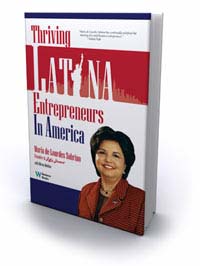 "Thriving Latina Entrepreneurs in America" written by Maria de Lourdes Sobrino, includes interviews with outstanding Latinas including: Liza Roeser Atwood, Martha De La Torre, Patricia Pliego-Stout, Olga Martinez, Carolina Jovenich, Martha Lugo-Aguayo and Theresa Alfaro-Daytner. Thriving Latina Entrepreneurs in America answers a question the author frequently encounters, "How did you take the determination to leave your family and your country to start a business in a foreign land?" This book is an inspiration and guide for everyone, especially for women of various ethnic backgrounds in different industry segments, who are entrepreneurs or plan to have a business one day. She tells the stories of seven successful Latinas that inspire and direct you in your journey through the business world. After learning what these women went through to pursue their passion and achieve success, you will feel like you can accomplish anything. Thriving Latina Entrepreneurs in America is a book that encourages the reader to follow your dreams and succeed. It will also provide you with the tools and knowledge to get your business up and running. And it will save you time, energy and perhaps money. Check out the interview on YOUTUBE |
|||
| The Connection |
|
By Patrick Osio http://www.sandiegometro.com/2007/dec/connection.php Identification, Please New border entry rules may greatly harm U.S.-Baja economies It is incredible that more than six years has passed since our lives were so dramatically changed on Sept. 11, 2001, and with it our country’s attitude toward our international borders and measures of security implemented to keep out potential terrorists. Prior to that infamous day, the border crossing concerns were the interdiction of drugs and the undocumented. Since then, the primary mission of the Department of Homeland Security, organized in the attack’s aftermath, has been to secure the borders from further terrorist infiltration. (The terrorists had legally entered the United States through land and air ports.) A major new step in that security effort takes effect Jan. 31 that has the potential to dramatically impact San Diego’s social and economic relationship with Baja California. Known as the Western Hemisphere Travel Initiative (WHTI), this law will require U.S. citizens 19 and over to present a government-issued photo ID such as a driver’s license, and proof of citizenship, such as a birth certificate, naturalization certificate or passport to enter the United States by land or sea. A passport or NEXUS, SENTRI or FAST card will be accepted as ID and citizenship requirements. Border Crossing Cards will continue to be accepted documents for Mexican citizens to meet both requirements. WHTI affects travel between the United States and Canada, Mexico, Bermuda and the Caribbean. When the law was announced, it sent shock waves along both north and south border regions whose populations, in great numbers, daily cross the border for shopping, business or social occasions. Of course, passing such a sweeping law and gearing up to manage the logistics are two very different animals. We can be generous and say lawmakers did not fully realize the magnitude of border travel. In San Diego we are familiar with the primary number: more than 60 million people cross the border annually at the ports-of-entry at San Ysidro, Otay Mesa and Tecate. For perspective, this number represents nearly the combined populations of California, Arizona, New Mexico and Texas. And it only tells part of the enormity of border activity. The United States has 326 official ports-of-entry through which each day more than 1.1 million (401.5 million annually) travelers enter or re-enter, including 327,000 cars (119.4 million annually) and more than 18,000 commercial trucks (17.1 million annually). Requiring passports is not the sole new way to track visitors. Another law mandates that these documents be biometric, outfitted with an RFID chip that wirelessly can transmit information about the bearer, including fingerprints. It was a nice idea, but beyond the capability of technology and personnel to handle at the scale of legal border crossings. To top it off, fewer than 20 percent of Americans had passports when the WHTI was passed. This led to a flood of applications that bogged down passport issuance. The number of passports issued has risen from 7 million in 2002 to 7.3 million in 2003, 8.8 million in 2004, 10.1 million in 2005 and 12.1 million in 2006. Great progress, but the total issued is still less than 30 percent of the population. As the magnitude of meeting WHTI requirements became obvious, the effective date was delayed. For air travel, it finally became effective on Jan. 23 of this year. For those in cars or on foot crossing the border back into the United States, the historical practice of accepting oral declarations alone (Question: Citizenship? Answer: U.S.) will end, effective Jan. 31. Additional requirements, however, will be gradual. The Department of Homeland Security expects that by summer the equipment and training will be in place so that full implementation of WHTI requirements will take effect for all land and sea entries. (The precise date will be announced with at least 60 days notice.) As this column has reported, the border regions of San Diego and Baja are economically integrated far more than most San Diegans care to admit. Border crossing delays already cause $8.5 billion in economic disruptions a year, according to a recent study by the San Diego Association of Governments and California Department of Transportation. Sadly, information about these new requirements has been woefully underreported and explained. For many it will be a shock, followed by either the wait it takes to get a passport or a simple abandonment of the idea of even crossing the border. At a time of economic slowing, doing business with our best partner in a global world likely will take a hit. Then again, Washington politicians already have shrugged off the $8.5 billion in ongoing economic losses. What’s another few million or billion to San Diego mean to them?  Patrick Osio Jr. can be reached at posiojr@sandiegometro.com
. The
veteran consultant also has issued The Mexican Perspective, an
intensive primer on business culture and protocol. Copies are
available at hispanicvista.com/sales/book_sale.htm .
Patrick Osio Jr. can be reached at posiojr@sandiegometro.com
. The
veteran consultant also has issued The Mexican Perspective, an
intensive primer on business culture and protocol. Copies are
available at hispanicvista.com/sales/book_sale.htm .
|
|
Anti-Spanish Legends |
|
FBI: Hate Crimes Against Hispanics Up 25% Since 2004 Anti-Latino Humor Has Entered the Mainstream. |
|
|
FBI: Hate Crimes Against Hispanics Up 25% Since 2004 MALDEFian, November 26, 2007 LOS ANGELES, CA — Last week’s release of the annual Federal Bureau of Investigation (FBI) Hate Crimes Statistics Report documents and quantifies the increase in anti-Latino sentiment and community tensions we see across the nation. The FBI reports a sustained increase in crimes committed based on the perceived ethnicity or national origin of the victim. Some of the key points from the report: § A greater percentage of crimes motivated by national origin are committed against Hispanics compared to the previous year. § In 2006, almost two-thirds of all ethnic-based hate crimes were committed against Hispanics. § Since 2004, the number of victims of anti-Hispanic crimes increased by 25%. § While most race-based and religion-based hate crimes involve intimidation instead of assault, most hate crimes against Latinos (and Asian Americans, Indians and gays) were assaults. § Anti-Latino crimes are more severe. Unlike every other group, only Latinos suffered a greater number of aggravated assaults than simple assaults. The numbers do not tell the whole story. Crimes in which perpetrators choose their victims because they perceive them to be undocumented, and thus less likely to report crimes to the local police and more likely to be carrying cash, are often labeled “crimes of opportunity.” Even though the majority of such victims are Latinos, these crimes are not reported as offenses motivated by their ethnicity. In Pasadena, California, MALDEF has met with city officials about “Sock on Mexican” crimes which occur late at night against Latinos who may be leaving their jobs in restaurants or offices. Pasadena police reported 60 such crimes last year and, due to community policing and other efforts, a reduction to 23 this year. Yet, despite 60 “Sock on Mexican” crimes in 2006, the Pasadena Police Department reported only six ethnic-based hate crimes. The rise in hate crimes and other crimes where Latinos are singled-out is a consequence of the anti-immigrant hatred heard on the airwaves and in political debates that demonizes immigrants and Latinos. These attacks provide greater urgency for Congress and the President to enact comprehensive immigration reform. |
| Anti-Latino Humor Has Entered the Mainstream. | |
|
No laughing matter Anti-Latino humor has entered the mainstream. Roberto Lovato, The Progressive Magazine November 28, 2007 Roberto Lovato is a contributing associate editor with New America Media. He is also a frequent contributor to The Nation. His email is robvato@gmail.com . Late night funny man Conan O'Brien recently tickled his studio audience as he touched on immigration, a hot button topic heard with growing frequency on late night talk shows: "A man in Mexico weighing 1,200 pounds has lost almost half that weight and might enter the Guinness Book of World Records for most weight lost. The Mexican man lost the weight when the family inside him moved to America." Then at the Emmys on September 16, O'Brien, who won an award, provided a clip of his writing team depicted as Latino day-laborers. During a "New Rules" segment of his show broadcast in late August, liberal late nighter Bill Maher went to the well of immigrant humor: "New Rule: No more produce-scented shampoo: avocado, cucumber, watermelon. Gee, your hair smells like a migrant worker." Jay Leno, who has gone out of his way to tell people, "I'm not a conservative," has also joined in. During a show in mid-September, he joked, "Well, police across the country now say they're arresting more and more illegals who are prostitutes. But proponents say, 'No, no. They're just doing guys American hookers will not do.'" And during a recent sketch making light of Latino criticisms of Ken Burns for his exclusion of the more than 500,000 Latino veterans in the filmmaker's epic War documentary, Jimmy Kimmel deployed images of sombrero-wearing Speedy Gonzalez-a cartoon long considered racist by Chicano activists-yelling "Arriba. Arriba." Kimmel's shtick includes placing parking lot attendant Guillermo in compromising positions as when the heavily accented Latino immigrant participates in spelling bee contests with young champions. In another humiliating sketch, Kimmel begs him, "Please do not resort to violence." While the immigration debate in Congress ended months ago, the immigrant jokes haven't. This is not so much because the late night hosts are at the tail end of a political trend, but because they are, in fact, at the front end of a major cultural trend: the mainstreaming of anti-immigrant sentiment. Immigrant rights activists have concentrated much energy on challenging rightwing radio as well as blatantly racist, formerly fringe video games like "Border Patrol" in which players shoot immigrants for points. But little attention is paid to the more mainstream fare: Top-selling video games in which white good guys kill immigrant bad guys and black and Latino zombies; popular television shows like NBC's The Office, in which immigrant characters are ridiculed for their accents, nationality, and other traits; movies like the supernatural thriller Constantine or last year's comic hit Nacho Libre, in which immigrant characters embody evil and stupidity. The proliferation of anti-immigrant messages in pop culture moved UCLA linguist Otto Santa Ana to study what he calls an "explosion" of anti-immigrant representations in pop culture. "There've always been racist, anti-Latino stereotypes in the media, but things are getting quite bad now," says Santa Ana, who started documenting anti-immigrant language and imagery he found in California newspapers in 1993, the year that launched the political battles around that state's Proposition 187, which sought to deny education and social services to the undocumented and their children. Since then, says Santa Ana, anti-immigrant themes have become more intense. In his efforts to document these trends, Santa Ana, author of Brown Tide Rising: Metaphors of Latinos in Contemporary American Public Discourse, and several of his students have gathered more than 100 YouTube clips that he says represent only a small portion of a growing number of "extraordinarily racist, anti-immigrant jokes and other content in sitcoms, film, standup comedy, and other mediums." Santa Ana's collection includes a wide spectrum of mainstream programming and movies. "Some of the clips will make you laugh," he says. "But once you see the stream of those clips, you stop laughing. You see ten, twenty, thirty, forty, and then you recognize that they're actually laughing at you." In an episode on Fox's popular Family Guy animated comedy, for example, a couple of bandanad, knife-wielding, Chicano-accented gangster cockroaches in a dirty motel threaten intruders by saying, "Hey, you're on our turf, man," and, "Hey, man, I gonna cut you up so bad, you gonna wish I no cut you up so bad." One of the white characters responds, "I blame the schools." In a different episode, after Peter Griffin, the family guy, complains about another character, "He's a bigger mooch than the Mexican Super-friends," the scene moves to a tall, crowded building called the "Mexican Hall of Justice" that is packed with people. A white landlord walks up to Mexican Superman and says, "Hey, Mexican Superman, when you signed the lease, you said there were only going to be five of you here." Or take the Academy Award-winning hit Happy Feet. Santa Ana explains how the protagonist, Mumble, a blue-eyed emperor penguin, leads a group of bungling, Spanish-accented, smaller, weaker penguins known in the film as the Amigos. Mumble is exiled from his land and scapegoated by elders for allegedly causing a fish famine. Mumble then vows to find the "aliens" that, he says, are the true cause of the famine. Along the way, Mumble, says Santa Ana, has to "teach" what is right and wrong to the Amigos. "It's striking to see these penguins speaking in Mexican accents, walking funny, and being subservient," he says. Santa Ana worries about the effects on his students, most of whom said at the beginning of the class that they enjoyed and even bought the Happy Feet DVD. He also worries about the effect of the $384 million blockbuster on children worldwide, many of whom will also play the Happy Feet game that is part of the gigantic and expansive world of video, a more interactive world that may portend the future of funny and not-so-funny depictions of immigrants. Depictions of Latino immigrants do not all fall into the negative category, however. The Emmy award-winning Ugly Betty sitcom treats immigrant and immigration in a funny yet respectful manner. It's no accident that the show is produced by immigrant Salma Hayek. A new video game, "ICED! I Can End Deportation," developed by the New York-based nonprofit Breakthrough, turns players into undocumented immigrants as they flee from cruel border patrol agents. The same Spanish-language radio jocks who played definitive roles in last year's immigrant mobilizations are continuing citizenship and voter registration campaigns. Comedians such as George Lopez draw attention to racial issues in much the same way African American comedians have done for decades. Columnists such as Gustavo Arellano, who writes the popular "Ask a Mexican," similarly use judo-like methods to deflect and draw attention to an anti-immigrant streak that grows. For his part, Santa Ana, who lives in Los Angeles, takes the long view: "In twenty or thirty years we will be absolutely astonished that people could consume these racist depictions." Dr. Carlos Muñoz, Jr. Professor Emeritus, Department of Ethnic Studies 510-642-9134 http://ethnicstudies.berkeley.edu/faculty/munoz |
|
| Military and Law Enforcement Heroes |
|
Hispanic Medal of Honor recipients,
Part 11 |
|
Army and Navy (Marine Corps) Medals of Honor
Hispanic Medal of Honor recipients Part 11 By Tony (The Marine) Santiago
This is the eleventh part of the Hispanic Medal of Honor series which consists of the short biographies of Vietnam War Medal of Honor recipients Humbert Roque Versace* and Maximo Yabes* Sometimes there are stories so powerful that even grown men cry. One of the articles that I wrote and which brought tears to my eyes was the one about Captain Humbert Roque Versace. Yes, I am not ashamed to tell you that this tough Marine who some people called "Heart of Stone", could not contain his tears. Maybe it was that I remembered the friends that I lost but, mostly I believe that it was because as I wrote the article I placed myself, as a father and grandfather, in the place of his parents. You see, it is bad enough to lose a loved in combat, but I just can’t imagine the pain that a parent must feel when the loved one in question is captured by the enemy and you have no idea of his or her destiny. That is what happened to Versace, he was captured, tortured and executed. His mother, a talented writer whose work inspired the television series "The Flying Nun" spent her life trying to recover his remains to no avail. She then led the fight to have her son recognized with the Medal of Honor, a distinction which she was to never witness because she passed away before Congress gave their approval. In the case of Maximo Yabes, he was already a veteran of 15 years when he used his body as a shield to protect others in a bunker, moved 2 wounded men to a safer position where they could be given medical treatment and destroyed an enemy machine gun position before being mortally wounded. This is the last of my Medal of Honor series. Try to remember the names of our 43 MoH heroes, because these were men from all walks of life who in some cases made the ultimate sacrifice, so that everyone in this country can enjoy the freedoms which often are taken for granted. Note: "*" after a name indicates that the person was awarded the MoH posthumously. __________________________________________________________________________________ Humbert Roque Versace By: Tony (The Marine) Santiago
Captain Humbert Roque "Rocky" Versace (July 2, 1937–September 26, 1965) was a United States Army officer of Puerto Rican-Italian descent who was awarded the United States' highest military decoration — the Medal of Honor — for his heroic actions while a prisoner of war (POW) during the Vietnam War. He was the first member of the U.S. Army to be awarded the Medal of Honor for actions performed in Southeast Asia while in captivity. Early years Humbert Roque Versace was born in Honolulu, Hawaii on July 2, 1937. He was the eldest of five children born to Marie Teresa Rios (1917–1999) — the author of three books, including the Fifteenth Pelican, on which The Flying Nun (starring Sally Field), the TV series of the 1960s, was based — and Colonel Humbert Joseph Versace (1911–1972). Versace grew up in Alexandria, Virginia and attended Gonzaga College High School in Washington, D.C.. He joined the Armed Forces in Norfolk, Virginia. As had his father before him, Versace entered the United States Military Academy West Point. He graduated in 1959 and was commissioned a Second Lieutenant of Armor in the U.S. Army. He was a member of Ranger Class 4-60 and was awarded the Ranger Tab on December 18, 1959. Upon graduation from Ranger School, Capt. Versace attended Airborne School and was awarded the parachutist badge. He then served with 3rd Battalion, 40th Armor, 1st Cavalry Division in the Republic of Korea as an M-48 tank platoon leader from March 1960 to April 1961. Captain Versace was then assigned to the 3d U.S. Infantry (Old Guard), where he served as a tank platoon leader in Headquarters and Headquarters Company. After volunteering for duty in Vietnam, he attended the Military Assistance Institute, the Intelligence course at Fort Holabird, Maryland, and the USACS Vietnamese language Course at the Presidio of San Francisco. Vietnam War On May 12, 1962, Versace began his first tour of duty in the Republic of Vietnam as an intelligence advisor. In May 1963 he volunteered for a six month's extension of his tour, planning to attend seminary at the conclusion of his service and join the Catholic priesthood, hoping to return to Vietnam as a missionary working with orphans. Less than two weeks before the end of his tour, on October 29, 1963, while acting as intelligence advisor to Detachment 25, 5th Special Forces Group in the Mekong Delta, Versace accompanied several companies of South Vietnamese Civilian Irregular Defense (CIDG) troops who had planned to take out a Viet Cong (VC) command post located in the U Minh Forest, a Viet Cong stronghold. A VC Main Force battalion ambushed and overran Versace's unit, wounding him in the process. He was able to provide enough covering fire so that the CIDG forces could withdraw from the killing zone. A second government force of about 200 men operating only a few thousand yards from the main fight learned of the disaster too late to help. U.S. authorities said the communist radio jammers had knocked out both the main channel and the alternate channel on all local military radios. Versace was captured and taken to a prison deep in the jungle along with two other Americans, Lieutenant Nick Rowe and Sergeant Dan Pitzer. He tried to escape four times, but failed in his attempts. Versace insulted the Viet Cong during the indoctrination sessions and cited the Geneva Convention treaty time after time. The Viet Cong separated Versace from the other prisoners. The last time the prisoners heard his voice, he was loudly singing "God Bless America". On September 26, 1965, North Vietnam’s "Liberation Radio" announced the execution of Captain Humbert Roque Versace. Versace's remains have never been recovered. His headstone at Arlington
National Cemetery stands above an empty grave. Nominations to award Versace the Medal of Honor were initiated in 1969, but the nomination failed and he was posthumously awarded the Silver Star Medal instead. The quest for a Medal of Honor for Versace languished until the "Friends of Rocky Versace" reinitiated the crusade once more in 1999. Language added by Congress in the 2002 Defense Authorization Act ended the standoff and authorized the award of the nation's highest military decoration for combat valor to Versace. On July 8, 2002, in a ceremony in the White House East Room, Versace was posthumously awarded the Medal of Honor by President George W. Bush for his heroism, the first time an Army POW had been awarded the nation's highest honor for actions in captivity. Present were his surviving siblings, Dr. Stephen Versace, Richard (former coach of the Indiana Pacers), Michael and Trilby Versace. Medal of Honor citation Humbert Roque Versace Rank and organization: Captain, U.S. Army,
Intelligence Advisor, Special Operations
In memory The name Humbert R Versace is inscribed on the Vietnam Veterans Memorial ("The Wall") on Panel 01E, Row 033. On July 6, 2002, Rocky Versace Plaza in Alexandria, Virginia was dedicated in honor of Humbert R. Versace. There is a statue with the likeness of Versace in the Plaza, which was made possible with a donation of $125,000 raised by the citizens of Alexandria, Virginia. On July 9, 2002, the day after the White House Medal of Honor ceremony, Secretary of the Army Thomas E. White and Army Chief of Staff General Eric K. Shinseki inducted Versace into the Pentagon Hall of Heroes. The name of Humbert Roque Versace was engraved in "El Monumento de la Recordacion" (Monument of Remembrance), dedicated to Puerto Rico's fallen military members and situated in front of the Capitol Building in San Juan, Puerto Rico, and unveiled by Puerto Rico Senate President Kenneth McClintock and PR National Guard Adjutant General Col. David Carrión on Memorial Day, 2007. Awards and decorations Among Capt. Humbert Roque Versace's military
decorations are the following: Badges: Tabs: Ranger Tab Further reading Rowe, James N. [June 1971] (May 1984). Five Years to Freedom: The True Story of a Vietnam POW, reissue edition, Presidio Press. ISBN 0-345-31460-3.
Maximo Yabes By: Tony (The Marine) Santiago
Early years Yabes, a Mexican-American, was born in Lodi, California, and at a young age moved with his family to Eugene, Oregon where he received his primary and secondary education. In 1950, he dropped out of Oakridge High School and joined the United States Army. Vietnam War By 1967, Yabes was a First Sergeant with a total of 15 years in the Army. He was assigned to Company A, 4th Battalion, 9th Infantry, of the 25th Infantry Division which found itself in the Republic of Vietnam. The division had been stationed at Cu Chi, a village northwest of Saigon since January 1966. Yabes' company — Alpha Company — was assigned to protect a squad of Army engineers whose assignment was to bulldoze a swath between the village and a plantation. The objective of this assignment was to deny the enemy ambushers and snipers the protective cover of the lush jungles. On February 26, 1967, waves of Viet Cong, attacked Company A's position, blowing whistles and laying down deadly automatic weapons fire. The Viet Cong, who penetrated the barbed wire perimeter, hurled grenades towards the command bunker. Yabes ran inside the bunker and covered its occupants with his body, all the while receiving wounds from numerous grenade fragments. Yabes then moved to another bunker and with a grenade launcher fired upon the enemy, halting a further penetration of the perimeter. Yabes then assisted two fallen comrades before he noticed an enemy machinegun within the perimeter which threatened the whole position. Yabes then proceded to attack the enemy machine gun crew. He was able to kill the entire crew before falling mortally wounded. President Lyndon B. Johnson, presented Yabes' wife and children with the Medal of Honor in a ceremony held at the White House. Medal of Honor citation MAXIMO YABES Rank and organization: First Sergeant, U.S. Army,
Company A, 4th Battalion, 9th Infantry, 25th Infantry Division. Citation:
Honors First Sergeant Maximo Yabes was buried with full military honors at Fort Logan National Cemetery in Denver, Colorado. Dozens of individuals, businesses and organizations in Eugene, Oregon, donated time, money, labor and supplies to build a memorial to honor Yabes. They hired sculptor Tim Outman to create the memorial which features a fountain, a flag pole and a bronze bust with the likeness of Yabes set on a granite pedestal. Engraved on the base are the details of Yabes' Medal of Honor exploits. The memorial is located in Oakridge Oregon in the Greenwaters Park. Greenwaters Park is located on the east side of Oakridge, south of highway 58. The city of El Paso, Texas also honored Yabes by naming an avenue after him. His name can be found on panel 15E, line 102 of the Vietnam Memorial Wall in Washington D.C. Awards and recognitions Among Maximo Yabes' decorations and medals were the
following: Badges Foreign unit decorations Further reading References to First Sergeant Maximo Yabes exploits can be found in the following books: Shelby L. Stanton (2003). Vietnam Order of Battle: A Complete Illustrated Reference to U.S. Army Combat and Support Forces in Vietnam 1961-1973. Stackpole Books. ISBN 0811700712. Richard C. Campbell (1995). Two Eagles in the Sun: A Guide to U.S. Hispanic Culture. Two Eagles Press. ISBN 1884512747. Edward F. Murphy (1987). Vietnam Medal of Honor Heroes. Ballantine Books. ISBN 0345338901. Ron Owens (2004). Medal of Honor: Historical Facts And Figures. Turner Publishing Company. ISBN 1563119951.
List of 43 Hispanic Medal of Honor Recipients These are the last two men out of a total of 43 Hispanics who were awarded the Medal of Honor. Yes, 43, not 39 or 41 like you may have read in some other website, but 43. Here are once more the names of all the Medal of Honor recipients whose biographies I have included during the last year in the Hispanic Medal of Honor series of "Somos Primos" which started with Part I. I would like to wish you all a "Happy New Year" and I hope that you all enjoyed reading this series as much as I enjoyed writing it. Remember the names of our heroes. Civil War 1. Philip Bazaar 2. Joseph H. De Castro 3. John Ortega Boxer Rebellion 4. France
Silva 5. David B. Barkley* World War II 6. Lucian
Adams 7. Rudolph
B. Davila 8. Marcario
Garcia 9. Harold
Gonsalves* 18. Ysmael R. Villegas* Korean War 19. Fernando Luis Garcia* 20. Edward Gomez* 21. Ambrosio Guillen* 22. Rodolfo P. Hernandez 23. Baldomero Lopez* 24. Benito Martinez* 25. Eugene Arnold Obregon* 26. Joseph C. Rodriguez Vietnam War 27. John P. Baca 28. Roy P. Benavidez 29. Emilio A. De La Garza* 30. Ralph E. Dias* 31. Daniel Fernandez* 32. Alfredo "Freddy" Gonzalez* 33. Jose Francisco Jimenez* 34. Miguel Keith* 35. Carlos James Lozada* 36. Alfred V. Rascon 37. Louis R. Rocco 38. Euripides Rubio* 39. Hector Santiago-Colon* 40. Elmelindo Rodrigues Smith* 41. Jay R. Vargas Jr. 42. Humbert
Roque Versace* 43. Maximo
Yabes* Next month, I will write about four men who deserve
the Medal of Honor. They are: Marcelino Serna - World War I, Guy
Gabaldon - World War II, Modesto Cartagena - Korean War and Rafael
Peralta - Irak War. Til then "Que Dios los Bendiga" |
|||
| Articles about Hispanic Military Men and Women written by Tony Santiago | |||
|
This is a list of all the Hispanic military related articles that I
have written. As expected, the majority are about Puerto Ricans
because their contributions have never been mentioned before in any of
our history books. Which lead me to realize that the contributions of
all Hispanic Americans in general has been taken for granted by the
majority of the people in the United States and therefore I have
expanded my writing efforts to include other Hispanics who deserve to
be recognized. |
|||
| Staff Sgt. Humberto Acosta-Rosario, U.S. Army, only Puerto Rican
still listed as Missing in Action Brigadier General Ricardo Aponte, U.S. Air Force, currently the Director of the United States Southern Command, the first Puerto Rican to hold said position. PFC Domingo Arroyo, USMC, first Puerto Rican and U.S. serviceman to die during the Somalian Civil War Brigadier General Antonio Rodriguez Balinas, U.S. Army, was the first commander of the Office of the First U.S. Army Deputy Command. Rear Admiral Jose M. Cabanillas, U.S. Navy, In WWII he was Executive Officer of the USS Texas and participated in the invasions of Africa and Normandy(D-Day). Staff Sgt. Modesto Cartagena, U.S. Army, most decorated Hispanic in history Sergeant First Class Agustin Ramos Calero, U.S. Army, was the second most decorated soldier in all of the United States during World War II Rear Admiral Rafael Celestino Benitez, U.S. Navy, highly decorated submarine commander who led the rescue effort of the crew members of the USS Cochino during the Cold War. Tech4 Carmen Contreras-Bozak, WAC's, became the first Hispanic woman to serve in the Women's Army Corps as an interpreter and in numerous administrative capacities Capt. Antonio de los Reyes Correa, Spanish Army, defeated the British in Arecibo Brigadier General Ruben A. Cubero, U.S. Air Force, former Dean of the Air Force Academy. Captain Linda Garcia Cubero, USAF, was a member of the first class of women to graduate from the United States Air Force Academy (1980), and thus became the first Hispanic woman to graduate from any service academy. Major General Juan Cesar Cordero Davila, U.S. Army, commanding officer of the 65th Infantry Regiment during the Korean War becoming one of the highest ranking ethnic officers in the Army. Lieutenant General Pedro Del Valle, U.S. Marine Corps, first Hispanic three-star Marine general Lieutenant Carmelo Delgado Delgado, Abraham Lincoln International Brigade and fought against General Francisco Franco in the Spanish Civil War. Delgado was amongst the first U.S. citizens to die in that conflict. Rear Admiral Dr. Alberto Diaz, Jr. , U.S. Navy, first Hispanic Director of the San Diego Naval Medical District 2 Lt. Carmen Dumler, WAC's, one of the first Puerto Rican women Army officers Major General Luis R. Esteves, U.S. Army, organized the Puerto Rican National Guard Major General Salvador E. Felices, U.S. Air Force, first Puerto Rican general in the U.S. Air Force CWO3 Rose Franco, USMC, first Hispanic woman Chief Warrant Officer in the Marine Corps PFC Fernando Luis Garcia, USMC, first Puerto Rican awarded the Medal Of Honor Brigadier General Mihiel "Mike" Gilormini, USAF, World War II hero, recipient of 5 Distinguished Flying Cross's and founder of the Puerto Rico Air National Guard. Capt. Miguel Henriquez, Captain Spanish Navy, defeated the British in Vieques Vice Admiral Diego E. Hernandez, U.S. Navy, the first Hispanic to be named Vice Commander, North American Aerospace Defense Command. Major General Orlando Llenza, U.S. Air Force, is the second Puerto Rican to reach the rank of Major General (two-star General) in the United States Air Force General Manuel Goded Llopis, Spanish Army, was a high ranking general who fought alongside Generalisimo Francisco Franco in the Spanish Civil War PFC Carlos Lozada, U.S. Army, awarded Medal of Honor Brigadier General Antonio Maldonado, U.S. Air Force, was the at age 25 the youngest person to pilot a B-52 aircraft Lt. Francisco Gonzalo Marin, Cuban Liberation Army, fought alongside Jose Marti Lieutenant Colonel Teofilo Marxuach, U.S. Army, fired the first shot in World War I on behalf of the United States Rear Admiral George E. Mayer, U.S. Navy, first Hispanic Commander of the Naval Safety Center. Capt. Angel Rivero Mendez, Spanish Army, fired the first shot against the Americans in the Spanish-American War in Puerto Rico, invented the "Kola Champagne" Col. Virgil R. Miller, U.S. Army, Regimental Commander of the 442nd Regimental Combat Team in WWII, the most decorated unit in U.S. military history Captain Edwin Muñiz, Ph.D., M.D., Ed. D.,; was the first person of Hispanic heritage to be named Aerospace Physiologist in the United States Air Force and NASA Major General William A. Navas, U.S. Army, first Puerto Rican named Assistant Secretary of the Navy Colonel Hector Andres Negroni, U.S. Air Force, first Puerto Rican graduate of the United States Air Force Academy PFC Ramón Nuñez-Juarez, USMC, listed as Missing in Action during the Korean War and posthumously awarded the Navy Cross, second highest medal after the Medal of Honor, that can be awarded by the Department of the Navy. Capt. Maria Ines Ortiz, U.S. Army, first Puerto Rican nurse to die in combat and first Army nurse to die in Iraq. Brigadier General Luis Padial, Spanish Army, played an essential role in the abolishment of slavery in Puerto Rico Admiral Ramon Power y Giralt, Spanish Navy, distinguished himself in 1808-1809 with the defense of the Spanish Colony of Santo Domingo against an invasion from Napoleon's French forces by enforcing a blockade in support of Spanish ground troops. Col. Carlos Betances Ramirez, U.S. Army, first Puerto Rican to command a battalion in the Korean War Capt. Marion Frederic Ramirez de Arellano, U.S. Navy, was a submarine commander who was awarded two Silver Star Medals and a Bronze Star Medal for his actions against the Japanese Imperial Navy during World War II. Major Fernando L. Ribas-Dominicci, U.S. Air Force, perished in Operation El Dorado Canyon Rear Admiral Frederick Lois Riefkohl, U.S. Navy, was the first Puerto Rican to graduate from the United States Naval Academy and the first to be awarded the Navy Cross. General Juan Ruis Rivera, Commander-in-Chief of the Cuban Liberation Army Capt. Manuel Rivera, Jr., USMC, First Puerto Rican and U.S. servicemen to die in Operation Desert Shield Brigadier General Pedro N. Rivera, M.D., USAF, the first Hispanic to be named medical commander in the United States Air Force. Admiral Horacio Rivero, U.S. Navy, first Hispanic four-star admiral SPC Lizbeth Robles, U.S. Army, first Puerto Rican female soldier born in Puerto Rico to die in Iraq Master Sgt. Pedro Rodriguez, U.S. Army, awarded two Silver Stars in one week Major Fernando E. Rodriguez Vargas, DDS, U.S. Army, discovered the bacteria which causes dental caries Captain Humbert Roque Versace, U.S. Army, first Army P.O.W. to be awarded the Medal of Honor for actions in captivity. Captain Euripides Rubio, U.S. Army, awarded Medal of Honor Sergeant Major Jose Luis Santiago, USMC , has the distinction of being the 2nd Battalion 9th Marines' first Hispanic Sergeant Major and its first Sergeant Major since its reactivation on July 13, 2007. Sp4c Hector Santiago-Colon, U.S. Army, awarded Medal of Honor MGySgt. Frankie Segarra, USMC, First Hispanic to reach the grade of Master Gunnery Sergeant in the Marine Corps Brigadier General Antonio Valero de Bernabe, fought alongside Simon Boliver SPC Frances M. Vega, U.S. Army, first Puerto Rican female soldier born in the U.S. to die in a war 2Lt. Juan Alonso Zayas, Spanish Army, fought in the Battle of Baler, Philippines |
|||
|
Non Puerto Rican: Seamen Philip Bazaar (U.S. Navy MoH), Staff Sergeant Rudolph B. Davila (U.S. Army MoH), Corporal Joseph H. De Castro (U.S. Army MoH), Staff Sergeant Marcario Garcia (U.S. Army MoH), Pvt. David M. Gonzales (U.S. Army MoH), Cpl. Rodolfo P. Hernandez (U.S. Army MoH), PFC Silvestre S. Herrera (U.S. Army MoH), Corporal Benito Martinez (U.S. Army MoH), Private Joe P. Martinez (U.S. Army MoH), Seaman John Ortega (U.S. Navy MoH), P.F.C. Manuel Perez, Jr.(U.S. Army MoH), Major Alfred V. Rascon (U.S. Army MoH), Chief Warrant Officer Louis R. Rocco (U.S. Army MoH), Colonel Joseph C. Rodriguez (U.S. Army MoH), Private First Class Alejandro R. Ruiz (U.S. Army MoH), S/Sgt. Elmelindo Rodrigues Smith (U.S. Army MoH), PFC Jose F. Valdez (U.S. Army MoH), Staff Sergeant Ysmael R. Villegas (U.S. Army MoH), First Sergeant Maximo Yabes (U.S. Army MoH) Rear Admiral Jay A. DeLoach (U.S. Navy), Brigadier General Joseph V. Medina (USMC), Colonel Louis Gonzaga Mendez Jr.(U.S. Army), Major Oscar F. Perdomo (U.S. Air Force), PFC Guy Gabaldon (USMC) Hispanic related Military articles: Military history of Puerto Rico Puerto Ricans in World War II Hispanic Admirals in the United States Navy Hispanics in the United States Naval Academy Hispanic Americans in World War II The 65th Infantry List of Hispanic Medal of Honor recipients Puerto Ricans Missing in Action in the Vietnam War Puerto Ricans Missing in Action in the Korean War Puerto Rican women in the military Puerto Rican recipients of the Navy Cross Puerto Rican recipients of the Distinguished Service Cross Puerto Rican recipients of the Medal of Honor |
|||
| Tony the Marine-Marcelino Serna update | |||
| Tony the Marine-Marcelino Serna update From: Nmb2418 Mimi, I have added some more information to the Marcelino Serna article, therefore I am sending you the updated version. This is what I have added: "Serna was told by an officer that "Buck Privates" were not eligible for the Medal of Honor, and that he did not know enough English to be promoted. The officer in question was wrong because Private David B. Barkley who also served in the 89th Division, was awarded the Medal of Honor for his actions. It so happens that years later it was discovered that Barkley was Hispanic, thus the only Hispanic recipient of the Medal of Honor in World War I." What this proves is that there was racism involved. You see the officer claimed that Privates were not eligible for the Medal of Honor, yet Private David B. Barkley, who belonged to the same division as Serna and who used his anglo surname to avoid discrimination was awarded the Meda of Honor. Another thing that I added was that he was buried at Fort Bliss National Cemetery with full military honors in El Paso. Tony Santiago a.k.a. Tony the Marine |
|||
| Tony the Marine-A surprise recognition | |
From: Nmb2418 Dear Mimi, I met with the President of the Puerto Rican Senate yesterday. I went alone to the Biltmore Hotel figuring that we would eat supper and talk. When I arrived at the Hotel, to my surprise there was a convention of Congressmen and women from all the states and I was greeted by a group of Puerto Rican Senators. I was dumbfounded because they knew about me. I was then escorted to a large meeting room in the Hotel where I was greeted by the President of the Senate. To my surprise I was the subject of a tribute. Can you imagine that? The government of Puerto Rico presented me with Senate Resolution # 3603 in recognition for my work in military related articles. This is the highest honor that the government can bestow on a civilian. I couldn't believe it. "Somos Primos" is also mentioned in the resolution. I only regret that I didn't bring my family along. Anyway, after all the pictures were taken and after I was introduced to the members of Congress from other states, I started telling everyone about Guy Gabaldon. To my surprise no one had heard of him and I recommended that they see the movie "From Hell to Eternity". I also spoke about Modesto Cartagena. I am starting to get the ball rolling and soon will hear from other Congressmen in regard to the Medal of Honor issues. I was informed that I will be a member of a "Think Tank" and the government will pay for my travel expenses to Puerto Rico next years Memorial Day. When I returned home, you can't imagine the celebration in my house after they saw the resolution. Mimi I want to share this with you and would like you to see for yourself the resolution here: http://en.wikipedia.org/wiki/User:Marine_69-71/Press_Releases Tony Santiago a.k.a. Tony the Marine |
|
|
Patriots of the American Revolution |
|
SPANISH PATRIOTS OF PERU |
| continued, Alzamora to B Felipe Alzamora. SubLt, Milicias Prov. De Inf Urubamba, 1797. Leg 7287:XXXVIII:30. José Amador. SubLt, Inf Real de Lima, 1800. Leg 7288:XXII:55. Manuel de Amandarno. Capt, Milicias Prov de Dragones de Carabayllo, 1800. Leg 7288:IV:9. José Amar. Capt de Granaderos, Milicias Urbanas Inf de Huamanga, 1797. Leg 7286:IV:7. Pascal Amaya. Lt, Milicias Discip Inf Española, Lima, 1788. Leg 7283:I:28. Gerardo Ampuero. Sgt, 1st Comp Inf Discip de San Carlos de Guapilacuy, Chiloe, 1800. Leg 7288:VIII:4. Gregorio Ampuero. Alférez, Milicias Prov Discip de Dragones de Caraveli, 1796. Leg 7287:VIII:24. Manuel Ampuero. Sgt, Milicias Urbanas de Inf de Huancavelica, 1800. Leg 7288:XVI:25. Pedro Ampuero. Sgt, Milicias Discip Dragones de Lima, 1792. Leg 7284:XIX:22. Mariano Ampuero y Tejada. Lt, Milicias Prov Discip de Inf de Arequipa, 1800. Leg 7288:I:21. Manuel Ampuero y Valverde. Capt, Milicias Prov de Cab de Cuzco, 1797. Leg 7287:X:8. Francisco Anaya. Lt, Milicias Prov Urbanas de Dragones de Chota, 1793. Leg 7284:XVI:26. Manuel Andia. Capt, Milicias Prov Discip de Dragones, Valle de Majes, 1797. Leg 7287:XXV:7. Marcos de Andia. Sgt, Milicias Prov Discip de Cab de Cuzco, 1792. Leg 7284:XVII:41. Basilio Andrade. Capt, Escuadrón Milicias discip de Cab de Castro, Chiloe, 1800. Leg 7288:X:3. Francisco Andrade. Ayudante Mayor, Milicias Prov de Cab del Valle de Chinca, 1797. Leg 7287:XII:11. Manuel de Andrade. Lt, Milicias Prov Discip de Inf de Castro, Chiloe, 1800. Leg 7288:IX:42. Manuel Andrade, Lt Col, Milicias Urbanas de Dragones de Palma, Partido de Jauja, 1800. Leg 7288:XXI:2. Pedro Andrade. Sgt, Milicias Prov Discip de Cab del Valle de Chincha, 1797. Leg 7287:XII:40. Pedro Andrade. Sgt, Comp Veteranas de la dotación de Chiloe, 1800. Leg 7288:XI:9. Manuel Andrea Doria. Capt de Granaderos, Milicias Inf de Huanuco, 1796. Leg 7286:V:8. Pascual Andus. Sgt, Inf Real de Lima, 1800. Leg 7288:XXII:94. Feliciano Angulo. SubLt, Comp sueltas de Milicias Discip de Inf de Ica, 1800. Leg 7288:XIX:12. Gaspar Angulo. Capt, Milicias discip de Cab de los Valles de Palpa y Nasca, 1797. Leg 7287:XXXI:8. Jacinto Angulo. Sgt, Milicias prov discip Cab del Valle de Chincha, 1797. Leg 7287:XII:37. José de Angulo. Sgt Major, Esquadrones Milicias Urbanas Dragones Moquegua, 1797. Leg 7287:XXVII:2. José Manuel Angulo. Capt, Milicias Discip de Cab de los Valles de Palpa y Nasca, 1797. Leg 7287:XXXI:10. Juan Marcos de Angulo. Lt, Milicias Urbanas Inf Moquegua, 1797. Leg 7287:XXVI:19. Manuel Angulo. Sgt, Milicias Urbanas Inf de Moquegua, 1797. Leg 7287:XXVI:30. Manuel Angulo. Cadet, Escuadrón Milicias Urbanas Dragones Mogua, 1797. Leg 7287:XXVII:16. Marcos Angulo. Capt, Comandante, Escuadrones de Milicias Prov Dragones de Moquegua, 1792. Leg 7284:XXI:4. Joaquin Ansotegui. Sgt, Inf Real de Lima, 1790. Leg 7283:VIII:110. Prudencio Ansotegui. Sgt, Partida de Asamblea de Inf de la dotación de Chiloe, 1798. Leg 7286:XVI:3. Pedro Antezana. SubLt, Milicias Prov Ing de Huanta, 1800. Leg 7288:XVIII:43. Marcelo Añazgo. SubLt, Comp Sueltas de Inf del partido de Caselmapu, Chiloe, 1800. Leg 7288:XIII:7. Vicente Aragon. Sgt, Inf Real de Lima, 1793. Leg 7284:IX:104. Froilán Francisco de Aragon y Valdivieso. Cadet, Inf Real de Lima, 1800. Leg 7288:XXII:135. Agustin Hipólito Araico. Lt de Granaderos, Milicias Prov Discip Dragones del Valle de Majes, 1797. Leg 7287:XXV:10. Domingo Aramburo. Lt, Milicias Prov Urbanas de Inf de Urubamba, 1797. Leg 7287:XXXVIII:15. Luis Aramburo. Capt, Milicias Prov Urbanas de Inf de Urabamba, 1797. Leg 7287:XXXVIII:5. Florentino Arana. Alférez, Milicias Urbanas Cab, Can Pablo de Chalaquez, 1798. Leg 7287:XI:35. José de Arana. Portaguión, Milicias Prov Urbanas de Gragones de Chota, 1797. Leg 7287:XIII:36. Juan Arana. Abanderado/color bearer, Milicias Prov Urbanas de la Inf de San Antonio de Cajamarca, 1797. Leg 7287:III:18. Juan Francisco de Arana. SubLt de Inf de Cajamarca, 1797. Leg 7287:IV:24. Manuel de Arana. Lt, Milicias Prov Urbanas de Inf fe Cajamarca, 1797. Leg 7287:IV:9. Martin de Arana. Lt Col, Milicias Prov Urbanas de Inf de Urubamba, 1797. Leg 7287:XXXVIII:1. Nicolás Arana. Lt, Milicias Prov Urbanas de Inf de Urubamba, 1797. Leg 7287:XXXVIII:20. Pedro Arana. SubLt, Milicias Prov Bubanas de Inf de San Antonio de Cajamarca, 1797. Leg 7287:III:20. Agustin Arango. Lt, Milicias Prov Urbanas Inf de Huanta, 1800. Leg 7288:XVIII:26. Tomás Arango Valer de Los Rios. Capt, Milicias Discip de Inf de Cuzco, 1800. Leg 7286:XXIV:10. Dionisio Aranguren. Lt, Milicias Discip Dragones de Acari y Chala, 1796. Leg 7285:I:12. Agustin Aranivar. Sgt, Milicias Discip Cab de Camaná, 1798. Leg 7286:XIV:33. Diego Aranivar. Sgt. Milicias Prov Urbanas de Inf de Abancay, 1793. Leg 7284:II:72. José Aranivar. Alférez, Milicias Discip Cab de Cumaná, 1798, Leg 7285:XIV:19. Pedro Aranivar. Sgt Major, Milicias Discip de Cab de Camaná, 1798. Leg 7285:XIV:4. Vicente Aranivar. Sgt, Milicias Prov Urbanas de Inf de Abancay, 1793. Leg 7284:II:68. Juan Bautista de Aranzabal. Lt, Milicias Prov Urbanas de Dragones de Quispicanchi, Cuzco, 1798. Leg 7286:XX:17. Basilio Arauco. Capt, Milicias Urbanas de Dragones de Palma, Partido de Jauja, 1800. Leg 7288:XXI:7. Bernardo Araujo. Lt, Milicias Prov Urbanas de Dragones de Celedin, Partido de Cajamarca, 1797. Leg 7287:IX:15. José Araujo. Sgt, Milicias Prov Discip de Inf de Arequipa, 1800. Leg 7288:I:61. José Araujo. SubLt, Milicias Urbanas de Inf de Guancavelica, 1800. Leg 7288:XVI:15. Nicolás Araujo. Portaguión, Milicias Prov Urbanas de Dragones de Celedin, Partido de Cajamarca, 1797. Leg 7287:IX:23. Francisco Araujo Serrano y Arroyo. Lt Col, Milicias Prov Discip de Inf de Arequipa, 1800. Leg 7288:I:4. Joaquin de Arbaiza. Sgt Major, Milicias, Prov Urbanas de Dragones de Huambos, Partido de Cajamarca, 1797. Leg 7287:XVII:3. Ramón Arbonias. SubLt, Inf Real de Lima, 1800. Leg 7288:XXII:52. Francisco Arce. Lt, Milicias Prov Urbanas Inf de Huánuco, 1796. Leg 7286:V:17. Francisco de Arce. Lt, Milicias Prov Discip de Inf de Arequipa, 1800. Leg 7288:I:29. José Antonio de Arce. Lt Col, Milicias Prov Urbanas de Inf de San Antonio de Cajamarca, 1797. Leg 7287:III:2. José Matias Arce. Cadet, Milicias Prov Urbanas de Inf de Cajamarca, 1797. Leg 7287:IV:39. Manuel Sylvestre de Arce. Cadet, Milicias Prov Urbanas de Inf de San Antonio de Cajamarca, 1797. Leg 7287:III:38. Tiburcio Arce. Alférez, Comp de Cab Milicias del Partido de Santa, 1799. Leg 7286:XXIII:13. Vicente Arce. SubLt de bandera, Inf Real de Lima, 1800. Leg 7288:XXII:75. Juan José Arechavala y Leal de Ibarra. Coronel, Milicias Prov Discip de Inf de Arequipa, 1800. Leg 7288:I:3. Francisco Arenas. SubLt, Bn Prov Milicias Discip Inf, española de Lima, 1790. Leg 7283:VII:39. Francisco Arbenas. Lt, Comp Veteranas de la dotaciób de Chiloe, 1800. Leg 7288:XI:6. Julián Arenas. SubLt, Milicias Prov Urbanas de Inf de Urubamba, 1797. Leg 7287:XXXVIII:23. Norberto Arenas. Sgt, Escuadrones milicias Urbanas, Dragones de Moquegua, 1797. Leg 7287:XXVII:12. Raimundo Arenas. Sgt, dos comp. sueltas de Milicias Urbanas de Inf, Ancon, 1797. Leg 7287:I:9. Lucas Arescurenaga. SubLt, Inf Real de Lima, 1800. Leg 7288:XXII:69. Pedro Arquedas SubLt, Milicias Urbanas Inf Moquegua, 1797. Leg 7287:XXVI:27. Bartolomé Arguelles. 2nd Cl Lt Col, Comandante, Inf Real de Lima, 1800. Leg 7288:XXII:9. Francisco Arguello. SubLt, Inf Real de Lima, 1800. Leg 7288:XXII:58. Martin Arguiseña. SubLt, Milicias Prov Urbanas Inf de Huánuco, 1796. Leg 7286:V:24. Gaspar Arias. Sgt, Milicias de Dragones Prov de las Fronteras de Tarma, 1800. Leg 7288:XXIX:36. Joaquin Arias. Lt, Milicias Prov Urbanas de Inf de Cajamarca, 1797. Leg 7287:IV:14. José de Arias. Alférez, Milicias discip Dragones de Arica, 1800. Leg 7288:II:41. José Gabriel Arias. Portaestandarte, Milicias Discip de Cab de los Valles de Palpa y Nasca, 1797. Leg 7287:XXXI:29. Juan Arias. Sgt, Milicias Prov de Huambos, Partido de Cajamarca, 1797. Leg 7287:XVII:28. Lucas Arias. Sgt, Milicias Urbanas Inf Moyobamba, 1797. Leg 7287:XXIX:29. Mariano Arias. Sgt, Milicias Prov Discip de Cab de Cuzco, 1797. Leg 7287:X:35. Mariano Arias. Capt, Milicias Discip de Cab de los Valles de Palpa y Nasca, 1797. Leg 7287:XXXI:9. Ramón de Arias. Capt de Granaderos, grad Coronel, Inf, Real de Lima, 1800. Leg 7288:XXII:8. Silvestre Arias. Lt, Milicias Prov Urbanas de Inf de Abancay, 1793. Leg 7284:II:52. Tomás Arias. Capt, Milicias Discip Cab de los Valles de Palpa y Nasca, 1797. Leg 7287:XXXI:3. José Arias Jaramillo. Alférez, Milicias Discip Dragones de Lima, 1800. Leg 7288:XXIV:51. Mariano Arias de Lira. Lt, Milicias Discip Inf de Cuzco, 1792. Leg 7284:V:3. José Arias de Miranda. SubLt de Granaderos, Milicias Discip de Inf de Cuzco, 1800. Leg 7286:XXIV:24. Matias Arica. Sgt, Milicias Discip de Pardos y Morenos de Inf de Lambayeque, 1797. Leg 7287:XXIII:23. Bernabé Arisa. Lt, Milicias Prov Urbanas Cab de Humalies, 1800. Leg 7288:XVII:15. Mariano Arisquitain. Portaestandarte, Milicias Discip Cab de los Valles de Palpa y Nasca, 1797. Leg 7287:XXXI:31. Jacinto Aristegui. Lt, Milicias Prov Urbanas Inf de Huanta, 1800. Leg 7288:XVIII:29. Felipe Arjona. Lt, Inf Real de Lima, 1790. Leg 7283:VIII:86. Juan Armendariz. Sgt, Inf del Real Asiento de Paucas-tambo, 1798. Leg 7286:XIX:36. Luis Armendariz. Capt, Milicias Prov Urbanas de Cab de Huanuco, 1797. Leg 7286:VI:5. Manuel Armendariz. Lt, Milicias Discip de Inf de Cuzco, 1800. Leg 7286:XXIV:14. Jerónimo Arnal. Cadet, Bn Prov Milicias Discip Inf Española de Lima, 1792. Leg 7284:VIII:53. Juan Agustin de Arostegui. Ayudante Mayor, Milicias Discip de Cab de Ica, 1800. Leg 7288:XX:14. Ciriaco Arteaga. Lt, Milicias Prov Urbanas de Dragones de Chota, 1797. Leg 7287:XIII:18. Miguel de Arteaga. Lt, Milicias Discip de Cab del Valle de Chincha, 1797. Leg 7287:XII:17. Pedro José Arteaga. Cadet, Inf, Real de Lima, 1790. Leg 7283:VIII:125. Pablo de Artete y Torres. Lt Col, grad Col, Inf del Real Asiento de Paucartambo, 1798. Leg 7286:XIX:1. José Marcos de Artieda. Ayudante Mayor, Escuadrón Milicias Urbanas Dragones Moquegua, 1797. Leg 7287:XXVII:7. Manuel Mosdesto Artieda. Col, Escuadrón Milicias Urbanas Dragones Moquegua, 1797. Leg 7287:XXVII:1. Leonardo Arve y Adriasola. Lt, Milicias Prov Discip Inf de Arequipa, 1800, Leg 7288:I:22. Miguel Arzave. Lt, Inf del Real Asiento de Paucartambo, 1798. Leg 7286:XIX:22. Miguel Arzore. Sgt, Milicias Prov Urbanas Inf de Abancay, 1793. Leg 7284:II:70. Manuel Arranz. Sgt, Milicias Discip de Cab de Ica, 1800. Leg 7288:XX:39. Vicente Arrascue. Abanderado, Milicias Urbanas Cab San Pablo de Chalaquez, 1798. Leg 7287:XI:33. Andrés Arrendondo. Capt, Milicias Prov Urbanas de Inf de Urubamba, 1797. Leg 7287:XXXVIII:10. Juan José Arredondo. Sgt, Milicias Discip Dragones de Arica, 1800. Leg 7288:II:52. Tiburcio Arrendondo. Sgt, Milicias Discip Dragones de Arica, 1800, Leg 7288:II:53. Nicolás Arregui. Lt, grad Capt, Bn Prov Milicias de Pardos Libres de Lima, 1790. Leg 7283:XII:3. Juan Bautista Arresi. Alférez, Milicias Urbanas de de Dragones de Palma, Partido de Juaja, 1800, Leg 7288:XXI:28. Juan Manuel Arribasplata. Cadet, Milicias Urbanas Cab de San Pablo de Chalaquez, 1792. Leg 7284:XVIII:45. Mariano Arribasplata. Abanderado, Milicias Urbanas Cab San Pablo de Chalaquez, 1798. Leg 7287:XI:29. Rafael Arrieta de la Torre. 1st Sgt, Milicias Discip de Inf de Cuzco, 1792. Leg 7284:V:28. Francisco Javier de Arrillaga. Lt, Milicias Prov Urbanas de Dragones de Quispicanchi, Cuzco, 1798. Leg 7286:XX:10. Mariano Arrinaga. Sgt, Partida de Asamblea de Inf de la dotación de Chiloe, 1798. Leg 7286:XVI:2. Pedro Arriola. Sgt, Milicias Disciplinadas Cab de Ferreñafe, 1797. Leg 7287:XIV:48. Antolin Arrizabal. 1st Sgt, 3rd Comp Milicias Discip de Inf de Cuzco, 1792. Leg 7284:V:31. Juan Bautista de Arrospide. Cadet, Milicias Prov Discip Inf de Qrequipa, 1800. Leg 7288:I:88. Atanasio Arroyo. Sgt, Inf Real de Lima, 1788. Leg 7283:II:100. Ildefonso Arroyo. Capt, Milicias Prov Urbanas de Inf de San Antonio de Cajamarca, 1797. Leg 7287:III:8. Lino Arroyo. Lt, Milicias Discip de Pardos y Morenos Inf de Lambayeque, 1797. Leg 7287:XXIII:8. Mariano Arroyo. Lt, Bn Prov de Milicias de Pardos Libres de Lima, 1796. Leg 7286:XII:33. Silvestre Arroyo. Lt, Milicias Prov Urbanas de Inf de San Antonio de Cajamarca, 1797. Leg 7287:III:10. Remigio Arrozarena. Alférez, Milicias Discip Cab de los Valles de Palpa y Nasca, 1797. Leg 7287:XXXI:27. Manuel de Arrunategui. Lt de Granaderos, Bn Prov Milicias Discip Inf Española de Lima, 1800. Leg 7288:XXIII:27. José Ascarza. Lt, Milicias Prov Urbanas de Cab de Huanco, 1797. Leg 7286:VI:10. Pedro Asenjo y Cotera. Capt, Milicias Prov Urbanas de Dragones de Huambos, Partido de Cajamarca, 1797. Leg 7287:XVII:10. Marcelo Asensio. SubLt, Comp sueltas de Inf del Partido de Carelmapu, Chiloe, 1800. Leg 7288:XIII:8. Ignacio Asin. SubLt de Granaderos, Inf Real de Lima, 1800. Leg7288:XXII:53. Francisco Asnau. Alférez, Milicias Prov Urbanas de Dragones de Chota, 1797. Leg 7287:XIII:32. Mariano Aspur. Capt, Dos Comp sueltas de Milicias Urbanas de Inf de Anco, 1797. Leg 7287:I:4. Felipe Atalaya. Sgt, Milicias Prov Urbanas Dragones de Celedin, Partido de Cajamarca, 1792. Leg 7284:XV:38. Cipriano Atenas. Sgt, Bn Prov de Milicias Pardos Libres de Lima, 1796. Leg 7286:XII:66. Diego Román de Aulestia. Col, Bn Prov Milicias Discip Inf Española de Lima, 1796. Leg 7286:X:7. Francisco Antonio de Aulestra. Ayudante Mayor, Escuadrón de Cab Milicias Urbanas de Moquegua, 1792. Leg 7284:XXII:3. Tomás de Ausejo. Comandante de Escuadrón, Milicias Discip de Cab de Ica, 1800. Leg 7288:XX:1. Gregorio Avalos. Sgt, Milicias Prov Urbanas de Inf de Abancay, 1793. Leg 7284:II:36. Fermin Avendaro. Sgt, Inf Prov Milicias Discip de Castro, Chiloe, 1800. Leg 7288:IX:103. Ignacio Aviles. Lt, Milicias Prov Inf de Huanta, 1800. Leg 7288:XVIII:31. Manuel Aviles. Sgt, Milicias Discip Cab de Ferreñafe, 1797. Leg 7287:XIV:43. Francisco Aya. Capt, Milicias Inf Española de San Juan de la Frontera de Chachapoya, 1792. Leg 7284:VI:8. Domingo Ayala. Capt, Milicias Prov Urbanas Inf de Huánuco, 1796. Leg 7286:V:6. Luis de Ayala. Sgt, Comp de Cab Milicias del Partido de Santa, 1799. Leg 7286:XXIII:15. Nicolás Ayala. Alférez, Dragones prov de las Fronteras de Tarma, 1800. Leg 7288:XXIX:24. Ramón Ayerbe. Capt, Milicias prov Urbanas de Inf de Urubamba, 1797. Leg 7287:XXXVIII:9. José Gabriel de Azcarsa. Capt, Milicias Prov Urbanas Inf de Huanta, 1800. Leg 7288:XVIII:15. Joaquin Dionisio. Lt Col, grad Col, Bn, Prov Discip Inf Española de Lima, 1792. Leg 7284:VIII:9. Narciso Azcurra. Lt, Comp Cab Milicias del Partido de Santa, 1799, Leg 7286:XXIII:8. (to be continued.) |
| New Year Perspective from
an Old Chicano by
Gilbert "Magu" Lujan Echo Park, by Leticia Duran En La Vecidad de las ormigas Rojas Furiosas |
| A New Year Perspective from another Old Chicano | |
| We all have stories of regrets and
aspirations and yet the world goes on as it was doing when we in our
youth-hood realized our social circumstance. ...As young people
finding a path not seen before to liberate ourselves from old ideas of
who we were to becoming children of the Sun. Savoring our
antepasados and finding we are their children. Discovering our very complicated genetic ancestry from both sides of the new and the old world. I see remember and saw other things as well as Chanclas' version. No te querdas que we would fight among each other to define things into the night. To try to understand the world with the freedoms and a democracy that made this country great and which we were taught in school but didn't get in the streets of life. My dad would never be the president of General Electric. But do not forget the Royal Chicano Air Force which did give us generals. On the flip side we had humor to divulge among those soldados as general disorder...general hysteria and of course General disaster( you remember who you are ). Remember las Mamas who kept our moral attention, and who fed us while we talked into the night, drinking and smoking spiritual devices, attempting to bridge the gap of success with revolutionary ideals we didn't always know how to obtain. Listening to the guitara de Augustin Lara in the fields of Fresnal. Then the famous Teatro Campesino answering the call to make awareness funny and a real effort to challenge the feudal system. Watching Bert Corona slam the system with his tumultuous oratory making us young vatos feel the pride of our ethnicity and need for political involvement. Then see it deteriorate into those who gained into political service and become what we fought in the first place....representation without a just voice. Some became the enemy in our name. Yes !! and Chanclas reminds us of the differences and hopes and dismay caused in the barrios with new thinking about what to do in spite of the more cautious gente wanting to not create more pain and hardship then there was already. Our abuelas had no agreement either but yet in their aged wisdom worried as our madres do when war is declared. We all had to endure changes and the problems the new paths opened to claim our birth rights as free people in economic slavery and doomed to never succeed except maybe a local market ownership. We struggled and won and lost. We are this and that in looking for that identity with the soul of our antiquity when we ruled ourselves without the distracting pollution and electrical airwaves causing cerebral tumors. Look at our pains and disappointments and cry. Look at our gains and the little ones and be in good cheer. Keep the spirit of the experience and our heroes close to you for times of despair. Life is fun when you play in it. Gilbert "Magu" Lujan magu4u@hotmail.com |
|
| Echo Park, by Leticia Duran | |
Sitting on the park bench last summer, I sat and thought of the day. Old men playing board games absorbed in thought, young couples slow dancing under the gazebo at dusk and not far away children running into their mother's arms. It was then I remembered the Spanish lullaby my mother said to me. It spoke of the love that we shared between brothers and sisters and of the promise land in the sky. Everything seemed so surreal, I surmised heaven must have opened up and kissed earth's ground that day last summer in the park. Sent by Henry Godinez henryg@translogicinc.com |
|
| En La Vecidad de las ormigas Rojas Furiosas | |
| por: Frank M. Sifuentes, cuentista LasOrmiga Rojas de la Calle Siete y Chicon, wereTexas-size critters that stung with enough venom to make a cowboy cry: when the ants crawled into their boots. Even Luis (viz) Lopez - the leading Musketeer of East 7th & Comal: the toughest of The Three Musketeerd, including myself and Victor Sanchez - ended up weeping a storm after the rough and ready ormigotas got up into his pant legs and stung without mercy on his thighs: With a triple whammy: HERE cabroncito i what you get for dragging your knees around Our universe and whacking us down into the ground with boards and palas..no no no muchachito..’bas a ver. Zaz, zas, sting sting hay se va… aaaHHHaaay aahay!!! me picaroon las orgmias …me duele..!!! amaaaaa! Viz empeso a chillar from the top of his lungs, as he rushed into his house. I really felt sorry for my fellow musketeer but Couldn't help thinking 'that's what he gets for beating me playing marbles all the time, just because he have big thumbs and can cut wood like a man at age 10. The worse part WAS THAT the marble belonged to my brother Benny, who deserved pity because no matter where he stashed his cigar box of marbles, I could find them. And take a handful or two with hopeS and the pipe dream of getting as good as Viz.. No way!! and Viz knew he'd remain best marble shooter de la Calle Siete y Chicon. . Hi’jole pobre de mi for being so self deluded, when Louie's shotS had been to slip the marbles out through this thumb and forefinger to blast the center of the ring aiming at getting triple action and knocking out MY brother Ben's favorite aggies. I learned to escape the potential wrath and shame of my older brother, if he found out. I became a real fregao . . . making myself disappear long enough ..…es dicer que me iba y no volvia hasta que Benny 'taba en el spirito de un Boy Scout..To Serve the family of man. It was the best of all worlds for me because my suffering big brother did everything possible to be a good older brother who had inherited the mantle from our dying daddy to show me more than a little about the work ethnic, pride & honor: with the two finger salute. Viz..was a lucky boy. He had a father who was old already tough as barbed wire. Don Luis swung a sharp ax and down came the cedar threes that were available for free beyond city limits. In the thickest wooded areas of cedar. Para calentar, pa’ pasar las noches en el campo. Durmiendo en la tierra como los cowboy hacian. Viz's father was master of three tools: la hacha, la pika y pala! Don Luis reigned as the best in the heart of Texas when he started working for the public cemeteries. One day in early l942 when WWII had begun to rage big time in the Pacific's war with Japon, just after they won the battle of Bataan...Me and Viz were having a struggle to the victory playing marbles. We started in my front yard drawing a circle and placing 40 canicas(15 ea.) as targets. Luis had whipped me out once already and I had returned with Benny's marble box he had hidden on the window seal in the kitchen window. We ended up in front's of Louie's yard which was flat and smoothed out, much to Viz's advantage. There were red ants mounds in our backyard; however in Luis' yard there were huge mounds. They made us feel that it went directly to China on the other side, as Miss Grimes our science teacher Zavala Elementary had taught. Luis was well on his way to putting all of 'my' marbles in his pantalones de pechera, as we crawled on our knees throughout his front yard, and surely becoming intrusive in the universe de las ormigas...AND it was at this time at least three ormigas had crawled up his pant legs, and like I said before made him scream bloody murder! When Vix did not come out because he was extracting the pity of his 'ama y 'apa, I proceeded to gather the remaining canics, putting them in Benny cigar box, feeling relieved that he would see PERHAPS same amount of marbles as before. I walked back outside and saw a Western Union boy had arrived in the Lopez'front porch..the first time i had been seen around 7th and Comal. He was delivering a telegram to the Lopez family. And Don Luis opened it and handed it to Louis to read . 'Que dice, mi'jo?? Dice que mataron a Elias en Bataan, he told them. not believing what he had just read! Dona Lopez would not believe it either..but when it sunk in good she started whailing and chorros of lagrimas started coming down her face. Don Luis was stunned and remained in a stoic trans. He pulled Luis, Jr. towards him and sat him of his lap..and said 'Tovia te duelen los piquitazos de las ormigas mi'jo, giving him caricias as he would a baby. They pictured the situation of the 7th and Chicon mound hill that maintained the most thriving of colonies of ormigas. And he grew angry..and then said,vamos "Viz' a condenar esas ormigas hijas de la tiznada.." He went and siffoned gas from his truck and added oil. Then Louie and Don Luis went to the ant hill of the colony that went all the way to China ... and probably Japan, too! Senor Lopez poured the lethal mixture into the ant hole and added some around to put a match to it. And as he stood watching it, his look conveyed a look of revenge.. while we tried to imagine the kind of hell had been created in the kingdom for las ormigaz that had bored through the center of the earth, and who knows met by a bigger colony from China or even Japan! Note: This cuento is highly fictionalized without the named changed. |
|
| S:
Yo Soy La Muerte por Carlos López Dzur S/Eng: La Fiesta de Chepetlan, por Vicente Riva Palacio Guerrerro S/Eng: porque . . . /because . . . |
|
---------------- |
|
-------------- |
|
Carlos López
Dzur, |
|
CONDADO DE ORANGE: La editorial Obsidiana Press, con sede en West Virginia, USA, publicó recientemente el libro de poemas «Yo soy la muerte» (Diciembre 2007), 280 páginas dedicadas al tema, escrito por el poeta y escritor Carlos López Dzur, residente en California desde hace veinte años. López Dzur obtuvo el premio del «Certamen Literario Chicano» de la Universidad de California, Irvine, en 1985, por un libro poético, titulado «El hombre extendido». Ha publicado dos novelas, un libro de cuentos y una extensa investigación sobre historia de la Guerra Hispanoamericana, las Partidas Sediciosas de 1898 y la influencia de «La Mano Negra» y el anarcosindicalismo en Puerto Rico y el Caribe. «Yo soy la muerte» es el segundo poemario, publicado en papel, pero, en ediciones electrónicas, en sus sitios en la internet y blogsites, se hallan diversos libros completos de este autor como son 'Tantralia', 'Teth, mi serpiente', 'Memorias de la contracultura', 'Heideggerianas' y otros. López Dzur fundó y dirige la revista virtual 'Sequoyah' (especializada en Literatura, Crítica y Bellas Artes) y que puede accesarse en: <http://espanol.geocities.com/gabilopezdzur/sequoyah1.html>. Recientemente, fue incluído en la antología, preparada en España por Umberto Stabile y Ana María Fuster, «(Per)versiones en el paraíso: Poesía entre siglos» (2005). Contrario a la connotación del título «Yo soy la muerte», según explica el autor, es un canto a la vida, a la idea de la reencarnación y la vida sucesiva y continuada, en distintos planos de energía. «El libro se estructura sobre varias alegorías. En el sentido interno y profundo, la Muerte en torno a la que yo poetizo es la consciencia de eternidad, de belleza, de éxito, de sentido y de Bien. Es por lo que comparo la Muerte con una Dama, con una Enamorada, con un Ser Adorable. En ese contexto, ella es la Vida deseable, el ideal de la Libertad en los cimientos de la Tierra. La muerte no es una especulación. Es un hecho que experimentaremos. Nos toca a todos, a unos más temprano que otros. Al envejecer y desgastarse el cuerpo, como se desgasta el árbol que dio buenos o malos frutos, al final moriremos en ese sentido literal del «fallecer» y quedar secos, sin una hojita o un tronco resistente. Nadie puede escapar a ese destino, el proceso de la muerte, ni aunque se dure más de cien años sobre el planeta... Quien vive teniendo la muerte como meta jamás descubre que la muerte es Vida / Dama / una riqueza extra / para el fin de nuestros días terrenales... Como existencialista práctico, repito a Heidegger. Somos seres 'arrojados' al mundo y ésto es triste si lo tomamos como una condena que anulará nuestro potencial creativo y de libertad. Lo maravilloso es que, si bien se nos arroja al mundo, también se nos arroja a la eternidad y, si así lo comprendemos, antes de morir, vivimos más felices, más armonizados» En la contratapa del libro, leemos: «Yo soy la muerte» es fruto de una mente intuitiva que no desvirtúa ni menosprecia el «aquí y ahora» ni la oralidad ni el mito. Ni lo histórico ni lo sociológico. En seis partes y más de 200 textos, Carlos López Dzur expone su 'meditatio mortis'. Un contenido existencial, no logificante, entreteje sus tópicos e impera en el conjunto con una expresión y riqueza léxica y verbal que pudiera recordar a los filósofos epicureístas, spinozianos y el hinduísmo tántrico y de Vallabha. López nos pasea en las ‘barcas de la muerte’ y la ‘gloria’, por la Estigia utilizando un recurso del simbolismo literario medieval al tiempo que nos invita a adentrarnos en el misterio de la reencarnación y las alegorías del alma reencarnante. El libro es también un canto elegíaco a personas que amó y ama de su familia y su pueblo natal». El libro puede adquirirse escribiendo a Obsidiana Press, 124 Meadow Drive, Scott Depot, West Virginia 25560 USA. O a través del website editorial: http://www.obsidianapress.net
|
|
| Subheading | |
|
Recuerdos
de la Guerra de Independencia
|
|
RIVA PALACIO REFLECTS ON HIS FAMOUS GRANDFATHER
The poem below about the annual fiesta in the little town of
Chepetlan relates an incident involving author Vicente Riva Palacio’s
grandfather, General Vicente Guerrero, who was Commander of the
Mexican army over tough final years of the nation’s 1810-1821 war
for independence from Spain.
Chepetlan is in the coastal mountains of the state named after
Guerrero. The Teponaxtle is a traditional Indigenous drum of
Southern Mexico and Guatemala, and is somewhat similar to the conga
drum.
|
|
Showing their finest gowns
The people of Chepetlan
Are celebrating the day
Of the fiesta in their name.
How the bells chime from
The parish church!
How the teponaxtle beats
Its monotonous count!
Here and there are
Casings and firecracker
And one hears everywhere
An infernal uproar.
Under roofs of branches
Flavored waters and sandia
Are sold, accompanied by
The tenacious sound of a harp.
Natives and visitors
Dance with sweet equality
One hears the booming voice
From the local lout
Another from he with the lottery
Calling all to play.
Between the arches of flowers
Pass fleeting breezes
Tempering the ardent fire
Of the tropical sun.
Zealous groups of the mob
Agitate themselves constantly
Eager for diversions
Craving pleasure.
The men, with wide sombreros,
Black, in general
Their wide shirt and breeches,
Very white, nothing more;
The women with petticoats
Of strange diversity
And everyone with smiles and song
Taking, now and then
A swig of mezcal
Among the visitors
Who have arrived at Chepetlan
Seeking these festivities,
and their pleasing recreation,
One notes many soldiers,
Royalists, who came with permission,
Perhaps, wishing not to think
of wars, nor of insurgents.
Because Guerrero and his men
are surely far away
And there is nothing to fear of them
At least while one remains
at the fiesta of Chepetlan.
As afternoon comes
And the sun declines,
One hears a strange murmur
Unusual and military,
And the people are aroused.
Yet, without need to explain
The cause of the alarm
That produces such reaction.
Suddenly through the streets
On a tall cinnamon horse
That champs impatient at the bit
And breaths with fire
Rides in fast but serene
A man of brave soul
As noble as he is loyal.
It is Guerrero, the indomitable
Son of freedom;
Followed by his valiant troops..
At the arrival of which
Some people in town hide themselves
While others come out to watch.
Guerrero enters the plaza,
And the prideful animal
Is reigned and brought
To a steady trot.
There pass but a few moments
And there begin to arrive,
One by one, prisoners,
Those of the band of Royalists
All look dejected
And stand in silence’
Guerrero looks at them a while
And then, in a soft tone
He asks them, "Why have you come?"
No one dares answer.
Again Guerrero asks them
And then, with daring step
A sergeant, with easy manner
Answers, "My General,
We came for the fiesta
To enjoy Chepetlan
And we came with permission."
"And nothing else?
"Nothing else."
Silence reigned
Guerrero pleasantly unfazed
Said with an easy voice
"Then, since you have come for pleasure,
For what might meat your favor
I give you freedom today,
But tomorrow, be warned,
I don’t want to find you here
At the light of dawn."
"Viva Mi General!"
Shouted the sergeant enthusiastically,
"Viva," shouted the rest.
And the happy fiesta continued
With no further interruption;
And jacket wearers and insurgents
Continued with enjoyable recreation
That made for a pleasurable night
This night in Chepetlan.
|
El
pueblo de Chepetlán
Que
está celebrando el día
De
la fiesta titular.
¡Cual
repican las campanas
De
la iglesia parroquial!
¡Cómo
suena el teponaxtle
Con
monótono compás ¡
Y
cámaras y cohetes
Estallan
aquí y allá,
Y
se escucha en todas partes
Una
algazara infernal.
Por
donde quiera enramadas,
En
las que vendiendo están
Aguas
frescas y sandias,
Y
al son de una arpa tenaz
Nativos
y forasteros
Bailan
con dulce igualdad;
Se
oye la voz estentórea
Del
que tiene el carcamán,
Y
de otro, que lotería
Llama
a todos a jugar.
Entre
los arcos de flores
Pasa
la brisa fugaz,
Templando
apenas el fuego
De
ardiente sol tropical.
En
grupos la muchedumbre
Se
agita, en constante afán,
Avida
de divertirse
Anhelando
por gozar.
Los
hombres, ancho sombrero
Y
negro, en lo general,
Camisa
y calzón muy anchos,
Muy
blancos, y nada más;
Las
mujeres con enaguas
De
extraña diversidad;
Y
todos ríen y cantan
Y
llegan, vienen y van,
Tomando
de cuando en cuando
Algún
trago de mezcal.
Que
ha llegado a Chepetlán
Buscando
en aquellas fiestas
Tener
un grato solaz,
Se
notan muchos soldados
Que,
con licencia quizás,
De
las tropas virreinales
Se
apartaron, sin pensar
En
guerras ni en insurgentes,
Porque
muy lejos están
Guerrero
y todos los suyos,
Y
no hay que temerles ya,
Al
menos mientras que dure
La
Fiesta de Chepetlán
Cuando
la tarde se acerca
Y
el sol declinando esta,
Se
escucha rumor extraño,’
Inusitado
y marcial,
Y
la gente se alborada
Ya,
sin poder explicar
Lo
que cause aquella alarma
Y
produce lance tal;
De
repente por las calles,
Sobre
un erguido alazán
Que
tasca el freno impaciente
Y
echa fuego al respirar,
Altivo
pero sereno,
Llega
un hombre en cuya faz
Se
pinta el alma de un bravo
Tan
noble como leal:
Es
Guerrero, el indomable
Hijo
de la libertad;
Le
sigue valiente tropa
Que
al pueblo llegando va,
Y
se ocultan los que temen
Y
otros salen a mirar.
Entra
Guerrero a la plaza,
Y
del soberbio animal
Tiempla
la rienda y detiene
Del
seco trote el compás.
Transcurren
pocos instantes
Y
comienzan a llegar
Unos
y otros, prisioneros
Los
de bando virreinal.
Todos
ellos cabizbajos
Y
silencioso están;
Guerrero
les mira un rato
Y
luego con dulce faz
Les
pregunta:. “¿A que
han venido?”
Y
nadie osa contestar.
Vuelve
a preguntar Guerrero,
Y
entonces, saliendo audaz
Un
sargento, con despejo
Contesta:
- Mi general,
Hemos
vendido a la fiesta
A
gustar de Chepetlán:
Y
venimos con licencia.
-¿Y
nada más? Nada más.
Vuelve
a reinar el silencio,
Afable
Guerrero está,
Y
dice con voz pausada;
Pues
vinieseis a gustar,
Seguid
alegres gustando,
Que
yo os doy la libertad;
Pera
mañana, os lo advierto,
Que
no os halle por acá
La
luz de la madrugada.
“¡Que
viva mi general!”
Grita
entusiasta el sargento:
“¡Viva!”
gritan los demás,
Y
alegre sigue la fiesta
Que
nada vuelve a turbar;
Y
chaquetas e insurgentes
Siguen
con grato solaz,
Que
es una noche de gusto
Esa
noche en Chepetlán..
|
|
General Guerrero’s actions came in a war in which prisoners on
each side were quite often shot upon capture, and during 1812 the
Spanish side followed an order of General Felix Calleja that any
battle in which Royalists soldiers were killed, the number of
Mexicans must be ten times that of the Spaniards, civilians to be
used if needed to fill the quota.
Vicente Riva Palacio was a general in a later war against a European power. In 1862 the Arch-Duke Maximilian of the Austro-Hungarian Empire , sent a French-Austrian army that attempted a "reconquest"of Mexico. The Arch-Duke sought to create his personal Empire of Mexico. During his ill fated five year effort Maximilian’s policy on Mexican army prisoners was that they were "bandits" to be administered last rites and then shot. General Riva Palacio captured a group of Maximilian’s soldiers, and rather than the tit-for-tat that had marked this war, the author of "La Fiesta de Chepetlan," negotiated a prisoner exchange with Maximilian, after which the Arch Duke decreed that Mexican fighters were still considered "bandits"and upon capture should be promptly shot, except Vicente Riva Palacio. |
| porque . . . /because . . . | ||
|
The Distance The distance between us is holy ground to be traversed feet bare hands raised in joyous dance so that once it is crossed the tracks of our pilgrimage shine in the darkness & light our coming together in a bright & steady light. © Rafael Jesús González, 2007 (RUNES - A Review of Poetry: Connection; CB Follett & Susan Terris, Eds.; Arctos Press, Sausalito, California, Winter 2007; author's copyrights) |
La Distancia La distancia entre nosotros es suelo sagrado para atravesarse pies desnudos elevadas las manos en danza jubilosa para que una vez cruzado las huellas de nuestro peregrinaje brillen en la oscuridad y alumbren nuestro encuentro con luz brillante y fija. © Rafael Jesús González, 2007 (RUNES - A Review of Poetry: Conección; CB Follett y Susan Terris, editoras; Arctos Press, Sausalito, California, invierno 2007; derechos reservados del autor) |
|
|
Rafael Jesús González From: rjgonzalez@mindspring.com
P. O. Box 5638 Berkeley, CA 94705 U. S. A. http://www.rjgonzalez.blogspot.com (English) http://www.rjgonzalezg.blogspot.com (español) |
||
|
The Mexican Revolution and two streets in Ciudad
Mier Custom of the Vega Beam Mier revisited with presents Spanish naming Customs Garcia and Rodriguez now among top 10 U.S. surnames |
|
Two Streets in Ciudad Mier, Tamaulipas By Professor Enrique Maldonado Quintanilla Translated by Lauro E. Garza |
||
|
Two Streets named in
honor of Enrique Barrera Guerra and Miguel Barrera Guerra was written by
Professor Enrique Maldonado Quintanilla, city historian and former
Mayor of Mier, Mexico, 1993-1995. The translated by the great grandson
of Enrique Barrera Guerra and great nephew of Miguel Barrera Guerra,
Lauro Enrique Garza the son of Lauro Enrique Garza the son of Aurora
Barrera Garza, the daughter of Enrique Barrera Guerra and niece of
Miguel Barrera Guerra.
|
||
|
Baudilla Hinojosa wife of Colonel Enrique Barrera B.1887 Mier D 1930 Rio Grande City, TX |
|
Dear Mimi,  My
imagination is inspired when I look at the photographs and read or
remember their life stories. My grandmother Aurora Barrera Garza
would tell me the stories of her life in the Mexican revolution and
its consequences. After my great grandfather Col. Enrique Barrera
died in battle, his widow Baudilla Hinojosa Barrera took her
children and came over to the American side. This was possible as
the Barrera Spanish land grant extended to both sides of the river.
None the less, life was hard for a single woman with children. My
Mama Aurora came over to what is called San Fordyce in Starr County.
She later married my grandfather and namesake Lauro Higinio Garza.
He was the son of the county judge Higinio Garza, my great
grandfather, and was county clerk for 27 years. Their lives were
hard but my weekly visits only let me aware of great love and
comfort. My
imagination is inspired when I look at the photographs and read or
remember their life stories. My grandmother Aurora Barrera Garza
would tell me the stories of her life in the Mexican revolution and
its consequences. After my great grandfather Col. Enrique Barrera
died in battle, his widow Baudilla Hinojosa Barrera took her
children and came over to the American side. This was possible as
the Barrera Spanish land grant extended to both sides of the river.
None the less, life was hard for a single woman with children. My
Mama Aurora came over to what is called San Fordyce in Starr County.
She later married my grandfather and namesake Lauro Higinio Garza.
He was the son of the county judge Higinio Garza, my great
grandfather, and was county clerk for 27 years. Their lives were
hard but my weekly visits only let me aware of great love and
comfort.
My
great-grandmother Baudilla Hinojosa married my great
grandfather Col. Enrique Barrera Guerra. Her daughter Aurora
Barrera was my grandmother and she married Lauro Higinio Garza. Aurora looks amazingly like her
mother. When Col.
Enrique Barrera Guerra was killed in battle in 1914, Baudilla
moved to property holdings on the American side of the river. Life
was tough for a widow with children then. I grew up knowing Aurora
my grandmother very well and visiting her often, she was a
woman of extraordinary character! All of my Abuelas and Tia
Abuelas were very loving but Grandmother Aurora was a woman of
exceptional fortitude. When my wife and I were newly married of
three years she came and spent a week with us.
. . . Larry
|
|
|
B
|
Picture of the doors of Jose Miguel Barreras house in
Mier.
It was the custom when a family built their generational home to inscribe the main beam called in Spanish ,"The Vega".
All of the oldest existing houses from the historical district
of Mier, Mexico have a "Vega" inscribed with the family
name and date. This is a Spanish tradition of the highest order
and mandate as it communicates that the family has established an
"ancestral home; casa solariega"! Francesco Quevedo
(1580-1645) the William Shakespeare of Spanish literature is known
for a special quote dear to erudite Spaniards,"What a shame I
have no ancestor who died in battle or an ancestral home; casa
solariega!"
|
| December 18, Christmas Party in Mier | |
|
|
|
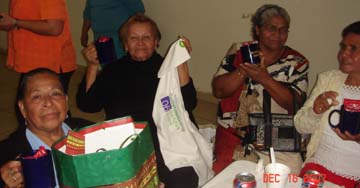 The group distributed $5,000 of all kinds of amenities as Christmas presents to about 95 elderly people over 70 years old. Every person also received a Christmas card with $5 US and a Bible. Rev. Garza addressed the crowd of people there and his wife Linda sang a Gospel song in Spanish, Somos Mas Que Vencedores. "Even though it was not a church meeting as the meeting was in a government facility, when Linda sang, many broke down in tears because of the anointing." The present Mayor (Ramos) and incumbent (Mancias) mayor attended the event.   Mayor Ramos and wife. Rev. Garza shared his goal, "to
propagate a vision to help the people of Mier. Our next project is
to reach every school child of 1,100 in the Mier school system with
humanitarian aid! " In a series of email, Rev. Garza shared
childhood memories underlying his desire to contribute to the
community of Mier. |
|
| Oral histories of Mier | |
|
Juanita, Ercilia, and Maria Reyes were Canales sisters born to a long time Canales family in Mier. Their father was Crescencio Canales inheritor to a Spanish land grant that extended to both sides of the Rio Grande River. Abuelita Juanita told me many stories of the Revolution but I'll start out with this one. All the sisters were blond and blue eyed. My mother's mother was Maria Reyes called Reyita. She died very tragically in her thirties leaving four kids, one of which was my mother, but that is another account. Abuelita told me a contingent of Pancho Villa's men came into Mier. She said Villaistas were well known to be thieves, liars, and rapists. Her father Crescencio hid his daughters in his house to protect them from being raped. The house was a prominent dwelling and is still there caddy corner to the plaza and across from the school named after the Canales family. Only at night would her father go out to get supplies and draw water from the well so that the Villaistas would not know how many were in his household. This was a dangerous trip as the men were out drinking and preying on passerbys. She said the water he brought back tasted horrible. Finally after days of abusing and living off the populace they left. Crescencio Canales was able to go to the well in daylight. He looked into the well and there were bodies of dogs and cats the Villa men had purposely killed and thrown the carcasses into it! The power of an idea or memory is awesome! About 47 years have passed since my grandmother took me to the tomb of Enrique Barrera Guerra. Now I have returned and I am determined to help those people to honor all my Mier ancestors. Rev. Larry Garza
|
|
| Spanish Naming Customs | |
| Spanish naming customs are used not only in Spain, but
also in the many speaking regions of Latin America. Most people have
one or two given names, followed by two surnames. The first surname
(considered the primary surname) is inherited from the father's
paternal surname, the second is inherited from the mother's paternal
surname. Women usually keep their names when they marry. For example, if José Lopez Garcia marries María Reyes Cruz, both will keep their surnames unchanged. If they have a child named Tomás, his full name will be Tomás Lopez Reyes. Sometimes the two surnames are separated by the word"y" meaning "and". Spanish given names are usually taken from the names of saints. There are also many names which honour the Virgin Mary, such as Dolores, Rosario, Mercedes, Pilar, Consolata and Luz. See European names. The word name in Spanish is "nombre". Sent by John Inclan |
|
| Garcia and Rodriguez now among top 10 U.S. surnames | |
|
In U.S. Name Count, Garcias Are Catching Up With Joneses By SAM ROBERTS, New York Times Step aside Moore and Taylor. Welcome Garcia and Rodriguez. Smith remains the most common surname in the United States, according to a new analysis released yesterday by the Census Bureau. But for the first time, two Hispanic surnames Garcia and Rodriguez are among the top 10 most common in the nation, and Martinez nearly edged out Wilson for 10th place. The number of Hispanics living in the United States grew by 58 percent in the 1990s to nearly 13 percent of the total population, and cracking the list of top 10 names suggests just how pervasively the Latino migration has permeated everyday American culture. Garcia moved to No. 8 in 2000, up from No. 18, and Rodriguez jumped to No. 9 from 22nd place. The number of Hispanic surnames among the top 25 doubled, to 6. Compiling the rankings is a cumbersome task, in part because of confidentiality and accuracy issues, according to the Census Bureau, and it is only the second time it has prepared such a list. While the historical record is sketchy, several demographers said it was probably the first time that any non-Anglo name was among the 10 most common in the nation. ?It is difficult to say, but it's probably likely, said Robert A. Kominski, assistant chief of social characteristics for the census. Luis Padilla, 48, a banker who has lived in Miami since he arrived from Colombia 14 years ago, greeted the ascendance of Hispanic surnames enthusiastically. It shows we're getting stronger,? Mr. Padilla said. ?If there's that many of us to outnumber the Anglo names, it's a great thing. Reinaldo M. Valdes, a board member of the Miami-based Spanish American League Against Discrimination, said the milestone gives the Hispanic community a standing within the social structure of the country. People of Hispanic descent who hardly speak Spanish are more eager to take their Hispanic last names, he said. Today, kids identify more with their roots than they did before. Demographers pointed to more than one factor in explaining the increase in Hispanic surnames. Generations ago, immigration officials sometimes arbitrarily Anglicized or simplified names when foreigners arrived from Europe. The movie studios used to demand that their employees have standard Waspy names, said Justin Kaplan, an historian and co-author of The Language of Names. Now, look at Rene Zellweger,? Mr. Kaplan said. And because recent Hispanic and Asian immigrants might consider themselves more identifiable by their physical characteristics than Europeans do, they are less likely to change their surnames, though they often choose Anglicized first names for their children. The latest surname count also signaled the growing number of Asians in America. The surname Lee ranked No. 22, with the number of Lees about equally divided between whites and Asians. Lee is a familiar name in China and Korea and in all its variations is described as the most common surname in the world. Altogether, the census found six million surnames in the United States. Among those, 151,000 were shared by a hundred or more Americans. Four million were held by only one person. "The names tell us that we're a richly diverse culture," Mr. Kominski said. But the fact that about 1 in every 25 Americans is named Smith, Johnson, Williams, Brown, Jones, Miller or Davis suggests that there's a durability in the family of man, Mr. Kaplan, the author, said. A million Americans share each of those seven names. An additional 268 last names are common to 10,000 or more people. Together, those 275 names account for one in four Americans. As the population of the United States ballooned by more than 30 million in the 1990s, more Murphys and Cohens were counted when the decade ended than when it began. Smith which would be even more common if all its variations, like Schmidt and Schmitt, were tallied is among the names derived from occupations (Miller, which ranks No. 7, is another). Among the most famous early bearers of the name was Capt. John Smith, who helped establish the first permanent English settlement in North America at Jamestown, Va., 400 years ago. As recently as 1950, more Americans were employed as blacksmiths than as psychotherapists. In 1984, according to the Social Security Administration, nearly 3.4 million Smiths lived in the United States. In 1990, the census counted 2.5 million. By 2000, the Smith population had declined to fewer than 2.4 million. The durability of some of the most common names in American history may also have been perpetuated because slaves either adopted or retained the surnames of their owners. About one in five Smiths are black, as are about one in three Johnsons, Browns, and Joneses and nearly half the people named Williams. The Census Bureau?s analysis found that some surnames were especially associated with race and ethnicity. More than 96 percent of Yoders, Kruegers, Muellers, Kochs, Schwartzes, Schmitts and Novaks were white. Nearly 90 percent of the Washingtons were black, as were 75 percent of the Jeffersons, 66 percent of the Bookers, 54 percent of the Banks and 53 percent of the Mosleys. Frequently Occurring Surnames From Census 2000 NOTE: This presentation of data focuses on summarized aggregates of counts of surnames, and does not in any way identify specific individuals. Tabulations of all surnames occurring 100 or more times in the census 2000 returns are provided in the files listed below. The first link explains the methodology used for identifying and editing names data. The second link provides an Excel file of the top 1000 surnames. The third link provides zipped Excel and CSV (comma separated) files of the complete list of 151,671 names. The top ten surnames are: NAME Number of occurrences Smith 2,376,206 Johnson 1,857,160 Williams 1,534,042 Brown 1,380,145 Jones 1,362,755 Miller 1,127,803 Davis 1,072,335 Garcia 858,289 Rodriguez 804,240 Wilson 783,051 Sent by Juan Marinez marinez@anr.msu.edu
|
|
| January
26, 2008: SHHAR Quarterly
Meeting Let your opinions be known Orange County Safe Schools & Support Services Orange Family History Center Schedule of Free Mini-classes List of Family History Centers in Orange County |
|
SHHAR Society of Hispanic Historical and Ancestral Research 2008 First Quarterly meeting |
|
| Date: Saturday, Jan. 26, 2008
Location: Orange Family History Center: 674 S. Yorba, Orange, CA 92869 Schedule 9:00 - 10:00am : Beginners Workshop 10:00-11:00am: "Doing research in Jalisco, Zacatecas, Guanajuato & Aguascalientes" by John Schmal 11:00-12:00 : Sharing and Networking. (Bring your books, Charts, family trees and Success stories to share)
Please save these dates for future Quarterly meetings: SHHAR is a non-profit, non-dues organization with family history
research and networking as its prime focus. Everyone is welcomed. |
|
| Let your opinions be known | |
| Your opinion is being sought. The
Orange County Register will be running polls during the upcoming
election. They would like to hear from the Orange County
Latinos. I have already said I would participate. I think we
need to let people know that we are here and have opinions, diverse
and complicated like every other group. Below is the email that I received. When I responded in the affirmative, I received several emails asking me to please invite other Latinos to participate. Mr. Wisckol says we have been the least responsive. So, I hope some of you will jump in and get involved in what appears to be a very easy way. Dear Orange County Latino,
|
|
| Orange County Safe Schools & Support Services | ||
| Editor: On October 30th,
I was invited by Cris Villasenor, Westminster LULAC Council to
attend a luncheon of Safe Schools & Support Services, a Division
Education under the Orange County Department of Education ACCESS
program. The ACCESS programs provide year-round educational options through curriculum offerings aligned with local districts and with the California State Frameworks and Standards. Through a variety of powerful learning strategies (e.g., directed study, differentiated instruction, and mastery learning), students achieve basic skills proficiency. The aspects that particularly interested me was the non-building based structure, and that the teachers go where the students are, functioning on a one-to-one basis or through group participation. In Orange County there are 130 sites being used for the program, as needed. It could be schools accessed after-school, a library, playground, business office, etc. Although the program fulfills the basic graduation requirements, field trips, and alternate life-experiences broadens and expands the student's perception of himself and the community around him. The staff deals with the areas of mental health, career services, prison exit/re-entering/ drug rehabilitation. The hours (although flexible) in general, meetings with students are usually after-school 12-5 pm. The Safe Schools & Support Services program started in 1998. We were entertained by a young man, who prior to the program did not know he had a singing talent. He sang with pose and confidence, a very moving performance. In addition, these two young men, Ivan Navarro and Maeson Showalter spoke about their change of life style, from gangs and drugs, going down-hill, to a life with a future.
Orange County Department of Education is seeking volunteers to
serve in a great variety of their Safe Schools & Support
Services programs, from observing art classes to ride along with
ACCESS Safe Schools Resource Officer. Phone: 714-953-6513 Fax: 714-953-9611
|
||
| Orange Regional
Family History Center 674 S. Yorba St., Orange, California (714) 997-7710 |
||||||||||||||||||||||||||||||||||||||||||||||
| Tuesday – Thursday 9:00 a.m.- 9:00 p.m. (Second Thursday) 9:00 a.m. -7:00 p.m. Friday – Saturday 9:00 a.m .- 5:00 p.m.
FAMILY HISTORY FAIR APRIL 26 Watch for flyers at your church buildings and Family History Centers with class schedules and time. You can Pre-register via the flyers or register at 8:00 a.m. at the fair. The Fair hours are 9:00 a.m. – 5:00 p.m. ANCERSTRY.COM IS NOW AVAILABLE AT THE LIBRARY!
|
||||||||||||||||||||||||||||||||||||||||||||||
| Family History Centers in Orange County | |
|
Orange Regional
Family History Center |
Poway
Family History Center |
|
Jan
5: Participants > Immigrant Rights Writing
& Working Group |
| Call for Participants for an LA Immigrant Rights Writing and Working Group | |
| Beyond
"La Gran Epoca Primavera 2006": A historical
analysis of the Immigrant Rights Movement in Los Angeles Convened by: Jesse Díaz, University of California, Riverside jessediazjr@gmail.com Luisa Heredia, Harvard University Saturday, January 5, 2008 at 1pm, Casa del Mexicano, 2900 Pedro Infante Dr., East Los Angeles The mass mobilizations of spring
2006 in Los Angeles were the largest demonstrations ever witnessed
in the United States. Undocumented immigrants and their supporters
took to the streets to protest against repressive immigration
legislation and for a comprehensive immigration reform. Yet,
contrary, to popular perception these mobilizations were not
"spontaneous" eruptions, rather they form part of a larger
movement for immigrants' rights that includes a cadre of leaders,
organizations, and community members that have been organizing and
struggling against consistent repressive anti-immigrant legislation
as far back as the 1960's. For more information: (213.725.1714) Sent by Charlie Erickson
|
|
|
History and Heritage of
Indigenous México. |
|
|
Join historian, genealogist and
lecturer John Schmal as he discusses the history and heritage of
indigenous México.
If your family comes from México and you have always wondered what tribes lived where your ancestors lived, this presentation will enlighten, educate and entertain. In addition, there will be a detailed discussion of the process of mestizaje and assimilation as it occurred in colonial Mexico. Mr. Schmal has published several books on Mexican history and culture, including the recently published "The Journey to Latino Political Representation," which chronicles the story of Latinos and their struggle for political representation from the Nineteenth Century to 2004.
|
|
|
| Rancho Los Cerritos, Two January Events | |
| January 24: Living
History Tours, 1-4 pm Tour the 163-year old adobe house with "visitors from the past" who step forward in time to conduct tours of the Rancho. Free January 26: Volunteer Open House, 10 A.M. Look into exciting volunteer opportunities, both in the public eye and behind-the-scenes. Reservations Requested. Rancho Los Cerritos Foundation
|
|
| Feb 1: Los Lobos, UCLA Royce Hall | |
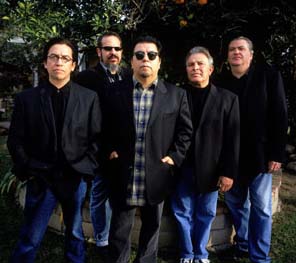 The
band that Time says has "master[ed] the synthesis of styles
that has always been the driving force of American music"
started in East Los Angeles in 1973, coming together to play
weddings and other small gigs. They went on to release more
than 18 albums, gaining the number-one spot of the Billboard Top 40
charts in 1987 with their remake of Ritchie Valens' La Bamba,
part of an album that went double platinum. The
band that Time says has "master[ed] the synthesis of styles
that has always been the driving force of American music"
started in East Los Angeles in 1973, coming together to play
weddings and other small gigs. They went on to release more
than 18 albums, gaining the number-one spot of the Billboard Top 40
charts in 1987 with their remake of Ritchie Valens' La Bamba,
part of an album that went double platinum.
They followed their huge mainstream success by recording an album of original and traditional Mexican music called La Pistola y El Corazón, a decision that was looked upon as commercial suicide at the time. but the band played on, never settling down or conforming to a strict genre. Los Lobos traveled with Bob Dylan and the Grateful Dead, releasing the brilliant, eclectic album Kiko in 1992 and scoring the Antonio Banderas hit film Desperado in 1995. Their new tour, which promotes their latest
album the Town and the City, makes its way to California after
playing 10 midwest states.
|
|
| Latinos with Diabetes, Symposium | |
| A Free Continuing
Education Regional for Physicians, Nurses, and Pharmacists.
9:00 AM - 2:55 Activity Overview: Register for Free Center for
Accredited Healthcare Education Symposium at: For information about a new
sweetner, click.
|
|
| The Search for a Civic Voice,
California Latino Politics January 5th: Casa de España en San Diego Early California website Presidio Historical Association fighting to preserve historical site Juan Bautista de Anza Trail Guide Audio Files |
| THE SEARCH FOR A CIVIC VOICE, CALIFORNIA LATINO POLITICS |
| How Non-Citizens Won Old Age Pensions The book is THE SEARCH FOR A CIVIC VOICE, CALIFORNIA LATINO POLITICS by Kenneth C. Burt, 2007, ISBN 1-930053-50-9 438 pp., 40 illustrations, Regina Books, $24.99, P.O. Box 280, Claremont, CA 91711, (909) 624-8466 Rueben Martinez stocks it. it has blurbs by Dolores Huerta, Francisco Balderrama and Antonio Villaraigosa. Amin David, and Orange County, California
honoree of the Anti-Defamation League paid tribute to Jewish friends by noting that
Burt's book named at least 60 Jewish leaders who helped Latinos
achieve their California political presence beginning in Boyle
Heights. |
|
| January 5th: Casa de España en San Diego | |
| Estimados amigos,
La directiva de la Casa de España en San Diego tiene el gusto y el honor de invitarlos a nuestra tradicional fiesta de Reyes el Sabado, 5 de Enero 2008 a las 5:00 de la tarde, en el salón del "House of Pacific Relations" ubicado detrás de nuestra "Casa de España" en Balboa Park. Como todos los años ofreceremos la tradicional rosca de Reyes y chocolate al estilo español. Tendremos rifas y la alegría de pasar un tiempo juntos con nuestra tradición. Regalos para los peques, entregado por los Reyes de Oriente mismos que vendrán a nuestra celebración para recordarnos el significado de la Navidad y la buena voluntad. La entrada es gratis para todos los niños menores de 14 años y nuestros miembros. Adultos no miembros de nuestra organización pagaran $10.00 dólares de admisión. ¡Los esperamos con los brazos abiertos!. Saludos, Mª Ángeles O'Donnell Olson spainhcsd@cox.net
|
|
| Early California website | |
| Visit the California-Spanish website at http://www.sfgenealogy.com/spanish/ |
|
| Presidio Historical Association fighting to preserve historical site | |
| Summary: The Presidio
Trust Association is in the process of developing plans for an
art museum complex to housed in what is now the historical Presidio
of San Francisco site. Public meetings have been held. Boyd
Delarios commenting on one meeting stated "The art community of San Francisco appeared to be strongly
represented at the meeting last night, mostly by gallery owners. All
speakers were in favor of the art museum. I doubt we could get
strong support from artists or their organizations. The Presidio
Historical Association's
official position is not to oppose the contemporary art museum; they
are opposed to the art museum at this location." A SF Chronicle's
statement on the meeting was that "All the attending members of the Presidio Historical Association
were stunned at the huge size of the proposed art museum and the
incompatibility of its design with the historic buildings." http://www.sfgate.com/cgi-bin/article.cgi?f=/c/a/2007/12/04/MNCSTNE54.DTL
|
|
| Juan Bautista de Anza Trail Guide Audio Files | |
Editor: The National Park Service is making available a fun way to experience history at your computer. . audio files. These audio files are taken from the CD distributed with the printed version of the Juan Bautista de Anza National Historic Trail Guide. The sounds were recorded on, or near, the Anza Trail itself. For most counties in the Guide, there is a section called "On the CD" in which you can learn more about the audio tracks. Click on each track listing to load the sound file, then press the "Play" button to hear the track. Download Musical Scores in pdf format (2.6 Mb, with scores for Alabado, A la Virgen de los Dolores, Marcha Real, ¡Ay, Susanita!, and To Alta California). Listen to sounds from the Anza Junior Ranger Site. http://www.solideas.com/DeAnza/TrailGuide/Anza_CD_Player.html Also recommended by Dr. Smestad: |
|
|
NORTHWEST UNITED STATES |
| Explore North features articles by Dr. Arsenio Rey Tejerina |
Since January 2003, Dr. Rey has been Professor and Head of the Department of Modern Languages at South Dakota State University. Prior to that he had spent over twenty years at the University of Alaska Anchorage, where he took an active interest in the 18th century Spanish explorations in the Pacific Northwest. Click here to see his C.V. Dr. Rey’s research interests are multiple, but his specialization is mystical weltanschauung, such as Miguel de Molinos’, father of quietism and a great influence on the Pietistic movement, particularly the Quakers. The articles presented here describe the Spanish explorations in Alaska and some cultural aspects that remain.
|
|
| 2 Revillagigedo
Island - The
island on which Ketchikan is located is 55 miles long by 35 miles wide
and situated between the mainland and Prince of Wales Island. The name
comes from the Count of
Revillagigedo, Don Juan Vicente de Güemes Pacheco de Padilla y
Horcasitas, who was the Viceroy of New Spain in the late 18th century.
Nueva España was the name for Spain's northern possessions on the
Western Hemisphere, which at one time included Alaska and down to South
America as far as modern day Colombia, Central America, Mexico, the West
Indies, Florida and the lands west of the Mississippi River. The so
called Spanish Illinois was then a no man's land and under discussion.
Juan Vicente was born in Havana, Cuba and reared in Spain. His father, the first count of Revillagigedo and Viceroy of Mexico, had paved his way to a brilliant career. Don Juan was General of the Royal Army, general director of the Royal Artillery, and Knight of Calatrava and when Don Manuel Flores resigned in 1789, Revillagigedo became the 52nd Viceroy of New Spain holding the office until he died in 1794. His tenure was full of success: developing both the agricultural and industry of New Spain, and improving public education, communications and the postal service. He ordered the first thorough census of the vice royalty which counted a total of 4,483,569 people (mostly in Mexico). Revillagigedo was particularly supportive of the exploration of Alaska, sending several well-organized expeditions. He had to deal with the Nootka Sound Controversy, in which Spaniards and British differences regarding the control of the Pacific Northwest were more or less settled. Because of his energy and intelligence, he won the admiration of all who knew him. Mexican, historians have judged him as one of the best of the viceroys. The spacious palace of Revillagigedo still stands facing the seaport in the city of Gijon of northern Spain. http://www.seacex.com/documentos/legacy_12_fronteras.pdf |
|
| A
Patriarch Bentura Jimenez Excerpts: Ringside Seat to a Revolution by David Dorado Romo Revolt of the Mexican Amazons at the Santa Fe Bridge |
| Patriarch Bentura Jimenez | |
|
|
October 1895, Beehive, Texas
An article about Bentura Jimenez,
|
| Excerpts from Ringside Seat to a Revolution by David Dorado Romo | |
The Bath Riots
Many years later, as part of my research for this book at the National Archives in the Washington, D.C. area, I came upon some photographs taken in 1917 in El Paso. The pictures, which were part of the U.S. Public Health records, showed large steam dryers used to disinfect the clothes of border crossers at the Santa Fe Bridge. Here it was. But I also unexpectedly uncovered other information at the National Archives that took my great-aunt's personal recollections beyond family lore or microhistory. These records point to the connection between the U.S. Customs disinfection facilities in El Paso-Juárez in the 20s and the Desinfektionskammern (disinfection chambers) in Nazi Germany. The documents show that beginning in the 1920s, U.S. officials at the Santa Fe Bridge deloused and sprayed the clothes of Mexicans crossing into the U.S. with Zyklon B. The fumigation was carried out in an area of the building that American officials called, ominously enough, "the gas chambers." I discovered an article written in a German scientific journal written in 1938, which specifically praised the El Paso method of fumigating Mexican immigrants with Zyklon B. At the start of WWII, the Nazis adopted Zyklon B as a fumigation agent at German border crossings and concentration camps. Later, when the Final Solution was put into effect, the Germans found more sinister uses for this extremely lethal pesticide. They used Zyklon B pellets in their own gas chambers not just to kill lice but to exterminate millions of human beings. But that's another story. Our story, instead, begins with the account of the 1917 Bath Riots at
the Santa Fe Bridge. It is the story of a traumatic separation, an event
that perhaps best epitomizes the year that the border between El Paso
and Juárez, in the memories of many of its citizens, shut down for
good.
|
|
| REVOLT OF THE MEXICAN AMAZONS AT THE SANTA FE BRIDGE | |
|
"The soldiers were powerless." THE EL PASO TIMES described the leader of the Bath Riots as "an auburn-haired Amazon." She sparked an uprising against a policy that would change the course of the history in El Paso and Juárez for decades. Some even consider her a fronteriza Rosa Parks, yet her name has been mostly forgotten. The "Amazon" was Carmelita Torres, a 17-year old Juárez maid who crossed the Santa Fe International Bridge into El Paso every morning to clean American homes. At 7:30 a.m. on January 28, 1917, when Carmelita was asked by the customs officials at the bridge to get off the trolley, take a bath and be disinfected with gasoline, she refused. Instead, Carmelita got off the electric streetcar and convinced 30 other female passengers to get off with her and demonstrate their opposition to this humiliating process. By 8:30 a.m. more than 200 Mexican women had joined her and blocked all traffic into El Paso. By noon, the press estimated their number as "several thousand." The demonstrators marched as a group toward the disinfection camp to call out those who were submitting themselves to the humiliation of the delousing process. When immigration and public health service officers tried to disperse the crowd, the protesters hurled bottles, rocks and insults at the Americans. A customs inspector was hit in the head. Fort Bliss commander General Bell ordered his soldiers to the scene, but the women jeered at them and continued their street battle. The "Amazons," the newspapers reported, struck Sergeant J.M. Peck in the face with a rock and cut his cheek. The protesters laid down on the tracks in front of the trolley cars to prevent them from moving. When the street cars were immobilized, the women wrenched the motor controllers from the hands of the motormen. One of the motormen tried to run back to the American side of the bridge. Three or four female rioters clung to him while he tried to escape. They pummeled him with all their might and gave him a black eye. Another motorman preferred to hide from the Mexican women by running into a Chinese restaurant on Avenida Juárez. Carrancista General Francisco Murguía showed up with his death troops to quell the female riot. Murguía's cavalry, known as "el esquadrón de la muerte," was rather intimidating. They wore insignia bearing a skull and crossbones and were known for taking no prisoners. The cavalrymen drew their sabers and pointed them at the crowd. But the women were not frightened. They jeered, hooted and attacked the soldiers. "The soldiers were powerless," the El Paso Herald reported.
http://www.npr.org/templates/story/story.php?storyId=5176177&sc=emaf
|
|
| A Language, Not Quite Spanish, With African Echoes Black Wealth, White Wealth By Henry Louis Gates |
| A Language, Not Quite Spanish, With African Echoes | |
| The New York Times http://www.nytimes.com/slideshow/2007/10/18/world/20071018_COLOMBIA_ San Basilio de Palenque was founded by runaway slaves. On the surface it resembles any other impoverished Colombian village. But when adults here speak with one another, their language draws inspiration from as far away as the Congo River Basin in Africa. This peculiar speech has astonished linguists since they began studying it several decades ago. The language is known up and down Colombia’s Caribbean coast as Palenquero and here simply as "lengua" — tongue. Theories about its origins vary, but one thing is certain: it survived for centuries in this small community, which is now struggling to keep it from perishing. Today, fewer than half of the community’s 3,000 residents actively speak Palenquero, though many children and young adults can understand it and pronounce some phrases. "Palenge a senda tielan ngombe ri nduse i betuaya," Sebastián Salgado, 37, a teacher at the public school here, said before a classroom of teenage students on a recent Tuesday morning. (The sentence roughly translates as, "Palenque is the land of cattle, sweets and basic staples.")
The survival of Palenquero points to the extraordinary resilience of San Basilio de Palenque, part of whose very name — Palenque — is the Spanish word for a fortified village of runaway slaves. Different from dozens of other palenques that were vanquished, this community has successfully fended off threats to its existence to this day. Colonial references to its origins are scarce, but historians say that San Basilio de Palenque was probably settled sometime after revolts led by Benkos Biohó, a 17th-century African resistance leader who organized guerrilla attacks on the nearby port of Cartagena with fighters armed with stolen blunderbusses. And while English-, French- and Dutch-based Creole languages are found in the Caribbean, the survival of one in the interior of Colombia has led some scholars to theorize that Palenquero may be the last remnant of a Spanish-based lingua franca once used widely by slaves throughout Latin America. Palenquero was strongly influenced by the Kikongo language of Congo and Angola, and by Portuguese, the language of traders who brought African slaves to Cartagena in the 17th century. Kikongo-derived words like ngombe (cattle) and ngubá (peanut) remain in use here today. Advocates for keeping Palenquero alive face an uphill struggle. The isolation that once shielded the language from the outside world has come to an end. Once three days by mule to the coast, the journey to Cartagena now takes two hours by bus on a bumpy dirt road. Electricity arrived in the 1970s as a government gift in recognition of Antonio Cervantes, better known as Kid Pambelé, a Colombian world boxing titleholder who was born here. With electricity came radio and television. The schoolhouse, named in honor of Biohó, has an Internet connection now. But Palenqueros, as the community’s residents call themselves, say the biggest threat to their language’s survival comes from direct contact with outsiders. Many here have had to venture to nearby banana plantations or cities for work, and then found themselves ostracized because of the way they spoke. "We were subject to scorn because of our tongue," said Concepción Hernández Navarro, 72, who survives by farming yams, peanuts and corn. Only two of Ms. Hernández’s eight children live here; five are in Cartagena and one moved as far away as Caracas, drawn by Venezuela’s oil boom. "We have always been poor here," she said in an interview in front of her modest house, "but our poverty has grown worse." If there is one blessing to this impoverishment, it may be that Colombia’s long internal war has largely been fought over spoils in other places, allowing teachers here to toil uninterrupted at reviving Palenquero since classes were introduced in the late 1980s. Undaunted by the prospect of Palenquero’s disappearing after centuries of use, Rutsely Simarra Obeso, a linguist who was born here and lives in Cartagena, is compiling a lexicon. Others are assembling a dictionary of Palenquero to be used in the school. The defenders of Palenquero view their struggle as a continuation of other battles. "Our ancestors survived capture in Africa, the passage by ship to Cartagena and were strong enough to escape and live on their own for centuries," said Mr. Salgado, the schoolteacher. "We are the strongest of the
strongest," he continued. "No matter what happens, our
language will live on within us." |
|
| Black Wealth, White Wealth By Henry Louis Gates | |
| November 18, 2007 Op-Ed Contributor Forty Acres and a Gap in Wealth By HENRY LOUIS GATES Jr. Cambridge, Mass. LAST week, the Pew Research Center published the astonishing finding that 37 percent of African-Americans polled felt that “blacks today can no longer be thought of as a single race” because of a widening class divide. From Frederick Douglass to the Rev. Dr. Martin Luther King Jr., perhaps the most fundamental assumption in the history of the black community has been that Americans of African descent, the descendants of the slaves, either because of shared culture or shared oppression, constitute “a mighty race,” as Marcus Garvey often put it. “By a ratio of 2 to 1,” the report says, “blacks say that the values of poor and middle-class blacks have grown more dissimilar over the past decade. In contrast, most blacks say that the values of blacks and whites have grown more alike.” The message here is that it is time to examine the differences between black families on either side of the divide for clues about how to address an increasingly entrenched inequality. We can’t afford to wait any longer to address the causes of persistent poverty among most black families. This class divide was predicted long ago, and nobody wanted to listen. At a conference marking the 40th anniversary of Daniel Patrick Moynihan’s infamous report on the problems of the black family, I asked the conservative scholar James Q. Wilson and the liberal scholar William Julius Wilson if ours was the generation presiding over an irreversible, self-perpetuating class divide within the African-American community. “I have to believe that this is not the case,” the liberal Wilson responded with willed optimism. “Why go on with this work otherwise?” The conservative Wilson nodded. Yet, no one could imagine how to close the gap. In 1965, when Moynihan published his report, suggesting that the out-of-wedlock birthrate and the number of families headed by single mothers, both about 24 percent, pointed to dissolution of the social fabric of the black community, black scholars and liberals dismissed it. They attacked its author as a right-wing bigot. Now we’d give just about anything to have those statistics back. Today, 69 percent of black babies are born out of wedlock, while 45 percent of black households with children are headed by women. How did this happen? As many theories flourish as pundits — from slavery and segregation to the decline of factory jobs, crack cocaine, draconian drug laws and outsourcing. But nobody knows for sure. I have been studying the family trees of 20 successful African-Americans, people in fields ranging from entertainment and sports (Oprah Winfrey, the track star Jackie Joyner-Kersee) to space travel and medicine (the astronaut Mae Jemison and Ben Carson, a pediatric neurosurgeon). And I’ve seen an astonishing pattern: 15 of the 20 descend from at least one line of former slaves who managed to obtain property by 1920 — a time when only 25 percent of all African-American families owned property. Ten years after slavery ended, Constantine Winfrey, Oprah’s great-grandfather, bartered eight bales of cleaned cotton (4,000 pounds) that he picked on his own time for 80 acres of prime bottomland in Mississippi. (He also learned to read and write while picking all that cotton.) Sometimes the government helped: Whoopi Goldberg’s great-great-grandparents received their land through the Southern Homestead Act. “So my family got its 40 acres and a mule,” she exclaimed when I showed her the deed, referring to the rumor that freed slaves would receive land that had been owned by their masters. Well, perhaps not the mule, but 104 acres in Florida. If there is a meaningful correlation between the success of accomplished African-Americans today and their ancestors’ property ownership, we can only imagine how different black-white relations would be had “40 acres and a mule” really been official government policy in the Reconstruction South. The historical basis for the gap between the black middle class and underclass shows that ending discrimination, by itself, would not eradicate black poverty and dysfunction. We also need intervention to promulgate a middle-class ethic of success among the poor, while expanding opportunities for economic betterment. Perhaps Margaret Thatcher, of all people, suggested a program that might help. In the 1980s, she turned 1.5 million residents of public housing projects in Britain into homeowners. It was certainly the most liberal thing Mrs. Thatcher did, and perhaps progressives should borrow a leaf from her playbook. The telltale fact is that the biggest gap in black prosperity isn’t in income, but in wealth. According to a study by the economist Edward N. Wolff, the median net worth of non-Hispanic black households in 2004 was only $11,800 — less than 10 percent that of non-Hispanic white households, $118,300. Perhaps a bold and innovative approach to the problem of black poverty — one floated during the Civil War but never fully put into practice — would be to look at ways to turn tenants into homeowners. Sadly, in the wake of the subprime mortgage debacle, an enormous number of houses are being repossessed. But for the black poor, real progress may come only once they have an ownership stake in American society. People who own property feel a sense of ownership in their future and their society. They study, save, work, strive and vote. And people trapped in a culture of tenancy do not. The sad truth is that the civil rights movement cannot be reborn until we identify the causes of black suffering, some of them self-inflicted. Why can’t black leaders organize rallies around responsible sexuality, birth within marriage, parents reading to their children and students staying in school and doing homework? Imagine Al Sharpton and Jesse Jackson distributing free copies of Virginia Hamilton’s collection of folktales “The People Could Fly” or Dr. Seuss, and demanding that black parents sign pledges to read to their children. What would it take to make inner-city schools havens of learning? John Kenneth Galbraith once told me that the first step in reversing the economic inequalities that blacks face is greater voter participation, and I think he was right. Politicians will not put forth programs aimed at the problems of poor blacks while their turnout remains so low. If the correlation between land ownership and success of African-Americans argues that the chasm between classes in the black community is partly the result of social forces set in motion by the dismal failure of 40 acres and a mule, then we must act decisively. If we do not, ours will be remembered as the generation that presided over a permanent class divide, a slow but inevitable process that began with the failure to give property to the people who had once been defined as property. Henry Louis Gates Jr., a professor at Harvard, is the author of the forthcoming “In Search of Our Roots.” rgrbob@earthlink.net
|
|
|
The Return of Native
Americans as Immigrants |
| The Return of Native Americans as Immigrants | |
|
New America Media, Commentary, Louis E.V. Nevaer, Posted: Oct 24,
2007 The United States is seeing a resurgence of Native Americans in the form of immigrants who are descendents of North America’s indigenous populations. As Native Americans, they are terrifying precisely because they have a moral claim to cross the borders imposed on their lands, writes NAM contributor Louis E.V. Nevaer. As the immigration debate rages throughout the nation, the lingering, but unspoken, fear is that illegal immigration from Mexico heralds the return of the Native American. “The persistent inflow of Hispanic immigrants threatens to divide the United States into two peoples, two cultures, and two languages,” Samuel Huntington famously argued in Foreign Affairs magazine in March 2004, unleashing a firestorm of protests among U.S. Hispanics and Latinos. “Unlike past immigrant groups, Mexicans and other Latinos have not assimilated into mainstream U.S. culture, forming instead their own political and linguistic enclaves — from Los Angeles to Miami — and rejecting the Anglo-Protestant values that built the American dream.” In fact, almost all Mexican immigrants are descendents of North America’s indigenous peoples. As Native Americans, they are terrifying precisely because they have a moral claim to migrate throughout the nation-states imposed on their lands. This vilification of immigrants differs from the same sentiment of earlier generations. Previously, Americans debated and settled immigration issues through legislation: the Alien and Sedition Acts of 1798 to keep French and Irish Catholics out, the anti-Papist sentiment that fueled Nativism in the 19th century aimed at Italian, Irish and German immigrants, the xenophobia that culminated in the Chinese Exclusion Act of 1882, and the “Gentlemen’s Agreement” of 1907 aimed at the Japanese. In “The Clash of Civilizations and the Remaking of World Order,” Huntington argued that the Mexican state was complementary to the American one, both heirs of Europe and the Enlightenment. This suggests that the cultural conflict he fears is between Western versus Native American. He is correct. Native Americans are indifferent to the Western values used to obliterate them, and he recognizes the moral authority with which they challenge the very concept of the nation-state. To refuse entry to immigrants from across the oceans, from Europe or Asia, is one thing; to stand against the internal movements of Native American people, Americans find unsettling. They can’t forget that efforts to transplant and expand European civilization in the New World have been the driving force behind the settling of the West in the 19th century and the exclusion of Native Americans from the mainstream of society in the 20th. It almost worked: There are no Manhattans on the island of Manhattan, no Coast Miwok in San Francisco. “The only good Injun is a dead Injun,” is a line in a Hollywood Western that sums up the nation’s attitude during the 19th century, and it is true that Native Americans were massacred, subjected to forced migrations and deliberately infected with contagious diseases so as to reduce their numbers. It is also true that during the last century, the establishment of reservations created marginalized communities where alcoholism, substance abuse and unemployment demoralized Native Americans into early graves. Now, peoples rendered almost irrelevant to American society are thriving in such large numbers that they are once again on the move across the continent. The return of the Native American began in earnest in the 1980s, during the Sanctuary Movement in California. Suddenly, people apprehended at the borders spoke neither English nor Spanish. Isa Gucciardi, who managed a translation company in San Francisco, reported getting calls from the Immigration and Naturalization Service (INS), as it was called then, with requests for interpreters who spoke “Indian” languages from southern Mexico and Central America. “We had to double the rate, since it was so difficult to find anyone who spoke English and Tzotzil Maya,” she said. Despite their best efforts to wipe them out, at the start of the 21st century, Zapotec, Mixtec, Maya and scores of other indigenous peoples have returned. They are working in our restaurants, stocking shelves in our stores, building houses and doing our landscaping. They are taking care of our kids while we’re at the office, and giving birth to more Native Americans in our hospitals. They are fueling the economic expansion, contributing to a society that looks upon them with disdain. Yet in the second half of 20th century, it was Europeans who looked on Americans with disdain. Walt Whitman celebrated America being one people out of many – “Of every hue and caste am I” – but to the Europeans, hyphenated Americans are mongrels and half-breeds: Irish-Americans, African-Americans, Italian-Americans, Anglo-Americans. The realization that Native Americans are crossing the borders that crossed them is alarming even Jesse Jackson. Interviewed on CNN’s “Lou Dobbs Tonight,” he complained that the workers streaming into New Orleans were “outside workers,” since he could not bring himself to say “Native Americans from Latin America.” My office in New York is in the Citigroup Center where the only Native American used to be the “Manna-Hata” Indian on the seal stenciled on the flag of the City of New York, standing next to an early Dutch colonist. Not anymore. Now when I go to the lobby and downstairs into the subway concourse that connects the Uptown Number 6 train with the E and V subways, there are Maya women, wearing their traditional textiles. Their babies strapped on their backs in shawls, with a blanket made of blue basket, they lay out before them for sale probably the last thing that is actually made in New York City: pirated DVDs of Hollywood movies. Having rid ourselves of the Manna-Hata people, we import Native Americans from Mexico. Given this demographic trend, it’s only a matter of time before we hear, “Press three to continue in Zapotec.” Related Articles: Alcatraz Sunrise Ceremony Celebrates UN adoption of the Declaration on the Rights of Indigenous Peoples Sent by Dorinda Moreno dorindamoreno@comcast.net Source: Glenn Welker |
|
| Tribal heritage learned, Conference aims to preserve traditions | |
|
Conference aims to preserve traditions Until a few years ago, when children in local classrooms learned about American Indians, they were taught about the culture and customs of tribes many states away. But the rich cultural heritage of the tribes living within their midst - of the San Manuel Band of Mission Indians and others - was left untouched as students studied the state's first peoples. "At the county's schools, we were learning about the Plains tribes, not local Indians," said Serrano/Cahuilla tribal member James Ramos, founder and project director of the California Indian Cultural Awareness Conference. The weeklong conference at Cal State San Bernardino, attended by hundreds of schoolchildren from San Bernardino City Unified and surrounding school districts, culminated Friday with the celebration of California Native American Day. The day, held on the fourth Friday in September, is not a holiday, insists Ramos, it is a day of education. All week, classrooms full of students came to the Cal State campus, whose Santos Manuel Student Union is named after Ramos' great-great-grandfather Santos Manuel, to meet tribal members and learn their crafts - from basketry and pottery to bird songs and storytelling. On Friday, students from two elementary schools watched as members of the Yurok band from Humboldt County performed a traditional brush dance. On the reservation, the dance would be performed with a real medicine woman, said Yurok member Joe James. The dance is done as a healing ceremony for a sick child. And students in the audience watched avidly as the Yuroks yipped and shook their gourd rattles. "It is a real resource in the Inland Empire to have the San Manuel tribe provide this outreach to all of our students," said county Superintendent of Schools Herb Fischer. Fischer was joined in honoring the tribal contributions to the community and to society by state Superintendent of Public Instruction Jack O'Connell, Rialto Councilman Joe Baca Jr., Assemblywoman Wilmer Amina Carter, Mayor Pat Morris and university President Al Karnig. Formerly American Indian Day, the day was established as an official state holiday in 1998 by a bill authored by then-Assemblyman Joe Baca. "All of us, Indian and non-Indian alike, need to understand the Native American culture," Karnig said. No study of California history would be complete without studying the first Californians, said O'Connell, who himself had been a history major. California has more than 100 federally recognized tribes - more than any state in the nation, Ramos pointed out. And the state has the largest American Indian population in the country. And yet, the history of local peoples is often lost on the communities that surround them, Ramos said. "A lot of people think the Indian people are gone, or just on a reservation or in a museum," he said. "But we're still here." In fact, Friday's celebration "reaffirms that the California people that once were forgotten are still here," Ramos said. "If we don't teach people who we are - the techniques of basketry, for example - who will?" he asked. http://www.sbsun.com/news/ci_7033963 Sent by Dorina Moreno dorindamoreno@comcast.net
|
|
|
By John P. Schmal |
||||||||||||||||||||||||||||||||||||||||||||||||||||||||||||||||||||||||||||||||||||||||||||||||||||||||||||||||||||
| Located in the
southwestern portion of the Yucatán Peninsula along the Gulf of
Mexico, the State of Campeche was named after the ancient Mayan
Kingdom of Ah Kin Pech (Canpech). Campeche is bounded on the north
and northeast by the State of Yucatán, on the east by the State of
Quintana Roo, on the southeast by the nation of Belize, on the
southwest by the State of Tabasco, and on the south by the Petén
Department of Guatemala. Campeche also shares 404 kilometers (251
miles) of coastline with the Gulf of Mexico on its west and
northwest.
With a total area of 56,798 square kilometers (21,924 square miles), Campeche is Mexico’s eighteenth largest state and occupies 2.9% of the national territory. With a population of 690,689 in the 2000 census, Campeche was ranked thirtieth among the Mexican states in terms of population. The territory of Campeche is politically divided into ten municipios. The capital city is Campeche, which had a population of 216,897 in 2000. |
||||||||||||||||||||||||||||||||||||||||||||||||||||||||||||||||||||||||||||||||||||||||||||||||||||||||||||||||||||
The Mayan World For about two thousand years, the Mayan culture prospered through most of present-day Guatemala, Belize, El Salvador, western Honduras and the five Mexican states of Yucatán, Quintana Roo, Tabasco, Campeche and Chiapas. In all, the territory occupied by the Mayan Indians was probably about 500,000 square kilometers (193,000 square miles) in area and is sometimes referred to collectively as El Mundo Maya (The Mayan World). The Mayas made a living through agriculture, hunting and fishing. They were also skilled weavers and temple builders who left a treasure trove of archaeological sites for later generations to admire. The Mayan Linguistic Group is one of the largest in the Americas and is divided into approximately 69 languages, including the Huastec, Yucatec, Western Maya, and Eastern Maya groups. For thousands of years, the Yucatec Maya has been the dominant Mayan language throughout the Yucatán Peninsula, including Campeche, Yucatán, and Quintana Roo. The language was documented in the ancient hieroglyphs of the Pre-Columbian Mayan civilizations at several archaeological sites and may be as much as 5,000 years old. Even at the time of the 2000 census, 799,696 individuals in the entire Mexican Republic still spoke this language. (This number does not include the other major Mayan linguistic groups, such as the Tzeltal, Tzotzil, Huasteca, and the Chol, all of which thrive in several other Mexican states). The Mayan ethnohistorian, Ralph L. Roys, has written that sixteen native Mayan states occupied most of the Yucatán Peninsula in the early Sixteenth Century and that this population was "remarkably uniform in language, customs, and fundamental political ideas." Some of the sixteen "provinces" were "true political units," while others were "loose confederations of autonomous communities, as well as groups of independent and mutually hostile states whose ruling families had a common lineage." Professor Roys and other historians have indicated that most of present-day Campeche was ruled over by four native states when the Spaniards first arrived in 1517: Acalán-Tixcel, Chanputún (Champotón), Canpech (Ah Kin Pech), and Ah Canul. While Acalán was primarily occupied by the Chontal Indians, the other three states were Yucatec Mayan nations. Acalán-Tixchel The Chontal Indians of Acalán-Tixchel primarily occupied the territory that now includes the eastern part of the State of Tabasco and the southwest Campeche Municipio of Palizada. In all, this kingdom included at least 76 communities. It is believed that Chontalli was a Náhuatl term meaning "foreigner." The Chontal of Tabasco speak one of the 69 Mayan languages and have a close relation to the Yucatec Maya and Chol on the east and the Tzeltal, Tzotzil, Kanjobal, and Chuj of Chiapas on the west. The original inhabitants of the present-day Palizada Municipio were the Chontal Indians living in the Acalán-Tixchel Province, literally "the place of canoes." However, at some point before the Spanish contact, Náhuatl-speaking merchants had settled at Xicallanco and Chanputún, driving out the Chontal. At the time of contact, an Aztec pochteca ruled over the important trading colony at Xicallanco and the surrounding area, while small Chontal communities were scattered along the lower Mamantel and Candelaria rivers. Living in the regions east of Acalán-Tixchel were a Yucatec Mayan people who were known as the Cehache or Mazateca, inhabiting the border region between what is now Campeche and the Petén District of Guatemala. Chanputún (Champotón) Northeast of Acalán-Tixchel, along the present-day central coastline of Campeche, was the Yucatec Mayan Province of Chanputún (Champotón), which ran from present-day Champotón northward to Tichac (Sihochac) and extended some distance inland. Apparently named for its principal town (now known as Champotón), Chanputún represented the southwestern extension of the Yucatec Mayan cultural region. The Aztecs referred to the entire region of Champotón and Campeche as the "Province of Cochistan." Canpech (Ah Kin Pech) Canpech probably earned its name from its principal town, the present-day city of Campeche (which was the Spanish pronunciation of the word). Cardinal Juan de Torquemada gives the Mayan name as Kinpech, which has also been reconstructed as Ah Kin Pech, but the colonial Maya manuscripts only refer to it as Canpech. Ah Kin Pech, in the Mayan language, means "the place of serpents and ticks." Ah Canul The Mayan Province of Ah Canul, with Calkiní as its primary town, extended about 145 kilometers (56 miles) along the western coastal plain from the Homtún River (slightly north of Campeche) to Punta Kipté on the northern coastline of Yucatán State. Ralph L. Roys wrote that "the Province of Ah Canul was one of the largest native states in the northern and more thickly populated half of the Yucatan peninsula." From the west coast it extended inland "for an average distance of about 50 km." Ah Canul included the present-day Campeche municipios of Tenabo, Hecelchakán, and Calkiní. The Province also extended into western Yucatán State, where it included the present-day cities of Kinchil, Umán, and Hunucma within its boundaries. First Contact with Spaniards On March 22, 1517, a Spanish naval force, under the command of Francisco Hernandez de Córdoba, sailing from Cuba, arrived off the shores of the Yucatán Peninsula, eventually passing south along the coastline of Campeche. The expedition stopped at a village named Lázarus, near the present-day site of Campeche, which was then part of the Canpech Province. According to Bernal Díaz del Castillo (a member of the expedition), crewmembers stopped briefly at this location to look for water and were approached by a group of fifty natives. Soon after, however, Mayan priests told the Spaniards to leave the area or face death, and they complied by departing. The Spanish force moved south along the Campeche coastline and – ten days later, the Spaniards landed again near Champotón, where a cacique named Moch-Cuouh ruled. Shortly after the arrival of the Spaniards, the Mayans attacked in force, killing more than fifty men. With their manpower reduced by half, the expedition was forced to return to Cuba. Córdoba himself received multiple wounds from ten arrows and died shortly after his return to Cuba. In April 1518, another expedition of four ships and 300 men under the command of Juan de Grijalva left Cuba for the Yucatán. This expedition landed near Campeche at the river Lagartos, but was soon attacked by the Mayan inhabitants and left the region. In 1525, Hernán Cortés, the conqueror of Tenochtitlán, passed through a small portion of Campeche. During this time, Cortés made an alliance with Paxbolonacha, the ruler of Acalán. This accommodation initiated a gradual incorporation of the Chontal Mayan into the Spanish empire. Cortés’ account of his journey through Acalán served as motivation for Francisco de Montejo to lead a second expedition to Acalán and the Yucatán area. The Conquest of Campeche (1527-1541) In December 1526, a wealthy nobleman from Salamanca, Spain, Francisco de Montejo was granted a royal contract (capitulación) to raise an army and conquer the Yucatán Peninsula. In 1527, Montejo landed with a crew of 500 Spanish soldiers at Cozumel (in present-day Quintana Roo) to commence with the conquest. Accompanied by his son – known as "El Mozo" (The Youthful) – and his nephew ("Sobrino"), Montejo crossed the Yucatán from east to west, eventually reaching the Campeche coastline near Kin Pech. The resistance of the Mayan provinces kept the Spanish forces in check for several years. In 1529, Montejo subdued the natives of Xicallanco, Copilco, and Hueyatastla in the south. After working to subdue the Chontal of Acalán and the Zoque of the highlands of Tabasco, Montejo later moved to the coastal region of Campeche where he was able to establish friendly relations with the natives of Champotón in 1530. By early 1531, Montejo controlled both Champotón and Campeche. Campeche became Montejo’s primary base of operations as he sent his lieutenant Alonso de Avila to explore and conquer the Mayan provinces in the central and eastern sections of the peninsula. While Avila made his way through the interior of the Yucatán, Montejo was able to consolidate his control over the province of Ah Canul north of Campeche, while the younger Montejo moved through several Mayan provinces. As a result, researchers France Scholes and Ralph Roys observed that "by the end of 1532 a considerable part of northern Yucatan had apparently accepted Spanish suzerainty." By the summer of 1534, however, Montejo the Younger’s position in the Yucatán became precarious. With a depleted force, he departed his headquarters at Dzilam and retreated to join his father at Campeche. At the end of 1534, the older Montejo and his forces evacuated Campeche altogether, withdrawing to Tabasco. Campeche would not return to Spanish rule until 1541. A contributing factor to the failure of the Montejos to hold their positions was the loss of men who decided to go to Peru to find greater spoils in the conquest of the Inca Empire. In 1537, Spanish forces under Alonso de Avila returned to Campeche and were able to establish a base at San Pedro de Champotón in present-day Campeche. During this period, the young settlement, according to France Scholes and Ralph Roys, "maintained a very uncertain existence." In 1540, Montejo the Younger arrived in Champotón to resume the conquest of the Yucatán Peninsula. By this time, Scholes and Roys explain, the indigenous inhabitants of the area had "became increasingly restive." At the end of 1540, Montejo moved the settlement at Champotón to Campeche, which ultimately became the first permanent Spanish settlement in the Yucatán Peninsula. Forming alliances with some of the local chieftains during 1541, the Montejos were able to subdue native forces in the provinces of Canpech and Ah Canul, bringing the present-day municipios of Tenabo, Hecelchakan and Calkiní under control. Later in the year, Montejo founded the "Villa and Puerto de San Francisco de Campeche." From Campeche, Montejo moved on to the rest of the Yucatán Peninsula, where he won several battles and broke the power of the Mayan resistance, founding the city of Mérida on January 6, 1542. Once effective control had been established, the City of Campeche served a "strategic role as a trade and administrative center." The first Franciscan missionaries arrived in Campeche perhaps as early as 1537, followed three years later by the founding of the first mission in Campeche. In the new few years, the Franciscans also moved into Champotón and Acalán. Consolidation Even before pacifying the native peoples of Campeche, Francisco Montejo and his lieutenants began to distribute the inhabitants through encomiendas, which were royal grants of indigenous inhabitants that licensed a Spanish encomendero to receive their labor and tribute. Unfortunately, the encomiendas became subject to abuse and were frequently enforced through brutality and cruelty. The Indians of Campeche, Champotón, and Acalán-Tixchel were distributed in encomiendas to the Spanish residents of Salamanca in 1530-1531, and they were reassigned in 1537. Disease also took its toll on the indigenous people of Campeche. At contact, the populations of Champotón and Acalán probably numbered about 110,000. But smallpox decimated several communities in 1519 or 1520. An assessment of Champotón in 1549 suggested that there were about 2,000 Indian inhabitants left. A similar assessment of the Acalán encomienda in 1553 suggested about 4,000 Indians living in that province. Ah Canul, which is located in a dryer climate than the rest of Campeche, was less affected by plagues than most other areas of Campeche and the Yucatán. It is estimated that the population at contact was 35,000 and that this dropped to 13,000 in 1548. After this, however, immigration from other areas helped rebuild the native population of Ah Canuel. Political Events After independence, Campeche was essentially a part of Yucatán, which proclaimed its sovereignty in August 1822. But Yucatán and Campeche were both re-incorporated into Mexico in February 1824. Yucatán became a state within the Mexican Republic on October 3, 1824. On May 31, 1841, Yucatán declared its independence from Mexico. The state was re-incorporated into Mexico in December 1843, but independence was restored in December 1846. In August 17, 1848, Yucatán and Campeche were once again reincorporated into the Mexican Republic. On August 7, 1857, Campeche was split off from Yucatán and declared as a district of Yucatán. On May 18, 1858, Campeche was created as the District of Campeche and the Isla de Carmen. Subsequently, upon approval of the Congress, Campeche was declared an "Estado Libre y Soberano de Campeche" (Free and Sovereign State of Campeche) of the Mexican Federation on April 29, 1863. From May 1864 to January 10, 1867, Campeche was reincorporated into Yucatán before returning to permanent statehood. Indigenous Campeche (1895-1910) In the 1895 census, Campeche was reported to have 39,212 persons aged 5 years or more who spoke an indigenous language, representing 44.5% of the population. During the same census, Campeche’s Spanish-speaking population numbered 48,671. After this census, the number of indigenous speaking persons in Campeche dropped steadily, in 1900 to 35,977 indigenous speakers and in 1910 to 28,280. The majority of the indigenous speakers in 1910 communicated in the Mayan language (26,998 speakers). Fifty-one Yaquis were also tallied, possibly Porfiriato exiles from Sonora. The Mayan Speakers in the 1910 Census In Mexico’s 1910 census, 227,883 persons were classified as speakers of the Yucatec Mayan language, representing 11.62% of the 1,960,306 indigenous-speaking population in the entire country. Mayan speakers were represented in 14 Mexican states, but only four states had significant numbers of them. Yucatán contained the largest number of Mayan speakers. A total of 199,073 Mayan speakers lived in that state, representing 87.36% of all the Yucatec Mayan speakers in the country. Campeche had the second largest number of Mayan speakers with 26,998, which represented 11.85% of all Mayan speakers. Two other states had significant numbers of Maya speakers: Quintana Roo (1,120) and Chiapas (638). The 1921 Census In the unique 1921 Mexican census, residents of each state were asked to classify themselves in several categories, including "indígena pura" (pure indigenous), "indígena mezclada con blanca" (indigenous mixed with white) and "blanca" (white). Out of a total state population of 76,419, 33,176 persons (or 43.4%) claimed to be of pure indigenous background. Slightly fewer – 31,675, or 41.5% – classified themselves as being mixed, while a mere 10,825 (14.2%) claimed to be white. When compared to the other Mexican states, Campeche had the sixth largest "indígena pura" population. Although a significant number of people in Campeche claimed to be of pure indigenous heritage, a much smaller number – 23,410 – were classified as speakers of indigenous languages five years of age and more, representing 35.9% of the state population. All but five of these persons were Mayan Indians, while four spoke the Amuzgo language. Indigenous Campeche (1930-1980) In the 1930 census, the number of indigenous speakers five years of age and over in the state of Campeche climbed to 31,324, representing 43.65% of the state’s population five years of age and over. The fact that 16,233 indigenous speakers were monolingual and unable to speak Spanish (representing 51.82% of the indigenous-speaking population) was indicative that some natives of Campeche successfully avoided assimilation into the central Hispanic culture. Over the next four decades, Campeche’s indigenous-speaking population continued to grow, even though its percentage of the population dropped significantly from 43.65% in 1930 to 27.09% in 1970. The Mayan language was, by far, the most widely spoken indigenous language in Campeche at the time of the 1970 census. At least 55,346 persons out of the 57,031 indigenous speakers spoke Mayan, representing 97.05% of all indigenous speakers in Campeche. The Chol language, in second place, was spoken by only 411 individuals, followed by Otomí (320) and Tzeltal (206). Native Peoples of Campeche in 2000 According to the 2000 census, 185,938 residents of Campeche were classified as "Indígena," representing 26.9% of Campeche’s total population (690,689). In contrast, the population of persons five years and more who spoke indigenous languages amounted to 93,765 individuals, who made up only 15.45% of Campeche’s population five years and older. These individuals spoke more than fifty Indian languages, some of which were transplants from Central America or other parts of the Mexican Republic. Although most of the indigenous speakers were bilingual, 5,308 persons were registered as monolingual. According to the estimates of INEGI and CONAPO, Campeche had four municipios that contained an indigenous population greater than 50 percent. In three of those four municipios, persons speaking indigenous languages also represented at least half the population of the municipio. At the same time, only two municipios contained populations that were less than ten percent indigenous. And, while Campeche’s overall indigenous-speaking population represented 15.5% of the total state population five or more years of age, five municipios had indigenous-speaking populations that were less than ten percent. Calkiní, the municipio in the northwest corner of Campeche along the border of Yucatán, boasted the largest number of indigenous inhabitants in 2000. According to census statistics, 42,008 persons were classified as "Indígena," representing 89.6% of the population of the municipio. Calkiní also contained 26,558 inhabitants 5 years of age or older who spoke some indigenous language, representing 63.16% of the municipio’s population and 28.3% of Campeche’s entire indigenous-speaking population of 93,765. Almost all of these individuals (26,453) spoke the Maya language. The Maya Indians In the year 2000, speakers of Yucatec Maya continued to represent the dominant language in the entire Yucatán Peninsula, with 547,098 (68.7%) in Yucatán, 163,477 (20.5%) in Quintana Roo, and 75,874 (9.5%) in Campeche. The 75,874 individuals 5 years of age and over who spoke the Mayan language in Campeche represented only 9.53% of the 796,314 Mayans who resided in the entire Mexican Republic in 2000 but also represented 80.9% of all indigenous language speakers in the state. The Mayan language family has a strong presence in seven Mexican states (Chiapas, Tabasco, Yucatán, Quintana Roo, Campeche, San Luis Potosí and Veracruz) and is the second most common language group in all of Mexico. The Mayan Language is the dominant indigenous language in all but three of Campeche’s municipios. In the 2000 census, four of the municipios had at least 10,000 Mayan speakers: Calkiní (26,453), Hopelchén (14,961), Campeche (12,463), and Hecelchakán (11,396). Adjacent to the Mayan-dominant Yucatán state, Calkiní contained 34.9% of all the Mayan speakers in Campeche in 2000. The Chenes Region of Campeche (Hopelchen,
and part of Campeche) contains a highly traditional and conservative
Mayan population, which due to its relative isolation, has a
significant number of Mayan monolingual speakers. In 2000, the 2,626
monolingual speakers in Campeche Municipio represented 9.9% of the
entire indigenous-speaking population. In Hopelchen, 1,045
monolingual speakers represented 7.0% of those who spoke Indian
tongues. Some two thousand or more years ago, the Chol Indians inhabited the region which is now known as Guatemala and Honduras. Over time, they split into two main groups, the Chol migrating gradually to the region of present day Chiapas, and the Chortis staying in the region of Guatemala. The Choles of the present day call themselves "Winik" ("Man") and primarily occupy northern Chiapas, adjacent to the states of Tabasco and Campeche. The Chol Indians of Campeche numbered 8,844 in the 2000 census and accounted for 9.4% of the indigenous-speaking population of the state. The small number of Chol living in Campeche, in fact, represented only 5.47% of the 161,766 Choles who lived in the entire Mexican Republic. According to Ethnologue.com, the Chol belong to the Chol-Chontal subfamily of the Mayan Linguistic Group. The Chontal of Tabasco are, in fact, a very closely related language as are the Chortí of Guatemala. The Chol are the dominant indigenous language in three southern Campeche municipios: Calakmul (4,253 speakers in 2000), Escárcega (1,804), and Candelaria (1,388). The Kanjobal Indians A total of 1,896 individuals five years of age or more in Campeche spoke the Kanjobal language in 2000, representing 2.0% of the population five years of age and older that spoke indigenous languages. The Kanjobal of Campeche represented 21.03% of the 9,015 Kanjobal-speakers living in the entire Mexican Republic in 2000. The Municipio of Champotón in southeastern Campeche contained 1,567 of the 1,896 Kanjobal-speakers in Campeche, but even in this municipio, they still only represented the second largest linguistic group (after the Mayans). The Kanjobal Language belongs to the Kanjobalan-Chujean subfamily of the Mayan Linguistic Family. This subfamily includes the Chuj, Jacalteco, Kanjobal, Motozintleco (Mocho, Tuzanteco), and Tojolabal languages. Most of the languages of this subfamily straddle the border between Chiapas and Guatemala. Ethnologue reported that in 1998, 48,500 persons in Guatemala spoke the Kanjobal language, which represented 82.8% of the worldwide population of 58,600 at that time. The presence of Kanjobal as a language of Campeche is not unusual considering that the non-native population numbered 26.4% in 2000. In all, 14,262 speakers of indigenous languages in Campeche were born in other states or countries. The Tzeltal Indians The 1,706 individuals who spoke the Tzeltal language in Campeche in 2000 represented only 0.6% of the 284,826 Tzeltal-speakers in the entire Mexican Republic. According to the 2000 census, 278,577 persons five years of age or more who spoke the Tzeltal language lived in the State of Chiapas, representing 97.8% of the total population in the Republic. The Mame Indians The Mame language is not a common language in Campeche, largely because it is primarily a language of Guatemala, where as many as 200,000 people probably speak the language. In the Mexican Republic, however, Mame was spoken by only 7,680 individuals aged 5 or over in 2000. Mames inhabit small portions of Campeche, Quintana Roo and Chiapas, mainly in the southeastern frontier zones adjacent to Guatemala and principally in the Sierra Madre de Chiapas. The majority of Mame speakers are immigrants from Guatemala who settled in refugee camps in recent decades. Other Languages Speakers of other indigenous languages in Campeche at the time of the 2000 census included the Tzotzil (552 speakers), Náhuatl (468), Zapoteco (468), Kekchi (366), and the Jacalteco (53). The Kekchi and Jacalteco, like the Mame language, are languages indigenous to Guatemala. The Jacalteco language appears to be another language that is primarily spoken by migrants and refugees from Guatemala. According to the 2000 census, only 53 persons aged 5 and over spoke the Jacalteco language in Campeche, most of them inhabiting Champotón Municipio. The state of Chiapas, in contrast, had 453 persons of the same age range who spoke the language. But the language is most common in Guatemala, where approximately 20,000 people speak the language today. The 2005 Conteo The number of indigenous speakers five years of age and older actually decreased from 93,765 to 89,084 between the 2000 census and the 2005 census count. As such, the percentage of indigenous speakers dropped from 15.5% to 13.3%. It is expected that some immigration from Guatemala, Chiapas and the Yucatán will probably continue to contribute new speakers of Indian languages to the State. However, the number of actual indigenous speakers, as a portion of the total population, will probably continue its decline. In spite of this, Campeche itself is a wonderful representation of the ancient Mayan world. With archaeological sites at Calakmul, Edzná, Balamkú, Becán, Chicanná, Dzbilnocac, Hochob, Xpuhil, Campeche can offer any tourist a glimpse into the life of the Mayan people when their culture was at its zenith. In this sense of the word, Campeche will always be indigenous and will always be Mayan. © 2007, John P. Schmal. All rights reserved. Primary Sources: Inga Clendinnen, Ambivalent Conquests: Maya and Spaniard in Yucatan, 1517-1570 (Cambridge: Cambridge University Press, 2nd edition, 2003). Peter Gerhard, The Southeast Frontier of New Spain (Norman, Oklahoma: University of Oklahoma Press, 1993). Raymond G. Gordon, Jr. (ed.), "Ethnologue: Linguistic Lineage for Maya, Yucatán," (Dallas, Tex.: SIL International, 2005). Online version: http://www.ethnologue.com/show_lang_family.asp?code=yua [Accessed February 27, 2006]. Ralph L. Roys, The Political Geography of the Yucatan Maya (Washington, D.C.: Carnegie Institution of Washington, 1957). France V. Scholes and Ralph L. Roys, The Maya Chontal Indians of Acalán-Tixchel: A Contribution to the History and Ethnography of the Yucatan Peninsula (Norman: University of Oklahoma Press, 1968, 2nd edition). About the Author John Schmal is the coauthor of "The Indigenous Roots of a Mexican-American Family" (available as item M2469 through Heritage Books at http://heritagebooks.com). Recently, he also published "The Journey to Latino Political Representation" (available as item S4114).
|
||||||||||||||||||||||||||||||||||||||||||||||||||||||||||||||||||||||||||||||||||||||||||||||||||||||||||||||||||||
|
Source: INEGI. Conteo de Población y Vivienda, 2005. |
||||||||||||||||||||||||||||||||||||||||||||||||||||||||||||||||||||||||||||||||||||||||||||||||||||||||||||||||||||
|
||||||||||||||||||||||||||||||||||||||||||||||||||||||||||||||||||||||||||||||||||||||||||||||||||||||||||||||||||||
| Hispanic women at risk of breast cancer gene |
| A gene known to give
many Jewish women a high risk of cancer also puts many Hispanic
women at high risk, U.S. researchers said on Tuesday.
They found that 3.5 percent of Hispanic women entered in a Northern California breast cancer registry had the BRCA1 genetic mutation, compared to 8.3 percent of Ashkenazic Jews and 2.2 percent of non-Ashkenazic white women. Ashkenazis are members of the group of Jews that settled in central, northern, and later eastern Europe and developed Yiddish as their spoken language. The BRCA1 gene mutation raises the risk of breast and ovarian cancer, with the risk of developing breast cancer by age 70 put at 65 percent, the researchers said. Women who find out they have the mutation are advised to be vigilant, and some opt for preventive chemotherapy or surgery. The study, published in the Journal of the American Medical Association, looked at more than 3,000 cancer patients in the United States diagnosed before age 65 between 1996 and 2005. It may be that many Hispanic women have unknown Jewish ancestry, Esther John of the Northern California Cancer Center in Fremont and colleagues said. The lowest incidence of the mutation was found among Asian-American women at 0.5 percent, and it was found among 1.3 percent of black women patients. However the BRCA1 mutation was most common among black women diagnosed with the disease before age 35 -- 16.7 percent, the researchers found. The findings about the hereditary risks facing racial groups argues for shifting gene testing resources to women who have a family history of breast cancer, John and colleagues said. In an accompanying editorial, two University of Chicago researchers said the findings spotlighted that minorities are rarely tested for the BRCA1 gene. They cited data showing that only 10 percent of BRCA1 testing procedures are done on U.S. minority populations. Source: Orange County Register 12-26-07 and Yahoo Reporting by Andrew Stern; Editing by Xavier Briand
|
|
| New
TCARA Officers Sworn In January 26: The "Battle of Medina" Archeological dig History Texts Need to Diversify, Says Texas State Historian San Benito Opens Long Awaited Museums A&M set to name first female and Hispanic president Some more Texas WW II web site La Voz de Culebra Park: Emma Tenayuca |
|
|
|
|
|
|
|
A marker at this mission tells the story
of the Texas cattle drives to Louisiana in support of the American Revolution
war. TCARA members took a fun and fact gathering trip along the
original El Camino Real, retracing those famous Texas cattle drives
that contributed to winning America's Independence from England.
The trip took us along US 181 through Floresville, Helena (keeping on
the North side of the San Antonio River) and on to La Bahia (Goliad). Other historical trips are planned. A possible continuation of the cattle drive trip to Louisiana is a possibility. Other possible trips are to Rancho Las Cabras near Floresville, or to the Mseum of the Coastal Bend in Victoria. If you are interested in joining the group on one of these trips, call: Jack Cowan, 210-651-4709 or email: TCARAHQ@aol.com For more on TCARA, go to www.TCARA.net |
| January 26: The "Battle of Medina" Archeological dig | |
|
On Saturday January 26, 2008 the volunteers for this research will assemble at 8:30 A.M., at the N.West intersection of Hi 281 South at 1604 at the Shell-McDonalds station south of San Antonio. From there we will be led to a private ranch where it has been rumored that artifacts have been discovered identifying this area as the possible location of the Battle of Medina. The team will be led by Dr Andres Tijerina Ph.D. Texas History Professor at Austin Community College and Dan Arellano, Author of Tejano Roots. Amateur and Professional Historians are invited to participate in this historical event. It is an isolated location and volunteers are asked to bring their own lunch and water. Bring your metal detectors and shovels. The Battle of Medina was the biggest and bloodiest battle ever fought on Texas soil. Over a thousand Tejanos sacrificed their lives for freedom and democracy that to this day remain unknown and unrecognized for their ultimate sacrifice. For more information contact: Dan Arellano darellano@austin.rr.com 512-826-7569 |
|
| History Texts Need to Diversify, Says Texas State Historian | |
|
María González-Escareño RIO GRANDE GUARDIAN http://www.riograndeguardian.com/rggnews_story.asp?story_no=26# 14 November 2007 Texas State Historian Jesus (Frank) de la Teja LAREDO, November 14 - A hero for the Texas War for Independence, former mayor of San Antonio and senator is relegated to a sub-section in a college history book labeled The Tejanos. Texan Juan Nepomuceno Seguin lead an active life as a military and political figure in Texas history, yet his name is not as resonant as Davy Crockett's, who was a Tennessee native. The list of marginalized groups in Texas history goes beyond Hispanics to include women, African-Americans and American Indians among many others. 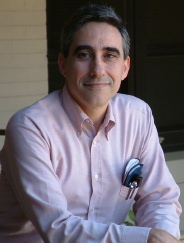 Texas State Historian Jesus F. de la Teja said groups that have been
marginalized in history must be integrated in history textbooks. The
Texas State history professor said that one of the main points he
has been discussing since initiating his tenure as state historian
is the need to open up the state's history.
Texas State Historian Jesus F. de la Teja said groups that have been
marginalized in history must be integrated in history textbooks. The
Texas State history professor said that one of the main points he
has been discussing since initiating his tenure as state historian
is the need to open up the state's history.We can't tell it the same way we have for generations, focusing on the actions of a few men and overwhelmingly the actions of men in the middle portion of the 19th century, said de la Teja. It has to be a story of a more diverse population. De la Teja gave his thoughts to the Guardian just two days after State Board of Education member Mary Helen Berlanga held a news conference in Brownsville to push for more accuracy in Texas public school textbooks. Berlanga urged South Texas parents and teachers to make their views known on the states guidelines for the next Texas curriculum. The State Board of Education rewrites the guidelines for the Texas Essential Knowledge and Skills (TEKS) in late 2008. If the parents and teachers in South Texas look at every point (of these guidelines) they can start to see where we might be able to plug in these individuals that have made contributions, Berlanga said. They have to do this because our history books are not accurate. If they do not have information regarding Hispanics, women, Native Americans, if we are not accurate on our stories, then the textbook is not accurate as a whole. De la Teja's intention is not to re-write history but to advise for a revision that includes the active participation of groups that have generally been cast into the margins of history textbooks. One of de la Teja's specialties is early Texas history, a period that covers Spanish and Mexican rule and society in the state. Texas history is generally seen in terms of the period following its independence from Mexico, which casts off an important period of the state's history. History textbooks also tend to include participation of groups such as Mexican-Americans, women and African-Americans in a separate section of the chapter. What the textbooks have to do and the direction that they are generally headed in, and hopefully in the next round of textbook adoption they'll be even farther down that road, is to not only include minorities, particularly Hispanics, but give them a place in the mainstream part of the story, said de la Teja. Its an effort to deal with these populations not as tokens but as an integral part of the story. One of de la Teja's concerns is the need for minority children, particularly Hispanics, to see themselves reflected in history textbooks in order to buy into the mainstream system. De la Teja said that it is difficult to get children and young adults interested in history because these age groups tend to look only to the future, and that it is harder for a group who does not see itself in the textbooks. If you have Hispanic students in the classroom, it's hard enough to get them to understand and to appreciate the importance of history without ignoring people who look like them, without making people like them part of their story so you can give them something to hang their hook on, said de la Teja. They really need to be able to relate and they can't do that if they don't see themselves as part of the story. One group that is by population a majority but by historical accounts a minority and therefore lands on the same marginalized section of history textbooks is women. De la Teja said women are still underrepresented in history and that there is enough research and writing on the role of Texas women to make them part of the mainstream story. The inclusion of women has to be along the same lines of the inclusion of minorities, said de la Teja. We have to do more social history. We have to talk about the roles these various groups played in the development and in the maintenance of the society that we have. Guardian reporter Steve Taylor contributed to this story from Brownsville. © Copyright of the Vox Veritas Corporation dba Rio Grande Guardian, www.riograndeguardian.com; Melinda Barrera, President, 2007. All rights reserved. Sent by Roberto Calderon beto@unt.edu |
|
| San Benito Opens Long Awaited Museums | |
| The city of San Benito has much to boast about this
fall as it finally showcases its rich history and culture in three
new museums: the San Benito History Museum, the Texas Conjunto Music
Hall of Fame and Museum and the Freddy Fender Museum. The three museums will be housed together in the San Benito Community Building, located in the Plaza San Benito on 210 E. HeywoodStreet. In one visit, guests will learn about and enjoy San Benito*s history and iconic music traditions. The history museum chronicles the origins of this Texas border town, from the flora and fauna of the land, the Spanish ranchos, to the arrival of the railroad and expansion of agriculture. Visitors will learn how the thriving business life of this city made it a central point of regional economic and social activity in the first half of the 20th century, and may be what has earned its place in Texan and American music history. Hailing as the *birthplace of conjunto,* San Benito was home to conjunto music pioneer Narciso Martinez, credited as solidifying the musical combination of the German and Polish accordion polkas, schotishes and redowas with the Spanish bajo sexto and musica ranchera. The Texas Conjunto Music Hall of Fame and Museum took roots in this city and will create a home to permanently display the history of south Texas accordion music and honor those who created it. The exhibit includes detailed information on the instruments used in conjunto music, its cultural origins, and will tell about some of San Benito*s legendary music institutions * *La Villita* dance hall and the Ideal Record Label. The exhibit will also display biographies and memorabilia of the 33 members it has inducted into its Hall of Fame. Another music icon for Mexican Americans all over the country is San Benito*s native son, Freddy Fender. The young Baldemar Huerta, Fender*s given name, was born and raised in the working-class barrios of the town and was exposed to its deep musical traditions at a young age. He went on to become one of the first to record rock and roll music in Spanish, and the first Mexican American to have cross-over success in American country music in the 1970s. A three-time Grammy Award winner, Fender made several national television and film appearances. He is remembered for his lively and loving personality as well as his achievements, which will be chronicled at the Freddy Fender Museum. All this history will be displayed together at the San Benito Museums and guests can enjoy it all for the admission of $3, Thursdays through Saturdays from 10 a.m. - 4 p.m. To celebrate the inauguration, the museums will host an opening gala on Saturday Nov. 17, 2007 from 7-11 p.m. The evening will include entertainment, food and beverages for an admission of $40 or $75 a couple. The museums will also host a free open house to the public on Sunday Nov. 18 from 12-5 p.m. The day will include programs and free admission to the museum. Museum sponsors include the City of San Benito, Gus Acevedo-Attorney at Law, Hamilton Electric, Mrs. L.T. Boswell, Jr., First Community Bank, Kellogg Automobile, Eagle Companies, A-Press Express & Nail Co., Vega Professional Building, L.T. Boswell, Armando Villalobos, District Attorney, Emerald Mortgage, Avila & Balboa Family, Bob Treviño Insurance Agency, Mr. G*s Fireworks * Ramiro Gonzales, Smith Reagan Insurance Agency, and Dr. & Mrs. John R. Tucker. For more information on the opening of the San Benito Museums, contact Cristina Balli at 956.361-3804 x 303. Roberto Calderon wrote: Source: Narciso Martinez Cultural Arts Center (NMCAC) nmcacsb@yahoo.com For Immediate Release: October 15, 2007 Contact: Cristina Balli, Tourism Coordinator City of San Benito (956) 361-3804 x 303 Sent by Dorinda Moreno dorindamoreno@comcast.net
|
|
| A&M set to name first female and Hispanic president | |
| Elsa Murano experienced in
government, academia. By Ralph K.M. Haurwitz, American-Statesman Staff, December 07, 2007 COLLEGE STATION — The governing board of Texas A&M University today named a top official in Aggieland as the sole finalist for president of the College Station campus. Elsa Murano, 48, is currently vice chancellor of agriculture for the A&M system and dean of the College Station campus' Agriculture and Life Sciences College. She was previously undersecretary for food safety for the U.S. Department of Agriculture. Before that, she was a faculty member at A&M. Assuming she is officially appointed, Murano will be the first woman and Hispanic ever named to the college's highest post. "The woman and Hispanic part had nothing to do with it," said Bill Jones, chairman of the A&M regents. "We looked nationally and internationally for a president and come to find we had one in our own back yard." Murano said she was thrilled at the prospect of leading what she called "the number one land grant institution in the country." Murano, who has served as vice chancellor and dean since 2005, paid tribute to her Cuban roots Friday. The Texas resident fled Cuba in 1961 with her family at the age of 2, shortly after Fidel Castro rose to power. The family lived in several Latin American countries before settling in Miami. "Only in America can a girl from Havana get to this point," she said. Under state law the regents can not appoint her to the post for another 21 days, but her ascension to the presidency is virtually certain. The selection process was contentious because faculty members felt they had not been given sufficient opportunity to interview candidates, including Murano, who were given serious consideration by the regents. A search committee that included faculty members, students, civic leaders and regents interviewed a number of candidates but not Murano. They sent three names to the A&M system for consideration. But when one withdrew shortly thereafter, the regents decided to bring in additional candidates, including Murano. "We wish her the best of luck," said Doug Slack, a professor of wildlife and fisheries sciences. "The faculty is really upset about the process." Murano pledged to work with faculty members, students and alumni and to be a good listener but also a firm decision maker. |
|
| Some more Texas WW II web site | |
| http://www.kwbu.org/index.php?id=47840 http://www.riograndeguardian.com/brief_story.asp?story_no=4 http://www.palaciosbeacon.com/home/features.shtml sent by Rafael Ojeda |
|
| La Voz de Culebra Park: Emma Tenayuca | |
| By Art Fuentes San Antonio, Tejaztlan (10/15/07) Emma Tenayuca December 21, 1916 - July 23, 1999 Emma Tenayuca was born in San Antonio, Texas on December 21, 1916. Emma lived with her grandparents to ease the burden on her family of eleven children. San Antonio native Emma Tenayuca was a pioneering activist involved with issues that resemble those of modern times: disparity of rich and poor, and substandard wages and working conditions of laborers and migrant workers. In her formative years Tenayuca followed election politics of the U.S. and Mexico. She became a labor activist before graduating from high school. She was arrested at age 16 when she joined the picket line of workers on strike against the Finck Cigar Company of San Antonio in 1933. She attended Brackenridge high school, and after graduating in 1934, obtained a job as an elevator operator. Emma's first knowledge of the struggles of working people came from visits as a young child to the Plaza del Zacate, a place where socialists and anarchists would come to speak and work with families with grievances. Emma joined the labor movement when she was 16 and read about strikes at the Finck Cigar Company. She joined the picket line, and was arrested. By 1937 Emma had become general secretary for ten chapters of the Workers Alliance in San Antonio. During the Depression most of the pecan shelling for the nation was done in San Antonio. Although the pecan industry had been formerly mechanized, hand labor became cheaper during this time period. Workers were paid about six cents per pound of pecans. Tuberculosis rates were high in San Antonio because of the fine dust in the air from the pecans. There were other dangers in the work, and adequate rest room and cleaning facilities were few. When in January of 1938 the wages for pecan shellers were cut in half, about 12,000 workers decided to strike. Emma was asked to be the strike representative. The strike lasted for several months. From six to eight thousand workers, mostly women, joined the strike. Intimidation was used to keep other workers from joining in the work stoppage. Strikers were tear gassed several times, and police were deployed to prevent the strike from being effective. Influenced by the causes of the Mexican Revolution, and Texas gubernatorial candidate Ma Ferguson's position against the Ku Klux Klan, Tenayuca's work for labor issues and civil rights predated Cesar Chavez and the Civil Rights movement. She founded two International Ladies' Garment Workers Unions, and organized strikes against San Antonio's large pecan shelling industry. On August 25th, 1939, Emma Tenayuca was scheduled to speak at a small meeting of the Communist Party at the Municipal Auditorium. Mayor Maury Maverick had granted the auditorium meeting permit. She founded two International Ladies' Garment Workers Unions, and organized strikes against San Antonio's large pecan shelling industry. Tenayuca worked as an organizer and activist for the Workers Alliance of America and Women's League for Peace and Freedom. She lobbied the mayor of San Antonio to improve relief distribution for unemployed workers during the Great Depression. 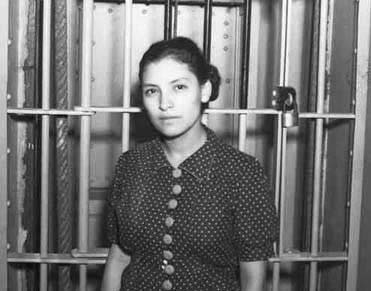 In 1937 she organized protests of the beating of migrants by US Border Patrol agents.
Like many artists and activists (including Frida Kahlo and Woody Guthrie) who were concerned about poor workers as industries grew powerful, Tenayuca joined the Communist Party in 1937. She was scheduled to speak at a meeting of the Communist Party in 1939, when organized opposition rioted at San Antonio's Municipal Auditorium. She received death threats and was blacklisted in San Antonio. She briefly relocated to Houston before moving to San Francisco, California to pursue a degree in education. As Emma tried to hold the meeting, an estimated 5,000 people stormed the auditorium, "huntin' Communists." Men, bricks, and rocks were trucked in for the attack, and several people were hurt. Police managed to get Emma to safety, but she was hounded by death threats long after the riot. Throughout her life, Tenayuca was a vocal advocate for free speech and workers' rights, and a critic of many government policies. She was a dedicated student of political issues and processes. She expressed her belief in greater economic equality for citizens over expensive government relief programs. In 1987, she told Jerry Poyo, with the Institute for Texan Cultures Oral History Program, "What started out as an organization for equal wages turned into a mass movement against starvation, for a minimum-wage law, and it changed the character of West Side San Antonio." After being forced to leave San Antonio because of being blacklisted after the municipal auditorium riot she moved to San Francisco. She obtained teacher certification in 1952. After returning to San Antonio in the late 1960's she taught reading in the Harlandale school district for many years. Emma earned a master's degree in education from Our Lady of the Lake University in 1974 She retired in 1982. Emma Tenayuca died July 23, 1999. December 21, 1916Emma Tenayuca is born in San Antonio, Texas 1924The U.S. Border Patrol is created. See a Timeline of the US-Mexico Border October 24, 1929Tenayuca is profoundly affected by the events of the stock market crash (Black Tuesday) and the Great Depression, particularly the condition of workers. She listens to speeches on the plaza in San Antonio. 1932-1933Tenayuca joins protests of working conditions at the Finck Cigar Company. She is arrested at age 16. 1 934Tenayuca graduates from Brackenridge High School in San Antonio. 1934-1935Tenayuca helps organize two branches of the International Ladies' Garment Workers Union in San Antonio. 1936Tenayuca lobbies Mayor Charles K. Quin to improve distribution of relief supplies. 1937Tenayuca has become general secretary for ten Workers Alliance chapters by 1937. 1937Tenayuca joins the Communist Party. February 24, 1937Tenayuca organizes Workers Alliance members to protest brutal beatings of migrants by US Border Patrol agents. June 30, 1937Tenayuca, national committeewoman for the Workers Alliance of America, is jailed for "disturbing the peace" during a nonviolent protest (a WPA sit-in). January 31, 1938Tenayuca is arrested for her role in organizing a labor strike of pecan shellers. 1938Tenayuca works with Women's League for Peace & Freedom to feed striking pecan workers. 1938Tenayuca marries Communist Party organizer Homer Brooks. 1939Tenayuca becomes chairperson of the Texas Communist Party. April 27, 1939Tenayuca and other members of the Workers Alliance stage a nonviolent demonstration at City Hall to protest the city's refusal to grant the organization a parade permit. August 25, 1939Tenayuca prepares to speak at a meeting of the Communist Party when a riot breaks out at Municipal Auditorium. Tenayuca receives death threats and is blacklisted in San Antonio. She relocates to Houston and soon moves to San Francisco, California. 1952Tenayuca receives teacher certification from San Francisco State College. 1960sTenayuca returns to San Antonio in the late 1960s. 1974Tenayuca receives her master's degree in education from Our Lady of the Lake University in San Antonio. 1982Tenayuca retires from Harlandale School District. July 23, 1999 Emma Tenayuca dies in San Antonio. Sent by Dorinda Moreno |
|
| Book: The Spanish in New Orleans and Louisiana |
| "The Spanish in New Orleans and Louisiana" by Jose
Montero de Pedro , Marques de Casa Mena, Published in 2000 by
Pelican Publishing Co. , 1000 Burmaster St. , Gretna , La. 70053.
Can be found in some public libraries under La. 973.3 ,M7785. He was
Spanish Consul in New Orleans 1976-80. Enjoy.
Sent by Bill Carmena |
| "Exploring the early Americas" at Library of Congress, Wash. DC |
|
|
|
|
|
|
|
Muzquiz, Velarde,
Rodríguez,
Ensayo Histórico
|
|
Muzquiz,
Velarde, Rodríguez
Aportación para el Colegio de
Investigaciones Históricas |
||
| Tres Apellidos, Diez Generaciones | ||
|
Introducción Cuando era niño me
fascinaba oír la historia familiar que nos contaba mi abuela Aurora
Velarde Garza, quien a su vez la había escuchado de su abuela María
Marta Salinas de Velarde y de lo que recordaba de sus tiempos, al
morir mi abuela en 1957 su hermana Beatriz mantenía vivo el
recuerdo del abolengo que habían heredado de su abuelo el Lic.
Policarpo Velarde Muzquiz, que tanto enorgullecía a sus
descendientes. Ahora que casi cumplo sesenta años de vida quiero
dejar testimonio por escrito a mis nietos de aquella fabulosa
historia que empieza en el siglo XVII, sin antes agradecer el
valioso apoyo recibido de algunos familiares que llevan tan ilustres
apellidos y amigos, de otra manera me resultaría difícil
escribirla. Su contenido refiere un puñado de recuerdos del pasado, busca crear una nueva visión para las generaciones venideras que quieran seguir los pasos de sus mayores, quienes lucharon por forjar un estado libre y soberano. Este ensayo histórico está basado en recuerdos, fotografías familiares, libros de registros públicos y en tradiciones orales. La metodología seguida describe vida y obra de cada una de las diez familias que integran la dinastía, partiendo del matrimonio, los hijos procreados y sus nietos. Los recuerdos aquí plasmados es la continuidad de las tradiciones orales de las diversas familias que integran ésta micro sociedad. Espero que mis nietos la disfruten y que se sientan orgullosos de su linaje y al mismo tiempo les sirva de ejemplo, inspiración y estímulo para trabajar incansablemente por la grandeza de nuestra tierra natal y por México. Asimismo quiero recordarle a los lectores que no pretendí hacer una biografía de los personajes, más bien tratar de mantenerlos siempre presentes. Las diez generaciones a que se refiere este trabajo se detallan en una lista aparte. Finalmente deseo que tengan presente que la historia es el legado de nuestros mayores y el principio del futuro donde se forjan nuestros ideales. Héctor Javier Rodríguez García
Hablar de Coahuila de Zaragoza para los oriundos norteños, necesariamente acabamos entrelazando la historia familiar con la del Estado y la República, motivo por el cual siempre terminamos transportándonos en un emocionante viaje por el pasado y al mismo tiempo nos hace evocar un futuro prometedor. Los coahuilenses nos sentimos orgullosos de su extenso territorio y de su rico legado, sobretodo cuando recorremos sus largos caminos para llegar de una población a otra, sus diversos paisajes nos pone nostálgicos al pensar como pueden vivir sus pobladores en esta inhóspita tierra. Si iniciamos nuestro viaje a partir de Monclova todo queda lejos, ir a Saltillo es atravesar 180 Km. de llanuras y montañas, ir a Torreón por Cuatro Ciénegas hay que andar 360 Km. de llanuras polvorientas en medio de una laguna extinta, con tan sólo unos manchones verdes en San Pedro de las Colonias y Madero, si tomamos el camino del norte que conduce a Piedras Negras nos separan 240 Km. donde encontramos que está salpicado de largas estepas de matorrales entreverados en lomeríos y llanos, un bonito río que conserva sus grandes sabinos, en San Juan de Sabinas y Sabinas, unos manantiales que dan vida a un encinal y grandes nogaleras entre los municipios de Allende, Nava y Morelos y si nos desviamos en Allende para continuar el camino a ciudad Acuña nos sorprenderemos de sus ríos y árboles, en bonitos parajes de Zaragoza y San Carlos, entre lomas y matorrales y que decir si vamos camino a Laredo, por Candela hay que viajar 100 km para entroncarnos con la carretera de Monterrey por Anahuac, N. L, en ese tramo se pasa por la Sierra de la Gloria, con sus antiguas Ex -Haciendas de San José del Oro, Carrizalejo, La Coma, La Caprichola, Las Higueras, el Mimbre, Santa Rosas, la Mota, mismas que hoy forman pequeñas poblaciones ejidales como Salitrillos y el Huizachal, enclavados en medio de llanuras pedregosas y fértiles tierras productoras de maguey y sotol, bañadas por pequeños manantiales. El actual Estado de Coahuila de Zaragoza tiene una superficie de más de 150 mil kilómetros cuadrados, se localiza en la parte central de los Estados Unidos Mexicanos, sus puntos extremos de su territorio son: al norte, los 29º51’50" de latitud en la frontera con Texas, Estados Unidos de América; al sur, el paralelo 24º32’10", en la línea divisoria con Zacatecas; al este, el meridiano 99º50’00" en el punto que colinda con Texas y Nuevo León con el cruce del Río Bravo; y al oeste, el meridiano 103º57’30" en el Rancho de Jaco, (que se encuentra casi a los 28º) en los límites con Chihuahua. Los estados vecinos son: al norte Texas, de la Unión Americana, al sur Zacatecas, al este Nuevo León, al oeste Durango y Chihuahua. Está dividido en 38 municipalidades y seis regiones, su capital es la ciudad de Saltillo. Su escudo de armas fue adoptado por el Congreso del Estado a iniciativa del saltillense ingeniero Vito Alessio Robles y del entonces gobernador constitucional Benecio López Padilla, data desde el 23 de octubre de 1942. Integrado por una bordura con volutas, en las que va la leyenda "Coahuila de Zaragoza" su interior esta cortinado por tres partes: en la superior derecha aparece un árbol y dos lobos atravesados sobre campo de plata, provenientes de las armas de la Nueva Vizcaya, recordando que la parte sur del estado formó parte de aquella provincia, en la cortina superior derecha aparece un león rampante y una torre decorada con una banda en que se lee la leyenda "Plus Ultra" en un campo de oro, tomada del escudo de armas de la ciudad de Badajos, España, cabecera de la provincia de Extremadura, no olvidando que la parte centro-norte del estado en tiempos coloniales llevó ese nombre y en el mantel inferior aparecen un río arbolado con un sol en el oriente, que representa el origen de la voz Coahuila, derivada de la lengua hablada por los nativos "Zahuales" descritos por Zavala en 1644 y que escribiera Luís de Carvajal en sus memorias en 1589 como el lugar donde fundó la Villa de Almaden provincia de "Quabila", (hoy Monclova) el sol naciente representa la libertad nacional lograda después de la revolución social iniciada por los hijos coahuilenses Francisco I. Madero y continuada por Venustiano Carranza. El inmenso territorio de Coahuila hasta antes de iniciarse el proceso de colonización española (1577 con Alberto del Canto, la parte sur del Estado, en 1585 por Luís de Carvajal y de la Cueva. parte centro y 1673 Fray Juan Larios, centro y norte hasta los confines de Texas, era habitado por gente nómada, sin una cultura propia, pero fieros defensores de su territorio, agrupados por familias pertenecientes a un mismo origen étnico, destacando cuatro naciones principales, los Guachichiles, en la región sureste Saltillo-Parras, los Rayados en la región suroeste Torreón-San Pedro, los Tobosos, en la región desierto Sierra Mojara-Ocampo, los Lipanes, región noroeste Ocampo-Muzquiz, los Zaguales o "cuagualas" en la región centro-norte, divididos en parcialidades independientes, controlados por jefes o capitanes, distribuidos como sigue: Monclova, boboles y xicocoges, en Candela, catujanos, tilijaes, apes, junees, pachaques, milijais, en San Buenaventura, contotores, cabezas, bobosarigames, en Nadadores, colorados y tocas sus aliados los mazapes, en Muzquiz (antes San Ildefonso de la Paz y Santa Rosa) gueiquezales manosprietas, bocoras, siaexer, pinanacas, escabaca, cacastes, cobiptas, cocomaque, oodame, contotores, colorados, babiamares, taimamares. Los 38 municipios que integran el estado según cada región son: Norte: Acuña, Jiménez, Piedras Negras, Guerrero e Hidalgo, de los cinco manantiales: Zaragoza, Morelos, Nava, Allende y Villa Unión, Carbonífera: Muzquiz, San Juan de Sabinas, Sabinas, Juárez y Progreso, Centro: Abasolo, Escobedo, Candela, Monclova, Castaños, Frontera, San Buenaventura, Nadadores, Sacramento, La Madrid, Desierto: Cuatro Ciénegas, Ocampo, Sierra Mojada, Sureste: Saltillo, Ramos Arizpe, Arteaga, General Cepeda, Parras, Laguna: San Pedro de las Colonias, Matamoros, Madero, Viesca, Torreón.
|
||
|
Teresa Garza Jasso |
||
Hijos Políticos y Nietos:
Entorno
Foto de la Parroquia de Santiago Aposto. Así lucia por el año de 1909.
Ermita de Nuestra Señora de Zapopan. Hacia 1909.
Presidencia Municipal y Teatro Hidalgo, hacia 1909. Vida
Boda de los hijos.  María de Jesús de Hoyos Castellanos y Leopoldo Velarde El día de su boda en 1919
Leonor Velarde contrajo matrimonio con Julio Rodríguez En 1920. (Familia de Saltillo)
Joaquín Velarde y Juana Foto tomada el 6 de noviembre de 1921 en EUA (No hubo descendencia vivieron en Ilinois)
Napoleón Velarde se casó con Carmen Rivera (Familia nacida en Houston, Texas y Anahuac, N L.) Foto tomada en 1922 (Familia en Anahuac N L)
Obra Defunciones
Foto tomada el 3 de mayo de 1909. Muerte de Joaquín Velarde Garza. Parados de derecha a izquierda: su esposa Teresa Garza Jasso, niño Elique, Carlota. Aurora, sostiene en sus brazos a su niño Ramiro Rodríguez, Beatriz. Leopoldo, Napoleón, Joaquín, recargado en la cabecera Julio, niña Carlota Amalia Jiménez hija de Carlota, Leonor, Josefa, Oralia Jiménez niña recostada hija de Carlota. Acta de Defunción de Doña Teresa Garza Jasso Vda. de Velarde Defunciones, Libro 1922, Oficialía 1ª del Registro Civil de Monclova. Libro 04 Tomo I, hoja 60/61, Acta 144.
En la ciudad de Monclova siendo las (8) ocho de la mañana del día (8) del mes de junio (1922) mil novecientos veintidós; Ante mí Ciudadano Cayetano V. Villarreal Juez (1º) primero del Registro Civil de esta ciudad y su comprensión, compareció el Ciudadano Leopoldo Velarde, casado, artesano de (26) años de edad, originario y vecino de esta Ciudad y presentó un certificado expedido por el médico A. Fernández cuyo documento con el número de esta acta, se agrega al expediente respectivo que lleva esta Oficina y en el que consta que ayer a las (17.20) diez y siete veinte minutos del día falleció de cáncer la Señora Teresa Garza Viuda de Velarde a la edad de (57) cincuenta y siete años del sexo femenino, en la casa marcada con el número (13) trece de la Calle de Allende de esta Ciudad de estado civil Viuda de profesión, ocupación doméstica, era de nacionalidad mexicana e hija legítima del Señor Gregorio Garza y de la señora Dolores Jasso de Garza finados. Se mandó inhumar el cadáver en el departamento especial comprado a perpetuidad de dos metros cuadrados del Panteón de Guadalupe de esta Ciudad, según consta del recibo numero (1730) mil setecientos treinta expedido por la Tesorería Municipal de la misma. El compareciente oyó leer esta acta y fue conforme con su contenido, en presencia de los testigos Ciudadano Francisco Peña, casado, artesano y Raúl E. Martínez soltero, comerciante mayores de edad y de esta vecindad, Firma el Juez y los presentes. Cayetano V. Villarreal, Leopoldo Velarde, Francisco Peña, Raúl E. Martínez.
|
||
|
Héctor Rodríguez Velarde |
||
|
Héctor Rodríguez Velarde |
Octava Generación: Héctor Rodríguez Velarde, nació el 29 de agosto de 1920 en Monclova y murió el 12 de febrero 2007 en Frontera, Coah., fue bautizado en la Parroquia de Santiago Apóstol en 1922 siendo sus padrinos Anselmo Velarde y la señorita Josefa Velarde Salinas, casado con Amalia García Barrera nacida el 18 de noviembre de 1924 en Monclova, hija de Manuel García Montemayor y Victoriana Barrera Guajardo, contrajeron nupcias por lo civil el 19 de abril de 1945, en Frontera, Coah. Por lo religioso en agosto de1961 en la Parroquia del Sagrado Corazón de Jesús. Procrearon nueve hijos: |
|
|
1. Ludivina Amalia *26/03/1946 2. Héctor Javier *06/05/1948 3. Sergio Rolando *25/05/1950 4. Joaquín Manuel *27/03/1952 5. Silvia *27/02/1954 6. Nereyda Aurora *26/08/1957 7. Lauro *31/07/1959 8. Ricardo *22/08/1963 9. Enrique *10/03/1966 Hijos Políticos y Nietos: 1. Ludivina & Juan Robles Salas, sus hijos: Raquel murió al nacer el 19/10/1964, María Guadalupe *03/06/1966, Juan Héctor *11/03/1968, Ludivina *21/05/1973. 2. Héctor Javier & Silvia Guillermina Cordero Castillo, sus hijos: Silvia del Carmen *21/11/1972, Héctor Joel *12/04/1976, Eli Kalid *12/08/1979. 3. Sergio Rolando & San Juana Sánchez Mata, sus hijos: Aurora *05/04/1970, Héctor Rolando *29/03/1971, Isabel *09/03/1972, Ulises *10/07/1974, Einstein *19/02/1977. 4. Joaquín Manuel & María Esther Aguilar Valero, sus hijos: Héctor Manuel *09/10/1973, Joaquín *19/08/1974, Jesús Orlando *17/02/1976, Erick Guadalupe *11/12/85. 5. Silvia & Cruz Rodríguez Flores, sus hijos: Víctor Manuel *12/06/1974, Ana Laura *25/06/1976, Silvia *10/03/1977, Raquel *05/06/1980. 6. Nereyda & Cesar de los Santos Olvida, sus hijos: Lluvia Saraí *12/05/1976, Asent *03/01/1979, Iris Samara *01/05/1985, Eliézer 14/09/1986, Belisario *15/09/1992. 7. Lauro & Rosa Martínez, sus hijos: Abigail *14/04/1982, Lauro Néstor *06/08/1985, Neptalí *29/07/1996. 8. Ricardo & Olga Iracheta Flores, sus hijos: Gloria Estefanía *26/05/1991, Mónica Carolina *06/06/1994, Ricardo Benjamín * 09/09/1998. 9. Enrique & Blanca Barajas Sanchez, sus hijos Amalia Natalí *19/07/1985, Dalí Marlene * 30/08/1991, Alicia *19/01/2005. Entorno Vida 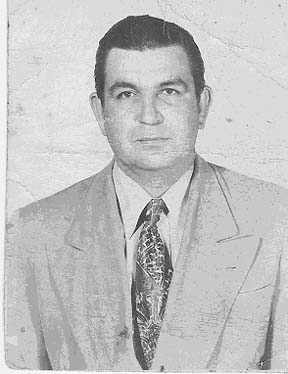 Héctor Rodríguez Velarde 1920/2007 Foto tomada en 1952, a la edad de 32 años. 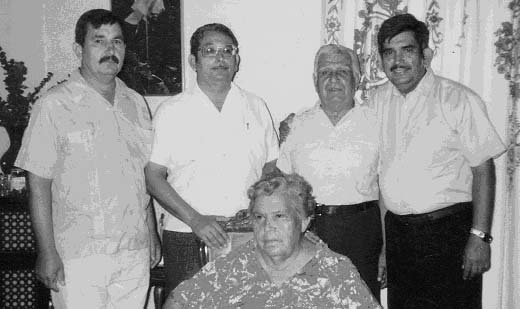 Foto tomada en 1997. Parados Iz. Joaquín Manuel, Sergio Rolando, Héctor (papá) y Héctor Javier, sentada Amalia (mamá)  Foto tomada el 19 de abril de 1996. Capilla de Guadalupe de Frontera, después de la misa para conmemorar sus bodas de oro. (50 años de casados) Sus hijos atrás: Iz. Joaquín Manuel, Ricardo, Héctor Javier, frente, Iz. Enrique, Sergio Rolando, Héctor (papá) Amalia (mamá) Silvia y Nereyda Aurora. Ausentes: Ludivina Amalia y Lauro, motivo, por profesar otra religión.  Foto tomada el 4 de febrero de 2007. Iz. Ricardo, Lauro, Nereyda Aurora, Silvia, Joaquín Manuel, Sergio Rolando, Héctor Javier, Ludivina Amalia y Enrique, Don Héctor y Doña Amalia, con casi 62 años de matrimonio.  Foto tomada el 4 de febrero de 2007. Iz. Parados: Olga Iracheta, Esther Aguilar, Cruz Rodríguez, Silvia Guillermina Cordero, Juan Robles, sentados Iz. Rosa Martínez, Doña Amalia, Don Héctor y Blanca Barajas. Ausentes: San Juana Sánchez, Cesar de los Santos (ya fallecido) Bodas de los Hijos  San Juana Sánchez y Sergio Rolando Rodríguez Boda civil y religiosa el 7 de febrero de 1970    Foto tomada el 20 de junio de 1972. Ceremonia de la boda por lo civil de Silvia Guillermina Cordero Castillo y Héctor Javier Rodríguez García, firmando como testigo el actor e intérprete Fernando Fernández. El evento se llevó a cabo en la residencia de los padrinos, don Fernando Fernández y Lupita Palomera, sita en el Pedregal de San Ángel, D. F:  Silvia Guillermina y Héctor Javier Boda religiosa, 29 de julio de 1972  Foto tomada en enero de 1974. Bodas de Nereyda Aurora y Cesar de los Santos Olveda. Obra Héctor Rodríguez Velarde, desde 1941 hasta febrero de 1980 trabajó en Ferrocarriles Nacionales de México, se inició como pasa carbón de las calderas de las máquinas de vapor, posteriormente pasó a talleres y desde 1959 como mecánico en el Taller de Carros y Coches, su labor consistía en reparar las bombas de aire de los frenos. Formó parte del Sindicato Nacional de Trabajadores Ferrocarrileros, sección 29, División Monclova. Antes de incorporarse a los Ferrocarriles, desde los doce años en 1932, empezó a ayudarle a su mamá en actividades de comercio, compraban y vendía productos del campo y animales, que sacrificaban y comercializaban sus derivados. A su papá le ayudaba en trabajos de carpintería, recordaba cuando tenían que tomar medidas al difunto para hacerle el féretro que algunas veces tenían que pintar y decorarlo a gusto de los deudos, de la noche a la mañana cuando lo iban a enterrar. En marzo de 1950 su mamá trató de adquirir el Rancho de la Coma que había sido propiedad de sus abuelos y bisabuelos y que a la muerte de Melchor Velarde hijo de Anselmo sus herederos pusieron en venta, sin embargo, la operación no se realizó ya que al hacer el levantamiento, las medidas originales no concordaban, dado que les faltaba un proporción significativa que los vendedores habían ofrecido en venta a los dueños del Rancho de la Caprichosa y que previamente habían cercado, lo que disgustó a doña Aurora Velarde y la operación no se llevó a cabo. En ese período se dio la epidemia de brucelosis o fiebre aftosa que afectaba a las vacas, y que hizo estragos en la región. Asimismo ocurrió una gran sequía. En 1954, intentó tramitar sus documentos para emigrar a los Estados Unidos a ruego de su hermana Teresa y su cuñado Joseph von Wernick, no obtuvo el pasaporte americano y desistió de su intento. |
||
Personajes de la historia PERSONAJES DEL CENTENARIO DE LA CIUDAD DE TORREÓN, COAH. Por: José León Robles De La Torre www.elsiglodetorreon.com.mx |
|
| CELEBRANDO EL CENTENARIO DE LA CIUDAD DE TORREÓN El general Eugenio Aguirre Benavides, nació en Parras de la Fuente, Coah., el seis de septiembre de 1884, donde realizó sus estudios primarios. “Su hermano mayor fue el licenciado Adrián, amigo personal de D. Francisco I. Madero y participó en la Revolución Mexicana al lado del General Francisco Villa. D. Eugenio, también tomó las armas con las fuerzas de Madero, llegando hasta el grado de General, pero las circunstancias lo hicieron participar en las elecciones de 1911 para la presidencia municipal de Torreón, mismas que ganó y así las calificó el Congreso del Estado, tomando posesión el día primero de enero de 1912, durando en el cargo hasta mediados de junio de ese mismo año, cuando Aguirre Benavides tomó las armas nuevamente para combatir la sublevación de Orozco, que se levantó en armas desde Chihuahua, para quitar de la silla presidencial a D. Francisco I. Madero y colocar en ella a D. Emilio Vázquez Gómez, enviando algunos jefes a hostilizar Torreón, tales como Caraveo, Salazar, Aniceto Ramírez y Benjamín Argumedo, que fue destinado para hostilizar San Pedro de las Colonias, tierra que conocía perfectamente por ser nativo de Matamoros, Coah. En Torreón se organizó la Base Militar de Operaciones y de aquí salió rumbo a Durango el general Aureliano Blanquet para combatir a los revolucionarios, mientras llegaba a esta ciudad el general D. Victoriano Huerta que fue designado por el Gobierno para detener a los oponentes. Aquí estableció su cuartel general de Huerta. El general Eugenio Aguirre Benavides que pertenecía a as fuerzas del general Villa, se retiró dejando la presidencia temporalmente, la que ocupó provisionalmente el D. Francisco Peña Ibarra durante parte de junio y julio de ese 1912 y por los meses de agosto y septiembre ocupó también provisionalmente la presidencia, el ingeniero Andrés L. Farías Hernández. La Revolución seguía haciendo estragos y las fuerzas revolucionarias tenían por objeto retomar la ciudad de Torreón. Se dividieron en cuatro columnas: La Zaragoza, al mando del general D. Eugenio Aguirre Benavides que avanzó a Tlahualilo, Dgo.; La Cuauhtémoc, con el general Tomás Urbina a la cabeza, que marchó sobre Mapimí, Dgo.; la tercera, al mando del general Felipe Ángeles y la cuarta dirigida personalmente por el general Villa. El general Aguirre Benavides avanzó sobre Sacramento para cortar las vías del ferrocarril procedente de Monterrey. Los combates se iniciaron contra los federales y Aguirre Benavides se lanzó contra las fuerzas del general Almazán. Los constitucionalistas en reñidos combates tomaron Gómez Palacio, Dgo., previo a la toma del Cerro de la Pila. Cuando las circunstancias de la Revolución lo permitieron, el general D. Eugenio Aguirre Benavides, regresó a la presidencia municipal a principios de octubre y lo terminó en diciembre de ese 1912, y el ingeniero D. Andrés L. Farías Hernández se retiró a realizar otras actividades. Gral. D. Eugenio Aguirre Benavides, fue presidente municipal electo en el año 1912, aunque como luego veremos, ese año fue muy complejo por la Revolución y ocuparon la presidencia tres personas en diferentes periodos. CELEBRANDO EL AÑO DEL CENTENARIO DE TORREÓN, COAH. 1907-2007 Doctor y general don José María Rodríguez y Rodríguez, fue Presidente Municipal de Torreón, Coahuila, durante dos meses, enero y febrero de 1913. No obstante la efervescencia política que dificultaba realizar elecciones, se logró convocarlas para el periodo de 1913. El triunfo fue a favor del doctor y general don José María Rodríguez y Rodríguez. Este importante personaje, nació en la ciudad de Saltillo, Coah., el 15 de octubre de 1870, siendo hijo de don Jesús M. Rodríguez y de su esposa doña Melquiades Rodríguez. Realizó sus estudios primarios en escuelas oficiales de Saltillo, luego ingresó al famoso Ateneo Fuente, pasando después a la Escuela Nacional de Medicina de la Ciudad de México y luego en el Hospital Militar capitalino, recibiendo su título de médico en 1895 y con el grado de Mayor del Ejército Mexicano. En 1904 fundó el Partido Liberal de Coahuila, durando al frente del mismo durante casi seis años. En 1909 se efectuó una junta revolucionaria en el consultorio del doctor don José Ma. Rodríguez y Rodríguez, en la calle Juan Antonio de la Fuente No. 103, a la que asistieron –dice Pablo C. Moreno- don Francisco I. Madero, don Catarino Benavides, don Indalecio de la Peña, don Sixto Ugalde, don Mariano López Ortiz, don Emiliano Laing, don Matías García, don Leopoldo Cepeda Morales, el profesor don Manuel N. Oviedo, entre otros más. Por la noche de ese mismo día nueve de febrero de 1913, el doctor José Ma. Rodríguez recibió un mensaje de la capital de la República, en el que se le comunicaba el levantamiento militar de los generales Mondragón y Ruiz, que liberaron de su prisión al general Bernardo Reyes que estaba recluido en Santiago y al general Félix Díaz que estaba en la penitenciaría. Reyes se dirigió al Palacio Nacional tratando de tomarlo y murió en el intento. Félix Díaz se apoderó de la ciudadela donde se encontraba el armamento. En el mensaje al doctor Rodríguez, se le pedía que apresara a los partidarios de Madero, lo que no hizo, y en su oportunidad se unió a las fuerzas de don Jesús Carranza. Por todos esos conflictos, el doctor José María Rodríguez y Rodríguez, sólo estuvo al frente de la Presidencia Municipal de Torreón los meses de enero y febrero de 1913. El general don José Ma. Rodríguez, participó en la batalla de N. Laredo, donde organizó los servicios médicos en campaña. También en Torreón fundó un sanatorio. En marzo de 1914, por instrucciones de Carranza, fue a Hermosillo, Son., como jefe del Cuerpo Médico Militar Nacional, con el ascenso, el día siete de ese mes, a coronel. El 28 de agosto del mismo año, don Venustiano Carranza, jefe del Ejército Constitucionalista, lo nombró presidente del Consejo de Salubridad y el nueve de octubre siguiente lo ascendió a general de Brigada y lo nombró como su médico particular, con cuyo cargo lo acompañó al Puerto de Veracruz, donde don Venustiano estableció su gobierno. El doctor y general José Ma. Rodríguez, fue electo Diputado Constituyente 1916-1917, firmando la Constitución de 1917 en Querétaro. Después fundó y fue jefe del Departamento de Salubridad hasta 1920. El Presidente de la República, develó un busto del general y doctor José Ma. Rodríguez en el jardín central de la Secretaría de Salubridad. Muchos otros homenajes se le hicieron a tan ameritado coahuilense que dejó de existir el 17 de marzo de 1946, en la ciudad de Torreón, Coah. CELEBRANDO EL AÑO DEL CENTENARIO DE TORREÓN, COAH. 1907-2007 Doctor don Adolfo Mondragón Bouckhardt, Presidente Municipal de Torreón, Coahuila, del 1º, de marzo de 1913 al tres de abril de 1914 El doctor Adolfo Mondragón Bouckhardt fue nombrado Presidente Municipal de Torreón, Coah., en calidad de interino, debido al que era electo general y doctor don José María Rodríguez, salió a desempeñar una comisión especial que le confirió don Venustiano Carranza, por lo que Mondragón tomó posesión del cargo el primero de marzo de 1913 y duró en el puesto hasta el cuatro de abril de 1914, fecha en que el general Francisco Villa que tomó la ciudad, nombró presidente interino al ingeniero don Andrés L. Farías. En esa era revolucionaria, las autoridades municipales ocupaban cargos de acuerdo con los que tomaban la ciudad y salían los que habían sido nombrados por las fuerzas que salían, generalmente huyendo de los enemigos que ostentaban mayor fuerza. El doctor Mondragón era originario de la ciudad de Piedras Negras, Coah., donde nació el año de 1869, quien por segunda ocasión contrajo matrimonio con la señorita Delfina Aguirre, quienes procrearon, entre otros hijos, a la famosa escritora coahuilense Magdalena Mondragón Aguirre, que ejerció el periodismo, escribió novelas, cuentos, historia, poesía, etc., y que tiene un busto en bronce en la Calzada de los Escritores de la Alameda Zaragoza en esta ciudad de Torreón. Fueron hermanos de la escritora el doctor Arturo Mondragón Aguirre, el doctor Julio Mondragón Aguirre, que radicaba en Torreón desde hace muchos años, y creo que todavía seguirá en esta ciudad, porque hace poco más de un año todavía lo saludé. Otra hermana la señorita Ofelia Mondragón Aguirre, que casó con otro brillante escritor don Enrique Borrego. En cuanto al doctor Adolfo Mondragón Bouckhardt, cambió su residencia de Piedras Negras, Coah., a finales del Siglo XIX o principios del XX, ya que Torreón era Villa todavía, pues como sabemos fue declarada Villa en 1893 y Ciudad en 2007. El doctor Mondragón pronto se hizo querer de la gente por su alta calidad de servicio hacia sus semejantes. Fundó el Sanatorio “Casa de la Salud” de La Laguna, después llamado “Sanatorio Mondragón”. El doctor Mondragón había sido el 5º. Regidor con el presidente emanado de la revolución maderista Profr. don Manuel N. Oviedo, un jerezano ilustre, en 1911. Cuando Villa nombró al Ing. Andrés L. Farías, para sustituirlo, creo que se retiró de la política para dedicarse a su profesión de médico y atender su sanatorio. Falleció en Torreón, Coah., el año de 1953, a la edad de 84 años, recordándolo con cariño los habitantes de Torreón y la Región Lagunera en general. Send by Mercy Bautista-Olvera scarlett_mbo@yahoo.com
|
|
|
THE PRESENT STATUS OF INDIGENOUS LANGUAGES IN MÉXICO By John P. Schmal
|
|
| The most recent census count in
México reveals that a multitude of languages are used by Mexican
nationals throughout the country. It is true that the percentage of
Mexicans who are speaking indigenous languages is steadily declining,
but a great many people have held on to their mother tongues, sometimes
taking it with them to other parts of México.
1. Náhuatl. 1,376,026 Mexicans speak twenty-eight Náhuatl languages and live in every state of México. Náhuatl speakers make up 22.89% of all indigenous speakers in the country and are most prominent in several eastern states, including Puebla (28.9% of all Náhuatl speakers), Veracruz (23.2%) and Hidalgo (15.8%). 2. Maya. The Mayan language is the second most commonly spoken language in México. In all, 759,000 persons speak Maya, representing 12.63% of the entire indigenous-speaking language. Almost 70% of these people live in Yucatán State, but many others live in Campeche, Quintana Roo and a multitude of other states where they have migrated to in recent decades. 3. Mixteco. In 2005, it was believed that 423,216 Mexicans spoke one of the 57 Mixtec languages, representing 7.04% of all indigenous speakers. Mixtecs are unique in that they have migrated in large numbers to every corner of the México and to many areas in the U.S. Although they are found in every state in significant numbers, the Mixtecs are indigenous to two Mexican states: 57.2% of the Mixtecs live in Oaxaca and 26.1% live in neighboring Guerrero. 4. Zapoteco. It was estimated that 410,901 persons spoke one of the 64 Zapotec languages of México, representing 6.84% of all indigenous speakers. Zapotecs have also migrated to areas throughout México and can be found in every state. However, the largest number of Zapotecs lives in the state of their origin, Oaxaca, where 86.9% of all Zapotecs live. Many people wonder how so many Zapotec and Mixtec languages evolved from the same origin. But, if one understands the topography of Oaxaca, it makes sense. Oaxaca is characterized by numerous valleys and mountains, which tend to separate closely related peoples. Over time, people who once spoke the same language become separated from one another and their languages evolve until finally, a new language comes into existence. This is, in fact, a very simple explanation for what is a very complex evolution that may take place over hundreds or thousands of years. 5. Tzeltal. In 2005, 371,730 persons spoke the Tzeltal language, representing 6.18% of all indigenous speakers in México. Although Tzeltal’s have migrated to other parts of México, 97.6% of their members still live in their homeland state of Chiapas. Tzeltal and its close cousin, Tzotzil, are both Mayan languages. 6. Tzotzil. The Tzotzil are close cousins of the Tzeltal who also inhabit Chiapas. In 2005, 329,937 Tzotzil speakers were estimated in México, representing 5.49% of all indigenous speakers. Like their cousins, the Tzeltal, the vast majority of Tzotzil (97.3%) lived in Chiapas. 7. Otomí. In 2005, 239,850 persons in México spoke this widely dispersed language, representing 3.99% of all the indigenous speakers. Approximately 34.8% of the Otomís live in the State of México, but large numbers also inhabit Puebla, Veracruz and many other states in the central and eastern regions of México. Many Otomís traveled north with the Spaniards in the early colonial period and settled in some areas of Jalisco, Nayarit and Guanajuato, but many of them assimilated and did not hold onto their language and culture. The Otomí language is part of the Oto-Manguean linguistic group. 8. Totonaca. The Totonaca language was spoken by 230,930 persons in 2005, representing 3.84% of the indigenous speakers in México. This language is a language that is not closely related to the other common languages of México but has made its imprint in the eastern regions of México. Two states have the largest shares of Totonaca speakers: Veracruz (50.3%) and Puebla (42.0%). 9. Mazateco. The Mazateco language was spoken by 206,559 individuals in 2005, accounting for 3.44% of the indigenous speakers. Mazateco is spoken in several states, but is most predominant in Oaxaca, where 79.7% of the Mazateco speakers resided in 2005. Significant numbers also live in Puebla, Veracruz and the State of México. The Mazateco language is part of the Oto-Manguean Linguistic group (as are the Zapotec, Mixtec and Popoloca languages). 10. Chol. A total of 185,299 persons in México spoke the Chol language in 2005. This represents 3.08% of all indigenous speakers in the country. Chol is a Mayan language that is spoken primarily in Chiapas, where 87.3% of the Chol speakers lived. 11. Huasteco. In 2005, 149,532 persons in México spoke the Huasteco language, making up 2.49% of all indigenous speakers. Huasteco is a northern extension of the Mayan language group. Speakers of this language are clustered in a three-state region that includes Tamaulipas, San Luis Potosi and Veracruz. The majority of Huasteco speakers live in San Luis Potosi (58.9%) but 33.8% also live in Veracruz. 12. Chinanteca. In 2005, 125,706 persons in México spoke one of the 14 Chinanteca languages. They represented 2.09% of all indigenous speakers in México and, like their distant Oto-Manguean relatives (the Zapotecs and Mixtecs), their people have migrated to many parts of the country. However, 81.7% of Chinanteca speakers lived in Oaxaca in 2005, and a considerable number inhabit Veracruz. 13. Mixe. The Mixe language is an isolated language that is primarily spoken in Oaxaca. In 2005, 115,824 persons spoke Mixe, representing 1.93% of the indigenous speakers in México. 14. Mazahua. The Mazahua tongue is a northern extension of Oto-Manguean language, which was spoken by approximately 111,840 Mexicans in 2005, representing 1.86% of all indigenous speakers. The Mazahua language is most commonly spoken in the State of México, where 85.3% of its speakers live. 15. Purépecha. The Purépecha people – sometimes referred to as the Tarascans – are a unique people and the only indigenous group that consistently defeated the Aztecs in battle. Their language is a language isolate which seems to have no known affiliation with any other Mexican languages. Some researchers have suggested a South American origin. At any rate, 105,556 Mexicans spoke Purépecha in 2005, representing 1.76% of all indigenous speakers. Purepéchas have migrated all over México in search of gainful employment, but their strong family ties and cultural pride has maintained Michoacán as their primary home base. Approximately 91.9% of all Purépecha live in Michoacán. 16. Tlapaneco. The Tlapaneco’s in Guerrero are very similar to the Purépecha of Michoacán. They too speak a language isolate, with no close affiliation with neighboring languages. The Tlapaneco’s also held out against the Aztecs and lived in a small enclave that resisted Aztec intrusions for more than a century. Their original homeland was a small area that lies completely within the present-day boundaries of Guerrero. As a result, 93.5% of all Tlapaneco’s lived in Guerrero in 2005. 17. Tarahumara. The Tarahumara of Chihuahua are famous and well-known to many Americans who have journeyed south of the border to visit these intriguing people. In 2005, 75,371 persons spoke Tarahumara, representing 1.25% of all indigenous speakers. Although 96.1% of these people lived in Chihuahua, smaller numbers inhabited Durango and Sinaloa. 18. Zoque. The Zoque are one of the few non-Maya groups living in Chiapas. In 2005, speakers of the Zoque language numbered 54,004 in México (representing 0.9% of the indigenous speakers). Closely related to the Mixe of Oaxaca, the Zoques primarily inhabit Chiapas, where 81.4% of the Zoque speakers live. A significant number of Zoques also live in Oaxaca. 19. Amuzgo. The Amuzgos are another Oto-Manguean language group. In 2005, 43,761 Mexicans spoke one of their three languages, representing 0.73% of México’s indigenous speakers. The lion’s share of Amuzgos live in Guerrero (85.5%), while smaller numbers live in nearby Oaxaca (10.8%). 20. Tojolabal. In 2005, 43,169 persons spoke the Tojolabal language, representing 0.72% of all indigenous speakers. This language is a Mayan language with its origins clearly tied to the State of Chiapas, where 99.1% of their speakers lived in 2005. There are almost 300 Mexican languages, and roughly 70 of them were tallied in the 2000 census and 2005 census count. Several more deserve honorable mention. Huichol: In twenty-fourth place, the Huichol language survived and prospered even as most of its neighbors in Nayarit and Jalisco died out from the onslaught of war, disease, assimilation and mestizaje. In 2005, 35,724 persons spoke the Huichol language in México, representing 0.59% of all indigenous speakers. While their neighbors stayed and fought the Spaniards or settled down alongside them, the Huicholes treasured their isolation and maintained their ancient language, culture and religion. In 2005, 55.2% of the Huichol speakers lived in Nayarit, while 36.2% lived in Jalisco. Mayo. In twenty-fifth place, the Mayo language is one of three surviving Cáhita languages. The Cáhita people originally spoke 18 languages, but were largely decimated during the 1500s and 1600s. The Mayo’s, and their Yaqui cousins, continued to endure and, at time resist, against both the Spanish Government and, later, the Mexican Government. In 2005, 32,702 Mexicans spoke the Mayo language, representing 0.54% of all indigenous speakers. They were primarily distributed across their two homeland states: Sonora (74.8%) and Sinaloa (23.9%). Cora. In twenty-eighth place, the Cora language was spoken by 17,086 persons in 2005, representing 0.28% of the indigenous speakers. The Cora’s primary homeland has always been Nayarit, where 97.0% of their speakers resided in 2005. Yaqui. In thirty-first place, the Yaqui Indians of Sonora are famous for their resistance against the Mexican Government. During the early 1900s, many Yaquis had to flee to Arizona or were exiled to faraway places such as the Yucatan peninsula. In 2005, 14,162 persons spoke Yaqui, representing 0.24% of all Mexican indigenous speakers. At that time 95.7% of the Yaquis lived in Sonora. Sources: Gordon, Raymond G., Jr. (ed.), 2005. Ethnologue: Languages of the World, Fifteenth edition. Dallas, Tex.: SIL International. Online version: http://www.ethnologue.com/. Instituto Nacional de Estadística Geografía e Informática (INEGI), II Conteo de Población y Vivienda 2005. Resultados definitivos. Tabulados básicos. About the Author: John Schmal was born and raised in Los Angeles, California. He attended Loyola-Marymount University in Los Angeles and St. Cloud State University in Minnesota, where he studied Geography, History and Earth Sciences and received two BA degrees. Mr. Schmal specializes in Mexican genealogical research and lectures on Indigenous Mexico. He is the coauthor of "Mexican-American Genealogical Research: Following the Paper Trail to Mexico" (Heritage Books, 2002). He has also coauthored six other books on Mexican-American themes, all of them published by Heritage Books in Maryland. He is an Associate Editor of www.somosprimos.com and a board member of the Society of Hispanic Historical and Ancestral Research (SHHAR). Recently, John Schmal published "The Journey to Latino Political Representation," about the struggle for Hispanic representation in California, Texas and the U.S. Congress. The preface to this book was written by his friend, Edward Telles, a professor at UCLA and the author of an award-winning book about race in Brazil and who is preparing to publish a book about Mexican-American assimilation.
|
|
|
The Descendents of
Don Juan Galvan y Alvarez de Godoy
Compiled by John D. Inclan
|
|
|
Generation No. 1
1.
JUAN1 GALVAN-ALVAREZ-DE-GODOY was born in Monterrey, Nuevo Leon, Mexico. He
married NICOLASA FLORES-DE-ABREGO-DE-LA-GARZA, daughter of JUAN
FLORES-DE-ABREGO and MELCHORA DE-LA-GARZA-FALCON-GONZALEZ. She was born
in Monterrey, Nuevo Leon, Mexico.
Children of JUAN
GALVAN-ALVAREZ-DE-GODOY and NICOLASA FLORES-DE-ABREGO-DE-LA-GARZA are:
i. JUAN2
GALVAN-ALVAREZ-DE-GODOY, b. Monterrey, Nuevo Leon, Mexico; m.
JOSEFA FLORES-DE-VALDEZ, 08 Mar 1717, Monclova, Nuevo Leon,
Mexico.
Marriage Notes for JUAN
GALVAN-ALVAREZ-DE-GODOY and JOSEFA FLORES-DE-VALDEZ:
Index to the Marriage
Investigations of the Diocese of Guadalajara by Raul J. Guerra,
Jr., Nadine M. Vasquez, Baldomero Vela, Jr. Page 62.
2. ii. CLARA
GALVAN-FLORES.
3. iii. MARIA-JOSEFA
GALVAN-FLORES, b. Villa de Pilon, Nuevo Leon, Mexico.
iv. NICOLAS-TOLENTINO
GALVAN-FLORES, b. 15 Dec 1690, Sagrario Metropolitano,
Monterrey, Nuevo Leon, Mexico; d. 14 Feb 1781, Cienega de
Flores, Nuevo Leon, Mexico; m. (1) MARIA-GUADALUPE ARUNAZA; m.
(2) JUANA-MARIA-HERMEREGILDA RODRIGUEZ-DE-QUIROGA, 17 Aug 1760,
Nuestra Sra de Guadalupe, Salinas Victoria, Nuevo Leon, Mexico;
b. 09 Dec 1732, Nuestra Sra de Guadalupe, Salinas Victoria,
Mexico.
Generation No. 2
2.
CLARA2
GALVAN-FLORES (JUAN1 GALVAN-ALVAREZ-DE-GODOY) She
married JUAN-ANTONIO MORENO.
Children of CLARA
GALVAN-FLORES and JUAN-ANTONIO MORENO are:
4. i. ANA-MARIA3
MORENO-GALVAN.
5. ii. MARIA-MARSELA
MORENO-GALVAN, b. 28 Jan 1721, Valle Del Pilon, Montemorelos,
Nuevo Leon, Mexico; d. Abt. 1772.
iii. MARIA-PETRONA
MORENO-GALVAN, b. 17 Jun 1729, Valle Del Pilon, Montemorelos,
Nuevo Leon, Mexico.
6. iv. JOSEPH-ANTONIO
MORENO-GALVAN.
3.
MARIA-JOSEFA2
GALVAN-FLORES (JUAN1 GALVAN-ALVAREZ-DE-GODOY) was
born in Villa de Pilon, Nuevo Leon, Mexico. She married (1) JUAN-CAYETANO
DE VILLARREAL, son of CRISTOBAL DE VILLARREAL-DE-LAS-CASAS and
IDELFONZA GUAJARDO. She married (2) JUAN DE TREMINO-SALDIVAR 02 Aug 1713
in San Mateo, Montemorelos, Nuevo Leon, Mexico1, son
of LUISA DE CALIZ-FLORES.
Marriage Notes for MARIA-JOSEFA
GALVAN-FLORES and JUAN DE TREMINO-SALDIVAR:
Marriage source:Index to the
Marriage Investigations of the Diocese of Guadalajara, by Raul
J.Guerra, Nadine M.Vasquez, Baldomero Vela, Jr. Page 52.
LDS Film #731,032.
Children of MARIA-JOSEFA
GALVAN-FLORES and JUAN-CAYETANO DE VILLARREAL are:
7. i. JUAN-FRANCISCO3
DE VILLARREAL, b. Salinas Victoria, Nuevo Leon, Mexico.
ii. MARIA-FRANCISCA
VILLARREAL-GALVAN, m. JOSEPH-MARCELO VILLARREAL-ELIZONDO, 08 Jan
1755, Salinas Victoria, Nuevo Leon, Mexico2.
8. iii. JOSE-MARIANO
VILLARREAL-GALVAN.
Children of MARIA-JOSEFA
GALVAN-FLORES and JUAN DE TREMINO-SALDIVAR are:
iv. CATARINA3
TREVINO-GALVAN.
9. v. MARIA-HERMENEGILDA
TREVINO-GALVAN.
vi. MARIANA
TREVINO-GALVAN, m. MATIAS DE HERRERA-ALDAFE.
vii. JUAN TREVINO-GALVAN,
b. 18 Nov 1714, San Mateo, Montemorelos, Nuevo Leon, Mexico.
viii. JUANA-GERTRUDIS
TREVINO-GALVAN, b. 13 Jan 1720/21, San Mateo, Montemorelos,
Nuevo Leon, Mexico.
ix. MARIA-GERTRUDIS
TREVINO-GALVAN, b. 01 Jan 1721/22, San Mateo, Montemorelos,
Nuevo Leon, Mexico.
Generation No. 3
4.
ANA-MARIA3
MORENO-GALVAN (CLARA2
GALVAN-FLORES, JUAN1 GALVAN-ALVAREZ-DE-GODOY) She
married JOSE-LEONARDO GARCIA-MARTINEZ 31 Oct 1734 in Montemorelos, Nuevo
Leon, Mexico, son of JUAN DE TREMINO-SALDIVAR and GERONIMA GUAJARDO-DE-LA-GARZA.
He was born Abt. 29 Mar 1705 in Monterrey, Nuevo Leon, Mexico.
Child of ANA-MARIA
MORENO-GALVAN and JOSE-LEONARDO GARCIA-MARTINEZ is:
i. CIRILDO4 TREVINO-MORENO, m. (1) ANA-MARIA
RAMON-TREVINO; b. Revilla, Tamaulipus, Mexico; m. (2)
MARIA-LUISA RAMON-TREVINO, 18 Nov 1806, San Agustin, Laredo,
Webb County, Texas3; b. Revilla, Tamulipas,
Mexico.
5.
MARIA-MARSELA3
MORENO-GALVAN (CLARA2
GALVAN-FLORES, JUAN1 GALVAN-ALVAREZ-DE-GODOY)
was born 28 Jan 1720/21 in Valle Del Pilon, Montemorelos, Nuevo Leon,
Mexico, and died Abt. 1772. She married JOSE-CAYETANO BERMUDEZ-TREVINO
Abt. 1755, son of JOSE BERMUDES and JUANA-AURELIA DE
TREVINO-MARTINEZ. He was born 1725.
Children of MARIA-MARSELA
MORENO-GALVAN and JOSE-CAYETANO BERMUDEZ-TREVINO are:
i.
MARIA-DE-LOS-DOLORES4 BERMUDES-MORENO, m. MIGUEL-CANDIDO DE-LA-GARZA-DE-LA-GARZA, 13
Feb 1774, Nuestra Sra de Guadalupe, Salinas Victoria, Nuevo
Leon, Mexico4; b. 24 Apr 1742, Nuestra Sra de
Guadalupe, Salinas Victoria, Nuevo Leon, Mexico.
Marriage Notes for
MARIA-DE-LOS-DOLORES BERMUDES-MORENO and MIGUEL-CANDIDO DE-LA-GARZA-DE-LA-GARZA:
Index to the Marriage
Investigations of the Diocese of Guadalajara by Raul J. Guerrera,
Jr., Nadine M. Vasquez, Baldomero Vela, Jr. 1751-1779. Page 173.
[#99-2].
ii. MARIA-RICARDA BERMUDES-MORENO.
iii. JOSE-FRANCISCO-YRINEO
BERMUDES-MORENO, b. 22 Dec 1757, Nuestra Senora de Guadalupe
Salinas Victoria, Salinas Victoria, Nuevo Leon, Mexico; m.
MARIA-TERESA GONZALEZ, 30 Jul 1772, Nuestra Sra de Guadalupe,
Salinas Victoria, Nuevo Leon, Mexico.
iv. MARIA-JULIANA BERMUDES-MORENO, b. 29 Jan
1760, Nuestra Senora de Guadalupe Salinas Victoria, Salinas
Victoria, Nuevo Leon, Mexico.
v. JOSE-CAYETANO BERMUDES-MORENO,
b. 14 Feb 1762, Nuestra Senora de Guadalupe Salinas Victoria,
Salinas Victoria, Nuevo Leon, Mexico.
vi. JOSE-ANTONIO-ISIDRO
BERMUDES-MORENO, b. 19 Feb 1764, Nuestra Senora de Guadalupe
Salinas Victoria, Salinas Victoria, Nuevo Leon, Mexico.
6.
JOSEPH-ANTONIO3
MORENO-GALVAN (CLARA2
GALVAN-FLORES, JUAN1 GALVAN-ALVAREZ-DE-GODOY) He
married MARIA-ROSA RODRIGUEZ-DE-QUIROGA-TREVINO 09 Apr 1744 in Sagrario
Metropolitano, Monterrey, Nuevo Leon, Mexico5,
daughter of JOSE RODRIGUEZ-DE-QUIROGA-DE-LA-GARZA and FRANCISCA-JAVIERA
DE TREVINO-AYALA.
Children of JOSEPH-ANTONIO
MORENO-GALVAN and MARIA-ROSA RODRIGUEZ-DE-QUIROGA-TREVINO are:
i. MARIA-HILARIA4
MORENO-RODRIGUEZ-DE-QUIROGA, b. 21 Jan 1744/45, Nuestra Sra de
Guadalupe, Salinas Victoria, Nuevo Leon, Mexico.
ii. MARIA-GUADALUPE
MORENO-RODRIGUEZ-DE-QUIROGA, b. 22 Feb
1746/47, Nuestra Sra de Guadalupe, Salinas Victoria, Nuevo Leon,
Mexico.
iii. JOSE-EUSEBIO
MORENO-RODRIGUEZ-DE-QUIROGA, b. 21 Dec 1752, Nuestra Sra de
Guadalupe, Salinas Victoria, Nuevo Leon, Mexico.
iv. MARIA-FRANCISCA
MORENO-RODRIGUEZ, b. 15 Oct 1754, Nuestra Sra de Guadalupe,
Salinas Victoria, Nuevo Leon, Mexico; d. Vallecillo, Nuevo Leon,
Mexico; m. JOSE-ANTONIO VILLARREAL-CANALES, 18 May 1775, San
Carlos, Vallecillo, Nuevo Leon, Mexico; b. 1755, Salinas
Victoria, Nuevo Leon, Mexico; d. Vallecillo, Nuevo Leon, Mexico.
v. JOSE-EUGENIO
MORENO-RODRIGUEZ-DE-QUIROGA, b. 1755; d. 13 May 1828, Marin,
Nuevo Leon, Mexico; m. MARIA-THOMASA GARCIA-TREVINO-SANCHEZ, 29
Jun 1777, Nuestra Sra de Guadalupe, Salinas Victoria, Nuevo
Leon, Mexico; b. 27 Mar 1754, Nuestra Sra de Guadalupe, Salinas
Victoria, Nuevo Leon, Mexico.
Notes for MARIA-THOMASA
GARCIA-TREVINO-SANCHEZ:
A.K.A. Maria Thomasa
Garcia
vi. JOSEPH-VICENTE
MORENO-RODRIGUEZ-DE-QUIROGA, b. 25 Nov 1757, Nuestra Sra de
Guadalupe, Salinas Victoria, Nuevo Leon, Mexico.
vii. MARIA-GERTRUDIS-EUFEMIA
MORENO-RODRIGUEZ, b. 30 Nov 1760, Nuestra Sra de Guadalupe,
Salinas Victoria, Nuevo Leon, Mexico.
viii. MARIA-IGNACIA
MORENO-RODRIGUEZ-DE-QUIROGA, b. 18 Aug 1762, Nuestra Sra de
Guadalupe, Salinas Victoria, Nuevo Leon, Mexico.
ix. MARIA-LORENZA
MORENO-RODRIGUEZ-DE-QUIROGA, b. 28 Aug 1764, Nuestra Sra de
Guadalupe, Salinas Victoria, Nuevo Leon, Mexico.
x. JOSE-LORENZO
MORENO-RODRIGUEZ-DE-QUIROGA, b. 08 May 1766, Nuestra Sra de
Guadalupe, Salinas Victoria, Nuevo Leon, Mexico.
xi. MARIA-ANTONIA
MORENO-RODRIGUEZ-DE-QUIROGA, b. 04 Jan 1768, Nuestra Sra de
Guadalupe, Salinas Victoria, Nuevo Leon, Mexico.
7.
JUAN-FRANCISCO3
DE VILLARREAL (MARIA-JOSEFA2
GALVAN-FLORES, JUAN1 GALVAN-ALVAREZ-DE-GODOY) was
born in Salinas Victoria, Nuevo Leon, Mexico. He married JUANA-GERTRUDIS
DE-LA-GARZA-VILLARREAL 18 Aug 1754 in Salinas Victoria, Nuevo Leon,
Mexico, daughter of JOSEPH DE-LA-GARZA-CANTU and MARIA-ROSA DE
VILLARREAL-FLORES. She was born in Salinas Victoria, Nuevo Leon, Mexico.
Children of JUAN-FRANCISCO
DE VILLARREAL and JUANA-GERTRUDIS DE-LA-GARZA-VILLARREAL are:
i. MARCOS-MARCELINO4
VILLARREAL-DE-LA-GARZA, m. MARIA-LUISA FLORES-DE-LA-SERNA, 28
Aug 1782, San Carlos, Vallecillo, Nuevo Leon, Mexico; b. 19 Jul
1787, San Carlos, Vallecillo, Nuevo Leon, Mexico.
ii. RAFAEL
VILLARREAL-DE-LA-GARZA, m. ANTONIA GARCIA-TREVINO, 29 Jul 1797,
San Carlos, Vallecillo, Nuevo Leon, Mexico; b. 1777.
iii. LEONARDA
VILLARREAL-DE-LA-GARZA, m. JOSE MARIA DE-LA-GARZA-DE-LOS-SANTOS, 12
Jan 1778, San Carlos, Vallecillo, Nuevo Leon, Mexico.
iv. PABLO JOSEPH
VILLARREAL-DE-LA-GARZA, b. 02 Feb 1769, San Pedro, Boca de
Leones,Villaldama,Nuevo Leon,Mexico.
v. MARIA-MICAELA
VILLARREAL-DE-LA-GARZA, b. 1775, Vallecillo, Nuevo Leon, Mexico;
d. Laredo, Webb County, Texas; m. JOSEPH-FRANCISCO-TOMAS
FLORES-SANCHEZ, 27 Jan 1800, San Carlos, Vallecillo, Nuevo Leon,
Mexico; b. 07 Oct 1766, San Pedro, Villadama, Nuevo Leon,
Mexico; d. Laredo, Webb County, Texas.
vi. MARIA-ANTONIA
VILLARREAL-DE-LA-GARZA, b. 1778; m. JOSEPH-MARIA FLORES-SANCHEZ,
11 Sep 1797, San Carlos, Vallecillo, Nuevo Leon, Mexico; b. 25
Sep 1768, San Pedro, Villadama, Nuevo Leon, Mexico.
8.
JOSE-MARIANO3
VILLARREAL-GALVAN (MARIA-JOSEFA2
GALVAN-FLORES, JUAN1
GALVAN-ALVAREZ-DE-GODOY)
He married MARIA-GERTRUDIS AYALA 19 Feb 1760 in Salinas Victoria, Nuevo
Leon, Mexico.
Children of JOSE-MARIANO
VILLARREAL-GALVAN and MARIA-GERTRUDIS AYALA are:
i. MARIA-BARBARA4
VILLARREAL-AYALA, b. 20 Dec 1760, Nuestra Sra de Guadalupe
Salinas Victoria, Salinas Victoria, Nuevo Leon, Mexico.
ii. JOSE-JOAQUIN
VILLARREAL-AYALA, b. 31 May 1768, Nuestra Sra de Guadalupe
Salinas Victoria, Salinas Victoria, Nuevo Leon, Mexico.
9.
MARIA-HERMENEGILDA3
TREVINO-GALVAN (MARIA-JOSEFA2
GALVAN-FLORES, JUAN1 GALVAN-ALVAREZ-DE-GODOY) She
married MARCOS VILLARREAL-FLORES 10 Feb 1743/44 in Sagrario
Metropolitano, Monterrey, Nuevo Leon, Mexico, son of MARCOS VILLARREAL-DE-LA-GARZA and
MARIA-RITA FLORES-Y-AYALA. He was born 29 Dec 1722 in Nuestra Senora de
Guadalupe Salinas Victoria, Salinas Victoria, Nuevo Leon, Mexico.
Notes for MARIA-HERMENEGILDA
TREVINO-GALVAN:
A.K.A. Hermenegilda Garcia.
Notes for MARCOS
VILLARREAL-FLORES:
Source:Mil Familias III by
Rodolfo Gonzalez de la Garza, Page 94.
Children of MARIA-HERMENEGILDA
TREVINO-GALVAN and MARCOS VILLARREAL-FLORES are:
i. MARIA-NICOLASA4
VILLARREAL-TREVINO, b. 31 Jan 1744/45, Nuestra Senora de
Guadalupe Salinas Victoria, Salinas Victoria, Nuevo Leon,
Mexico; m. FRANCISCO-JAVIER GONZALEZ, 09 Jan 1764, Nuestra Sra
de Guadalupe, Salinas Victoria, Nuevo Leon, Mexico.
ii. MARIA-GERTRUDIS
VILLARREAL-TREVINO, b. 19 Apr 1746, Nuestra Senora de Guadalupe
Salinas Victoria, Salinas Victoria, Nuevo Leon, Mexico; m.
JOSE-ALEJANDRO DE-LA-GARZA-ELIZONDO, 04 Aug 1771,
Nuestra Sra de Guadalupe, Salinas Victoria, Nuevo Leon, Mexico;
b. 26 May 1736, Sagrario Metropolitano, Monterrey, Nuevo Leon,
Mexico; d. Aft. 08 Nov 1802, Cerralvo, Nuevo Leon, Mexico.
Notes for JOSE-ALEJANDRO
DE-LA-GARZA-ELIZONDO:
Parish priest of Cerralvo.
He signed his last will and testament on November 8, 1802.
Source:Restamentos de
Monterrey, En resumen genealogico, by Lilia E. Villanueva de
Cavazos.
iii. MARIA-JOSEFA
VILLARREAL-TREVINO, b. 19 Feb 1748/49, Nuestra Senora de
Guadalupe Salinas Victoria, Salinas Victoria, Nuevo Leon,
Mexico.
iv. NICOLAS-JAVIER
VILLARREAL-TREVINO, b. 19 Feb 1748/49, Nuestra Senora de
Guadalupe Salinas Victoria, Salinas Victoria, Nuevo Leon,
Mexico; m. (1) ANA-MARIA DE-LA-GARZA-JIMENEZ, 13 Feb 1774,
Sagrario Metropolitano, Monterrey, Nuevo Leon, Mexico6;
b. 13 Jan 1757, Sagrario Metropolitano, Monterrey, Nuevo Leon,
Mexico; m. (2) MARIA GUADALUPE GONZALEZ-DE-PAREDES, 07 Oct 1786,
Salinas Victoria, Nuevo Leon, Mexico; m. (3) MARIA ISABEL DE
CARDENAS-VILLARREAL, 22 May 1811, Salinas Victoria, Nuevo Leon,
Mexico.
Notes for NICOLAS-JAVIER
VILLARREAL-TREVINO:
Source:Mil Familias III by
Rodolfo Gonzalez de la Garza, Page 94.
Notes for ANA-MARIA
DE-LA-GARZA-JIMENEZ:
A.K.A. Juana Maria de la
Garza.
Marriage Notes for
NICOLAS-JAVIER VILLARREAL-TREVINO and ANA-MARIA
DE-LA-GARZA-JIMENEZ:
Marriage source:Index to
the Marriage Investigations of the Diocese of Guadalajara by
Raul J. Guerrera, Jr., Nadine M. Vasquez, Baldomero Vela, Jr.
1751-1779. Page 176.
Endnotes
1. Index to the Marriage
Investigations of the Diocese of Guadalajara by Raul J. Guerra, Jr.,
Nadine M. Vasquez, and Baldomero Vela, Jr., Page 52. [#10-4]..
2. Index to the Marriage
Investigations of the Diocese of Guadalajara by Raul J. Guerra, Jr.,
Nadine M. Vasquez, and Baldomero Vela, Jr., 1751 - 1779. Page 194.
[#102-4]..
3. San Agustin Parish of Laredo,
Marriage Book II, 1858-1881, by Angel Sepulveda Brown & Gloria
Villa Cadena, Page 74..
4. Index to the Marriage
Investigations of the Diocese of Guadalajara by Raul J. Guerra, Jr.,
Nadine M. Vasquez, and Baldomero Vela, Jr., Page 173. [#99-2]..
5. Mil Familias III by Rodolfo
Gonzalez de la Garza, Page 67..
6. Index to the Marriage
Investigations of the Diocese of Guadalajara by Raul J. Guerra, Jr.,
Nadine M. Vasquez, and Baldomero Vela, Jr., Page 176 [#99-12]..
|
|
|
The Descendents of
|
|
|
Generation No. 1 1. JOSEPH-ANTONIO4 CANTU-CANTU (FELIPE3 CANTU-VILLARREAL, CARLOS2 CANTU-DEL-RIO-Y-DE-LA-CERDA, JOSEPH-MIGUEL1)1 was born 05 Jul 1734 in Salinas Victoria, Nuevo Leon, Mexico, and died in Vallecillo, Nuevo Leon, Mexico. He married MARIA-IGNACIA-INES VILLARREAL-VILLARREAL 21 Aug 1753 in Salinas Victoria, Nuevo Leon, Mexico2, daughter of ANTONIO VILLARREAL-CORTINAS and MARIA-JOSEFA VILLARREAL-FLORES. She was born in Salinas Victoria, Nuevo Leon, Mexico, and died in Vallecillo, Nuevo Leon, Mexico. Notes for JOSEPH-ANTONIO CANTU-CANTU: Mil Familias III by Rodolfo Gonzalez de la Garza. Page 20. Children of JOSEPH-ANTONIO CANTU-CANTU and MARIA-IGNACIA-INES VILLARREAL-VILLARREAL are: 2. i. MARIA-IGNACIA5 CANTU-VILLARREAL, d. Abt. Aug 1800, Vallecillo, Nuevo Leon, Mexico. ii. JOSEPH-ANTONIO CANTU-VILLARREAL, b. 23 Aug 1755, Nuestra Sra de Guadalupe, Salinas Victoria, Nuevo Leon, Mexico. iii. MARIA-JOSEFA-CANDELARIA CANTU-VILLARREAL, b. 14 Feb 1757, Nuestra Sra de Guadalupe, Salinas Victoria, Nuevo Leon, Mexico; m. JOSE CORDERO-RUIZ, 04 Oct 1779, San Carlos, Vallecillo, Nuevo Leon, Mexico. iv. JOSE-IGNACIO-DE-JESUS CANTU-VILLARREAL, b. 30 Jan 1759, Nuestra Sra de Guadalupe, Salinas Victoria, Nuevo Leon, Mexico. 3. v. JOSE-TOMAS CANTU-VILLARREAL, b. 08 Jan 1761, Nuestra Sra de Guadalupe, Salinas Victoria, Nuevo Leon, Mexico. vi. MARIA-MANUELA-FELICIDAD CANTU-VILLARREAL, b. 31 Mar 1763, Salinas Victoria, Nuevo Leon, Mexico. 4. vii. JOSEPH-IGNACIO CANTU-VILLARREAL, b. 27 Oct 1764, Salinas Victoria, Nuevo Leon, Mexico. viii. PETRA-PAULA CANTU-VILLARREAL, b. 14 Jun 1767, Nuestra Sra de Guadalupe, Salinas Victoria, Nuevo Leon, Mexico. ix. MARIA-NICOLASA CANTU-VILLARREAL, b. 25 Jan 1769, Nuestra Sra de Guadalupe, Salinas Victoria, Nuevo Leon, Mexico. Generation No. 2 2. MARIA-IGNACIA5 CANTU-VILLARREAL (JOSEPH-ANTONIO4 CANTU-CANTU, FELIPE3 CANTU-VILLARREAL, CARLOS2 CANTU-DEL-RIO-Y-DE-LA-CERDA, JOSEPH-MIGUEL1) died Abt. Aug 1800 in Vallecillo, Nuevo Leon, Mexico. She married FRANCISCO-ANTONIO BELTRAN-Y-LAZARTE 17 Jan 1799 in San Carlos, Vallecillo, Nuevo Leon, Mexico, son of PEDRO BELTRAN and MARIA-NICOLASA LAZARTE. Child of MARIA-IGNACIA CANTU-VILLARREAL and FRANCISCO-ANTONIO BELTRAN-Y-LAZARTE is: i. MARIA-JUANA-TIMOTEA6 BELTRAN-CANTU, b. 26 Aug 1800, San Carlos, Vallecillo, Nuevo Leon, Mexico. 3. JOSE-TOMAS5 CANTU-VILLARREAL (JOSEPH-ANTONIO4 CANTU-CANTU, FELIPE3 CANTU-VILLARREAL, CARLOS2 CANTU-DEL-RIO-Y-DE-LA-CERDA, JOSEPH-MIGUEL1) was born 08 Jan 1761 in Nuestra Sra de Guadalupe, Salinas Victoria, Nuevo Leon, Mexico. He married MARIA-JULIANNA DE-LA-BARRERA-TREVINO 22 Jun 1789 in San Carlos, Vallecillo, Nuevo Leon, Mexico, daughter of TOMAS DE-LA-BARRERA and ANA-MARIA TREVINO. Children of JOSE-TOMAS CANTU-VILLARREAL and MARIA-JULIANNA DE-LA-BARRERA-TREVINO are: 5. i. JOSE-PAULINO-MANUEL6 CANTU-DE-LA-BARRERA, b. 28 Jun 1791, San Carlos, Vallecillo, Nuevo Leon, Mexico. ii. JOSE-BARTOLO-DEL-REFUGIO CANTU-DE-LA-BARRERA, b. 30 Aug 1795, San Carlos, Vallecillo, Nuevo Leon, Mexico. iii. MARIA-MAXIMA CANTU-DE-LA-BARRERA, b. 12 Sep 1800, San Juan Bautista, Lampazos de Naranjo, Nuevo Leon, Mexico. 4. JOSEPH-IGNACIO5 CANTU-VILLARREAL (JOSEPH-ANTONIO4 CANTU-CANTU, FELIPE3 CANTU-VILLARREAL, CARLOS2 CANTU-DEL-RIO-Y-DE-LA-CERDA, JOSEPH-MIGUEL1) was born 27 Oct 1764 in Salinas Victoria, Nuevo Leon, Mexico. He married MARIA-JOSEFA NORIEGA-CISNEROS 27 Jul 1793 in San Pedro, Boca de Leones, Villaladama, Nuevo Leon, Mexico, daughter of JUAN-FRANCISCO DE NORIEGA and MARIA-ANTONIA CISNEROS. Children of JOSEPH-IGNACIO CANTU-VILLARREAL and MARIA-JOSEFA NORIEGA-CISNEROS are: i. MARIA-JUANA6 CANTU-NORIEGA, b. 11 May 1794, San Carlos, Vallecillo, Nuevo Leon, Mexico; m. PEDRO PEREZ-HOYOS-Y-CUMAN, 06 Jul 1813, Asuncion, Cuauhtemoc, Mexico City, D. F., Mexico. ii. JOSEPH-IGNACIO CANTU-NORIEGA, b. 22 Dec 1795, San Pedro, Boca de Leones, Nuevo Leon, Mexico. iii. MARIA-FRANCISCA CANTU-NORIEGA, b. 06 Apr 1797, San Carlos, Vallecillo, Nuevo Leon, Mexico. iv. JOSE-MANUEL-DIONICIO CANTU-NORIEGA, b. 14 Apr 1799, San Pedro, Boca de Leones, Nuevo Leon, Mexico. Generation No. 3 5. JOSE-PAULINO-MANUEL6 CANTU-DE-LA-BARRERA (JOSE-TOMAS5 CANTU-VILLARREAL, JOSEPH-ANTONIO4 CANTU-CANTU, FELIPE3 CANTU-VILLARREAL, CARLOS2 CANTU-DEL-RIO-Y-DE-LA-CERDA, JOSEPH-MIGUEL1) was born 28 Jun 1791 in San Carlos, Vallecillo, Nuevo Leon, Mexico. He married GERTRUDIS DE-LA-BARRERA. Children of JOSE-PAULINO-MANUEL CANTU-DE-LA-BARRERA and GERTRUDIS DE-LA-BARRERA are: i. JOSE-MARIA7 CANTU-DE-LA-BARRERA, m. FILOMENA TORRALBA, 13 Jul 1864, Nuestra Sra del Refugio, Eagle Pass, Maverick County, Texas. ii. JOSE-FRANCISCO-GERARDO CANTU-DE-LA-BARRERA, b. 28 Oct 1813, San Juan Bautista, Lampazos de Naranjo, Nuevo Leon, Mexico. iii. MARIA-TERESA CANTU-DE-LA-BARRERA, b. 22 Nov 1824, San Juan Bautista, Lampazos de Naranjo, Nuevo Leon, Mexico; d. 03 Dec 1883, Lampazos de Naranjo, Nuevo Leon, Mexico. Endnotes 1. Mil Familias III by Rodolfo Gonzalez de la Garza, Page 20.. 2. Index to the Marriage Investigations of the Diocese of Guadalajara by Raul J. Guerra, Jr., Nadine M. Vasquez, and Baldomero Vela, Jr., Page 46. [#69-10].. |
|
| Book: The Birth of a Rican Francisca de la Rocha |
| Book: The Birth of a Rican | |
| Book: The Birth of a Rican Prof. Hernandez, I just finished reading the story "The Birth of a Rican" and I must say it is amazing how you capture the reader's attention. I honestly couldn't stop reading. In some parts of the story I wanted to know more details. For example, Manolo working on his Uncle's farm; how he dressed, what it was like for him on a daily basis; his feelings toward his own uncle mistreating him, etc. I really liked the story. It opened many emotions in me. I hope the story isn't finished yet. I still want to know what happened to Cappone's daughter, Did Manolo arrive to Puerto Rico?, What was it like for him, visiting the island for the first time?, His opinions in regards to his father's mean uncle, etc. Thank you so much for sending me this story. Once again, I enjoyed it very much. Take care professor.—Lucille lucille_7902@yahoo.com
|
|
| Francisca de la Rocha | |
| Lynne Furet Doherty From: Lynned56 Hola!!!! Mi papa es John Furet. Su mama, "Panchita" era Francisca de la Rocha, uno de 11 hijos de un conde de espana. Panchita, mi abuela,nacio en Puerto Rico, y fue muy amiga del familia Ferre. Su familia tenia mucha plata. Pero el conde tomo su amigita, abandono la familia de Panchita, y se fue a Cuba a vivir con ella (la amiguita), dejando 11 hijos, incluyendo a Francisca, mi abuela. Panchita se caso con Don Charlie Furet, un Americano hacido en los Virgin Islands, de papa frances. Los padres tuvieron dos hijos, Beryl (Sherry) y mi papa John (Jack) Furet. Jack, mi papa, se caso con Sesarina Fernandez en la Republica Domicana, y tuvieron un hijo Johnny. Se divorciaron dentro de un ano. Mi papa se caso con mi mama Carol Morton (ella fue desendiente de signer de delclaracion de independencia de los Estados Unidos John Morton de Pensylvania, uno de ellos fueron duque en Inglaterra). Yo soy la primera hija de ese matrimonio, Lynne Eleanor Furet, y me case con Kieran Joseph Doherty, Americano de padres de Irlandia. Mi hermana menor, Jennifer Suzanne Furet, caso con David Gorsline, y tiene 4 hijos de edad 8 a 13 bellos, creativos y muy intelligentes. Yo tengo 51 anos y Jenny tiene 47. Creo que es todo. No se el nombre de mis abuelos de mi papa. Voy averiguar. Perdona mi espanol! Con mucho gusto sinceramente, Lynne Furet Doherty Lynned56@aol.com
|
|
| Kings and Queens of Spain Jornadas "Archivos para todos", Bilbao S: Mas Sobre Colón |
| Kings and Queens of Spain | |
| In the 10th century all of Spain was under the control
of the Islamic Caliphate of Cordoba, with the exception of the
northern Kingdoms of Asturias and Navarre and the Spanish March.
Sancho III of Navarre united the greater parts of these realms in
the early 11th century, but upon his death his kingdom was split
between his sons into Navarre, Aragon, and Castile. Castile soon
merged with the Kingdom of Leon in the northwest of Spain, while
Aragon and the county of Catalonia eventually merged in the east.
Meanwhile the caliphate in the south had collapsed, and Castile and
Aragon expanded their borders south until in 1248 the only Muslim
possession in Spain was Granada (which lasted until 1492). Castile and Aragon were united as Spain in 1479 when the husband and wife team of Fernando III of Aragon and Isabel I of Castile ascended the thrones. After their deaths the crown of Spain went to their grandson Carlos (the Holy Roman Emperor Charles V), a Hapsburg, who also possessed extensive territories in Austria. Spain was ruled by the Spanish Hapsburgs until 1700, at which time occurred the War of the Spanish Succession and the installment of a French Bourbon king, Felipe VI, as the ruler of Spain. The monarchy was absent in Spain from 1808 to 1814 (as a result of Napoleon), and from 1931 to 1975. Sent by John Inclan |
|
| Jornadas "Archivos para todos", Bilbao | |
|
Jornadas "Archivos para todos", Bilbao, 8 y 9 de noviembre de 2007 Adjunto remitimos la información sobre las Jornadas "Archivos para todos. El proyecto de digitalización y difusión de los Archivos Históricos Diocesanos : debate y perspectivas de futuro", organizadas por los archivos diocesanos de Bilbao, Donosti y Vitoria, e Irargi - Centro de Patrimonio Documental de Euskadi, y que se celebrarán los días 8 y 9 de noviembre de 2007 en Bilbao, en el Palacio Euskalduna. Para más información, jornadas2007@aheb-beha,org (Secretaría Técnica de las Jornadas 2007) Para inscripciones, comercialbilbao@viajeseci.es Un saludo, Cristina Castillo Elena Cortaza, Secretaría Tecnica de las Jornadas 2007 From: bilbaolersundi@viajeseci.es |
|
| MAS SOBRE COLÓN | |
|
A
nosotros los onubenses, todo lo que sea referente a Cristóbal
Colon y su aventura, siempre nos ha fascinado. Por ello, cuando
surge la polémica, que se mantiene desde hace siglos, de si había
nacido en Génova, en Portugal, en Galicia, en Mallorca, y en
muchos otros lugares, es un tema que nos atrae muchísimo, ya que
nos sentimos vinculados al Almirante, porque de lo que no hay duda
es que las tres carabelas partieron el 3 de agosto de 1492, de las
aguas de nuestro río. Hace
unos años, cayeron en mis manos los tomos
de Mascarenas Barreto, en los que
defiende la teoría de que Colón era portugués y desde el
principio no me sentía convencido por lo que leía, porque había
contradicciones que caían por su propio peso, se veía que era
una teoría muy personal, por la que siento respeto, pero que no
me convence. Hace
un año, ha aparecido en el mercado un libro titulado “O
MISTERIO COLOMBO REVELADO”, que traducido al castellano sería,
“El misterio de Colon revelado”, escrito por Manuel da Silva
Rosa, historiador portugués residente en los Estados Unidos de América
y por Eric James Steele, que creo es
historiador norteamericano. En
este libro, cuya investigación nos dicen ha durado quince años,
nos afirman que Colon no era genovés, como se ha dicho hasta
ahora, pero que si era un espía que estaba al servicio del rey
Juan II de Portugal. Pero
los señores da Silva y Steele nos
traen una nueva teoría, (porque al parecer no teníamos muchas),
y nos dicen que eran dos personas diferentes, ya que el Cristoforo
Colombus o Colombo, genovés, era
plebeyo y el Cristóbal Colón, que vino a Se
mantiene esta teoría, porque se dice que el Cristóbal Colón que
partió del puerto de Palos, estaba casado con Filipa
Moniz de Perestrelo,
que era de una familia de la alta nobleza portuguesa y emparentada
con la familia real,
y en aquellos tiempos no estaban en uso y eran casi imposibles las
bodas entre nobles y plebeyos. Corrobora la tesis, que el
Almirante se movía con extraordinaria facilidad y soltura entre
la clase noble portuguesa. Esto
nos crea una nueva complicación, porque si antes que creíamos
era solo uno hemos estado cinco siglos sin poder averiguarlo,
ahora que son dos, veremos a ver lo que podremos hacer.
Ángel Custodio Rebollo
|
|
|
S/Eng:
Cristina Fernández de Kirchner, New Argentina President |
|
New Argentina President By Mercy Bautista-Olvera |
|
|
Cristina Elisabet Fernández was born on February 19, 1953, daughter of Eduardo Fernández (Spanish heritage) and Ofelia Wilhelm (German heritage). She married Néstor Kirchner, who years later became Argentina’s president. They have two children, Máximo and Florencia. Cristina was born in a middle-class family in the city of La Plata, the capital of the province of Buenos Aires. Her father belonged to the Radical Civic Union (UCR) her mother to the Justicialista (Peronist) Party -- the two forces that governed Argentina throughout the 20th century. "I inherited the best of each of them," says Fernández, who grew up as a Peronist. Cristina started her political career in the Peronist Youth movement in the 1970’s, she met her future husband Néstor Kirchner in college, they both dropped out of politics and practiced law in Rio Gallegos, but her interest was in politics again in the late 1980’s. She was elected to the Santa Cruz provincial legislature in 1980, and re-elected in 1993. In 1995, Cristina was elected to represent Santa Cruz in the Senate and in 1997 in the Chamber of Deputies. She served three terms as a Senator for Buenos Aires Province, Some people compare her to Eva Duarte de Perón, Cristina says that Eva opened the doors for women, the wife of then President Juan Domingo Perón (1946-1955 and 1973-1974), Eva who became a powerful leader in her own right as first lady in Argentina and was already a legend. "My mother had photos of Evita, recalls Fernández, she was beautiful in the photos, like a fairy," she remembers. Cristina Fernández de Kirchner became Argentina’s first elected woman president, (Maria Estela Martínez de Perón) also known as Isabel Martínez de Perón, President Juan Domingo Peron’s third wife was actually the first woman elected to higher political office in Argentina as vice president, not to the presidency. Mrs. Martínez de Perón succeeded her husband as president (July 1, 1974 to March 24 1976) when he died in office. Cristina Fernández de Kirchner was to become the first wife in history to succeed her husband as a president. Fernández, a former first lady and senator, began a 4-year term promising to continue the policies of her husband, former President Néstor Kirchner, (2003-2007). who presided over a dramatic recovery in South America's second-biggest economy. The Kirchner’s are Argentina's most politically
powerful couple since Juan and Eva Duarte de Peron. |
|
|
Mexican
Christmas Inauguration in Rome Inaugura Benedicto XVI la "Navidad Mexicana"
|
|
|
Pope Benedict XVI presented the audience with the Mexican Christmas Inauguration on December 19, 2007 which took place at the Vatican in Rome. First lady of Mexico Margarita Zavala de Calderón, wife of president Felipe Calderón and Mexican artists Agustín Parra, Jesús Guerrero Santos and Gibrán Peña attended. The artists decorated the nativity and a Christmas tree. The ceremony was celebrated at the Pope Paul VI Hall, where lectures are given, The Nativity display, with Christmas lights decorated by Mexican artists, marks the first time that Latin America has a direct presence in the Vatican Christmas festivities. Pope Benedict XVI received the Mexican delegation, 20 people included was Mexican First Lady and Governor of Jalisco, Emilio González Márquez. First lady of Mexico Margarita Zavala de Calderón gift to Pope Benedict XVI, a silver (Retablo) Splendid altar of Virgen of Guadalupe. The Pope embraced each member of the delegation and gave each of them rosaries as gifts, the artists also received rosaries. Previously, Pope Benedict XVI expressed greetings in Spanish, in particular to the Mexican Government, the state of Jalisco, and Mexican college priests in Rome. At a previous reception from the Embassy of Mexico. First lady of Mexico Margarita Zavala de Calderón stated, "The presence of the Mexican culture and art in different places of the world gives great pride in our country". "Mexico shares its culture with the World, growth and enrichment through the time, to become a sign of identity" "Christmas is one of the festivities that demonstrates Mexican culture, roots and diverse origin, that shares the great trditions in a universal culture". expressed the First Lady of Mexico Artist Jesús Guerrero Santos, who helped decorate the Christmas tree with 150 ornament birds stated, "The colors represent all the colors existing in all Mexican states and the Garland, a wreath with cherubs, a celestial spirit represents our children, asking Our Lord for Peace. "This is our gift to Pope Benedict XVI asking him to visit Mexico, I believe he would visit, we have great love for him". "We demonstrate this by singing, yelling, crying, and I believe that once he arrives in Mexico, we would sing, yell and cry". Artist Agustín Parra, who designed the four angels in the Nativity, celebrated on December 24 at La Plaza de San Pedro, said that his participation in this project, represented a dream, that never came to his mind. "My project represents the color and Mexican joy". Angels, sculptored in glass fibre, finished by hand, Mexican style that was well known in the XVI and XVIII era. Parra also designed the Nativity with 11 sculptors made by hand, next to the Christmas tree, inaugurated by Pope Benedict XVI at the Paul VI Hall in the Vatican. The exposition, presented by the Mexican governmenet and the state of Jalisco demonstrates the rich tradition on the Nativity. There were 415 pieces that decorated the tree, besides the multicolor birds, traditional, as the (caña) sugar cane and traditional fruit.
El papa Benedicto XVI inauguró en la audiencia pública de los miércoles la Navidad mexicana ante la presencia de la esposa del presidente de ese país, Margarita Zavala de Calderón. |
El Papa Benedicto XVI inauguró ayer en la audiencia pública de los miércoles la Navidad mexicana ante la presencia de la primera dama, Margarita Zavala de Calderón y los artistas mexicanos Agustín Parra, Jesús Guerrero Santos y Gibrán Peña. La ceremonia se efectuó en el aula Pablo VI donde fue instalado el Nacimiento y se iluminó el árbol de Navidad decorado por artistas mexicanos, marcando la primera vez que un país de América Latina tiene una presencia directa en las festividades navideñas del Vaticano. Al término de la audiencia, el Pontífice recibió en la galería del aula a la delegación mexicana, unas 20 personas encabezada por la esposa del presidente, Felipe Calderón y el gobernador de Jalisco, Emilio González Márquez. La primera dama le regaló al Papa un retablo, un críptico de plata que en el centro tiene la imagen de la Virgen de Guadalupe. El Pontífice saludó posteriormente a cada miembro de la delegación y les regaló un rosario a cada uno de ellos, incluidos los artistas. Previamente, en la audiencia, expresó en español un saludo "en particular a las delegaciones del Gobierno mexicano y del estado de Jalisco, a los sacerdotes del Colegio Mexicano de Roma". En una recepción ofrecida posteriormente por la Embajada de México ante la Santa Sede, Zavala destacó que "la presencia de la cultura y del arte mexicano en distintos lugares del mundo constituye un gran orgullo para nuestro país". "México comparte su cultura con el mundo, que se ha creado y enriquecido a través del tiempo, hasta convertirse en el signo de su identidad", expresó la primera dama. También dijo que la "Navidad es una de las fiestas que mejor muestra lo que ha sido la cultura de México, de fuentes y orígenes diversos, que comparte las grandes tradiciones de la cultura universal". Por su parte, Guerrero, quien adornó el árbol de Navidad con 150 pájaros, declaró que en éstos están presentes todos los colores que existen en los estados de México, además de las "guirnaldas con querubines que representan a nuestros hijos, pidiéndole la paz al Santo Padre". "Ha sido nuestro regaló al Pontífice, que queremos que vaya a México", expresó el artista. "Yo creo que va a ir porque sentimos un gran amor hacia él, que lo manifestamos cantando, gritando, llorando y creo que cuando llegue, México va de nuevo a cantar, gritar y llorar". Parra, quien realizó los cuatro ángeles que adornarán el tradicional pesebre que se inaugura el 24 de diciembre en la Plaza de San Pedro, comentó que su participación en el proyecto "representa un sueño que jamás pasó por mi mente". "Mis obras representan el color y la alegría de los mexicanos", afirmó. Los ángeles, unas esculturas de fibra de vidrio terminadas a mano, de 1.60 metros y alrededor de 70 kilos, corresponden al estilo del barroco mexicano que se desarrolló ampliamente entre los siglos XVI y XVIII. Parra también realizó el nacimiento que está al pie del árbol, que inauguró el Pontífice en el aula Pablo VI, compuesto por 11 esculturas talladas y decoradas a mano. La exposición, patrocinada por el Gobierno mexicano y el Estado de Jalisco, muestra la riqueza de las tradiciones y sus costumbres natalicias. Entre las 415
piezas que decoran el árbol destacan, además de los pájaros
multicolores, frutas tradicionales mexicanas como la caña y el
tejocote.
|
| More Central American Immigrants Choosing Europe over U.S. | |
| By Frances Robles, Miami Herald,
November 6, 2007 A growing percentage of the billions of dollars Central America receives from émigrés abroad is coming from Europe, illustrating a dramatic new shift in migration away from the United States, a new study released Tuesday shows. Central Americans around the world send some $12 billion back home each year, according to an Inter-American Development Bank study. Historically, that money came almost entirely from the United States, but experts say a sluggish construction sector and anti-immigrant backlash here appears to have pushed some of that migration -- and money -- elsewhere. An IDB survey of 3,403 Central Americans showed 81 percent of the remittances they got came from the United States, down from 96 percent just four years ago. The shift underscores the immigration boom in Spain, which in 2005 legalized some 800,000 undocumented immigrants. The shift is most dramatic in Honduras, where 16 percent of those surveyed said their remittances came from Europe, according to the study, which was presented on the concluding day of the 41st Annual Assembly of the Latin American Federation of Banks in Miami. ''Many immigrants are now going to Spain, Portugal and Italy, where they treat them much better, don't abuse them and treat them with more respect,'' said pollster Sergio Bendixen, who conducted the survey for the IDB. ''One of the things we have seen in our study is the United States is losing the battle in attracting Latin Americans to the United States,'' Bendixen said. Sooner or later, the United States will suffer the consequences of a deficit of low-skilled labor, he said. ''It could be that lettuce will become more expensive than caviar,'' Bendixen added. While experts said the shift is significant, its effect on the U.S. economy is difficult to determine. If more remittances are coming from Europe, presumably more low-skilled workers are headed there as well, experts said. ''If you are pro-growth for the U.S. economy, you must be pro-immigration, because we need the workers,'' said Donald F. Terry, of the Inter-American Development Bank. Remittance expert Manuel Orozco of the Inter-American Dialogue think tank in Washington said sample surveys often over-represent new trends, and that it's unlikely that only 81 percent of Central America's remittances are coming from the United States. ''I think the survey reflects a shift in the trend,'' he said. ``I think people are increasingly going other places, and, on top of that, people here feel less confident sending money.'' Other key findings of the study: • In 2003, people said they received remittances about every two months; now it's every month. • In Guatemala and El Salvador, remittances have almost doubled in the past four years, while in Honduras, they have tripled. • With $4 billion in remittances sent each year, Guatemala leads Central America in the amount of money pouring in from abroad. • The average amount sent each month is $240, with El Salvador leading the pack at $300 a month. • Four million Central Americans receive remittances: 58 percent of them women, and 55 percent between the ages of 18 and 34. • Although 56 percent of the people surveyed picked up their money at a bank, most do not have accounts there, showing the banking industry is letting a key business market slip away. The poll surveyed 3,403 people from July 16 to Sept. 4 this year, and has a margin of error of plus or minus two percent. Sent by Howard Shorr howardshorr@msn.com |
|
| La emigración a Cuba en siglos XVII y XVIII y las tres primeras décadas del XX. | |
La emigración a Cuba en los siglos XVII y XVIII y las tres primeras décadas del XX. Uno de sus rasgos característicos fue el asociacionismo canario creando delegaciones de la Asociación Canaria por toda la Isla, que dieron pie a centros sanitarios y a un importante movimiento periodístico. Una parte minoritaria de éstos dio lugar en los años 20 a la creación del Partido Nacionalista Canario y su órgano de expresión, El Guanche. Lunes, 03 de Diciembre de 2007 Autor: Manuel Hernández González Uno de sus rasgos característicos fue el asociacionismo canario creando delegaciones de la Asociación Canaria por toda la Isla, que dieron pie a centros sanitarios y a un importante movimiento periodístico. Una parte minoritaria de éstos dio lugar en los años 20 a la creación del Partido Nacionalista Canario y su órgano de expresión, El Guanche. La emigración canaria se extiende desde el último tercio del siglo XVII en la provincia de La Habana, y en menor medida por la región central de la isla. Gracias al tabaco, esos nuevos pobladores transforman la economía insular y marcan el comienzo de una etapa de crecimiento económico marcada por las exportaciones. En 1693 con familias canarias nació Matanzas. Los canarios no se dedicaron exclusivamente al cultivo del tabaco, explotaron pequeños huertos para abastecer de maloja (alimento para el ganado) o de vegetales a los centros urbanos. Un volumen significativo del pequeño comercio estaba en sus manos. El tráfico con Canarias fue el punto de partida para la formación de elites mercantiles isleñas que se integraron dentro de los estratos altos de la sociedad cubana. Sin embargo la mayoría lucha por acceder a la tierra y por obstaculizar el desarrollo de los privilegios señoriales de los terratenientes cubanos, como los de Bejucal y Nuestra Señora del Rosario en 1713 y 1731 respectivamente. Jalón esencial en esa lucha sería Santiago de las Vegas, constituida en villa en 1775, tras un dilatado pleito. La Corona quiso monopolizar el tabaco a través del monopolio estatal. En 1717 se estableció el Estanco, frente al que se opusieron los vegueros con motines. La represión alcanzó su punto culminante en 1723. Once serían los fusilados y más de 50 los muertos. La emigración de varones será la predominante en la segunda mitad del XVIII a causa de las mayores dificultades de acceso a la tierra y la menor rentabilidad del cultivo del tabaco. La liberalización de la trata de esclavos en 1789 ocasiona su introducción masiva, favorecida por la rebelión de los esclavos en Haití. Este cambio cualitativo coincide con una grave crisis económica en Canarias. Aunque entre 1783 y 1791 creció sin cesar el número de vegueros, la situación cambió radicalmente. Los que cultivaban las tierras a censo y por arrendamiento se vieron obligados a dejarlas y a dirigirse hacia zonas más alejadas como Pinar del Río, que se convertirá en la célebre Vuelta Abajo, el centro tabaquero por excelencia. Los hatos se transformaron en plantaciones. El choque entre hacendados y cultivadores se hizo evidente en Güines y San Antonio de los Baños. Una parte considerable de los cultivadores serían expulsados de sus tierras, para ser sustituidos por mano de obra esclava en las nuevas plantaciones azucareras. Bienmesabe, Revista Digital de Cultura Popular Canaria http://www.bienmesabe.org / http://www.bienmesabe.org/noticia.php?id=22880 Sent by Bill Carmena |
|
THE SPANISH OF THE CANARY ISLANDS, El Gaucho Canario |
|
Estimada Mimi: Acabo de recibir de Las Palmas de Gran Canaria, mi ciudad natal, este mensaje riquisimo en informacion. Una de sus mejoress inserciones esta en ETIQUETAS donde dice TENDERETE, que se va a transmitir por television a toda America (del Polo Norte al Polo Sur). Encontrara mucho material paa sus proyectos. Cordialmente, Alfonso Rodriguez alfonso2r@hotmail.com |
|
| THE SPANISH OF THE CANARY ISLANDS | |
|
http://www.personal.psu.edu/faculty/j/m/jml34/Canary.htm An indisputable influence in the formation of Latin American Spanish, often overshadowed by discussion of the `Andalusian' contribution, is the Canary Islands. Beginning with the first voyage of Columbus, the Canary Islands were an obligatory way-station for Spanish ships sailing to the Americas, which often stayed in the islands for several weeks for refitting and boarding of provisions. Canary Islanders also participated actively in the settlement and development of Spanish America. The Canary Islands merit a bizarre entry in the history of European geography, since the islands were well known to ancient navigators, only to pass into oblivion by the Middle Ages. After the early descriptions of Pliny and other writers of the time, more than a thousand years were to pass before the Canary Islands were mentioned in European texts, although contact between the indigenous Guanches and the nearby north African coast continued uninterrupted. Spain colonized the Canary Islands beginning in 1483, and by the time of Columbus's voyages to the New World, the Canary Islands were firmly under Spanish control. The indigenous Guanche language disappeared shortly after the Spanish conquest of the islands, but left a legacy of scores of place names, and some regional words. From the outset, the Canaries were regarded as an outpost rather than a stable colony, and the islands' livlihood revolved around maritime trade. Although some islanders turned to farming, particularly in the fertile western islands, more turned to the sea, as fishermen and sailors. With Columbus's discoveries, the Canary Islands became obligatory stopover points en route to the New World, and much of the islands' production was dedicated to resupplying passing ships. Seville still held a monopoly on commerce, but an ever-growing Canarian merchant class began to challenge that domination. The islands were ideally situated for influencing trans-Atlantic trade, and Canarian merchants began to implement their own agenda, fitting ships to sail directly to the Americas. Many islanders signed on as sailors, joining hands with Andalusians, Galicians and Asturians in providing Spain with a trans-Atlantic seafaring class. The Canary Islands were also the site of the first Spanish-owned sugar plantations, and when sugar was introduced into the Antilles, it was from the Canary Islands, complete with Canarian experts in sugar cultivation. The flourishing Caribbean sugar industry overtook the originally prosperous Canary Island production, initiating the economic decline of the islands which would ultimately result in heavy emigration to the Americas. With the sugar industry already in disarray, islanders turned to winemaking, an activity which still continues. For more than a century, Canarian wines were in demand both in Spain and in the Americas, but once again Peninsular winemaking overshadowed insular production, which was reduced to a cottage industry. The islands next turned to the harvest of dyestuffs, including orchilla, made from a lichen, and cochinilla or cochineal, made from an insect which infests cactus plants. By this time however, all possibilities for the Canary Islands to compete economically with Spanish America had disappeared, and in ever larger numbers the islanders turned to emigration, temporarily or permanently. Once the settlement of Spanish America was underway, Spain established administrative centers in the Canary Islands, in an attempt to halt the flagrant contraband and illicit commerce between the islands and the Americas. A Juzgado de Indias or judicial zone was established in the islands in 1566. This entity undertook, among other duties, the inspection of ships bound to and from the Americas, to assure compliance with Spanish laws. For most of the period of island trade, only Tenerife was authorized as a port of exportation; later, Puerto de La Luz near Las Palmas de Gran Canaria also became important. Islanders who ended up in the Americas were often from the two largest islands, whose speech has always showed more Andalusian traits and fewer archaic curiosities of the sort that abound in the more isolated islands. At the American end, trade with the Canary Islands was extremely limited at first, due to the strict Spanish monopolistic practices which limited official trade to a handful of Latin American ports. Beginning in the 18th century and continuing until colonial independence in the 1820's, Spain loosened its grip, forced by the growing discontent among colonists and merchants at home. Canarian ships regularly travelled to Havana, Santiago de Cuba, Santo Domingo, La Guaira, Cumaná, Chagres, Portobelo, Riohacha, Santa Marta, Cartagena, Veracruz, Campeche, Omoa, and several smaller ports. The climate of the Canary Islands is capricious. The easternmost islands receive hot winds off the Sahara Desert, and support only sparse vegetation and a few vegetable crops. The western islands are greener, but undergo periodic droughts which make stable agriculture risky. Canary Islanders repeatedly petitioned the Spanish government for relief, but the Spanish Crown was more concerned with extracting wealth from its American colonies, and the Canarian pleas fell on deaf ears. Since many islanders had already travelled to the Americas as sailors or in pursuit of island-based commercial activities, emigration to the New World was a logical next step. Emigration was not based only on economic necessity, for the Spanish government at times actively recruited islanders for various settlement plans. Emigration from the Canary Islands to the Americas began almost as soon as the latter region became settled, in small numbers and leaving no verifiable linguistic traces. It was not until the 18th century that any large-scale emigration began, following well-established trade routes to the Caribbean (Morales Padrón 1951, 1977). The Antilles and Venezuela were the preferred destinations, although Canary Islanders settled in other regions. In the last decade of the 18th century, Spain actively recruited Canary Islanders to settle areas of Louisiana, establishing a territorial presence against real or imagined French encroachment. These settlers were later abandoned following the transfer of Louisiana to French and then American ownership, and the descendents lived in relative isolation in central and extreme southeastern Louisiana. The latter group, the Isleños of St. Bernard Parish, still retains the Spanish language (Armistead 1992, Lipski 1990c, MacCurdy 1950), while descendents of the first group, known as Brulis (Armistead 1978, 1983, 1985, 1991, 1992; MacCurdy 1959; Holloway 1998oH) have lost the Spanish language. Canary Islanders were also settled in the western areas of Santo Domingo to counter the increasing French presence (Moya Pons 1980: 107-8, 127). To this day, the speech of this region bears great similarity with the rustic vernacular of the Canary Islands. With the coming of independence to most of Latin America in the early 19th century, Spanish trade with the New World diminished considerably. The Canary Islands increased their commercial traffic with the United States, and emigration concentrated on the two remaining Spanish-American colonies, Puerto Rico and particularly Cuba. Alvarez Nazario (1972a) has traced the successive waves of Canary Island immigration to Puerto Rico, where entire villages were formed of relocated islanders. In Cuba, the isleño became a well-known personage, characterized by a combination of industriousness and peasant superstition, and the speech and behavior of Canary Islanders figure prominently in Cuban literature of the 19th and early 20th centuries. Spain was always ambivalent about the Canary Islands and its inhabitants. Islanders were viewed as provisioners of passing ships, and as a ready source of cheap labor, military conscripts, and settlers for new colonies. During most of the colonial period, Canary Islanders were officially prohibited from travelling to the American continent except as soldiers. In practice, this prohibition was seldom respected. As traffic with the Caribbean grew, so did the number of Canary Islanders residing in the Americas. Given the preferred trade routes, the majority ended up in Venezuela, with a large number also reaching the Antilles. Some representative figures hint at the magnitude and linguistic importance of the Canarian presence in Latin America. In 1714, for example, the governor of Caracas observed that half the white population of the city was composed of Canary Islanders (Béthencourt Massieu 1981: 18). Following the wars of colonial independence and until 1853, official Spanish policy allowed islanders to emigrate only to the remaining Spanish possessions: Cuba, Puerto Rico and the Philippines. Few took the last option, but emigration to Cuba grew steadily during the remainder of the 19th century. In 1853, a royal decree permitted emigration to all American territories, whether Spanish colonies or free nations. This increased Canary emigration to other Latin American areas, especially Argentina and Uruguay, as well as providing more immigrants for Venezuela, but the majority continued to head for Cuba. Accurate figures for immigrants during the 19th century do not exist, but an approximate picture can be reconstructed (Hernández García 1981). In the 20-year period from 1818-1838 for example, more than 18,000 islanders emigrated to the Americas, most to Cuba and proportionately fewer to Venezuela and Puerto Rico. This represents a significant proportion of the islands' population, and given the relative size of cities in Latin America in the early 19th century, a not inconsiderable shift in the linguistic balance of such places as Caracas, Havana and Santiago de Cuba. In the half century from 1840 to 1890, as many as 40,000 Canary Islanders emigrated to Venezuela alone. In the period from 1835-1850, more than 16,000 islanders emigrated to Cuba, a rate of approximately 1000 per year. In the 1860's, Canary emigration to the Americas took place at the rate of over 2000 per year, at a time when the total islands' population was perhaps 240,000. In the 2-year period 1885-6, more than 4500 Canarians emigrated to Spanish possessions (including the Philippines and Fernando Poo), of which almost 4100 went to Cuba and 150 to Puerto Rico. During the same time period, some 760 Canary Islanders emigrated to Latin American republics, with 550 going to Argentina/Uruguay and more than 100 to Venezuela. By the period 1891-1895, Canary emigration to Argentina/Uruguay was slighly more than 400, to Puerto Rico was 600, immigrants arriving in Venezuela numbered more than 2000, and to Cuba more than 17,000. By comparison, in the same half century or so, emigration to Cuba from other regions of Spain included: 14,000 from Barcelona, 18,000 from Asturias and more then 57,000 from Galicia. During the same period more than 18,000 Galicians arrived in Argentina/Uruguay, but only a handful arrived in Venezuela. These are only official figures; when clandestine emigration is taken into account, the numbers would be much larger. For example, Guerrero Balfagón (1960) has documented the illegal but significant immigration of Canary Islanders to Argentina and Uruguay in the first half of the 19th century. Following the Spanish-American War of 1898, Cuba and Puerto Rico were no longer Spanish territories, but Canary immigration to the Americas continued. Until the Spanish Civil War of 1936, most islanders arrived in Cuba, and it is difficult to find a Canary Island family today in which some family member did not go to Cuba during the early decades of the 20th century. In some of the poorer regions, entire villages were left virtually without a young male population. Many islanders returned after a few years, although some made several trips to Cuba or remained indefinitely, thus increasing the lingusitic cross-fertilization between the two regions. Following the Spanish Civil War, which created even more severe economic hardships in the Canary Islands, islanders once more turned to Venezuela as the preferred area of emigration, a trend which continued until the early 1960's. Contemporary Venezuela still harbors a large Canary-born population, which retains much of the vocabulary, traditions and speech forms of the Canary Islands, more so than in any other region of Latin America. In 19th century Cuba and Puerto Rico, Canary Islanders worked principally in agriculture, particularly the sugar industry, and to a lesser extent in urban areas. In the 20th century, islanders in Cuba and Venezuela found more employment in cities, although some moved to rural areas in search of permanent homesteads. The linguistic contributions of Canary Islanders are difficult to separate from those of Andalusia, given considerable similarities as well as the close linguistic and cultural contacts between Andalusia and the Canaries. Few exclusively Canary lexical items penetrated Latin American Spanish, so the fact that a given term is used in the Canary Islands and also in Latin America does not automatically entail direct transfer. Sometimes the choice of competing variants can be influenced by migratory trends. Thus, for example, Laguarda Trías (1982: 50) suggests that the preference for durazno instead of melocotón `peach' in the Southern Cone may reveal a Canary influence. Cubans and Venezuelans know the word gofio, although the word no longer designates the same mixture of ground toasted grains as in the Canary Islands. The word was once used in Argentina and Uruguay, especially by the canarios, a term coming to mean all rural dwellers regardless of origin (Guarnieri 1978: 32-3). The term guagua is used in Cuba, the Dominican Republic, Equatorial Guinea and Puerto Rico to refer to a city bus. At the turn of the 20th century, the term referred to a horse-drawn wagon, and viajar de guagua meant `to ride for free.' The same term is found in the Canary Islands, with identical meaning, and is used even in the most remote regions, on all seven islands. Most analyses of Canary Spanish attribute this term to Cuban influence, brought back by returning islanders who had lived in Cuba. The use of guagua in Equatorial Guinea (formerly Fernando Poo) has also been attributed to the Cuban exile and slave population which was sent to the island in the mid 1800's (González Echegaray 1959: 64). The form, however, bears the characterstic shape of Guanche words, and the existence of this word among the Isleños of Louisiana, whose ancestors left the Canary Islands in the late 1700's, suggests the opposite route of transfer. The general absence of the word in the Spanish of Venezuela, where the Canary Island presence was also strong, adds to the confusion concerning the origins of guagua. Several syntactic patterns found in the Caribbean region may be of Canary origin, or may have been reinforced by the arrival of large numbers of Canary Islanders (Gutiérrez Araus 1991). One such case is the combination más nada `nothing else,' más nunca `never again,' más nadie `no one else,' used very frequently in Caribbean and Canary dialects. Other Spanish dialects prefer the reverse word order, although combinations beginning with más are occasionally found in Andalusia and elsewhere in Latin America. These combinations bear a close resemblance to Galician-Portuguese constructions, and in view of the documented Portuguese/Galician influence in the Canary Islands, may be part of the Galician/Portuguese contribution. In Cuba and Venezuela, the Canary influence cannot be entirely separated from the direct influence of Galician Spanish speakers. Non-inverted questions of the sort ¿qué tú quieres? `what do you want?' are usual in Cuban, Puerto Rican and Dominican Spanish, somewhat less so in Venezuelan and Panamanian Spanish, and quite uncommon in the remainder of Latin America, as well as being extremely rare in the Iberian Peninsula. In the Canary Islands, non-inverted questions are not as common as in the Caribbean, but among older speakers in rural regions, the frequency rises appreciably, indicating a higher rate of usage in the past, when the Canary influence on Caribbean Spanish was strongest. Galician/Portuguese also employs non-inverted questions, but not due to the cliticization of subjects but rather to the general lack of subject-verb inversion. The tight concentration of non-inverted questions in Latin American Spanish, limited to the Antilles and a few coastal Caribbean regions, correlates neatly with Canary Island influence, and also with recent Galician arrivals. Found throughout the Caribbean are combinations in which an infinitive is preceded by an overt subject, usually following a preposition, with para being the most common preposition: para yo salir `in order for me to leave,' para ellos entender `for them to understand,' antes de yo venir `before I came,' etc. Unlike noninverted questions or the word guagua, preposed subjects of infinitives are not limited to the Antilles or the Caribbean, although they are most common in that area. On the other side of the Atlantic, such constructions are usual in the Canary Islands. In peninsular Spain, infinitives with preposed subjects are not unknown in Andalusia, although never common. In Galicia, such combinations occur in Spanish as translations of Galician patterns. In Latin America, the Canary/Galician contribution converged most strongly in the Caribbean, which is where infinitives with preposed subjects are most frequent. This distribution provides circumstantial evidence in favor of a Canarian contribution in the Caribbean zone (cf. Lipski 1991). Phonologically, Canary Island Spanish could easily be confused with Cuban, Panamanian or Venezuelan Spanish by the casual observer (cf. Almeida 1989a, 1989b, 1990; Alvar 1959, Catalán 1960, 1964; Lorenzo Ramos 1976; Samper Padilla 1990). Even members of these speech communities are not always able to distinguish between a Canary Islander and a speaker of Caribbean Spanish. Although some have seen a direct Canary Island influence in Caribbean Spanish pronunciation (e.g. Alvarez Nazario 1972a), this cannot be objectively verified. The phonological patterns of the Canary Islands continue the patterns of consonantal weakening found throughout southern Spain, but do not differ qualitatively from Andalusian and Extremaduran dialects. Canary Island immigration to the Caribbean added to phonetic tendencies which were already well-developed, but the overall Canarian contribution is largely supportive rather than innovative. Portuguese presence in the Canary Islands The Portuguese presence in the Canary Islands began in the 15th century, and continued for several centuries thereafter. As a result, Canary Island Spanish has absorbed numerous Portuguese/Galician lexical items, and possibly some grammatical constructions. The Canary Islands were known to the ancients of the Mediterranean region, only to be collectively forgotten during the Dark Ages. The development of the compass, the rudder, and the availability of more accurate maps spurred exploration of the near Atlantic beginning in the 13th century, and Genoese, Moroccans, and possibly even Castilians had visited the Canary Islands by the end of the century. In 1336 the Genoan sailor Lancelotto Malocello arrived on the island of Lanzarote, whose name is derived from that of the Italian navigator. The first known map of the Canary Islands was drawn in Mallorca, in 1339. In 1341 the king of Portugal sent a military expedition to the islands, under the command of Niccoloso da Recco; Florentines, Genoese, Portuguese, and Castilians were included in the force. Four indigenous Canarians were captured and taken as slaves; the soldiers also obtained samples of gofio, the staple food made from toasted grains, Canary millo or millet, and several cultural artefacts. During the following years the king of Mallorca and the Avignon Pope Clement VI authorized settlements, and by 1352 a Catalan-Aragonese expedition, headed by Arnau Roger, left for the islands with the intent of establishing a colony and converting the native Guanche population to Christianity. The shipwreck of a Castilian vessel in 1382 briefly brought a Castilian presence to the islands, and by 1402 the newly arrived French conquerors described the activities of previously-established Castilian and Aragonese pirates. By this time, hundreds of Guanches had been sold as slaves in Morocco and Andalusia, while European diseases had decimated the Guanche population remaining on the islands. The definitive European colonization of the Canary Islands began with the French invasions of 1402 and the succeeding years. The Guanches resisted tenaciously, but the French prevailed along coastal areas, and a few years later the `Kingdom of the Canaries' was proclaimed. Indigenous uprisings and resistance did not cease until the final decades of the 15th century, and at best the European colonies were no more than fortified coastal enclaves surrounded by hostile natives. By 1424 the ships of Portuguese Prince Henry `the Navigator' attempted to take possession of the Canary Islands. These initial skirmishes were followed by full-scale Portuguese invasions in 1446 and 1468, although the Portuguese never wrested control of the islands from the French. By the end of the 15th century the Canary Islands already contained a considerable Portuguese population, thus beginning the linguistic cross-fertilization that was to shape the emerging Canary Spanish dialect. With the death of King Henry IV of Portugal in 1474 a fierce war between Portugal and Castile broke out. The Catholic Kings Ferdinand and Isabella claimed the `Guinea Coast' (the Senegambia region and the Windward coast to the south), in an attempt to slow the Portuguese expansion in West Africa. The Portuguese responded by stepping up their agression against the Canary Islands. A peace treaty signed in Alcáçovas in 1479 resulted in Castile's desisting in its claims to West Africa and the definitive renunciation of navigation rights in African waters. The Portuguese agreed to stop their attacks on the Canary Islands, but the Portuguese presence on the islands continued to grow, dominating agriculture and commerce during the 16th century. Spain launched its first serious effort to capture the Canary Islands in 1461, with attacks by Diego García de Herrera. In 1478 the Catholic Kings sent another expedition headed by Juan Rejón, who built a fort on Gran Canaria. From this beachhead Spain began its systematic attacks on the native population, obtaining a final surrender in 1483. Spanish attacks on Tenerife began in 1496, and by the end of the 15th century the Canary Islands were under nominal Spanish control, although native insurrection continued for many more years. The Spanish occupation of the Canary Islands coincided with the massive deportation of Guanches, many of whom were sent as slaves to Spain and other European countries. The Guanches who remained on the islands were forced to work on the estates and in the businesses run by the new masters. A contigent of Spanish Jews expelled from the Iberian Peninsula arrived in the islands beginning in 1492; following the establishment of the Inquisition in 1499 some emigrated to the Americas. Although Spain effectively controlled the Canary Islands by the turn of the 16th century, heavy immigration of Portuguese and Genoan colonists continued, spurred by the liberal immigration policies of Alfonso Fernández de Lugo, the first governor of Tenerife and La Palma. Fernández de Lugo recognized that the islands contained much fertile land, and encouraged the planting of sugar cane. The first sugar mill was constructed in 1484 in Agaete, on Gran Canaria. Another mill was built by a Genoan entrepreneur in 1501 in Gáldar, Gran Canaria, and much Genoan investment capital arrived to support the new sugar industry. During the 16th century numerous Portuguese immigrated to the Canary Islands. Many came from the Madeira islands, where they were engaged in sugar cane cultivation. Others arrived directly from Portugal and worked in agriculture. Portuguese settlers also worked as artesans and laborers, and a considerable number managed to acquire small properties. At the beginning of the sugar industry in the Canary Islands the technical personnel were almost all Portuguese, having obtained their experience in Madeira, whence sugar cultivation techniques had arrived via Genoans and Sicilians, who had transplanted the sugar industry from the Mediterranean to the Portuguese Atlantic islands during the 15th century. Guanche slaves were eventually deported from the Canary Islands and sent to Madeira, thus forming a vicious circle of sugar and slavery, which would be replicated a century later in the infamous sugar-slave-rum triangle encompassing Europe, West Africa, and the Caribbean. As the Guanche population was diminishing--through deportations and European diseases--the newly arrived colonists turned to the importation of black slaves from the Senegambia and from the nearby Barbary Coast (Lobo Cabrera 1982). The arrival of black slaves in the Canary Islands coincides chronologically with the initial presence of West Africans in Portugal and Andalusia. Granda (1972) speculates as to whether a bozal Spanish was ever formed in the Canary Islands, similar to the Afro-Hispanic pidgin which was to be found in major Peninsular cities during the 16th and part of the 17th centuries. To date, no credible evidence has come to date, but the sociodemographic conditions on some of the islands were similar to those which obtained in the Iberian Peninsula. The Spanish also captured `Moorish' slaves from the neighboring coast of Morocco and Mauritania, thereby creating a linguistic and cultural mosaic which presaged the African communities in the large cities of Spain during the 16th and 17th centuries. Berber slaves arrived in the eastern Canary Islands, the `moriscos' who served as crewmembers on Canary ships. By the end of the 16th century, it is estimated that the `moriscos' constituted a majority of the population of Lanzarote. By 1600 the Guanches had for all intents and purposes vanished from Canary life, although a few remote settlements continued to exist in isolation. Portuguese emigration to the Canaries dwindled during the first decades of the 17th century, as Portugal fought to free itself from Spanish domination. With the definitive independence of Portugal in 1640, Portuguese immigration to the Canary Islands increased once more, spurred by the economic devastation suffered in Portugal, a situation exacerbated by the war with the Dutch over African and South American colonies. The Portuguese presence in the Canary Islands profoundly affected the vocabulary of Canary Spanish, and may have left traces in grammatical constructions as well. The now somewhat moribund non-inverted questions of the sort ¿Qué tú quieres?, overt subject + infinitive (te digo eso para tu entender las consecuencias), and the combinations más nunca, más nada, más nadie, are all found both in Portuguese and in Canary Island Spnaish, as well as in Latin American dialects heavily influenced by Canary immigration. Scholars have proposed that dozens of lexical items also bear a Portuguese imprint. Of these, faca `dagger,' fechar, `to close, bolt shut,' guinchar `to scream,' jeito `cunningness,' rapadura `crystalized unrefined sugar' are the most notorious, but hundreds of other supposed Portuguese incursions have been collected by Pérez Vidal (1991); Morera (1994a) gives a more detailed analysis.. Many of these words have to do with meterological phenomena, particularly variants of light rain and drizzle: cheire `thick fog/drizzle,' cherizo `cold drizzle,' chobasco `drizzle,' choricera `drizzle with strong breeze,' chumbar `persistent drizzle,' chumirisquear `intermittent drizzle,' chumisca `drizzle of short duration,' churiza `persistent drizzle with light breeze,' churume `drizzle with breeze,' churivisca/chuvisca `drizzle of short duration,' chuvizna `drizzle,' gargón `drizzle with northwest wind,' garubar `light rain with wind,' garuga `fine drizzle with fog,' garuja/jaruya `drizzle,' moliña `cold drizzle without wind,' moraliña `drizzle with wind,' morriña `drizzle,' muña `light rain,' etc. (Pérez Vidal 1991: 154-9). Most of these items are found only regionally and only among older rural residents, although some are known throughout the islands. Studies of Canary Island Spanish Numerous monographs and
articles have explored various facets of Canary Island Spanish,
initially from a purely descriptive perspective, and more recently
incorporating sociolinguistics, phonological theory, syntactic
theory, and semantics. Medina López (1996) surveys the literature,
and the remaining articles in Medina López and Corbella Díaz
(1996) provide a useful cross-section of recent research. Almeida
and Díaz Alayón (1988) and Lorenzo Ramos (1988) summarize many
features of Canary Island Spanish. Medina López (1995, 1999) offers
a trans-Atlantic perspective on Canary Spanish. Alvar (1975b) is a
linguistic atlas of the Canary Islands, based on Alvar’s personal
fieldwork. As with similar linguistic atlases from Spain and other
European countries, the principal methodology consisted in the
elicitation of individual words—often monosyllabic—in isolation,
with the result that apparent patterns of regional variation appear
which do not always correspond with observed speech in the same
regions. Alvar (1959) is an early monograph on the Spanish of
Tenerife, while Alvar (1972) provides a first glimpse into social
variation in Las Palmas de Gran Canaria. Almeida (1989, 1990)
provides monographic treatments of rural and urban Gran Canaria
speech, while Samper Padilla 1990, 1996) offers a sociolinguistic
treatment of Las Palmas de Gran Canaria utilizing contemporary
variational methodology. Torres Stinga (1995) is a monographic
treatment of Lanzarote Spanish, while Morera (1994b) describes the
popular speech of Fuerteventura. C. Alvar (1975) conducted a
rudimentary survey in a fishing village on La Gomera, while Trujillo
(1970) is a monograph on the speech of a village on Tenerife.
Lorenzo Ramos (1976) is an exceptionally detailed monograph on
another town on Tenerife, and many typically Canarian traits are
described in this book. Trujillo (1978) is a phonetic study of the
whistled language of La Gomera, now virtually defunct. Piñero
Piñero (2000) is a study of verbal constructions in the educated
speech of Las Palmas, while Troya Déniz (1998) describes
periphrastic constructions based on the infinitive in the same
dialect. Almeida (1999) examines aspects of rhythm in Canary
speech.. Medina López (1993) gives a glimpse into the
sociolinguistics of pronominal usage in one rural community.
Cáceres Lorenzo (1992) is a more general study of adverbial
expressions. Canary Islanders abroad. The frequent emigration of Canary Islanders over the past four centuries resulted in numerous transplanted Canarian communities throughout North and South America. Linguistic traces of Canary Island Spanish continue to persist in the Caribbean, particularly in the Dominican Republic, Cuba, Puerto Rico, and Venezuela. During the course of the 18th century, Spain sent large numbers of settlers from the Canary Islands to hold the line against French incursions at the western edge of the Spanish colony of Santo Domingo. The significant proportion of Canary Islanders in rural western regions and also in the capital city may account for some of the features of Dominican Spanish, particularly the use of non-inverted questions. Golibart (1976) believes that vocalization of syllable-final /s/ and /r/ (e.g. mujer mujei, carta caita, algo aigo) in the northern Cibao region of the Dominican Republic is of Canary Island origin, although this pronunciation is very rare in contemporary Canary Spanish. Megenney (1990a: 80f.) hints at an African origin for the same pronunciation. Few other areas of Latin America have ever manifestated this phenomenon. Puerto Rican jíbaro speech of the 19th century apparently had this trait, now absent in all Puerto Rican dialects (Alvarez Nazario 1990: 80f.). Vocalization of liquids was also prevalent among the negros curros of 19th century Cuba, free blacks living in Havana who adopted a distinctive manner of speaking (Bachiller y Morales 1883, Ortiz 1986), more related to Andalusian than to Afro-Hispanic patterns. It is thus possible that vocalization of liquids was once more common in many Spanish-speaking regions, being now reduced to a few small areas. Granda (1991) believes that liquid vocalization is due primarily to sociolinguistic marginality, rather than to substrate influences. In Cuba, immigration from Spain was especially heavy in the second half of the 19th century, particularly from Galicia/Asturias and the Canary Islands. Canarian immigration peaked in the first decades of the 20th century, and was responsible for a not inconsiderable amount of linguistic transfer between the two territories. So concentrated was Spanish immigration that Cubans began to refer to all Spaniards from the Peninsula as gallegos `Galicians,' and to the Canary Islanders as isleños `islanders.' Alvarez Nazario (1972) gives an overview of the Canary Island influence on Puerto Rican Spanish. Sent by Bill Carmena |
|
| Filipinos and other Asian Am. immigration discrimination in the USA. | |
|
Please click "Filipinos in the Americas" 1898-1940 and 1870-80
Legislative Restrictions. http://www.pbs.org/ancestorsintheamericas/timeline.html Sent by Rafael Ojeda, RSNOJEDA@aol.com |
|
| POW website updated, Filipino inclusion | |
| Rafael Ojeda sends an email from the son of Jose Calgas
(From: CalugasJr@aol.com)
the first Fipilipino Scout to be awarded the CMOH in WWII. Jose
Calgas asks if there are any Latinos veterans in these POW camps which
can be included on this site. He says, so their stories can be told also.
http://www.us-japandialogueonpows.org
For more information contact: Kinue Tokudome,
Founder and Executive Director,
US-Japan Dialogue on POWs, Inc. |
|
| El Entierro del Libertador-El Carabobeño 19-XII-2007 | |
|
Hola General En una oportunidad fui con Mis Padres y Hermanos a Colombia. Pasamos por: Río Hacha, Barranquilla, Santa Marta y Cartagena. En esa ocasión visitamos la Hacienda San Pedro Alejandrino,... y creo que en la Catedral de Santa Marta había un Frasco con el corazón del Libertador... no me recuerdo mucho porque ese viaje fue hace mas de 30 años... Parece que es Histórico el hecho que le quitaron el corazón y lo dejaron en Colombia. En Colombia en una oportunidad la Guerrilla se robo una espada del Libertador y fue un Gran acontecimiento Político, Mediático,... No me extraña que hayan colocado otro corazón para mantener el atractivo Turístico-Histórico... Ahora lo Peor que Nos puede pasar es que habrán el sarcófago donde reposan los restos del Libertador para: Profanar, Manosearlos, Tocarlos, Regalarlos, hacer Brujería, hacer Talismanes, utilizarlo en su Proyecto Político ... asi como lo ha hecho con la espada de Bolívar y sus Objetos Personales, Que son Patrimonio de Todos los Venezolanos del Pasado, Presente y Futuro. Mas de una vez lo hemos visto con la Espada de Bolívar, haciendo Teatro: Meditando, Transmutándose, Comunicarse directamente con el Libertador solicitándole Iluminación, Instrucciones, pasársela por todo el cuerpo, utilizarla en todos su Discursos,...hasta regalándosela a otros Iguales que el, Dictadores, Asesinos, Corruptos, Megalómanos, Manipuladores, Represores,... Y los Militares, Bien Gracias... Haciendo los Grandes Negocios de sus Vidas, asi como cuando cambiaron el Nombre de la Republica de Venezuela, El Escudo Nacional, la Bandera Nacional, la Moneda Nacional, la Constitución,... cuando se regala a otras regimenes, naciones, ... la renta Petrolera de Venezuela. Que pasaría en Francia, USA, en Países Desarrollados No Bananeros... si cada gobierno, presidente, régimen, ... decide manosear al Emperador Napoleón Bonaparte, George Washington,... Que Vergüenza vivir para ver esta Degradación y sentirme corresponsable de esta Destrucción. ¿Como decirle a Mis Hijos, Nietos,.. que todo esto paso teniéndome a Mi y Mi Generación como Testigos?
Buen día, Roberto José Pérez Guadarrama
|
|
|
Historia y Tradición: El
Entierro del Libertador |
|
| Bolívar, se traslada el 8 de mayo de 1830
de Bogotá hacia Cartagena de Indias, había presentado el 27 de abril
su renuncia irrevocable al Congreso Admirable; se sentía vejado,
traicionado, agredido por todas las injusticias y todas las ingratitudes;
expulsado de la patria que había libertado de la nada. El 1ro de julio
recibe en Cartagena, la infausta noticia del asesinato del general Sucre,
"El Abel de América". El Padre de la Patria, deseaba
dirigirse a Curazao, Jamaica y Europa para atender su maltrecha salud,
pero no disponía ni de dinero, ni resistencia física para soportar las
penurias del viaje, a duras penas podía caminar. Había salido con
diecisiete mil pesos y llega a Cartagena con casi ocho mil. Tenía
propiedades en Venezuela pero no podía disponer de ellas en el momento
oportuno. El 8 de noviembre se encuentra en Barranquilla rumbo a su
destino final; le escribe a Juan José Flores: "Quien lucha por una
revolución ha arado en el mar". A través del general Mariano
Montilla, gobernador de Santa Marta, recibe las facilidades del buque
"Manuel", propiedad del bondadoso español Joaquín de Mier y
Benítez, para trasladarlo desde Sabanilla a Santa Marta, quien lo
recibe el 1ro de diciembre en la Casa de la Aduana, dueño también de
esta instalación, quedando a partir de ese momento bajo los solícitos
cuidados, del doctor francés, Alejandro Próspero Reverend. El día 6
llega a San Pedro Alejandrino, hacienda-ingenio de producción de caña
y aguardiente, cedida gentilmente por Don Joaquín. El ilustre enfermo,
en momentos de lucidez, dicta el día 10 su Testamento y su Ultima
Proclama dirigida a los pueblos; igualmente recibe de monseñor José
María Estévez los auxilios espirituales. La tuberculosis estaba muy
avanzada, el 17 de diciembre a la una y siete minutos, entrega su alma
al Supremo Creador, para convertirse en el "Caballero inmortal de
la historia". Luego de la autopsia realizada en la tarde por el
doctor Reverend, cerca de la cocina de la casa, se le colocó una camisa
cedida por el ilustre prócer de Tinaco, José Laurencio Silva. El
humilde féretro fue construido por el carpintero Diego Soto, utilizando
seis tablas y quinientos clavos. Los venerados restos, fueron
trasladados en la noche a la Casa de la Aduana para ser expuestos en
Capilla Ardiente. El coronel Pedro Rodríguez, jefe del estado mayor del
Magdalena, emite el primer documento oficial conocido, anunciando la
muerte del "Sol de América". Todas las autoridades civiles y
militares y la población, en regio luto asistieron masivamente a las
honras fúnebres. El día 20 a las cinco de la tarde, se estableció
para el entierro en la Catedral de Santa Marta en el panteón facilitado
por la familia Díaz Granados, frente al altar de San José. El cortejo
iba precedido por las cabalgaduras del Libertador, seguido de tres
oficiales con sable en mano, una compañía de soldados del batallón
Pichincha, las parroquias de la ciudad, inmediatamente el cadáver con
sus condecoraciones colocadas; el carruaje fúnebre es conducido por dos
generales, dos coroneles y dos comandantes; seguían los oficiales de la
guarnición y personalidades. al llegar a la Catedral, las unidades
militares realizaron los honores correspondientes. Para sufragar los
gastos de los funerales se recogieron ochenta y dos pesos. La Partida de
Entierro dice: "En el año del señor, a veinte de diciembre de
1830, yo, presbítero José Arenas, Cura Interno de la Catedral de Santa
Marta. Certifico; que el señor Deán, Don José Antonio Pérez, en
unión del Ilustrísimo de esta sagrada Iglesia, dio sepultura
eclesiástica en una bóveda de la referida Catedral al cadáver del
Excelentísimo Señor General Libertador de la República de Colombia
Simón Bolívar, natural de la ciudad de Caracas, viudo de la señora
María Teresa Rodríguez del Toro. Habiendo hecho testamento, se le
administraron todos los Santos Sacramentos y llevó un entierro mayor
con siete posas gratis, al que concurrieron todas las Corporaciones,
Generales del Ejército. Oficiales y demás sujetos de distinción de
esta ciudad, con asistencia también del clero y señores curas
comarcanos y para que conste lo firmo José M. Arenas". La palabra
"Posa", significa misa de responso realizada en cada una de las siete paradas o altares, establecidas entre la Casa de la Aduana y la Catedral. La lápida fue colocada meses después, donada por el capitán Joaquín Márquez. Los oficios religiosos, los realizó el sacerdote venezolano José Pérez de Velasco, mencionado en la Partida de Entierro. Colombia, pidió el corazón de Bolívar, el cual se enterró en un cofre al lado del féretro, pero desapareció misteriosamente... debe estar esparcido en toda la América libre. (*) General de Brigada (Ej.) Roberto José Pérez Guadarrama perezfru@movistar.net.ve |
|
| Between Here and There: How Attached Do Latino Immigrants Remain to Their Native Country? |
|
|
by Roger Waldinger, University of California, Los Angeles Summary: Most Latino immigrants maintain some kind of connection to their native country by sending remittances, traveling back or telephoning relatives, but the extent of their attachment varies considerably. Only one-in-ten (9%) do all three of these so-called transnational activities; these immigrants can be considered highly attached to their home country. A much larger minority (28%) of foreign-born Latinos is involved in none of these activities and can be considered to have a low level of engagement with the country of origin. Most Latino immigrants (63%) show moderate attachment to their home country; they engage in one or two of these activities. Latino immigrants who have been in the United States for decades and those who arrived as children are less connected than those who arrived more recently or migrated as adults. There are also significant differences by country of origin, with Colombians and Dominicans maintaining more active connections than Mexicans, and with Cubans having the least contact. Whether Latino immigrants maintain active, moderate or limited connections is an important marker of their attitudes toward the United States, their native country and their own lives as migrants. Those with the highest levels of engagement have deeper attachments to their country of origin than immigrants whose connections are less robust. They also have more favorable views of their native country in comparisons with the U.S. Nonetheless, a clear majority of even these immigrants see their future in the U.S. rather than in the countries from which they come. Most Latino immigrants reveal moderate levels of engagement with the home country -- both in the extent of their transnational activities and in their attitudes. They maintain some connections to the country of their birth through such activities as sending money or phoning regularly. And their opinions blend optimism about life in the U.S. and positive evaluations of some aspects of American society (notably political traditions) with less favorable comparisons to their native land on other aspects (such as morals). Their attachments and identities are a mix of views that might be expected of people navigating an emotional terrain that encompasses two nations. That mix differs in several important respects, with people who have been in the U.S. longer being more ready than recent arrivals to declare this country their homeland and to describe themselves as Americans. The Pew Hispanic Center's 2006 National Survey of Latinos collected data on a variety of transnational activities and a wide range of attitudes and beliefs. This report is based on a new analysis of that survey data, which for the first time examines the extent to which Latino immigrants with different characteristics maintain connections to their native lands and assesses how different levels of transnational activities are associated with an immigrant's views on key subjects. The analysis thus explores the question of whether maintaining connections to a country of origin is associated with more positive or negative views of the U.S., a greater or lesser sense of attachment to this country and a stronger or weaker sense of identity as an American. The 2006 survey was conducted by telephone among a random sample of 2,000 Hispanic adults from June 5 to July 3. The respondents include 1,429 foreign-born Latinos whose activities and attitudes are explored in this report. Respondents could choose to be interviewed in English or Spanish. The survey has a margin of error of plus or minus 3.8% for the full sample and plus or minus 4.4% for the foreign-born sample. Fieldwork for the survey was conducted by International Communications Research, an independent research firm headquartered in Media, Pa. (See appendix for detailed methodology. The full dataset is available for download at www.pewhispanic.org.) Other major findings include:
Read
the full report at pewhispanic.org
|
|
| Book: Manifest Destinies
The Making of the Mexican American Race Why Texas was Destined to Become Part of the United States History's Great Leaders |
Book: Manifest Destinies The Making of the Mexican American Race |
|
| By Laura E. Gomez New York University Press Gómez sets out to write an antidote to historical amnesia about the key nineteenth-century events that produced the first Mexican Americans. A law professor at the University of New Mexico, Gómez takes a three-pronged approach: she looks at Chicano history via sociology, history, and law, using New Mexico as a case study. At the heart of the book is the idea that Manifest Destiny was not, according to Gómez, a neutral political theory. Rather, it was a potent ideology that endowed white Americans with a sense of entitlement to the land and racial superiority over its inhabitants.--La Bloga Gómez's insights into the struggles at play in the nineteenth-century Southwest are extremely relevant for today's time in which identity politics are still predominant in discussions about culture. . . . With Chicanos making up the youngest racial group in America (34 percent are under the age of 18), the complicated relationship between the U.S. and its Mexican citizens is clearly something that is going to be on the table for a long time to come. Manifest Destinies presents a portrait of the forces that were present when this group was still in its infancy.--Pop Matters "Are Mexican Americans a racial or ethnic group? This is the important question Manifest Destinies asks and answers... [M]arvelous, dense, and richly researched."-- Ramon A. Gutierrez, University of Chicago "Highlights the largely neglected history of multiracial populations that, throughout our nations history, have come together along the frontier. With her analysis of racial ideologies ...Gómez promises to make a valuable contribution to this literature."-- Rachel Moran, author of Interracial Intimacy: The Regulation of Race and Romance "Anyone interested in understanding the historical experience of the largest ethnic group in the country will find Manifest Destinies both timely and of great interest. . . . Simply put, her work is first rate in every way."--Tomas Almaguer, author of Racial Fault Lines: The Historical Origins of White Supremacy in California In both the historic record and the popular imagination, the story of nineteenth-century westward expansion in America has been characterized by notions of annexation rather than colonialism, of opening rather than conquering, and of settling unpopulated lands rather than displacing existing populations. Using the territory that is now New Mexico as a case study, Manifest Destinies traces the origins of Mexican Americans as a racial group in the United States, paying particular attention to shifting meanings of race and law in the nineteenth century. Laura E. Gómez explores the central paradox of Mexican American racial status as entailing the law's designation of Mexican Americans as "white" and their simultaneous social position as non-white in American society. She tells a neglected story of conflict, conquest, cooperation, and competition among Mexicans, Indians, and Euro-Americans, the regions three main populations who were the key architects and victims of the laws that dictated what ones race was and how people would be treated by the law according to ones race. Gómez's path breaking work spanning the disciplines of law, history, and sociology reveals how the construction of Mexicans as an American racial group proved central to the larger process of restructuring the American racial order from the Mexican War (1846-48) to the early twentieth century. The emphasis on white-over-black relations during this period has obscured the significant role played by the doctrine of Manifest Destiny and the colonization of northern Mexico in the racial subordination of black Americans. A native New Mexican, LAURA E. GÓMEZ is Professor of Law and American Studies at the University of New Mexico. She is the author of Misconceiving Mothers: Legislators, Prosecutors, and the Politics of Prenatal Drug Exposure. NYU Press, Champion of Great Ideas for 90 Years 838 Broadway, 3rd flr, New York, NY 10003-4812 http://www.nyupress.org/webchapters/9780814731741_Gomez_toc2.pdf Contents Introduction 1 1 The U.S. Colonization of Northern Mexico and the Creation of Mexican Americans 15 2 Where Mexicans Fit in the New American Racial Order 47 3 How a Fragile Claim to Whiteness Shaped Mexican Americans Relations with Indians and African Americans 81 4 Manifest Destiny's Legacy: Race in America at the Turn of the Twentieth Century 117 Epilogue 149 Notes 163 Bibliography 211 Index 235 About the Author 243 URL: http://www.nyupress.org/webchapters/9780814731741_Gomez_intro2.pdf Introduction (15pp.) / (See attached PDF) University of New Mexico Law School URL: http://lawschool.unm.edu/faculty/gomez/index.php Professor Laura E. Gómez Profile Laura E. Gómez Associate Dean for Faculty Development and Professor of Law A.B., 1986, Harvard College; M.A., 1988, Stanford University; J.D., 1992, Stanford Law School; Ph.D. (Sociology), 1994, Stanford University. Gómez joins the UNM faculty in fall 2005, with a joint appointment at the Law School and in the American Studies Department. She is a native New Mexican, attended public schools in Albuquerques North Valley, and is thrilled to be back in her home-state. From 1994 thru 2005, Gómez was a member of the faculty of the University of California, Los Angeles, where she held a joint appointment at the School of Law and in the Sociology Department. She founded and co-directed UCLAs Critical Race Studies Concentration. Gómez has held prestigious fellowships at the School of American Research (2004-05) and the Stanford Humanities Center (1996-97). Prior to her academic career, her experience includes working in the legislative and judicial branches of government -- for Senator Jeff Bingaman and for Judge Dorothy W. Nelson of the Court of Appeals for the Ninth Circuit. During the 2005-06 academic year, Gómez will teach Civil Procedure I and Mexican Americans and the Law (seminar). She will teach Race and the Law in American History and Contemporary Society in the American Studies Department. Gómez writes in the broad areas of law, race, and gender. Her book Misconceiving Mothers: Legislators, Prosecutors and the Politics of Prenatal Drug Exposure (Temple University Press, 1997) explored how politics and the media shaped debates among members and sub-groups of the medical and legal professions in the late 1980s as they constructed and responded to the crack baby problem. She currently is writing a book about the primary role of law, legal actors, and legal discourse during the early years of the American colonization of the Southwest. She will argue that reinterpreting this period of New Mexico history is crucial for understanding the evolution of race and ethnicity in the Southwest, in the nineteenth-century U.S. (and, particularly, how we understand colonialism in the context of the Civil War and federal Indian policy), and even the twenty-first-century trajectory of race in the U.S. Manifest Destinies is under advance contract with New York University Press.
Laura E. Gómez |
|
|
Why the Province of
Texas was Destined to Become a Part of the United States |
|
| If history tells us anything, it should enlighten us as to how we became what we are, Americans. But the subject has become so obtuse, due to a myriad of reasons that we often come away from school with a very distorted view of the chronicles of history. The idea of "Manifest Destiny" was not an invention of American political maneuvering, but rather was born through the necessity for world peace and its inception was the early 1800s. France's domination of Europe was becoming a reality and its only obstacle was England. This put the newly formed United States in the middle of a World War between France and England, with the prospect of being engulfed by the victor. A newly discovered letter, buried in the State Department archives until recently, from William Shaler to Secretary of State Monroe in 1812 puts things in clear perspective. (Parts have been omitted in the interest of saving space) "I have ever believed that common justice on the part of England, and a due appreciation of the political importance of the United States would prevent war with them; I am confident that she will severely feel its effects; I believe that the declaration of War by us, will restore her to her senses; and that a ministry such as may be formed in England will be desirous of restoring harmony between two states that seem destined by Providence to be the guardians of the liberties of mankind. … The political ballance in Europe being irrecoverably destroyed by the humiliation of the great states on the continent, and the incorporation of the minor ones into the French Empire; and the rule of the ocean usurped and maintained by Great Britain; the whole civilized world seems on the point of being forced into a contest against their consent, and against their interests, the object of which seems to be to ascertain from which of the two great powers they may quietly secure laws. I t seems impossible according to the immutable laws of nature that the weak must cede to the strong, that the political ballance can again be restored in Europe. The resources and courage of England will struggle in vain against the power of France on the continent; they may for a time retard the catastrophe, but they must finally cede and leave the French Emperor master of the Peninsulae[sic] of Spain. Neither does it seem probable that Russia can oppose any effectual resistance to the overwhelming power of France, and prevent her from organizing the turkish Empire and turning its immense resources to the accomplishment of her views of universal dominion. England alone in this old world seems to rise in the majesty of her strength & oppose an insurmountable barrier to the destructive ambition of Napoleon. … As the independence of European Spain is absolutely unattainable, it should be abandoned as such: all treaties having that object in view should be considered as null. There is no dishonor in abandoning an impracticable object, and there are other interests still existing which if properly fostered and managed may again restore the political ballance, and give peace to mankind. The Spanish and Portuguese colonies in america contain an active population of more than twelve millions of souls besides Indians; those countries abound in provisions; timber; every species of raw material; and the precious metals: their soil, climates sea coasts, bays and harbors, seem to mark them as destined by nature to favor the greatest devellopment of human industry if they were freed from the shackles of barbarism and ignorance, and under the influence of wise and patriotic governments. The Union in friendship of England and the U.S. and consequent action in concert of those two powers would cause discord to cease in those fine countries; would give the people full liberty to chuse and organize such forms of government as best suit their manners, habits, and local circumstances; and finally to unite them in a grand confederation on principles best calculated to insure their own happiness and the peace of the world. This confederation should be formed on principles that remove forever every political jealousy. England may have a fair claim to such indemnities as shall give complete security to her possessions in the East and West Indies; and the U.S. require the same for the security and future peace of the Union. It is therefore presumed that a treaty formed on the fo[llo]wing basis would attain and secure the objects desired. Viz. Article 1' . The provinces of the Canadas; Nova Scotia; the Island of Cuba; and the Florida's with their respective dependencies shall be forever united to the American Confederation. Article 2' A portion of Brasil begining at a convenient boundary south of the river amazons and extending north and west to the southern limits of French Guiana; the Islands of Puerto Rico and Santo Domingo; and the Philipine Islands with their respective dependencies shall be forever united to the British Empire. Article 3'. The remaining Spanish provinces on the Continent of America shall be united into Sovereign independent States, under such forms of government as their respective inhabitants shall elect, and their independence be forver guarrantied by the contracting parties. Their inhabitants shall be invited to adopt the following political limits as the most natural Viz. 1'. The provinces north and west of the Istmus of Darien to form a sovereign state. 2'. The provinces lying on the atlantic from the Istmus of Darien to the western limits of Dutch Guiana, and on the pacific ocean from the same Istmus to the S. E. limits of the Province of Quito to form a sovereign state. 3'. The remainder of the Provinces forming the Vice Royalty of Peru in their whole extent to form a sovereign state. 4'.The Vice Royalty of Buenos Ayres and the Captaincy General of Chile to form a sovereign state. The Contracting parties pretend not to meddle with or interfere in the political or civil concerns of the above mentioned states, further than at their request to furnish them with the necessary aid to prevent every foreign power whatever from a similar interference. But they shall be invited to join in a grand confederation for the purpose of securing the great interests embraced in this treaty; and shall not but by common consent make a separate peace with the common enemy during the present War. Observations on the foregoing Treaty. I '. As the Canadas must be regarded as at the mercy of the U.S.; as they are necessary to the future peace and security of the Union; and as in the hands of England they will ever be considered as a germ of War, it is believed that no insurmountable objection [to] their cession can be made. Nova Scotia may be a subject of more discussion from the probability of its being regarded as necessary to the prosperity of the British fisheries. Cuba is certainly of incalculable Value and importance: if it is duly apreciated objections will certainly be made to its union, to obviate which an arrangement may be made for its intire independence, which if properly secured would be as beneficial to the U.S. as its incorporation into the Union. To the cession of the Floridas no objection is foreseen. It may also be observed that the great and important acquisitions that will naturally fall to England in the European and African Seas; such as Cyprus; Candia; Sicily; Sardinia; the Belearic Islands; the Azores; the Canaries &c ought to annul1 any jealousy she might feel at the acquisitions of power to the U.S. contemplated in this arrangement. 2'. The command of the navigation of the amazons gives England the most complete security for her southern continental possessions, and may also be regarded as a very important source of commercial prosperity. The Islands of Puerto Rico and Santo Domingo, considered as colonies, are of incalculable importance. The Philipine Islands are necessary to the security of the British Empire in the East: besides their importance as terretorial possessions of the greatest value, they will give to G.B. the command of a most important commerce with Mexico, Peru, and Chile. The only objection foreseen to this cession is, that it can be obtained without our consent. It may be objected that these cessions are made at the expense of the Spanish monarchy, the ally of England, but in reply it may be observed that this arrangement is predicated on the necessary conquest of Spain & Portugal, where those portions of territory however valuable they may be, must be regarded as a derelict: they belong to no one, unless it be to the conqueror of the Peninsulae. The Continental Spanish provinces have no interest in claiming them, or the means of supporting their claims if they had the interest. The Kingdom of Brasil will be amply remunerated for the inconsiderable cession required for England by the security they will acquire for the vast remains of their territory. Those provinces which by this arrangement are created into independent states, will undoubtedly be the greatest gainers, as by it they will acquire a powerfull and competent garrantie for their independence, and every obstacle is removed to the formation of regular governments, which if they have common sense, will secure their national prosperity & happiness. Finally this arrangement secures to the U.S. their natural boundaries, and the intire command of the navigation of all their great rivers: and it is believed that it would place the confederate States in intire independence of France and oblige her to conclude a general peace on principles consistent with the future safety and independence of all parties." From a photostatic reproduction loaned by the Florida State Historical Society. The original is in the State Department, Special Agents, Shaler to Monroe, August 18, 1812. William Shaler received his first appointment, as a special agent to Mexico, in 1810 and had gone, early in 1812, to Natchitoches, Louisiana to await developments. There the organization of the Gutierrez-Magee expedition was conducted with his counsel and material assistance. He must have reasoned that if this venture succeeded, the United States would then be in a much more advantageous position for negotiating with both England and France controlled Mexico regarding this territory as Spain's colonies in America were, in his words, "…regarded as derelict: they belong to no one…" Thus the stage was set for "Manifest Destiny" and the annexation of Texas. But would Texas go willingly into the arms of an English speaking nation? When one takes a close look of the Province of Texas from the very beginning, there can be no doubt of Texas' destiny. 1. The method of settling the Spanish colonies was not through transporting Spanish citizens to the New World but by converting the indigent people into the Catholic faith and thus allegiance to Spain. This went well south of the Rio Grande, but the "Nortinos" Indians north of that river were hostile and those that were friendly, proved too independent. Thus the settlement of San Antonio de Bejar was an exception to the normal Spanish rule of colonization. In 1731 the King of Spain financed the move of several families from the Canary Islands in an effort to show a Spanish presence in the Province of Texas which was always in danger of being taken by France. 2. During the period prior to the American Revolution, Bernardo de Galvez was further occupied with problem of settling the Province of Texas to protect it from the British who were knocking on the Spanish colonial door. Toward that effort, Galvez directed many French Arcadian (Spanish subjects from Louisiana) to Texas. These rarly settlers of Texas married other Spanish subjects along the way, adopted Spanish names and customs and settled along the Rio Grande from Matamoros to San Elizerio (the forerunner of El Paso). These early years demonstrate Spain's constant struggle to protect its colonies from England and France, depending on who was on the march. 3. Trade between the Province of Texas and Louisiana was a growing industry, far more so than between Texas and Mexico for obvious reasons. New Orleans was a major port and its proximity to Texas made the availability of goods far more assessable than via Mexico. Further the close family ties between the French Arcadians and the Canary Islanders who lived in both Texas and Louisiana cemented extensive trading activities. 4. The American Revolutionary War demonstrates the reliance on trade between Louisiana and Texas as thousands of cattle as well as Spanish "Tejano" soldiers answered the call of General Bernardo de Galvez in his fight against the British along the Mississippi River and Gulf Coast. Thus the ties between Texas and Louisiana and the United States grew stronger and closer. For now, both citizens of the Province of Texas and Louisiana had fought together for the American cause and had been indoctrinated into government by democracy and the freedoms it offered. They had made an investment of blood! 5. The Louisiana Purchase in 1803 made the citizens of that territory, Americans and as the border with Texas was in dispute, many Tejanos believed they were also citizens of the United States. They also, no doubt, were faced with the prospect of being under the control of France, as Spain had fallen to Napoleon who had little interest in seeing to the needs of the Spanish colonies but only to the value they could contribute to his European war. With this in mind, it is easy to understand the spread of civil war from French occupied Spain to virtually all the Spanish colonies including the Providence of Texas in 1810. The short lived First Republic of Texas did not quite the yearning for freedom by the Tejanos whose goal wasn't fully achieved until 1836. When things finely settled down in Europe (1823) and the Holy Alliance (Russia, Prussia, Austria, and France) offered to help Spain get back their lost colonies, the damage was irrevocable. The effort only prompted the "Monroe Doctrine" which put the Old World on notice that era of colonization in the New World was over. Is it any wonder that Texas as well as all America (North and South) looked toward the United States as somewhat of a protectorate? 6. In 1836 Texas was being pulled from both sides. Mexico, with whom it had very little in common, saw Texas as a it did 100 years before, as a buffer between it and the treat from the American colonies. But the people of Texas had established too many ties with its sister state, Louisiana. There were close family and trade ties, which linked the social, economic, and cultural activities as well as the freedoms offered by a democratic type government. As Louisiana went, so would Texas. The die had been cast from the very beginning in 1731, when San Antonio de Bexar was settled by the free spirited Canary Islanders, in 1765, when Galvez encouraged Louisiana Arcadians to settle in Texas and finally in 1779 when Tejanos spilt their blood for American Independence. Their determination was never in doubt when on that fateful day in April 1836 the self styled "Napoleon of the West" (Santa Ana) was captured and Texas became free of his tyrannical rampage. Proving its willingness to die for freedom by surviving repeated invasions from Mexico, in violation of Mexico-Texas treaties, the Republic of Texas, on July 4, 1845, agreed to become the 38th state of the United States of America. Truly, Texas and its Tejanos (all who lived in Texas) are American by Choice. |
|
| History's Great Leaders | |
| Click here for a five minute video with
pictures and quotes of history's great leaders: http://www.greatquotesmovie.com/ Sent by Eddie Grijalva grijalvaet@sbcglobal.net
|
|
|
FAMILY HISTORY |
| Successful
Message Board Networking by Yolanda Magdaleno Historic Newspapers Collections U.S. Passport Applications, 1787-1925 Military Personnel Files Released by U.S. Government Free DNA Testing Kits Lost Half Sisters Found Linda Wilson's photo log of San Francisco's mission district Major Regional Family History to offer Free Ancestry.Com Access Buscando Ancestros Mexicanos en el Internet'on Rootstelevision.com |
| Successful Message Board Networking | |
|
|
|
|
These photos are shared by SHHAR Board member Yolanda Magdaleno who
writes: "Thanks to a message board, through the internet I found a cousin, Roberto Delgado Garza who lives in Puerto Rico. He generously shared all these photos via the internet. I hope you enjoy the photo them. His grandfather Jesus Garza was my great grandfather's brother. His mother Esther Garza Delgado is the one in the wedding picture. According to Roberto when he was a young boy living in El Paso, his mother used to make tamales with my Tia Meme at Esther's house." My great-grandfather, Geronimo was born in Cuatro Ciengas, Coahuila My mother Elisa Garza born in El Paso TX. She was the third child of Manuela Garza Ronquillo, Solis and Geronimo II Garza, Carranza, |
||
Jesus Garza seated with his wife , Genoveva Rodriguez, Guajardo, daughters, Esther and Erlinda and Esther's three children, Pablo, Jr., Raymundo and Orailia taken in the 1920's. Roberto Delgado's grandparents. |
The Pablo and Esther Delgado family in late 1930's El Paso, TX and
their five children, from left to right, is Robert Delgado at
about age fives years, his sister Irma, Raymundo who died in the Korean War,
Orailia, Pablo Jr. and
Esther and Pablo Sr. My great-grandfather, Geronimo married Benedicta (Benita) Carranza,Herrera and my grandfather, Geronimo II was their fourth born. My mother, Elisa Chavez Garza was third born child to Manuela Garza Ronquillo, Solis and Geronimo II, Garza, Carranza in El Paso. |
|
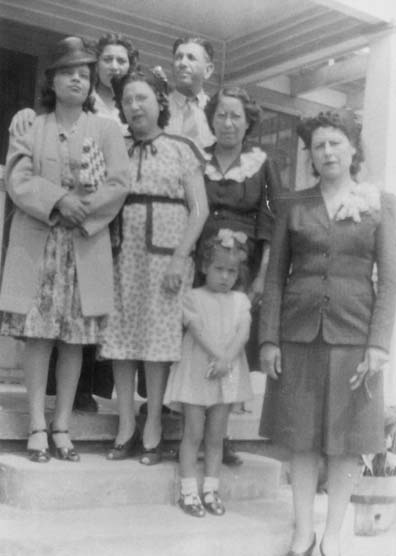 Robert recalled that as a youngster his mother Esther would make
tamales for Christmas and my grandfather's younger sister, Maris
Luisa (Tia Meme) would help Esther in the preparation.
Robert recalled that as a youngster his mother Esther would make
tamales for Christmas and my grandfather's younger sister, Maris
Luisa (Tia Meme) would help Esther in the preparation.My Tia Meme made the tamales at Esther's house in El Paso I have attached a picture of My Tia Meme taken in East LA in 1946 at the age of 53 she is front row second from the left, my mother on left, my grandmother third from left and my grandmother's young sister Tia Anita on her right, second row is my Tia Celia and my grandfather, little girl is my cousin, Irene. I hope you enjoy the pictures. I encourage you to start or continue searching for your family tree and contact SHHAR for networking support. If you have questions, please fell free to contact me at yoleno@sbcglobal.net, Yolanda Chavez Garza (Magdaleno) Carranza, Ronquillo,Solis, Estrada, Herrera |
||
|
|
|
| Historic Newspapers Collections | ||
| There are plenty of updates on the way:
Our historic newspapers collections will grow by over 1 billion
names, and we’ll add 20 million new images from all 50 states •
We’ll update our high school yearbooks collection to include over
200,000 new names and 20,000 images • Our Missouri vital records
collection dating back to 1805 will add over 13 million names and
2.5 million images • We’ll cover the south with Southern Claims
& Freed- men’s Bureau Records, over 300,000 names and images crucial to research on African American ancestors • And we’ll learn more about the pacific theatre of WWII with new editions of Stars and Stripes - over 5 million names and 80,000 images, complete with gripping stories from embedded reporters.
|
||
| U.S. Passport Applications, 1787-1925 | ||
| What’s the first thing many
immigrants did upon reaching The Land of Opportunity? Go back home.
For many, the pull to revisit family and reconnect with familiarity
was too great to ignore. Now you can trace ancestors through their
birthplace, residence and their intended destinations — many times
leading you back to their native town. Some records in this
collection also include pictures (over 300,000) and additional
information that may offer clues to other details in their lives.
Search
U.S. Passport Applications, 1787-1925
|
||
| Military Personnel Files Released by U.S. Government | ||
The U.S. National Personnel Records Center (NPRC) for the first time will open all of the individual Official Military Personnel Files (OMPF) of those who served and were discharged, retired or died while in the service prior to 1946. Collectively, these files comprise more than six million records. The contents of these files outline all elements of military service, including assignments, evaluations, awards and deck. |
||
| Lost Half Sisters Found | |
| Hi Mimi:
I hope you are doing well.
It is always a wonderful experience reading about our families,
thank you for your dedication and hard work.
I recently found lost half sisters through a posting I made at
www.geneology.com That part of my family was lost to me, no address,
no contact until posted an information wanted email on this website. |
|
| Linda Wilson's photo log of San Francisco's mission district | |
|
Linda, these are so much fun viewing, makes me very homesick.... they are lovely. also, mimi
lozano, 'somos primos', is great resource for sharing our historic work, so subscribe and keep on your
email list whenever you have more mission sharings. Linda Wilson wrote: Hi Folks, my
photo blog is at www.fotosatlindas.blogspot.com
|
|
| |
12/30/2009 04:49 PM
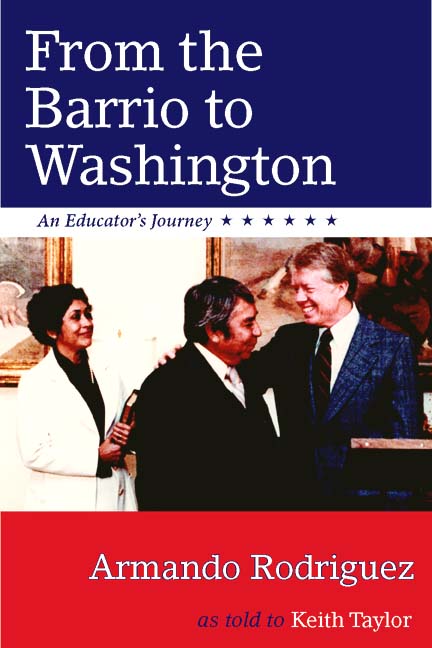
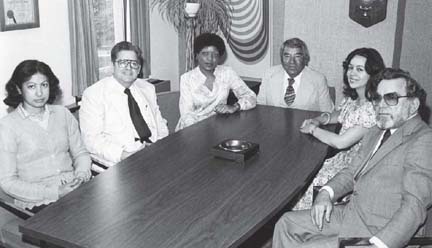
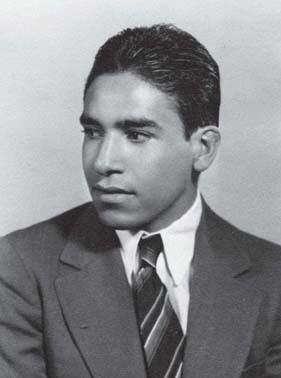 The story of Armando Rodriguez and how he
overcame obstacles are told in his biography From the Barrio to Washington: An
Educator’s Journey (Univ. of New Mexico Press, $24.95
cloth). When his family migrated to southern California in the 1920s,
Armando spoke no English. He was dark-skinned and nicknamed
"Shadow" by other kids. When Mando was just old
enough, he started school in a district that had few Spanish-speaking
teachers. Luckily, Armando’s parents emphasized the importance of
education and despite language barriers and his struggle to
acculturate Armando persisted.
The story of Armando Rodriguez and how he
overcame obstacles are told in his biography From the Barrio to Washington: An
Educator’s Journey (Univ. of New Mexico Press, $24.95
cloth). When his family migrated to southern California in the 1920s,
Armando spoke no English. He was dark-skinned and nicknamed
"Shadow" by other kids. When Mando was just old
enough, he started school in a district that had few Spanish-speaking
teachers. Luckily, Armando’s parents emphasized the importance of
education and despite language barriers and his struggle to
acculturate Armando persisted.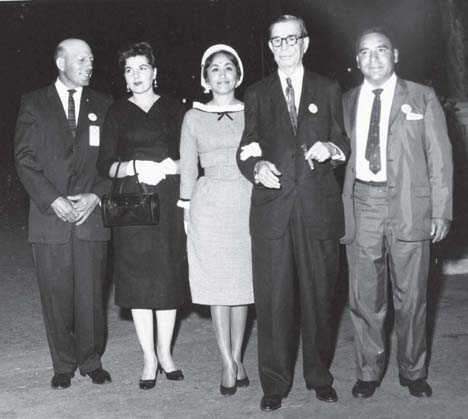
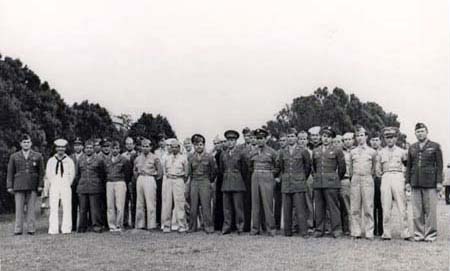
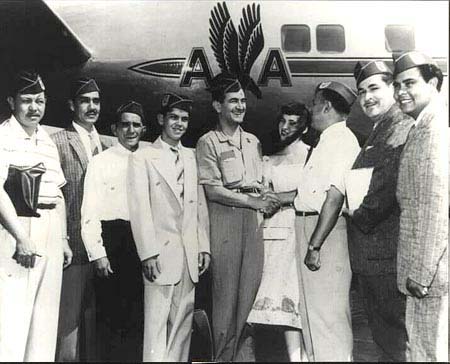 AGIF is a veteran’s family organization that
includes all family members, the veteran, women and youth. The dates of
the AGIF National Conferences coincide with National holidays to make it
easier for families to attend. So entire families attend and participate
since there is a role for everyone. Dr. Hector symbolized many things to
the members. To the youth, Papa was a father figure; to the women he was
a man who recognized their contributions by giving them an equal voice,
and to the veteran, a leader.
AGIF is a veteran’s family organization that
includes all family members, the veteran, women and youth. The dates of
the AGIF National Conferences coincide with National holidays to make it
easier for families to attend. So entire families attend and participate
since there is a role for everyone. Dr. Hector symbolized many things to
the members. To the youth, Papa was a father figure; to the women he was
a man who recognized their contributions by giving them an equal voice,
and to the veteran, a leader. 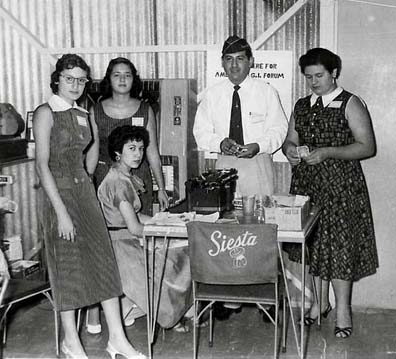
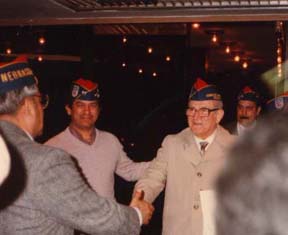 In 1980 when I was the state commander of
California, there was a member, John Estrada of the Newark chapter,
who came up with the idea of placing the name of Dr. Hector P. Garcia to
be awarded the Presidential Medal of Freedom. A resolution to that
effect was prepared by Leo Avila and John Estrada, which passed in the
California state conference. The resolution was then taken to the
national conference in Dallas, Texas where it also passed. Jose
Cano the commander at that time, with the help of Raul Yzaguirre, took
the resolution to the White House, did all the lobbying to get the medal
awarded to Dr. Garcia. I was happy to have been the National Commander
when Dr. Garcia received the Presidential Medal
In 1980 when I was the state commander of
California, there was a member, John Estrada of the Newark chapter,
who came up with the idea of placing the name of Dr. Hector P. Garcia to
be awarded the Presidential Medal of Freedom. A resolution to that
effect was prepared by Leo Avila and John Estrada, which passed in the
California state conference. The resolution was then taken to the
national conference in Dallas, Texas where it also passed. Jose
Cano the commander at that time, with the help of Raul Yzaguirre, took
the resolution to the White House, did all the lobbying to get the medal
awarded to Dr. Garcia. I was happy to have been the National Commander
when Dr. Garcia received the Presidential Medal 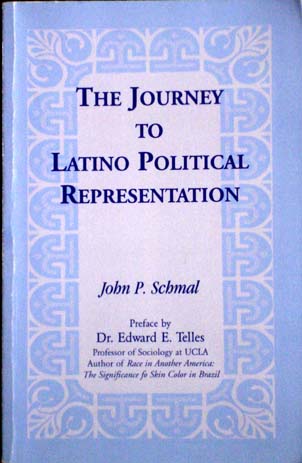 The Journey to Latino Political Representation is a detailed,
yet succinct, description of the struggle of Latino Americans to
express their political voice from 1822 to the present day. There
are essentially two parts to this story: the decline of Hispanic
representation in the nineteenth century and the revival of their
political voice in the second half of the twentieth century. To
explain this, the author discusses Latino population demographics,
anti-immigrant legislation and other political influences. In
addition, short biographies throughout the book help to familiarize
the reader with some of the politicians. The Journey is one of the
few works that describes the step-by-step struggle of one cultural
group to achieve political representation. In this respect, the book
fills a niche that has been neglected for decades. In the preface,
Dr. Edward E. Telles, the author of the award-winning, Race in
Another America: The Significance of Skin Color in Brazil, states
that this book is "an important educational service" that
"will be useful in classrooms throughout the United
States." He adds that, "no longer can educators in any
part of the United States deny or ignore the political importance of
Latinos to their students, as this book makes apparent." 2007,
5½x8½, paper, index, 228 pp.
The Journey to Latino Political Representation is a detailed,
yet succinct, description of the struggle of Latino Americans to
express their political voice from 1822 to the present day. There
are essentially two parts to this story: the decline of Hispanic
representation in the nineteenth century and the revival of their
political voice in the second half of the twentieth century. To
explain this, the author discusses Latino population demographics,
anti-immigrant legislation and other political influences. In
addition, short biographies throughout the book help to familiarize
the reader with some of the politicians. The Journey is one of the
few works that describes the step-by-step struggle of one cultural
group to achieve political representation. In this respect, the book
fills a niche that has been neglected for decades. In the preface,
Dr. Edward E. Telles, the author of the award-winning, Race in
Another America: The Significance of Skin Color in Brazil, states
that this book is "an important educational service" that
"will be useful in classrooms throughout the United
States." He adds that, "no longer can educators in any
part of the United States deny or ignore the political importance of
Latinos to their students, as this book makes apparent." 2007,
5½x8½, paper, index, 228 pp.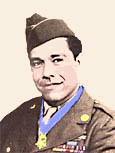
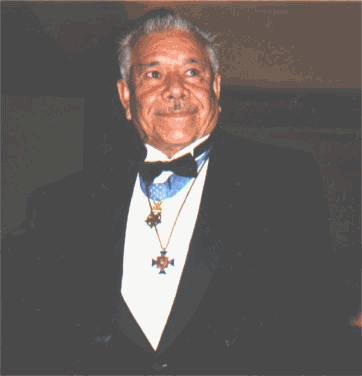
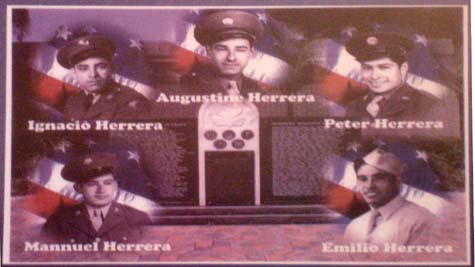
 A
Novel Inspired by a true experience of the Repatriation of a Mexican
American Family by the United States government Immigration Policies
during the Great Depression in 1932. The mother and children were all
United States citizens. The father was a Mexican national who had
worked in the United States for thirty-eight years. The family stayed
together and overcame many obstacles and ordeals caused by poverty and
Mexican government policies before they returned to their hometown of
Miami, Arizona, 1938.
A
Novel Inspired by a true experience of the Repatriation of a Mexican
American Family by the United States government Immigration Policies
during the Great Depression in 1932. The mother and children were all
United States citizens. The father was a Mexican national who had
worked in the United States for thirty-eight years. The family stayed
together and overcame many obstacles and ordeals caused by poverty and
Mexican government policies before they returned to their hometown of
Miami, Arizona, 1938.
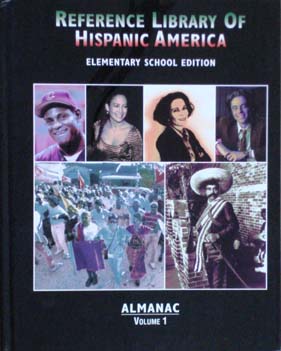 Source:
Reference Library of Hispanic America, Elementary School
Edition, edited by Sonia G. Benson, Micholas Kanellos, and Bryan
Ryan. The article above is the first part on the topic, Hispanic
American Theater, found in Volume 1, Almanac. The 4-Volume
series is published by African American Publications. African
American Publications has also produced series for Asian Americans,
Native Americans, Middle Eastern Americans, Americans of European
descent, and notable American men and women.
Source:
Reference Library of Hispanic America, Elementary School
Edition, edited by Sonia G. Benson, Micholas Kanellos, and Bryan
Ryan. The article above is the first part on the topic, Hispanic
American Theater, found in Volume 1, Almanac. The 4-Volume
series is published by African American Publications. African
American Publications has also produced series for Asian Americans,
Native Americans, Middle Eastern Americans, Americans of European
descent, and notable American men and women. 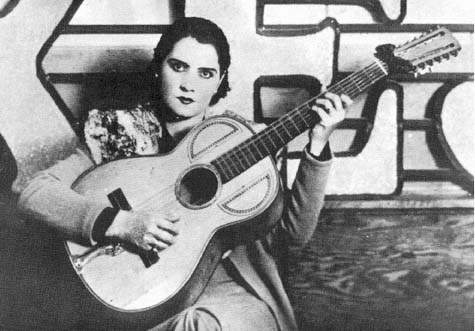
 Hollywood,CA. - In the
modern Hollywood the American artists continue to succeed
everyday, although it’s the Latin Flavor which is more present.
Recently the City of El Cajon, California, asked its
residents to choose the Artists that they wanted to see in their
annual “Mother Goose Parade” and the surprise was to see that
the majority of the Artists requested were Hispanic, which they
reined by representing the best of the world of entertainment in
the music and television.
Hollywood,CA. - In the
modern Hollywood the American artists continue to succeed
everyday, although it’s the Latin Flavor which is more present.
Recently the City of El Cajon, California, asked its
residents to choose the Artists that they wanted to see in their
annual “Mother Goose Parade” and the surprise was to see that
the majority of the Artists requested were Hispanic, which they
reined by representing the best of the world of entertainment in
the music and television.
 José-Luis
Orozco is an author and recording artist
whose work draws upon the rich heritage of the Spanish-speaking
world. Through his music José-Luis Orozco has sought to expose a
wider audience to Spanish language children's traditions and promote
Latin American culture. It is his desire to pass on this heritage to
the children of today so that they may take pleasure in passing it
on to the children of tomorrow.
José-Luis
Orozco is an author and recording artist
whose work draws upon the rich heritage of the Spanish-speaking
world. Through his music José-Luis Orozco has sought to expose a
wider audience to Spanish language children's traditions and promote
Latin American culture. It is his desire to pass on this heritage to
the children of today so that they may take pleasure in passing it
on to the children of tomorrow. 
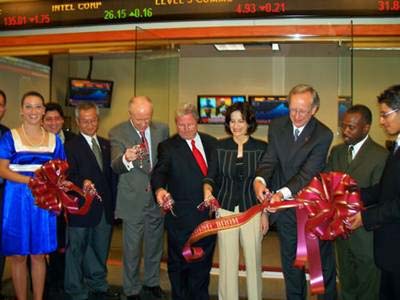
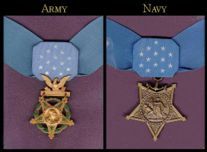
 Upon learning of their son's fate, Marie Teresa Rios Versace and
her husband, Colonel Versace, tried to find out what they could about
the circumstances. She went to Paris in the late 1960s, trying
unsuccessfully to see the North Vietnamese delegation as it arrived
for peace talks. Rios Versace expressed her frustration and anguish in
poems.
Upon learning of their son's fate, Marie Teresa Rios Versace and
her husband, Colonel Versace, tried to find out what they could about
the circumstances. She went to Paris in the late 1960s, trying
unsuccessfully to see the North Vietnamese delegation as it arrived
for peace talks. Rios Versace expressed her frustration and anguish in
poems.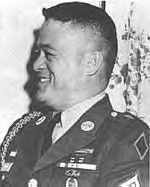
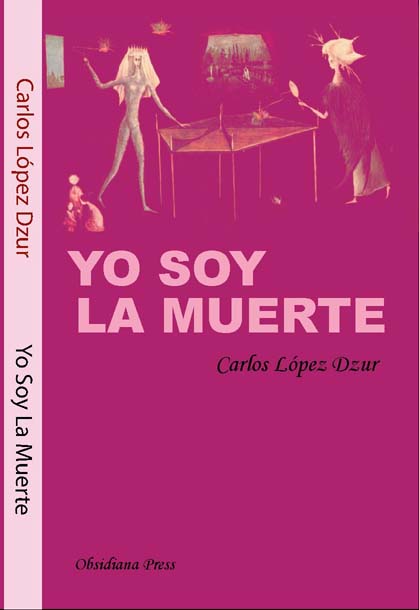
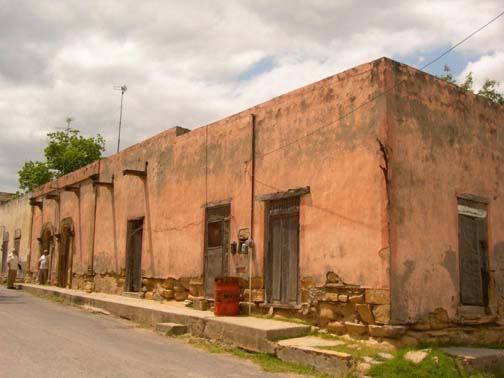

 The Mexican Revolution was a violent social movement, it began as a
response to the abuse of the nation; it exploded with the end of
liberties. The inequalities began to add up and at the opportune
moment it exploded with anger. So was born the Mexican Revolution, a
movement convened by an apostle, Don Franciso Madero. Quickly this
movement of social non-conformity spread throughout the nation, like
a catharsis of hate that had accumulated in the conscience of the
nation, it exploded through the same conscience that had been the
victim of the rule of absolute power.
The Mexican Revolution was a violent social movement, it began as a
response to the abuse of the nation; it exploded with the end of
liberties. The inequalities began to add up and at the opportune
moment it exploded with anger. So was born the Mexican Revolution, a
movement convened by an apostle, Don Franciso Madero. Quickly this
movement of social non-conformity spread throughout the nation, like
a catharsis of hate that had accumulated in the conscience of the
nation, it exploded through the same conscience that had been the
victim of the rule of absolute power.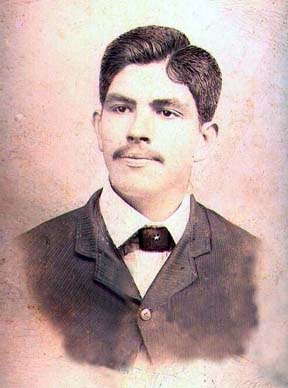 Col. Miguel Barrera Guerra was
originally of Mier, where he was born June 21, 1875; He was the
brother of the
Col. Miguel Barrera Guerra was
originally of Mier, where he was born June 21, 1875; He was the
brother of the 
 "When
I was about five years old my Tia Abuela Juanita Canales, who was
born in Mier, took me to the tomb of my great grandfather Enrique.
For decades I had the memory of the sword on the monument of his
grave. Abuelita Juanita almost raised me as I lived in her house,
and my mother worked. When I stood to speak at the Christmas party
and I saw all the faces of the elderly, I could not help but reflect
on all those wonderful Tias, Tios, Abuelos, and Abuelas that I knew
as a child from Mier. It was like giving back to them even though
they are all gone. Abuelita Juanita lived through the Mexican
revolution in Mier. As a child my grandmother told me all kinds of
true stories from the Revolution that she experienced.
"When
I was about five years old my Tia Abuela Juanita Canales, who was
born in Mier, took me to the tomb of my great grandfather Enrique.
For decades I had the memory of the sword on the monument of his
grave. Abuelita Juanita almost raised me as I lived in her house,
and my mother worked. When I stood to speak at the Christmas party
and I saw all the faces of the elderly, I could not help but reflect
on all those wonderful Tias, Tios, Abuelos, and Abuelas that I knew
as a child from Mier. It was like giving back to them even though
they are all gone. Abuelita Juanita lived through the Mexican
revolution in Mier. As a child my grandmother told me all kinds of
true stories from the Revolution that she experienced. 


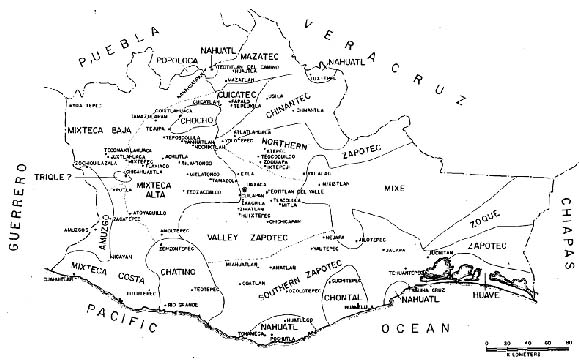
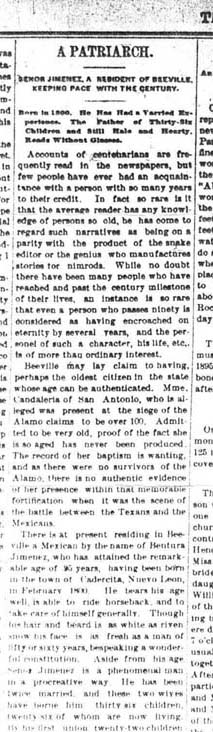
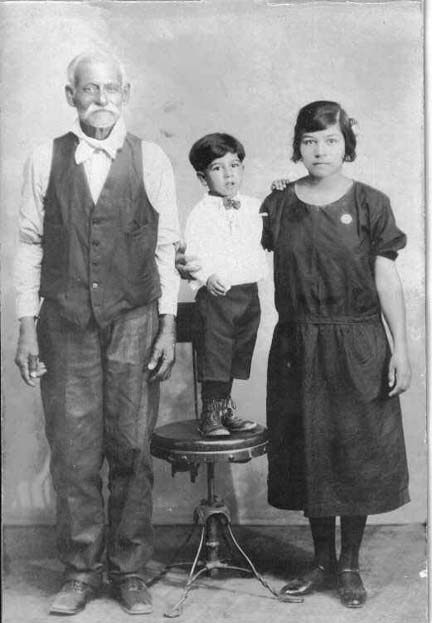 .
. MY
INTEREST IN the El Paso-Juárez Bath Riots didn't start with something I
read in any history book. Most historians have forgotten about this
obscure incident that took place on the border in 1917. I first heard of
the U.S. government's policy that provoked these riots while I was still
in high school. One evening, during a family dinner, my great-aunt Adela
Dorado shared her memories with us about her experiences as a young
woman during the Mexican Revolution. She recalled that American
authorities regularly forced her and all other working-class Mexicans to
take a bath and be sprayed with pesticides at the Santa Fe Bridge
whenever they needed to cross into the United States. My great-aunt, who
worked as a maid in El Paso during the revolution, told us she felt
humiliated for being treated as a "dirty Mexican." She related
how on one occasion the U.S. customs officials put her clothes and shoes
through a large secadora (dryer) and her shoes melted.
MY
INTEREST IN the El Paso-Juárez Bath Riots didn't start with something I
read in any history book. Most historians have forgotten about this
obscure incident that took place on the border in 1917. I first heard of
the U.S. government's policy that provoked these riots while I was still
in high school. One evening, during a family dinner, my great-aunt Adela
Dorado shared her memories with us about her experiences as a young
woman during the Mexican Revolution. She recalled that American
authorities regularly forced her and all other working-class Mexicans to
take a bath and be sprayed with pesticides at the Santa Fe Bridge
whenever they needed to cross into the United States. My great-aunt, who
worked as a maid in El Paso during the revolution, told us she felt
humiliated for being treated as a "dirty Mexican." She related
how on one occasion the U.S. customs officials put her clothes and shoes
through a large secadora (dryer) and her shoes melted. Mexican
contract workers undergo medical inspection before being sprayed
with pesticides, ca. 1942. The disinfections along the U.S.-Mexico
border continued until the late 1950s.
Mexican
contract workers undergo medical inspection before being sprayed
with pesticides, ca. 1942. The disinfections along the U.S.-Mexico
border continued until the late 1950s. 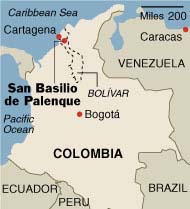 Palenquero
is thought to be the only Spanish-based Creole language in Latin
America. But its grammar is so different that Spanish speakers can
understand almost nothing of it. Its closest relative may be
Papiamento, spoken on the Caribbean islands of Aruba, Bonaire and
Curaçao, which draws largely from Portuguese, Spanish and Dutch,
linguists say. It is spoken only in this village and a handful of
neighborhoods in cities where workers have migrated.
Palenquero
is thought to be the only Spanish-based Creole language in Latin
America. But its grammar is so different that Spanish speakers can
understand almost nothing of it. Its closest relative may be
Papiamento, spoken on the Caribbean islands of Aruba, Bonaire and
Curaçao, which draws largely from Portuguese, Spanish and Dutch,
linguists say. It is spoken only in this village and a handful of
neighborhoods in cities where workers have migrated.