|
LANGUAGE OPPRESSION AND RESISTANCE:
THE CASE OF MIDDLE CLASS LATINOS IN THE UNITED
STATES
Articulo by Jose A. Cobas
ABSTRACT
The growth of the U.S. Latino population is a source of concern for
many white Americans, who assert this means the death of the U.S. way
of life and the English language. This racialized rhetoric masks an
attempt to maintain the preeminence of the language of the dominant
group over latinos and thus helps whites to sustain their
political-economic domination. Using interviews with 72 middle-class
latinos in seven U.S. states, we document five strategies employed by
the whites in everyday interaction to discourage latinos’ heritage
language use and resistance to such discrimination. Finally, we
discuss ideological elements in U.S. culture that hide the racism in
these language struggles.
LANGUAGE OPPRESSION AND RESISTANCE: U.S. LATINOS
U.S. Latinos have increased steadily and now constitute 13.7
percent of the population (U.S. Bureau of the Census 2004). This
steady growth, ‘the browning of America,’ is viewed with alarm by
many whites, who often view such immigrants as a threat to ‘American
values’ and the U.S. ‘core culture’ (Cornelius 2002).
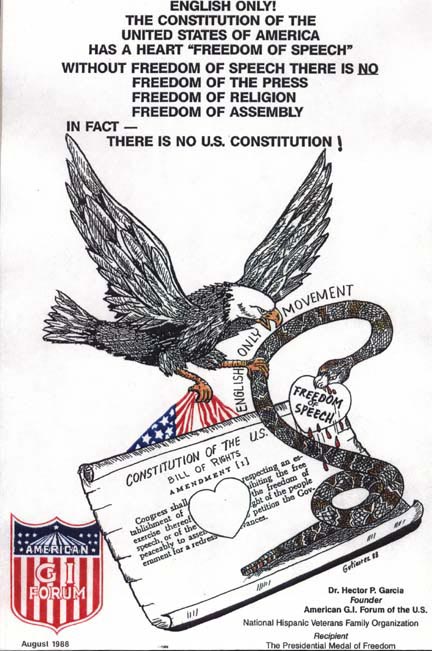
Language lies within that core, and the dramatic growth of U.S.
Latinos is viewed by many whites as a threat to the survivability of
English, often termed by them ‘the official language of the country.’
As recently as 1987, most people in one national poll thought that the
U.S. Constitution already had made English the official language
(Crawford 1992) and thus they saw no real threat. This benign
perception has changed. For example, the influential Harvard professor
Samuel Huntington (2004), who has served as advisor to government
officials, has articulated strong anti-latino sentiments in his
stereotyped assessment of U.S. immigration. Like many prominent white
officials and executives (Feagin and O' Brien, 2003), Huntington
worries greatly that the United States will become aggressively
bilingual, with English-speaking and Spanish-speaking sectors
incapable of comprehending each other’s languages and values.
OUR CONCEPTUAL APPROACH
When the first English settlers arrived in North America, they saw
themselves as bringing ‘civilization’ to the colonies. ‘Civilization’
meant English language and culture. American Indians, viewed as ‘savages,’
constituted the serious barrier to their plans (Fischer 1989). German
immigrants represented another obstacle; Benjamin Franklin established
a school in Pennsylvania to educate them. Franklin feared these
immigrants could ‘Germanize us instead of us Anglifying them’
(Conklin and Lourie 1983, p. 69).
By the mid-nineteenth century the civilized-savage polarity was
replaced by a racist Weltanschauung which played up achievements of
the ‘Anglo-Saxon race’ against the shortcomings of inferior ‘others.’
A common element in both the English-other and the white-other
conceptions was that the dominant group viewed the language of the ‘others’
with suspicion and often sought to eliminate it. In the aftermath of
the 1848 Mexican-American War, the eradication of the Spanish language
became an important U.S. goal. This objective was pursued in the
schools of the Southwest (Gonzalez 1990).
Efforts to squelch the Spanish and other languages persist today.
Since 1986 two dozen U.S. states have enacted similar provisions (Navarrette
2005). Many contemporary Spanish speakers feel in their daily lives
the pressure to give up their mother tongue in favor of English
(Montoya 1998). One might argue that whites’ attempts to limit
latinos from using Spanish do not involve negative racial attitudes.
Yet, this is a difficult position to sustain in light of many negative
stereotypes about Latinos’ language and accents. In whites’
stereotypical accounts, the latino speech is said to reveal low
intelligence and untrustworthiness ( Urciuoli 1999; Santa Ana 2002).
Interference with latino speech occurs regularly, and the interlocutor
is often well educated. Such acts seem to derive from strong emotions
in a country which Silverstein (1996, p. 284) characterizes as having
a ‘culture of monoglot standardization.’
Pierre Bourdieu (1991) identified as socially significant a group’s
linguistic capital (e.g., a prestigious language dialect). The
linguistic capital of Parisian French is higher than that of French in
the countryside. According to Bourdieu (1979, p. 652 ), when
individuals are in the linguistic market, the price of their speech
depends on the status of the speaker. The outcome of linguistic
exchange is contingent on the speaker’s choice of language, such as
in situations of bilingualism, when one of the languages has a lower
status. A group can strive for advantage in the linguistic market in
order to bring about political and material gains. One way to achieve
this end is by promoting the language it commands. Yet, the efforts of
a group to achieve linguistic dominance is often met with resistance (Bourdieu,
1991, pp. 95-6). Although some classes, as the members of the
bourgeoisie in post-Revolution France, operate from an advantageous
position, the linguistic ascendancy of a class is the result of a
struggle in the language market that is seldom permanently resolved.
Achievement of language dominance does not necessarily mean that other
languages disappear. Nonetheless, the dominant language becomes ‘the
norm against which the (linguistic) prices of the other modes of
expression… are defined’ (Bourdieu 1977, p. 652). Drawing in part
on these ideas, we view white efforts to delimit or suppress Spanish
as a thrust to protect or enhance the reach and power of English
speakers vis-à-vis Spanish speakers.
The mechanisms used by U.S. economic and political elites to
establish English ascendancy over Spanish vary, as we will
demonstrate. Language subordination of latinos in the United States
includes the idea that English is superior to Spanish (Santa Ana
2002). A second method is the denigration of Spanish-accented English.
Other foreign accents are not judged in the same harsh terms (Lippi-Green
1997, pp. 238-39): ‘It is crucial to remember that not all foreign
accents, but only accent linked to skin that isn’t white, or which
signals a third-world homeland, that evokes… negative reactions.
There are no documented cases of native speakers of Swedish or Dutch
or Gaelic being turned away from jobs because of communicative
difficulties, although these adult speakers face the same challenge as
native speakers of Spanish.’
Another form of language denigration is ignoring speakers of
Spanish even when they have a command of English. They are ignored by
some whites as groups of people not worth listening to, as if their
knowledge of their mother tongue renders their message meaningless and
undeserving of attention (Lippi-Green 1997, p. 201). The process of
linguistic denigration of non-whites also includes another component:
the expression of skepticism or surprise when people of color evidence
command of standard English. It is as if non-whites’ linguistic
abilities were so contaminated that when they show their abilities in
writing or speaking unaccented English some whites are unprepared to
believe what they see (Essed 1991, p. 202).
Oppressed groups typically defend to the best of their ability
against efforts to denigrate their languages or erect barriers against
their use. Some examples are the Basque, Catalan, Occitan, and Bosnian
peoples (Shafir 1995; Siguan 2002; Wood 2005). Cultural groups
struggle to keep their language because it is fundamental to social
life and expresses the understandings of its associated culture in
overt and subtle ways (Fishman 1989, p. 470). Many latinos prefer to
use Spanish because it affords them a richer form of communication.
Other U.S. racial groups struggle to protect their languages (cf.
Horton 1995, p. 211).
Although latinos are disadvantaged in the language market, because
of the power of whites, they often resist attempts to squelch their
language. When told to stop speaking Spanish on the grounds that
Spanish is out of place, latinos often respond by asserting the
legitimacy of their mother tongue. At a deeper level, this may be seen
as a disagreement in which the white side is trying to disparage
latinos’ language and latinos’ efforts to counter that image. In
other instances, the latino individual persists against prohibitions
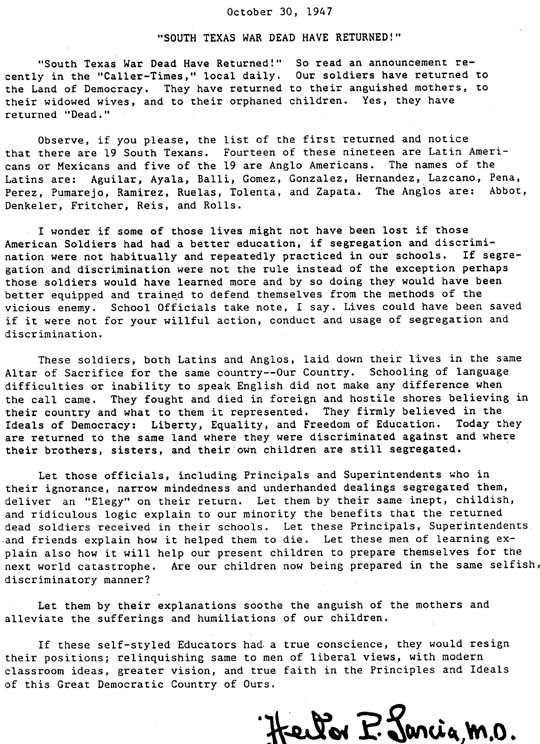
that he or she speak Spanish through different means. In a celebrated
U.S. court case, Héctor García was employed as a salesperson by
Gloor Lumber and Supply, Inc., of Amarillo, Texas. Gloor Lumber
allowed its employees to communicate in Spanish on the job only if
there were Spanish-speaking customers. García broke company policy by
speaking Spanish with latino coworkers. He was fired, sued and lost
(Gonzalez 2000). García insisted on his right to speak
Spanish.
In this article, we demonstrate a number of different techniques
that are perceived by our subjects as attempts by whites to undermine
the status of Spanish and Spanish speakers and discourage the language’s
everyday use. We also examine forms of latino resistance to this
linguistic restriction and oppression.
OUR DATA
In this exploratory analysis of linguistic
barriers and resistance, we employ new data from 72 in-depth
interviews of mostly middle-class latinos carried out in 2003-2005 in
numerous states with substantial latino populations.
For this pioneering research (the first of its kind, so far as we
can tell), we intentionally chose middle-class respondents for two
reasons. First, they are the ones most likely to have substantial
contacts with white Americans in their daily rounds, and are thus more
likely to encounter racial barriers from whites and to feel the
greatest pressures to give up language and cultural heritage.
Secondly, they are the ones who are considered, especially by the
white-controlled mass media and by middle-class white Americans
generally, to be the most successful members of their group – and
thus to face little discrimination in what is presented as a nonracist
United States. Thus, since social scientist Nathan Glazer’s 1975
book, Affirmative Discrimination, was published, a great many U.S.
scholars have argued that there is little or no racial discrimination
left in U.S. society and that, in particular, middle-class people of
color face no significant racial or ethnic barriers. The first
extensive qualitative fieldwork on the life experiences of
contemporary African Americans--conducted in the late 1980s and early
1990s--took this approach, and in this research project we have
followed much of the rationale and research guidelines for that
prize-winning research (Essed 1991; Feagin and Sikes 1994; Feagin,
Vera, and Imani 1996).
In this innovative research we intentionally focus on those latinos
generally considered middle class and economically successful, such as
teachers, small business owners, office workers, and mid-level
government administrators. More than 90 percent of the respondents
have at least some college work, and 58 percent have completed at
least a college degree. A small minority hold clerical or manual jobs.
Using the qualitative methods of researchers studying everyday racial
experiences (Essed 1991; Feagin and Sikes 1994), we used a carefully
crafted snowball sampling design and used more than two dozen
different starting points in seven states to insure diversity in the
sample. Initial respondents were referred by colleagues across the
country. As we proceeded, participants suggested others for
interviews. Few respondents are part of the same networks as others in
the sample.
The respondents are mainly from the key latino states of Arizona,
California, Florida, Illinois, New Jersey, New York and Texas. Sixty
percent of our respondents are Mexican-American; 18 percent are
Cuban-American; 13 percent are Puerto Rican; and the remaining 9
percent are other from Latin American countries. This distribution is
roughly similar to that of the U.S. latino population. Sixty-four
percent of the respondents are women, and 36 percent are men.
LANGUAGE CONTROL stratagemS AND RESISTANCE RESPONSES
We examine relationships between whites, the most powerful U.S.
racial group, and latinos, a group that whites usually define racially
as "not white" (Feagin and Dirks 2006). One reason for this
focus is their central importance for the position of latinos in U.S.
society. Another is that there are very few accounts in our latino
interviews of other Americans of color attempting to discriminate
latino respondents on language grounds. One reason for this, we
venture, is that non-latino people of color are usually not in
position to complain loudly about Spanish language even if they wished
to, because they do have significant power in U.S. institutions.
As we observe below, even those whites not in the middle class, as
much recent research has demonstrated (see Feagin and Sikes 1994),
feel great power as whites to assert the privileges of whiteness
versus people of color. As we will observe constantly in our accounts,
Anglo whites in the upper middle, middle, and working classes feel
powerful over middle-class latinos. In most accounts, the whites
discriminators are of equal or higher socioeconomic status than those
latinos targeted for discrimination.
The common goal in the language control methods of whites is to
disparage the language of latinos. The methods follow a variety of
strategies. Some are aimed at latinos’ use of English: asking
participants to stop speaking Spanish, because ‘English’ is the
language of the land or because the white interlocutors want to know
‘what’s going on,’ and ignoring latinos who speak Spanish. Other
forms of control are deriding latinos’ accents, raising questions
about their proficiency in English when Latinos demonstrate skill.
Whites define latino speech as tainted in two senses. First, when
latinos speak Spanish they are using a language that ‘does not
belong’ in the United States and may be saying things behind whites’
backs. Second, when they speak English, their accent is inferior and
does not belong. Whites see themselves as the authorities to
adjudicate language use. Attempts to control latinos’ language or
disparage it often provoke responses from the latinos involved in the
interaction or witnessing it. The discussion that follows is organized
around the different types of language control and denigration
stratagems.
Silencing Spanish Speakers
One language control strategy is ‘silencing.’ It is the
stratagem most frequently mentioned by the respondents. Silencing is
straightforward: It consists of a command from members of the white
group to latinos to stop speaking Spanish. It carries the supposition
that whites can interfere in Spanish conversations of latinos to stop
them from speaking Spanish. The command is usually based on the
explicit or implied assumption by the interlocutor that, ‘We only
speak English in America.’
A Cuban-American attorney remembers this story from her childhood a
few decades back. It shows a classic case of silencing:
We were in (a supermarket)…. It was during the Mariel
Boatlift situation … there was a whole bunch of negative
media out towards Cubans ‘cause … many of the people that
were coming over were ex-cons or what-not… And so my mother
was speaking to us in Spanish … and this (white) woman
passed by my mother and said… ‘Speak English, you stupid
Cuban!’ .… And then my mother turned around, and
purposefully, in broken English, because she speaks pretty
good English… said, ‘I beg your pardon?’… (The woman)
repeated the statement.
The Cuban interlocutor’s response is quite assertive:
And my mother… asked her if she was a native American
Indian. And when the lady responded ‘No… I’m Polish,’
… my mother responded … ‘Well, you’re a stupid
refugee just like me.…’ And, the lady, I don’t know what
she said, but my mother said, ‘Do you know why I’m here,
in this country?... I’m here (which was not true) because I
just came in the …( Mariel Boatlift) and the reason…was
because I killed two in Cuba, (and) one more here will make no
difference.’ …And so then (the woman) thought my mom was
being serious and left there really quickly.
When she asks the white interlocutor, who is likely a middle class
shopper, about her Indian ancestry, the respondent reposts by saying
in essence that she and her language are as American as the white
Polish woman’s.
In the next account, the attempt at silencing is indirect. A white
Anglo post office employee, who is likely working class or lower
middle class, complains to the postmaster, a latino, that two fellow
workers are speaking Spanish on the job, and asks the boss to make
them stop. The postmaster refuses to comply:
I had that situation when I was working for the post
office. I had two Chicanos that were talking in Spanish. There
was an Anglo carrier right in the middle and she approached me
and told me that I should keep them from speaking Spanish. I
said, ‘You know both of them are Vietnam veterans and I
think that they fought for the right to talk any language they
want to.’
The postmaster’s response attributes legitimacy to the latino’s
speaking any language they choose because they are veterans who fought
in Vietnam and are Americans entitled to any language they please.
A latino respondent in a southwestern city was trying to help a
Mexican immigrant at a convenience store. Their conversation was in
Spanish. As they talked, a white interlocutor interrupted and voiced
his displeasure at their use of Spanish, first by the indirect means
of complaining about the supposed loudness and then more directly by
suggesting the immigrant should leave the country.
(This) farm worker…. is Mexican. I was speaking to him
(in Spanish)…. and this (white) individual asked us if I had
to speak so loud. ‘Can you guys lower your voice?’...
[Were you guys talking out in the street?] ‘No, there is a
Circle K right by (work). We were standing right by (the
counter)’.... [Did you respond to this man?] ‘I very
politely explained to him and he was shocked (at the quality
of my English) when I looked at him and I said, pardon me sir,
I am speaking to him in Spanish … because he doesn’t speak
English.’ His response then was, ‘maybe he should move out’.
I said to him … ‘if he moves out, then why don’t you go
pick the stuff out in the field?’ [What did he say to that?]
‘He just turned around and walked away.’
The response from someone who may have been a fellow shopper says,
in essence, that the Mexican immigrant is performing a useful function
in the United States, doing necessary work that the white interlocutor
and many other whites apparently are not willing to do. At the very
least, the respondent appears to say, he has a right to communicate in
his mother tongue.
In the next episode, a successful executive related an incident
that happened when he was on vacation with his family and visiting a
famous amusement park. He and his wife came to the United States at an
early age, and they have an advanced English proficiency. Yet they
decided to often speak to their children in Spanish while they were
young, so that they would learn the Spanish language. He provided this
account:
‘I had a really bad experience at Disneyworld… My son
at the time was … three .… He jumped the line and went
straight to where there was Pluto or Mickey Mouse or something
and I said, (Son’s name), come back,’ in Spanish and …
ran after him. And I heard behind me somebody say, ‘It would
be a ------- spic that would cut the line.’ Now my wife saw
who said it, and I said, ‘Who said that?’ in English and
nobody said a word. And I said (to my wife), ‘Point him out,
I want to know who said that,’ and she refused. I was like,
‘Who was the ------------ who said that?’ I said, ‘Be
brave enough to say it to my face because I’m going to kill
you.’ You can see me, I’m 6’3’, 275 (pounds). Nobody
volunteered’.…[So nobody stepped up?] ‘No, no and there
was a bunch of guys there, and I would have thrown down two or
three of them; I wouldn’t have had a problem.’
The executive’s response was clear, to the point, and came from
the heart: his child was insulted by (probably middle class) white
visitors to this expensive theme park. He was deeply offended for his
family. Clearly his strong reaction could have led to further serious
consequences, yet he was willing to take this risk by responding
aggressively to the ultimate racist slur for latinos.
In these accounts, whites who are attacking or discriminating vary
in social status. Sometimes, they are of higher socioeconomic status
than our respondents, and at other times they are of equal or lower
status. Yet, all whites seem to feel the power to hurl racist
commentaries at latinos who are attempting to live out normal lives.
Practices silencing Spanish speakers reveal the asymmetric statuses
of the English and Spanish languages. It would be inconceivable for a
latino to ask a white Anglo to stop speaking English in any Latino
neighborhood. Such reciprocity in action would suggest a language
equality that does not exist, and latinos are well aware of this
societal situation. We asked a South American respondent the following
question, ‘Sometimes … I ask people I interview... have you ever
seen a Mexican at a grocery store turn to [white person] and say, ‘Please
do not speak English? Have you seen this happen?’ She laughed, ‘No,
no!’
Despite attempts at the imposition of barriers, Spanish speaking
respondents frequently answer back, softly or aggressively, thereby
insisting on their right to use their native language.
Voicing Suspicion: Fears of Spanish-Speaking Americans
In the everyday worlds of latinos, whites' language-suspicion
actions differ from language silencing acts in that the latter emanate
from a conviction that English is the only acceptable language in the
United States. Language-suspicion actions generally involve less
confrontation.
Whereas silencing actions derive from a strongly-held notion about
what should be the dominant language, suspicion actions likely reveal
a notion that Spanish speakers need to be watched, that they are
perfidious or sneaky (Urciuoli 1996). Silencing draws from a type of
an ethnocentric discourse, one that goes back to 18th
century Anglo-American fears of German immigrants and their language (Feagin
1997, p. 18). The suspicion response is rooted in anti-latino
stereotypes. There is a common substratum of racialized thinking: When
latinos speak Spanish, they are not playing by the ‘right’ rules
as envisioned and asserted by whites. White interlocutors assume a
right to interfere in a Spanish language interaction to put an end to
it or at least alter it.
A major difference between silencing and voicing suspicion is that
some of the white interlocutors who object to Spanish on the grounds
that they are excluded express, at least on the surface, a desire to
be included in the interaction. This inclusion is, however, one that
is seen and defined in white terms, for the conversation must be in
the white person’s language.
Another respondent provided an example of suspiciousness on the
part of a more senior white manager who did not want her workers
speaking Spanish:
‘Most of the coworkers and the supervisors or managers
are bilingual… but… my manager was only unilingual.… She
does not understand … that we were not talking about her…We
were talking about our business… and personal stuff, but she
doesn’t have to know what we were talking because we don’t
need for her to give us her … point of view. If we need for
her to talk we are going to ask her in English, not in Spanish….
(She said) ‘I don’t want you speaking Spanish’ and I
told her ‘I do not agree with you because this is not right’.
[And what did she say?] She said ‘Well, it’s not right; it
doesn’t matter’. And I said, ‘Yes, it does matter and
you’re not going to stop me from speaking my first language.’
The interviewee’s response is an unequivocal statement about her
right to speak her first language. It resonates with the theme so
frequently seen in the ripostes given by other respondents: ‘I’m
entitled to speak my language.’
A male respondent reported on a situation where he was speaking in
Spanish with another latino in a bank, when a white stranger broke
into their private conversation:
‘On one occasion we were at a Bank of … branch… We
were talking (in Spanish) and all of a sudden this (white)
lady comes and asks us (in English) what we were talking
about. [What did you reply?] We told her we were talking about
our business.
Although we do not know what the white woman in this affluent
setting had in mind when she interfered in the conversation, her
action suggests the recurring concern of many whites that those not
speaking in English may be plotting something contrary to white
interests. There is no doubt that she took it for granted that she was
entitled to interrupt. The latino’s response is matter-of-fact and
seems to convey the notion that in his mind what he and his friend
were doing was legitimate.
Another respondent reported that she was hired to work at a store
in a U.S. town near the Mexican border so that she could help the
numerous Spanish-speaking customers who crossed from Mexico to go to
the store. Yet she faced a significant problem when she tried to do
her job: she could not speak to customers in Spanish if white
customers were present. It seems that the store owners were less
concerned with causing difficulties for their Mexican customers than
with offending the white ones:
In a store where I worked… I (saw a) lot of
discrimination (against) the people that were coming from
across the line (frontier) to shop here… If I (spoke)
English (to them) they’d feel discriminated because they
couldn’t understand me. Or if I spoke Spanish and there was
an English patron shopping they’d feel that I was speaking
against them or saying something that I should not be saying
and I should be speaking (English) … How could I do this
when I had English speaking people and Spanish speaking people
but the one I was directly addressing was Spanish speaking and
a non-English speaking person? Yet I was felt made to feel
that I should be speaking English because I was in America.
Even though she was upset at the unreasonable situation in which
she was placed, there was little the respondent could do short of
quitting her job.
Another respondent, a female manager in a public agency, was also
asked if ‘Anglo whites ever object to your speaking Spanish at work?’
She replied:
Yes. They are like, could you please speak English because
we don’t understand what you are saying.… Even the
supervisor tells us sometimes that we should talk in English
because there are some people that don’t know Spanish. But
you know what, I feel better speaking Spanish … because that’s
my primary language. There is a lady that actually, that’s
always complaining…. There are times that … she just feels
like left out of the conversation. She’s like, I want to
know what’s going on, but there are times that she’s kind
of rude, so. [How do you usually respond to her?] I’m like,
well, you need to learn Spanish.
The middle class respondent asserted the legitimacy of her Spanish
use in a different form by suggesting that those fellow workers,
middle class whites here, who wanted to partake in her
Spanish-language conversations learn Spanish. Such a request may seem
ludicrous only if one believes that English is the only language worth
speaking in the United States. Even when languages have is granted
official status, individuals are not forbidden to use other tongues in
settings like work.
Suspicion of latinos speaking Spanish constitutes another instance
of attempts on the part of whites to regulate latinos’ speech. In
this instance, the reason given is that whites feel that Latinos are
talking about them. The justification for white attempts reveals a
view of Spanish speakers as sneaky and untrustworthy and the view that
whites should be included in interactions with Latinos on the white’s
terms. Despite whites’ objections, the typical Latino responds by
asserting his/her right to use their mother tongue.
Doubting English Proficiency of Latinos
Since anti-latino rhetoric places such a heavy emphasis on Latinos’
abandoning their heritage language, one would expect that when Latinos
venture into the world of English they would receive encouragement
from whites. This is often not the case. There is white obstinacy
here: latinos speak Spanish, an inferior language, and thus they are
apparently presumed to be tainted by their heritage language when they
speak or write English, even when there is evidence to the contrary.
In some cases, their English is assumed to be ‘too perfect’
(compare Essed 1991, p. 202).
One example comes from the college experience of a chicana
professional. She was born in a mining town in the Southwest, and her
English did not have the accent many whites consider undesirable. She
reported on an instructor who questioned her integrity:
(A professor) in college refused to believe that I had
written an essay… because she assumed that Mexicans don’t
write very well and so therefore I couldn’t have written
this paper. [Did she tell you that?] Yes she did.… And so
she asked that I write it over again…[So what did you do?] I
rewrote the assignment and she still didn’t believe that it
was my own .… She still refused to believe that it was my
handwriting or my writing because she still felt that Mexicans
could not express themselves well in English . . .
[Did she use those words?] Yes she did.
This woman explained that she came from a mining town where labor
unions had helped Mexicans gain access to schools, so she had good
English skills. The well-educated white instructor felt substantial
power to impose her views: Mexicans cannot express themselves well in
English. We see here an active countering response. The respondent
stood up to the instructor but was unable to change her mind. Here
again, we observe whites of higher social status or in more powerful
positions discriminating against our latino respondents.
Another latina had a different experience. Asked whether whites
have ever acted rudely after they heard her Spanish accent, she
answered in the negative and discussed ‘left-handed compliments’
she receives:
No. In fact people go out of their way to tell me that I
don’t have an accent. [Is that a compliment?]. I think so….[Tell
me in more detail].Well you know, they begin to ask me, well
where are you from? Am I from Arizona? No I am not from
Arizona…. I’m from Texas. And then their comment is that
you don’t have an accent. And I’m like what kind of accent
are you talking about? I don’t have a Texas accent, the
twang. And then I’ll say, no and I don’t have a Spanish
accent. I speak both languages. And they are like, well wow,
you don’t have an accent. Never fails….
White interlocutors in her immediate environment express surprise
at her apparently unaccented English. The astonishment expressed by
whites is reflective of stereotypes concerning some latinos’ English
proficiency. In such settings, whites assume they have the
right to determine which accented dialect of English is prized.
English has many dialects, all with distinctive accents, yet most U.S.
whites (unlike many European whites) are monolingual and do not view
their own prized versions of English as accented.
In the next excerpt, a woman from Latin America relates her
experiences with a paper she wrote. She had problems with contractions
in English and had her paper checked by a campus facility that helped
students. The center’s staff found no mistakes. Nonetheless, the
latina’s highly educated white male instructor did not approve of
how she used contractions, and even though he did not take off points
from her grade, he made some comments to the class about foreign
students:
I wrote a paper and I used some contractions and most of
the time I have some problems with contractions…. I took my
paper to the English writing center and nobody corrected
anything. And so when I got my paper back (from the [white]
instructor) and all the contractions were corrected and so I
didn’t say anything, but I took the paper back (to the
writing center) and they explained to me that there was not
any specific reason to have changed them… [Did you get a bad
grade on the paper?] No, but the teacher made a comment in
class about foreign students and that we were in graduate
school and we should write free of mistakes…. I said to
myself that if I had been an American student using these
words he would not have changed it…. It was because there
was nothing else to correct on the paper. [He just was looking
for something to correct, that’s what you are saying?] Yes.
This respondent did not confront her middle-class instructor
directly, but in going back to the writing center, she refused to
accept the definition of her abilities that he attempted to impose on
her and expressed her anger at the language-linked discrimination (on
a similar problem for African Americans, see Essed 1991, p. 232).
Intended or not, whites’ skepticism toward latinos’
demonstrated proficiency in English is part of the denigration of
latinos. Although it is not a direct attack on Spanish, it reflects
notions of language deficiency among the mass of latinos--based,
ironically, on the deviation of latino interlocutors from
stereotypical expectations.
Denigrating the Accent
Another method of undervaluing latinos’ English proficiency is by
mocking those who have an accent whites consider undesirable. When
they speak English, latinos frequently experience a close monitoring
by whites, and if some sign of a certain accent is detected, they risk
ridicule. In business or government settings white customers sometimes
even refuse to deal with latino personnel because their accent is
¨not American.’ Indeed, some latinos feel so self-conscious that
speaking English becomes difficult (Hill 1999).
Consider this account from a highly educated latino who went to a
computer store. In response to our question, ‘has a white Anglo . .
. acted abruptly after he heard your accent?’ he replied:
Oh, that has happened several times. I have had owners of
a store imitate my accent. [To your face?] In my face, yeah. I
went to buy a printer… I said, I’m here to buy a printer
and the owner imitated my accent, back…. [Did you buy the
printer?] No, I did not. … I felt that I was growing red in
the face… And I said, ‘You know what, just forget it I’ll
buy it somewhere else,’ and I turned around and left.
Something as simple as buying a printer turned into a humiliating,
in this case from upper middle-class whites. Having the experience of
someone powerful imitating his accent was not an isolated instance.
Indeed, we see in several respondents' quotes this cumulative reality
of discrimination; many forms of discrimination take place on a
recurring basis in the lives of latinos. In refusing to purchase, the
respondent resisted the discrimination and registered displeasure.
Another middle-class Latino who works at the customer service
department of a retail store gave this example:
There was one time that I answered (the telephone) at my
work currently, I had this lady, … and she goes, ‘I don’t
want to talk to you, you have an accent!’ I was like, ‘you
don’t want to talk to me?’ she goes, ‘Yeah, I want to
talk to an American.’ I was like ‘ok. We’ll I’m sorry
you’re gonna have to redial to speak to someone that you
want.’ She goes, ‘well go ahead and transfer me over.’ I
was like, ‘I’m sorry, I’m not going to be able to
transfer you over. I have to take the call. I’m here to help
you if you need anything.’ She goes, ‘well I don’t
understand you. And I just kept going, well I there’s
anything I can do for you, I’m here.’ So she finally gave
me her number and we went over the account and at the end she
goes, ‘I’m really sorry that I was too rude to you at the
beginning.’
The white caller assumed that the individual answering the
telephone could not be ‘an American’ because she had a Spanish
accent and went on to say that she wanted to deal with ‘an American,’
suggesting that the Latina could not offer the same level of service.
The Latina insisted that she was able to help and the white shopper at
the end gave the service representative a chance to help her.
A South American doctor, who works as a medical assistant while she
attempts to validate her medical credentials in the United States,
told us about her problems when dealing with patients. One in
particular was very rude:
There is a white female patient who has not come out and said it,
but lets me know that my accent bothers her…. I called
another patient, an elderly woman who was a little ways from
me, and she did not hear me. The first patient, in a rather
aggressive way, said to me, ‘Who is going to understand you
with that accent of yours?’ [What did you say?] I called the
elderly patient again …. [Do you prefer to remain quiet?] I
don’t like to get in trouble over things that don’t matter
that much.
This white patient took it upon herself to intervene where it did
not concern her and used the opportunity to make a scornful comment,
which served no purpose other than to demean the doctor’s accent.
Note again the repertoire of responses. Here the Latina did not
respond aggressively, but dismissed the patient’s behavior and kept
her professional demeanor.
For another woman, her accent was a cause of discomfort while
dealing with white clerks. She replied to the question, has ‘a white
Anglo store clerk acted abruptly after he heard your accent?’ this
way:
All the time.... They tend to say, ‘What?’ And in a
rude way.... Always it is this ‘What?’ .… Yes, it is
never ‘Oh, I am sorry I couldn’t hear you’…. They are
gesticulating… this non-verbal behavior that is telling you
… ‘who are you’ or ‘I can’t understand you’ or ‘Why
are you even here?’ … you get all these messages… (they
are all) very negative.
This respondent’s accent evoked unwelcoming behavior from whites
who may have been of lower social status than the respondent. In many
instances, as we have seen the whites who discriminate are of equal or
higher status than the respondents. In other settings, there are of
lower status, yet most whites in either status seem to feel the power
to discriminate in this fashion. The respondent clearly felt that the
legitimacy of her status in the country was being questioned. We see
here the way in which language attacks can literally crash into a
person's everyday life when least expected.
Language mocking can affect a person’s emotions, as the next
account illustrates. The perpetrator of an attack was a dear friend
who evidently thought she was just joking:
[Anybody ever approach you about your accent?] ‘Yeah, all
the time, all the time….I had a very… bad experience with
somebody love very much. I was in…in nursing school and I
had this friend and we’re very, very close. I mean we went
through the nursing school together and we were great friends
and I adored my friend, but she would always make fun of my
accent. Because there’s still a lot of words, I still can’t
say some words, a few words. She would always make fun of
either the way the word sounded or whatever and I would never
say anything because that’s the type of person I am. I just
take everything in and I don’t verbalize my feelings most of
the time. But that’s me. So when we were graduating from the
program I wrote her a letter and I told her that I loved her
very much and I wanted to continue to be her friend, but that
if my accent bothered her that much that it was ok with me not
to be friends anymore. And that I felt very uncomfortable with
the way she criticized me with my accent’. [She was a non-latino?]….
‘She was Italian.’
The latina’s educated Italian American friend evidently did not
know the pain her mocking was inflicting. Our respondent endured the
pain as long as she could, but eventually decided that if taking the
mocking was the price of the friendship, she could dispense with it.
She was gentle, but stood up for herself.
In her interview a Mexican American with a master’s degree
sounded apologetic about being U.S.-born yet possibly having an ‘accent.’
She noted that some white middle-class co-workers had been supportive,
but others had made fun of her:
English is my first language, so I really don’t know if I
have an accent, but there are sometimes where some words come
out different and that does get recognized by some people that
I work with. And I don’t think it’s an intentional making
fun of (it), but it’s noticeable and you know they kind of
make a slight joke off of it. But I’d have to say I work
around both types of people, (some) that have been really
supportive despite some other people which you know they
really look at you as not knowing as much (as whites).
Self-consciousness about a certain Spanish-linked accent is common
among latinos (Urciuoli 1996), including those who are U.S.-born. In a
related vain, Bourdieu (1991, p. 77) discusses the ‘self-censorship’
experienced by speakers who anticipate a low price for their speech in
the linguistic market. This causes a certain demeanor (tension,
embarrassment) which reinforces the market’s verdict.
The denigration of Spanish and Spanish accents, whether in joking
or more serious commentaries, is generally insidious and thus part of
the social ‘woodwork’ in the United States. In contrast, whites
rarely denigrate the many accents of fellow white English speakers in
such routine and caustic ways.
Most of our respondents resist through an array of strategies. At
work sometimes they refuse to go along with demands that they not
speak Spanish. There are other instances, such as when they work with
the public, when the targets of mocking are in no position to resist.
In other circumstances, as when they are customers in a store, they
can express their displeasure at the way they are being treated, such
as by discontinuing their shopping.
Ignoring Spanish Speakers
Many latinos report that whites dismiss them as not being worthy of
attention after hearing them speaking Spanish. Unlike silencing,
deriding Spanish accents , or voicing suspicion, ignoring Spanish
speakers is a passive form of expressing disapproval toward the use of
Spanish.
The case reported by the following interviewee occurred at a
high-end resort in Arizona. She and her family went for drinks:
[In the last five years have you been mistreated in
restaurants by whites because of your race, ethnicity,
speaking Spanish or accent?] Yeah, we went to (resort
restaurant) and we tried to order some drinks, but the lady
kept passing and passing and said that she would come, but
never came to ask what we want to drink I think because she
heard us speaking Spanish….[And was the server, the person
white?] She was white and we told her, we called her and told
her if she wasn’t going to take our order or what because
why that discrimination? We asked her a few times to come
nicely and she kept saying, ‘I will be back, I will be back’
and so she apologized and excused herself of course ‘cause
if not we were going to make a problem. [Then you told her
that you felt discriminated?] Yeah. [And you say ‘we’,
with whom were you at the hotel?] My mom and her husband and
other friends.[ And you were speaking Spanish?] Yeah. [And so
the lady then came and?] And she kind of apologized and we
said ‘if not we want to talk to your managers’. [Did she
change her attitude?] Yeah.
After repeated attempts, the respondent and family members said
they felt discriminated against, and it appears that this caused the
white server to change her attitude. In this case, the white person
was clearly of lower social status than the latino family members, yet
still felt she could discriminate in the provision of service.
CONCLUSION
The so-called ‘browning of America’ has raised fears among many
whites at all class levels. The reason typically given is that latinos
represent a threat to the U.S. way of life, with the English language
as a major symbol of that way of life. Many whites have responded in
part by racializing latinos and their language and attempting to
demean its importance.
Efforts at squelching Spanish at an interpersonal level take
various forms: Outright commands to Spanish speakers to speak English,
protestations that when they speak Spanish latinos are talking about
whites, skepticism about English proficiency of Latinos despite
evidence to the contrary, mocking Latinos’ ‘accents,’ and
ignoring Spanish speakers. Latinos often resist these incursions into
their heritage language, but their resources are usually limited when
compared to those at the disposal of most of their white antagonists.
Latinos often resist this mistreatment--a formidable task in light
of the white establishment’s resources. Today, Spanish is ridiculed
by influential whites, who often call for much stricter government
control over Latin American immigrants. Ideological elements emanating
from the dominant culture may mask for some Latinos the structural
basis of their victimization and thus interfere with their ability to
see the systemic structure of their oppression, yet there are no signs
of surrender to whites' anti-latino discrimination.
The xenophobic discourse aimed at latinos relies heavily on the
notion that they and their culture are sounding the death knell for
English culture. This white discourse is heavy in rhetoric and short
on evidence. Indeed, many English language programs for immigrants
have long waiting lists. Facility in multiple languages is a valuable
cultural resource for U.S. society. There is a widespread belief among
our study’s respondents that there should be more tolerance toward
languages other than English. Asked about attempts to ban Spanish in
U.S. society, one respondent’s answer was typical:
I think the more languages you speak, the more culture you
have, the more educated you are. We’re in a global society,
I mean Spanish is the number two spoken language of the
Americas. [Is it ok with you to use Spanish in ballots or
other official documents?] You know this is the United States
and English should be the number one language but, if they are
U.S. citizens and they are paying U.S. taxes, then they should
have Spanish ballots.
Interestingly, not one of our seventy-two respondents argued that
language tolerance should be limited only to Spanish. Not one
advocated that Spanish should replace English as the language inside
or outside latino communities. Analysts like Huntington (2004) accuse
latinos of being a threat to democracy and the ‘American way of
life,’ which for them means Anglo-Saxon ways of doing things. On
close examination, this is a peculiar accusation because most latinos
are accenting the virtues of language and other cultural diversity
that the official U.S. ideology accents in its omnipresent ‘melting
pot’ imagery.
The struggles between Latinos and whites over language do not take
place on a level playing field. As Barth (1969, p. 31) has put it, the
interaction between the majority group and the minority group ‘takes
place entirely within the framework of the dominant, majority group’s
statuses and institutions.’ Given their position in the racial
hierarchy of U.S. society, whites have tremendous resources at their
disposal in the worlds of politics, business, finance, mass media, and
education. Powerful white elites control much of the normative
structure (Gramsci 1988), as well as much of the dominant thinking
about what is right and proper in society. In this white-dominated
milieu, Latinos struggle to preserve their heritage language as best
they can, but it remains a difficult task.
REFERENCES
Barth, Fredrik 1969 ‘Introduction,’ in Fredrik Barth (ed.),
Ethnic Groups and Boundaries: The Social Organization of Culture
Difference, pp. 9-38. Boston, MA: Little, Brown and Company
Bourdieu, Pierre 1977 ‘The Economics of linguistic exchanges,’
Social Science Information, vol. 16, no. 6 , pp. 645-68
-- 1991 Language and Symbolic Power, Cambridge, MA: Harvard
University Press
Conklin, Nancy F. and Lourie, Margaret A..1983 A Host of Tongues,
New York: Free Press.
CORNelius, Wayne 2002 ‘Ambivalent reception: mass public
responses to the ‘new’ latino immigration to the United States,’
in Marcelo M. Suárez-Orozco and Mariela M. Páez (eds), Latinos:
Remaking America, Berkeley, CA: University of California Press, pp.
165-189
ESSED, PHILOMENA 1991 Understanding Everyday Racism, Newbury Park,
Calif.: Sage.
FEAGIN, JOE R. 1996 ‘Old poison in new bottles: The deep roots of
modern nativism," in Juan F. Perea (ed.), Immigrants Out! The New
Nativism and the Anti-Immigrant Impulse in the United States, New
York: New York University Press, pp. 13-43
FEAGIN, JOE R. and DANIELLE DIRKS 2006 "Who is White,"
unpublished research paper, Texas A&M University.
Feagin, Joe R. and O’Brien, Eileen 2003 White Men on Race,
Boston, MA: Beacon Press.
Feagin, Joe R. and SIKES, MELVIN P. 1994 Living with Racism,
Boston, MA: Beacon Press.
FEAGIN, JOE R., HERNAN VERA, and NIKITAH IMANI The Agony of
Education, Routledge, 1996.
Fischer, David Hackett 1989. Albion’s Seed: Four British Folkways
in America, New York: Oxford University Press
Fishman, Joshua A. 1989 Language and Ethnicity in Minority
Sociolinguistic Perspective, Clevedon: Multilingual Matters Ltd
GLAZER, NATHAN 1975 Affirmative Discrimination, New York: Basic
Books.
Gonzalez, Gilbert G. 1990 Chicano Education in the Era of
Segregation, Philadelphia, PA: The Balch Institute Press
Gonzalez, Juan. 2000 Harvest of Empire. New York: Viking
Gramsci, Antonio 1988. The Antonio Gramsci Reader: Selected
Writings 1916-1935, David Forgacs (ed.), London: Lawrence and Wishart
Henry, Bonnie 1997 ‘What Will I Do With $21 Mil?’ Tucson
AZ:Arizona Daily Star, January 19, p.J1
Hofstadter, Richard 1955 Social Darwinism in American Thought,
Boston, MA: Beacon Press
Horton, John 1995 The Politics of Language Diversity: Immigration,
Resistance, and Change in Monterey Park, California, Philadelphia, PA:
Temple University Press
Huntington, Samuel P 2004 Who are We?: The Challenges to America’s
National Identity, New York: Simon and Schuster
Lippi-Green, Rosina 1997 English with An Accent: Language,
Ideology, and Discrimination in the United States, London: Routledge
Montoya, Margaret E. 1998. ‘Law and language(s),’ in Richard
Delgadp and Jean Stefancic (eds.), The Latino/a Condition: A Critical
Reader, pp. 574-78, New York: New York University Press
Navarrette Jr, Ruben 2005 ‘The ways we deal with language,’ The
San Diego Union-Tribune, CA, April 17, page G-3
Noriega, Jorge 1992 ‘American indian education in the United
States.,’ in M. Annette Jaimes (ed.), The state of Native America :
genocide, colonization, and resistance, Boston, MA: South End Press,
pp. 371-83
Robbins, William G. 1994 Colony and Empire: The Capitalist
Transformation of the American West. Lawrence, KS: University Press of
Kansas
SANTA ANA, OTTO 2002 Brown Tide Rising: Metaphors of Latinos in
Contemporary American Public Discourse, Austin, TX: University of
Texas Press
Shafir, Gershon 1995. Immigrants and Nationalists: Ethnic Conflict
and Accomodation in Catalonia, the Basque Country, Latvia, and
Estonia, Albany, NY: State University of New York Press
Shannon, Sheila 1999. ‘The Debate on Bilingual Education in the
U.S.’ in Jan Blommaert (ed.), Language Ideological Debates, Berlin:
Mouton de Gruyter, pp.171-199
Silverstein, Michael 1996. ‘Monoglot ‘standard’ in America:
standardization and metaphors of linguistic hegemony,’ in Donald
Brenneis and Ronald K.S. Macaulay (eds.), The Matrix of Language:
Contemporary Linguistic Anthropology Boulder, CO: Westview Press, pp.
284-306
Siguan, Miquel 2002 Europe and the Languages, http://www.gksdesign.com/atotos/ebooks/siguan/europe.htm.
(Originally published in Catalan in 1995, as L' Europa de les
llengües, Barcelona, Spain: Edicions 62.)
Urciuoli, Bonnie 1996. Exposing Prejudice: Puerto Rican Experiences
of Language, Race, and Class, Boulder, CO: Westview Press
U.S. Bureau of the Census 2004 Annual Estimates of the Population
by Sex, Race and Hispanic or Latino Origin for the United States:
April 1, 2000 to July 1, 2003, Washington, D.C.:Population Division,
U.S. Census Bureau, Table 3
Wood, Nicholas 1995. ‘In the Old Dialect, a Balkan Region Regains
Its Identity,’ New York: New York Times, February 24, 2005, page A4
ENDNOTES
José A. Cobas,
Ph.D.
mailto:cobas@asu.edu
Professor, Program in Sociology
School of Social and Family Dynamics
Arizona State University
Tempe, AZ 85287-3701
(480) 965-3785
It is not enough
to prove something, one also has to seduce or elevate people to it.
Sent by Juan Ramos |






 Caldera,
46, is Vice Chancellor for University Advancement of The California
State University System. The CSU system is the largest four-year
university system in the country, with headquarters in Long Beach and
23 campuses across the state. As Vice Chancellor, his portfolio
includes system-wide fundraising and development programs, legislative
affairs, community relations, alumni affairs, public affairs and
communications. He also serves as President of the CSU Foundation.
Caldera,
46, is Vice Chancellor for University Advancement of The California
State University System. The CSU system is the largest four-year
university system in the country, with headquarters in Long Beach and
23 campuses across the state. As Vice Chancellor, his portfolio
includes system-wide fundraising and development programs, legislative
affairs, community relations, alumni affairs, public affairs and
communications. He also serves as President of the CSU Foundation.
 Stanley paid us a visit a in April of 2003. Alicia Armstrong (MSW)
gave Stanley a tour of The Health Care Agency here in Santa Ana, California. Stanley was just thrilled to meet all the hard working
employees that keep us healthy. Stanley
Stanley paid us a visit a in April of 2003. Alicia Armstrong (MSW)
gave Stanley a tour of The Health Care Agency here in Santa Ana, California. Stanley was just thrilled to meet all the hard working
employees that keep us healthy. Stanley  (The author is a
proud parent of a senior in high school and works as a high school
English teacher in the same school his first born will be graduating
from with honors this up and coming May of 2007. He is also the
author-editor of the textbook, Latino/a Literature in The English
Classroom)
(The author is a
proud parent of a senior in high school and works as a high school
English teacher in the same school his first born will be graduating
from with honors this up and coming May of 2007. He is also the
author-editor of the textbook, Latino/a Literature in The English
Classroom) James
Crawford, a Washington journalist, has vividly captured in his book,
Hold Your Tongue, the disturbing history and destructive politics
behind the English-only movement. He tells the stories of cities and
counties in California, Florida, Massachusetts, and other states where
activists have tried--and many have succeeded--in getting legislation
passed outlawing the use of any language but English.
James
Crawford, a Washington journalist, has vividly captured in his book,
Hold Your Tongue, the disturbing history and destructive politics
behind the English-only movement. He tells the stories of cities and
counties in California, Florida, Massachusetts, and other states where
activists have tried--and many have succeeded--in getting legislation
passed outlawing the use of any language but English.
 At an age when many are lucky to walk and talk unassisted, 99-year-old
ukulele legend Bill Tapia is recording new albums, touring the nation,
and giving private lessons to a couple dozen students in his Westminster
home. "I don't want to
retire," said Tapia, a Honolulu native with a strong island
accent. "When you retire, you're gone. I'm gonna keep on
playing and working until I forget to breathe."
At an age when many are lucky to walk and talk unassisted, 99-year-old
ukulele legend Bill Tapia is recording new albums, touring the nation,
and giving private lessons to a couple dozen students in his Westminster
home. "I don't want to
retire," said Tapia, a Honolulu native with a strong island
accent. "When you retire, you're gone. I'm gonna keep on
playing and working until I forget to breathe." 

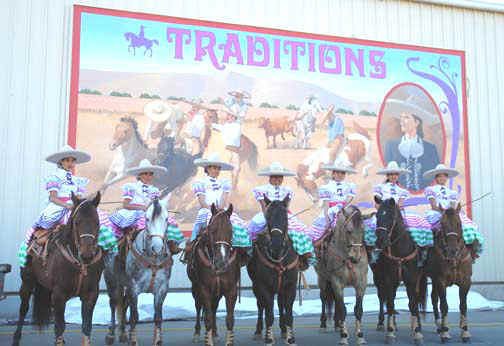

 On July 16, 1862, Flag Officer David Glasgow
Farragut was the first to be appointed to the rank of rear admiral.
Farragut, an Hispanic-American, became the first vice admiral in the
U.S. Navy two years later (1864), and the first full admiral in 1866. As
of April 2007, twenty one Hispanic-Americans have reached the rank of
Admiral.
On July 16, 1862, Flag Officer David Glasgow
Farragut was the first to be appointed to the rank of rear admiral.
Farragut, an Hispanic-American, became the first vice admiral in the
U.S. Navy two years later (1864), and the first full admiral in 1866. As
of April 2007, twenty one Hispanic-Americans have reached the rank of
Admiral.



 *Rear Admiral Philip A. Dur (Ret.), born in Bethesda, Maryland,
earned a bachelor’s degree in Government and International Studies and
a Master’s degree in Soviet East European studies from the University
of Notre Dame. He also earned a Master’s degree in Public
Administration and a Ph.D. in Political Economy and Government from
[[Harvard University]]. Dur served as Assistant Deputy Chief of Naval
Operations; Director, Navy Strategy Division; Commander, Battle Force
United States Sixth Fleet; Commander, Cruiser Destroyer Group EIGHT;
United States Defense Attaché accredited to the Government of France;
Commanding Officer, USS Yorktown; and Director, Political Military
Affairs on staff National Security Council.
*Rear Admiral Philip A. Dur (Ret.), born in Bethesda, Maryland,
earned a bachelor’s degree in Government and International Studies and
a Master’s degree in Soviet East European studies from the University
of Notre Dame. He also earned a Master’s degree in Public
Administration and a Ph.D. in Political Economy and Government from
[[Harvard University]]. Dur served as Assistant Deputy Chief of Naval
Operations; Director, Navy Strategy Division; Commander, Battle Force
United States Sixth Fleet; Commander, Cruiser Destroyer Group EIGHT;
United States Defense Attaché accredited to the Government of France;
Commanding Officer, USS Yorktown; and Director, Political Military
Affairs on staff National Security Council. *Rear Admiral Albert Garcia, Civil Engineering Corps, from Round
Rock, Texas. His academic background include a Bachelor of Science,
Master of Science, and Ph. D. in Environmental Engineering form Texas
A&M University. Garcia has served as Commanding Officer of Officer
in Charge of Construction, Atlantic; Commodore for the 9th Naval
Construction Regiment; Assistant Chief of Staff for Reserve Affairs in
the First Naval Construction Division; he commanded Task Force Charlie
of the MEF Engineering Group and later was assigned as the Deputy
Commander of the MEF Engineering Group in Iraq. In 2004 he assumed
responsibility for consolidating several reserve augment units into a
new command, NAVFAC Contingency OICC. He assumed the duties of Deputy
Commander of the First Naval Construction Division in August 2005.
*Rear Admiral Albert Garcia, Civil Engineering Corps, from Round
Rock, Texas. His academic background include a Bachelor of Science,
Master of Science, and Ph. D. in Environmental Engineering form Texas
A&M University. Garcia has served as Commanding Officer of Officer
in Charge of Construction, Atlantic; Commodore for the 9th Naval
Construction Regiment; Assistant Chief of Staff for Reserve Affairs in
the First Naval Construction Division; he commanded Task Force Charlie
of the MEF Engineering Group and later was assigned as the Deputy
Commander of the MEF Engineering Group in Iraq. In 2004 he assumed
responsibility for consolidating several reserve augment units into a
new command, NAVFAC Contingency OICC. He assumed the duties of Deputy
Commander of the First Naval Construction Division in August 2005.



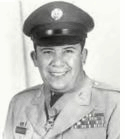


 Upon
reaching womanhood, she met and fell in love with Marcelino Ramirez
Bautista. Marcelino, a young and handsome man was the son of Tiburcio
Muro Bautista and Petra Arteaga Ramirez.
Upon
reaching womanhood, she met and fell in love with Marcelino Ramirez
Bautista. Marcelino, a young and handsome man was the son of Tiburcio
Muro Bautista and Petra Arteaga Ramirez.

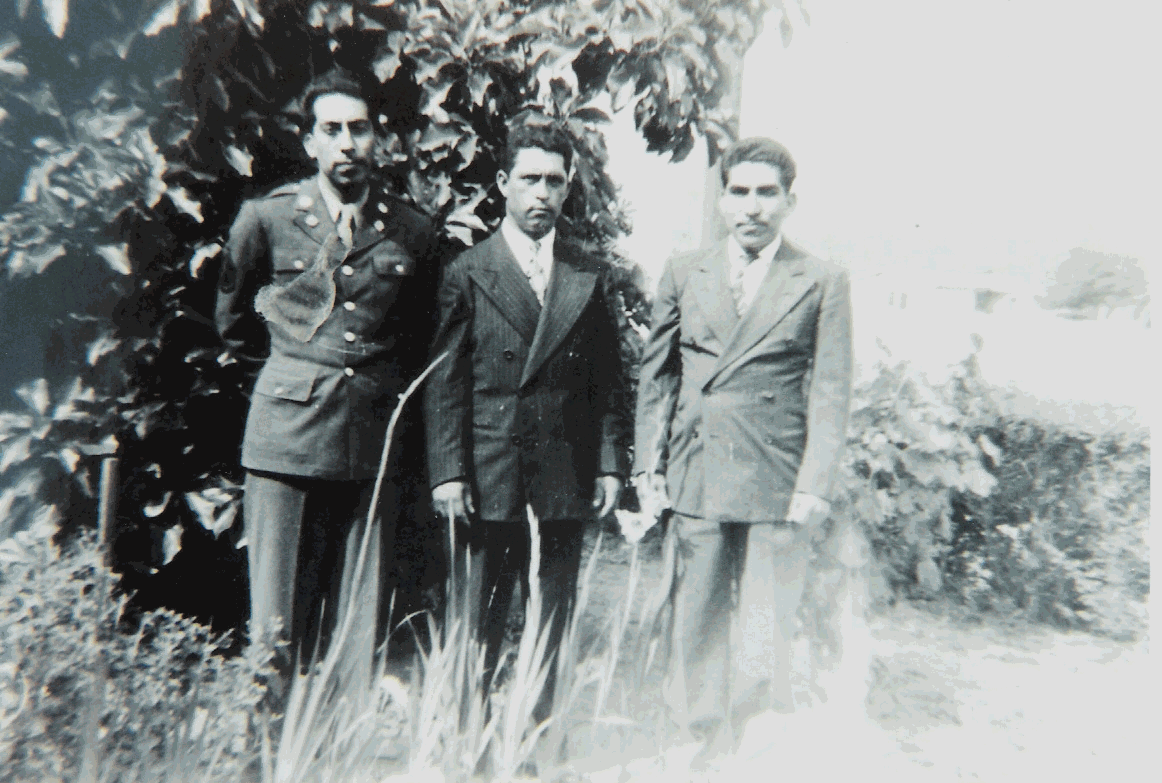 Marcelino
(center) visiting Marquez Bautista (cousin) in Upland, California in the
1940’s
Marcelino
(center) visiting Marquez Bautista (cousin) in Upland, California in the
1940’s
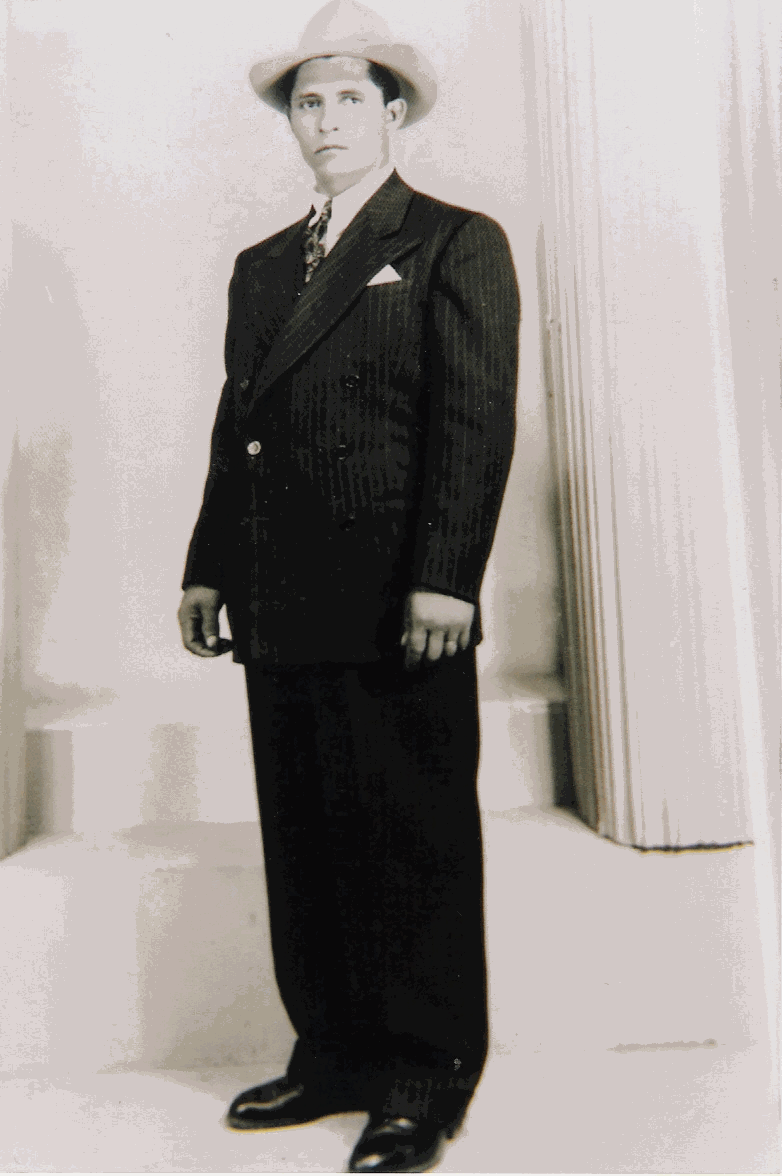 During
this time Marcelino traveled to Chicago, Illinois and California looking
for work, but jobs were scarce. For a while he returned to Zacatecas
only to leave his family again. Finally, while staying with his sister
Maria in California he secured a job as a construction worker.
During
this time Marcelino traveled to Chicago, Illinois and California looking
for work, but jobs were scarce. For a while he returned to Zacatecas
only to leave his family again. Finally, while staying with his sister
Maria in California he secured a job as a construction worker.
 would
return to Juarez and further assist his ill sister and now, mother.
Dismayed Henry found them both not only seriously ill, but abandoned by
his sick sister’s husband. To further compound the situation,
Guadalupe now had a one year old daughter. In time Anastacia’s health
improved. However, when they attempted to re-enter the United States,
Guadalupe was denied entrance because she was still too ill. The
situation resulted in Anastacia and Henry taking Guadalupe back to
Zacatecas and placing her in a hospital for long term treatment. Sadly,
in 1957, she passed away just months after being hospitalized.
After her passing, Henry again, returned to Juarez and brought Guadalupe’s
daughter to United States to live with her maternal grandparents.
would
return to Juarez and further assist his ill sister and now, mother.
Dismayed Henry found them both not only seriously ill, but abandoned by
his sick sister’s husband. To further compound the situation,
Guadalupe now had a one year old daughter. In time Anastacia’s health
improved. However, when they attempted to re-enter the United States,
Guadalupe was denied entrance because she was still too ill. The
situation resulted in Anastacia and Henry taking Guadalupe back to
Zacatecas and placing her in a hospital for long term treatment. Sadly,
in 1957, she passed away just months after being hospitalized.
After her passing, Henry again, returned to Juarez and brought Guadalupe’s
daughter to United States to live with her maternal grandparents. 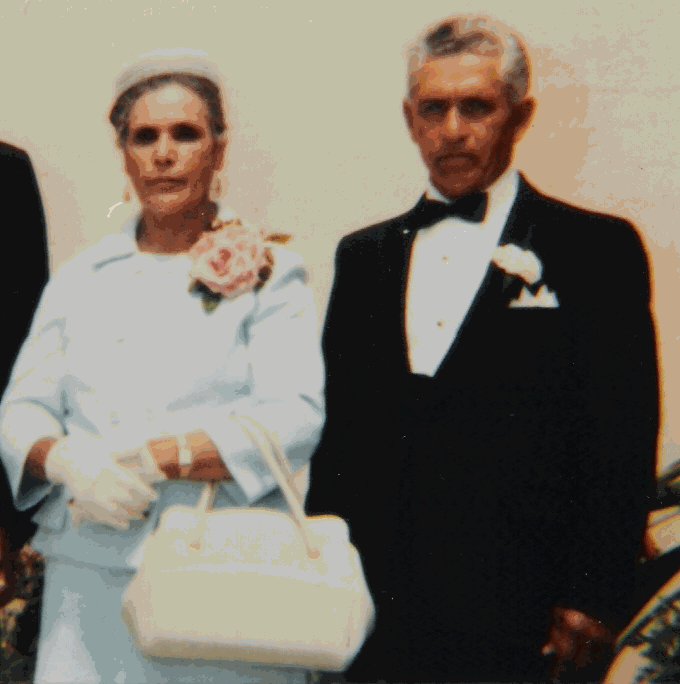
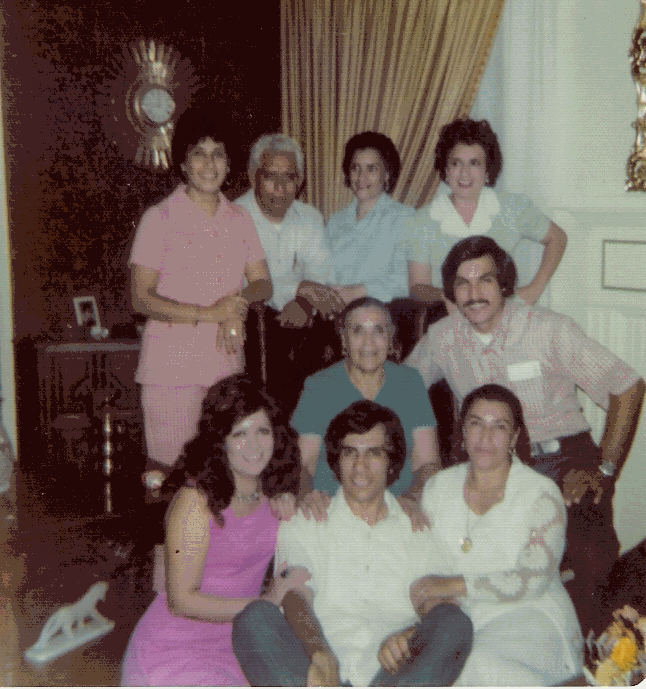
 Anastacia’s
final years were spend growing closer to her eldest son, Henry. Their
memorable years from the old country produced a unique bond. Whatever
mother needed Henry was there for
her, and living on the same block as our parents obviously helped. And
both she and Marcelino always looked forward to visiting their youngest
son (Jess), daughter-in-law, and grandchildren in Denver, Colorado.
Anastacia’s
final years were spend growing closer to her eldest son, Henry. Their
memorable years from the old country produced a unique bond. Whatever
mother needed Henry was there for
her, and living on the same block as our parents obviously helped. And
both she and Marcelino always looked forward to visiting their youngest
son (Jess), daughter-in-law, and grandchildren in Denver, Colorado.
 My life differs somewhat from end
Santos from Laredo, Texas who grew up in an Hispanic community in south
Texas; but, discrimination was present from the time of my parents who
lived in Kingsville, Texas in the '30s.
My life differs somewhat from end
Santos from Laredo, Texas who grew up in an Hispanic community in south
Texas; but, discrimination was present from the time of my parents who
lived in Kingsville, Texas in the '30s.



 In celebration of the 225th founding of Mission San
Buenaventura in Ventura, March 31, 1782, Los Soldados from El Presidio
State Historic Park participated in ceremonies at the mission on
Saturday, March 31, 2007. Father Damian Fernando of the parish at the
mission hosted the event, which included local Native American children
under the guidance of Mary Mendoza whose own grandchildren participated
in the event. Soldiers in the procession were directed by Jim Elwell
Martinez who portrayed Lt. Ortega. Jim Martinez as a native of
In celebration of the 225th founding of Mission San
Buenaventura in Ventura, March 31, 1782, Los Soldados from El Presidio
State Historic Park participated in ceremonies at the mission on
Saturday, March 31, 2007. Father Damian Fernando of the parish at the
mission hosted the event, which included local Native American children
under the guidance of Mary Mendoza whose own grandchildren participated
in the event. Soldiers in the procession were directed by Jim Elwell
Martinez who portrayed Lt. Ortega. Jim Martinez as a native of 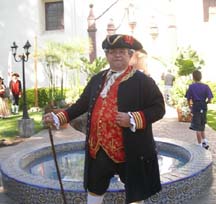 Ventura
and welcomed the opportunity to be a part of the founding ceremony.
Ventura
and welcomed the opportunity to be a part of the founding ceremony.  On Easter Sunday morning, March 31, Serra blessed the site under the
shadow of the hills far from the river and close to the sea. The Cross
was raised and blessed. Within an enramada, Serra sang a High Mass and
preached. After that, the soldiers took possession of the land in the
name of the king, permission having been obtained from the natives
through interpreters to settle here. Following this the Te Deum of
thanks was sung as Serra founded his 9th and last Mission in
Upper California.
On Easter Sunday morning, March 31, Serra blessed the site under the
shadow of the hills far from the river and close to the sea. The Cross
was raised and blessed. Within an enramada, Serra sang a High Mass and
preached. After that, the soldiers took possession of the land in the
name of the king, permission having been obtained from the natives
through interpreters to settle here. Following this the Te Deum of
thanks was sung as Serra founded his 9th and last Mission in
Upper California. The founding ceremony in Ventura was organized by the 225th
Anniversary Committee. Participants included Deacons in Training and
Visiting Priests and the Chumash descendants of Saticoy Native Americans
(Turtle Clan). Chumash re-enactors opened the ceremony with a song of
welcome in the native tongue. During the ceremony, they provided sage
incense within the church and sang sunrise/eagle songs.
The founding ceremony in Ventura was organized by the 225th
Anniversary Committee. Participants included Deacons in Training and
Visiting Priests and the Chumash descendants of Saticoy Native Americans
(Turtle Clan). Chumash re-enactors opened the ceremony with a song of
welcome in the native tongue. During the ceremony, they provided sage
incense within the church and sang sunrise/eagle songs. 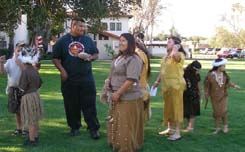 Chumas
songs
Chumas
songs In one of the photos Jim Martinez is standing in front of an original
ruin settling tank for the Mission water system. Mike Hardwick (Neve) is
standing in the garden in front of the fountain with the side of the
mission behind him. The lady with the green dress is wearing an outfit
that I believe she made. I don’t know here name, but it is her little
daughter that is wearing the soldier’s uniform.
In one of the photos Jim Martinez is standing in front of an original
ruin settling tank for the Mission water system. Mike Hardwick (Neve) is
standing in the garden in front of the fountain with the side of the
mission behind him. The lady with the green dress is wearing an outfit
that I believe she made. I don’t know here name, but it is her little
daughter that is wearing the soldier’s uniform.
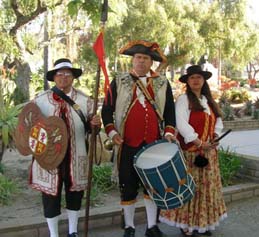 In April of 1990, this living history group formed to recreate the
Soldado de Cuera of the period 1769-1821. The group is chartered to
authentically portray the Spanish presidial soldier by means of
reenactments of military drill, use of period costumes, role playing,
and research into period history. Los Soldados re-enact the soldiers,
civilians and their families as they lived at the Presidio of Santa
Barbara in the period of time following the founding of the presidio in
1782.
In April of 1990, this living history group formed to recreate the
Soldado de Cuera of the period 1769-1821. The group is chartered to
authentically portray the Spanish presidial soldier by means of
reenactments of military drill, use of period costumes, role playing,
and research into period history. Los Soldados re-enact the soldiers,
civilians and their families as they lived at the Presidio of Santa
Barbara in the period of time following the founding of the presidio in
1782. Valenzuela, Jack Romero and Bud Decker participated in the annual Yuma
Crossing Day in historic Yuma, Arizona. Los Soldados were part of
the scores of re-enactors who helped celebrate the history of the Yuma
Crossing and the story of the diverse community that developed in what
is now known as the
Valenzuela, Jack Romero and Bud Decker participated in the annual Yuma
Crossing Day in historic Yuma, Arizona. Los Soldados were part of
the scores of re-enactors who helped celebrate the history of the Yuma
Crossing and the story of the diverse community that developed in what
is now known as the


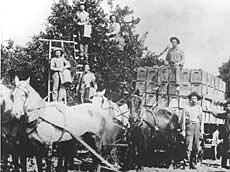
 We're
also celebrating 23 years of politically relevant, historical and
hysterical theater work as well as the launch of public ticket sales
to our L.A. premiere of Culture Clash's
We're
also celebrating 23 years of politically relevant, historical and
hysterical theater work as well as the launch of public ticket sales
to our L.A. premiere of Culture Clash's  Renowned Artist Nacho Duato first emerged as a choreographer to watch while a dancer with the Nederlands Dans Theater and quickly became the company's resident choreographer. Now one of the world's most sought-after artists, his works are in the repertoires of many great companies including American Ballet Theatre, Australian Ballet, the Royal Ballet and San Francisco Ballet, just to name a few.
 Dedicated to the memory of William Arvizu. He instilled in me a deep sense of the family pride and awareness of what our Arvizu ancestors contributed to the making of what is now California of today.
Our Arizu history parallels the history of many other Latino families who helped to settle the Western United States over many past generations.
Dedicated to the memory of William Arvizu. He instilled in me a deep sense of the family pride and awareness of what our Arvizu ancestors contributed to the making of what is now California of today.
Our Arizu history parallels the history of many other Latino families who helped to settle the Western United States over many past generations.

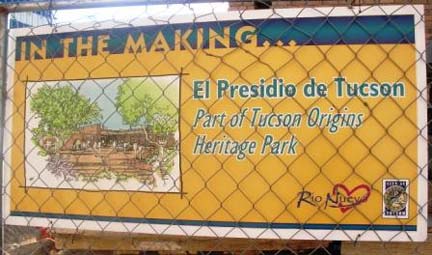
 On May 19, 2007,"La Gente del Presidio", a volunteer group,
will hold a historic re-enactment and living history at the Grand
Opening of the newly constructed adobe Presidio Tower and Wall which
depicts one corner of the original one. I just made a copy
On May 19, 2007,"La Gente del Presidio", a volunteer group,
will hold a historic re-enactment and living history at the Grand
Opening of the newly constructed adobe Presidio Tower and Wall which
depicts one corner of the original one. I just made a copy 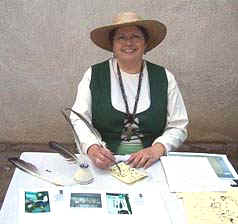 These photos are from our third annual Living History Fair circa
1775-1856, held March 24, 2007. There were soldados making leather
goods and other items, mujeres carding and spinning wool & cotton,
children's games, soap making, carpentry, indigenous grains, meats and
vegetables plus those introduced by the Spaniards, posole to taste and
tortilla making. This is a part of the Tucson Presidio Trust for
Historic Preservation.
These photos are from our third annual Living History Fair circa
1775-1856, held March 24, 2007. There were soldados making leather
goods and other items, mujeres carding and spinning wool & cotton,
children's games, soap making, carpentry, indigenous grains, meats and
vegetables plus those introduced by the Spaniards, posole to taste and
tortilla making. This is a part of the Tucson Presidio Trust for
Historic Preservation. 


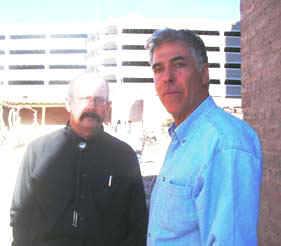 Richard A. Collins
 ,
,



 Formerly a hay
barn, this 1912 Rosenwald School will open in June on the grounds of a
museum. (Columbia Historical Museum)
Formerly a hay
barn, this 1912 Rosenwald School will open in June on the grounds of a
museum. (Columbia Historical Museum)


 Rudy A. Ramirez of Palestine, Texas President
of the Angel of Goliad Descendants Historical Preservation said, on March
25,2007 the Angel of Goliad descendants met at the Angel of Goliad Plaza
in Goliad, Texas.for the 2nd annual laying of a wreath
ceremony to honor Francisca Alvarez (The Angel of Goliad),Texan and
Mexican soldiers that were killed during that conflict and the civilians
who lost their lives that were causalities of war.
Rudy A. Ramirez of Palestine, Texas President
of the Angel of Goliad Descendants Historical Preservation said, on March
25,2007 the Angel of Goliad descendants met at the Angel of Goliad Plaza
in Goliad, Texas.for the 2nd annual laying of a wreath
ceremony to honor Francisca Alvarez (The Angel of Goliad),Texan and
Mexican soldiers that were killed during that conflict and the civilians
who lost their lives that were causalities of war.
 When Sam Houston's revolutionary soldiers won the Battle of San Jacinto and secured independence for Texas, their battle cry was "Remember the Alamo! Remember Goliad!" Everyone knows about the Alamo, but far fewer know about the stirring events at Goliad. Craig Roell's lively new study of Goliad brings to life this most important Texas community.


 Fort Pitt is
located in Point Park, on the tip of this peninsula, a state park that
has been a National Historic Landmark since 1960. (Greater Pittsburg
Convention & Visitors Bureau)
Fort Pitt is
located in Point Park, on the tip of this peninsula, a state park that
has been a National Historic Landmark since 1960. (Greater Pittsburg
Convention & Visitors Bureau)


 April 9, 2007—Geologist
Juan Manuel García-Ruiz calls it "the Sistine Chapel of
crystals," but Superman could call it home. A sort of south-of-the-border Fortress of Solitude,
April 9, 2007—Geologist
Juan Manuel García-Ruiz calls it "the Sistine Chapel of
crystals," but Superman could call it home. A sort of south-of-the-border Fortress of Solitude, 


 ¡BIENVENIDOS

 Rescue operations
were on hold until
Rescue operations
were on hold until